


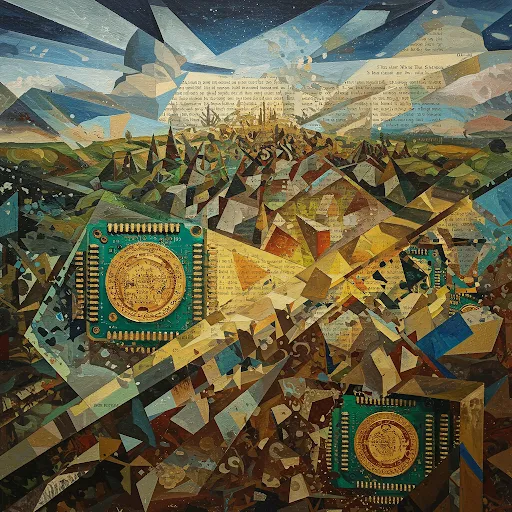
The Song of Songs A Beacon of Love, Nature, and Divine Harmony in a War-Torn World
Amidst a world often engulfed by conflict, division, and the pursuit of power, there exists a profound and timeless treasure, the one that has soothed hearts, cultivated spiritual enlightenment, and provided hope for millennia.
This treasure is found in the Song of Songs (also known as the Song of Solomon), a biblical poem that celebrates love, nature, and the divine in a manner that resonates deeply with the human soul.
Written thousands of years ago, even before the Bible emerged, this ancient text offers more than just an exploration of romantic love; it provides a pathway to healing, unity, and spiritual growth in a world ravaged by war and greed very similar to The Geeta.
In this article, we explore how the Song of Songs continues to speak to us today, its messages of love and peace in stark contrast to the power-hungry leaders of the modern world.
We will also examine how, in our age of supercomputing powered by quantum technologies such as Majoraran’s 1000-qubit chips we may find the tools to build a world of harmony, drawing inspiration from the divine love depicted in this sacred text.
Table of Contents
The Song of Songs: A Journey of Divine Love and Nature
At its core, the Song of Songs is a poetic dialogue between two lovers, one speaking from the perspective of the beloved and the other from the perspective of the lover. Their exchange is filled with vivid, often sensuous imagery that portrays the beauty and depth of their emotional and spiritual connection.
The text is traditionally attributed to King Solomon, though its origins and the identities of its characters remain the subject of scholarly debate. Regardless of its authorship, the Song of Songs stands as one of the most enduring expressions of the spiritual and earthly power of love.
The poem’s central theme is the celebration of love, both human and divine. It speaks to the mutual desire, adoration, and respect between the lovers, which is mirrored by the greater, more profound love between humanity and the divine.
Love, in this sense, is not confined to romantic affection but extends to the divine, to nature, and to the entire cosmos. In one of the most quoted verses, the speaker exclaims:
“Let my beloved come into his garden and taste its choice fruits” (Song of Songs 4:16).
Here, the garden, a symbol of nature, becomes a metaphor for spiritual abundance and divine communion. The beloved, in this context, is not just a lover, but a divine figure, a reflection of God’s love.
Nature, in the Song of Songs, serves as a mirror of divine creation: the earth’s beauty, its lush gardens, rivers, and flowers, are all emblems of the love that God has for the world. Thus, the poem invites us to contemplate the divine through the lens of nature and love, fostering an intimate connection with the Creator.
The Power of Love and Peace in a War-Torn World
In today’s world, filled with ongoing wars, political turmoil, and environmental degradation, the Song of Songs remains a powerful reminder of what we, as human beings, are capable of when we embrace love, compassion, and unity.
Across the globe, conflicts often arise from the selfish pursuits of power, greed, and control. Leaders, driven by their desires for money and dominance, stoke the flames of division and violence, leading to immeasurable suffering.
Yet, the Song of Songs offers an antidote to this destructive cycle by emphasizing love as the highest form of human expression, a love that transcends boundaries, ideologies, and nationalities.
Love, in this context, is not a mere sentiment or an abstract ideal; it is a powerful, transformative force capable of overcoming conflict. The love described in the Song of Songs is pure, selfless, and capable of healing deep wounds. It speaks of a love that binds together, that nurtures, and that gives. This kind of love is deeply spiritual, and its effects are far-reaching.
It suggests that when we align ourselves with love, whether in our relationships with others, our environment, or the divine, we align ourselves with the fundamental forces that bring peace and harmony to the world.
The idea that love can transcend the chaos of war is a powerful one. In a world where power-hungry leaders seem to perpetuate conflict for personal gain, the Song of Songs presents a radically different vision.
It calls upon us to prioritize love and unity over greed and division. It reminds us that true peace can only be achieved through a collective commitment to love, respect, and mutual understanding.
The Role of Power and Greed in Global Conflict
At the heart of many of today’s conflicts lies the pursuit of power and wealth. Political leaders and corporations often prioritize their own interests, seeking to control resources, manipulate markets, and wage wars to maintain dominance.
This greed-driven system perpetuates a cycle of violence, exploitation, and inequality. In contrast to this, the Song of Songs offers a vision of leadership rooted in love, compassion, and humility.
Rather than seeking power through coercion or force, the divine love in the Song of Songs encourages a kind of leadership that seeks to serve others, to uplift humanity, and to foster peace.
The poem’s portrayal of the beloved, who gives without expectation of return, provides a model for leaders who must act selflessly, always keeping the well-being of their people in mind.
This selfless approach to leadership is desperately needed in our world today. Instead of being driven by greed, leaders must learn to lead with love, guided by the principles of unity and peace that are central to the Song of Songs.
When love and compassion take precedence over the accumulation of wealth and power, it is possible to imagine a world free from the ravages of war and strife.
The Role of Modern Technology: Quantum Computing for Global Peace
As we look to the future, we find ourselves at the dawn of a new technological era, one that holds great promise for solving many of the problems facing humanity. Quantum computing, the realm of supercomputers powered by Majorana’s 1000-qubit chips, represents a leap forward in computational power.
It is astonishingly capable of addressing complex global issues such as climate change, disease, poverty, and cybersecurity. But can this advanced technology also be harnessed to create peace in this chaotic situation?
The power of quantum computing is its ability to process vast amounts of information at unprecedented speeds, solving problems that were once thought insurmountable. In the context of global peace, quantum computing could play a pivotal role.
It could help identify solutions to resource distribution problems, optimize diplomatic negotiations, and even predict and prevent conflicts before they escalate. In the realm of climate change, quantum computing can provide insights into sustainable energy solutions that might mitigate one of the greatest causes of global instability.
However, as with all powerful tools, quantum technology must be guided by ethical principles. Just as the Song of Songs emphasizes love and selflessness, the application of quantum computing must prioritize the common good over personal or national gain.
If used correctly, quantum computing can help pave the way for a more peaceful and equitable world, one where technology is used not to perpetuate conflict but to create harmony and prosperity for all.
A Vision for a World Guided by Love and Quantum Innovation
To imagine a world in which the teachings of the Song of Songs guide our leaders, our actions, and our technology is to envision a future of unprecedented peace. Leaders who act with love, compassion, and humility, guided by the wisdom of ancient texts, would create a political landscape in which cooperation replaces conflict.
Quantum computing, harnessed for the benefit of all humanity, could help solve pressing issues such as climate change, global health crises, and social inequality. By merging the spiritual wisdom of the Song of Songs with the transformative potential of quantum technology, we can cultivate a world in which love and peace are the guiding principles.
Just as the divine love in the Song of Songs transcends time and space, so too can our collective efforts transcend the boundaries that divide us. The future need not be one defined by war and greed, but one where humanity works together in harmony, united by a shared commitment to love, nature, and the divine.
Conclusion: A Hope for a Peaceful Future
In a world too often consumed by conflict, the Song of Songs stands as a beacon of hope, a reminder of the transformative power of love, nature, and divine harmony. As we navigate the complexities of the modern age, guided by the wisdom of ancient texts and the promise of quantum technology, we have the opportunity to create a world where love prevails over greed, and peace replaces war.
It is only through embracing these timeless values that we can hope to heal the wounds of our world and build a future grounded in unity, understanding, and love. In the words of the Song of Songs. Let us set love as a seal upon our hearts, and may that love guide us toward a future of peace and harmony for all.

Next Read: writing defeats as victories