


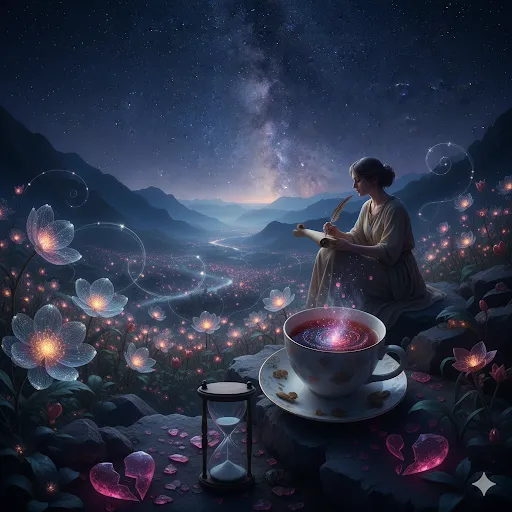
     Gazing Stars the Nights I Write
I live through memories, conversations I write,
Gazing at stars, the nights I write.

 Evermore, you've kept us in your thoughts' embrace,
 The states of heartache's pain I write.

 Time must slip away in silence, yet behold,
 The screaming silences before me, I write.

 You are the faint reason that shapes my life,
 The promises unfulfilled by us, I write.

 Dreams defeated, kin of my own I've slain,
 Loss upon loss, each victory's defeat I write.

Quantum dots in today's tea, come, let's sip,
 Beloved, memories of flowers and thorns I write.
Table of Contents

An Expert Critique
Gazing Stars the Nights I Write – English Content Essay: Echoes of Defeat – Lessons from a Ghazal for Global Peace and Humanity
In the intricate tapestry of human experience, poetry often serves as a mirror to the world’s chaos, reflecting personal sorrows that resonate with collective tragedies. The ghazal, originally Hindi, translated above, with its haunting refrain of writing defeats as victories, offers a profound lens through which to examine contemporary global crises.
This essay expands upon that poetic insight, weaving the ghazal’s themes of loss, unfulfilled promises, and silent screams into a broader analysis of 2025’s geopolitical landscape – from the lingering trauma of Trump’s political era to the diplomatic intricacies of the Shanghai Cooperation Organization (SCO) involving Modi, Xi Jinping, and Putin; the devastating wars in Gaza and Ukraine; and Netanyahu’s deepening crisis.
By drawing these parallels, this script aims to educate world leaders, diplomats, intelligentsia, and security forces, urging a paradigm shift toward humanity and sustainable peace. These are not mere observations but thought-provoking imperatives: in an era where “loss upon loss” defines our victories, how can we rewrite the narrative from defeat to genuine triumph?
Consider first the “Trump trauma,” a term encapsulating the enduring scars of Donald Trump’s political influence, from the January 6 Capitol riot’s aftermath to the 2024 election echoes still reverberating in 2025.
Much like the ghazal’s poet who “lives through memories” yet writes of heartache, Trump’s legacy has etched a narrative of division into American society – polarising communities, eroding trust in institutions, and amplifying misinformation through social media battles.
For world leaders and diplomats, this serves as a cautionary tale: political “victories” built on populist rhetoric often morph into societal defeats, fostering a “screaming silence” where democratic norms erode quietly.
Intelligentsia must advocate for media literacy and ethical AI governance to counter such traumas, while security forces should prioritise de-escalation training to prevent domestic unrest from escalating into global flashpoints.
The insightful question here is: If leaders continue to “write” their legacies in the ink of division, how can humanity heal? True peace demands introspection, where past traumas are not suppressed but transformed into bridges for unity, perhaps through an international truth and reconciliation commission modelled on South Africa’s post-apartheid efforts.
Shifting to the SCO’s diplomatic theatre, where Indian Prime Minister Narendra Modi’s engagements with Chinese President Xi Jinping and Russian President Vladimir Putin highlight the fragile dance of multipolar alliances.
In 2025, amid ongoing border tensions and economic rivalries, these interactions – such as recent SCO summits focusing on counterterrorism and trade – promise collaboration but often deliver unfulfilled vows, echoing the ghazal’s lament of “promises unfulfilled by us.”
Modi’s strategic balancing act, positioning India as a bridge between the East and West, is commendable yet undermined by underlying distrust, particularly in light of China’s assertiveness and Russia’s isolation following the Ukraine invasion.
Diplomats and intelligentsia should ponder this: In a world where time “slips away in silence,” how can forums like the SCO evolve from ceremonial “tea-sipping” (a nod to the ghazal’s quantum dots in tea) into substantive peace-building mechanisms?
Leaders must integrate humanitarian clauses into SCO agendas, emphasising conflict prevention through shared intelligence on climate-induced migrations or cyber threats. Security forces, too, could benefit from joint exercises focused on non-violent resolutions, fostering trust that prevents alliances from fracturing into defeats.
The deeper insight? Diplomacy without empathy is a hollow victory; by humanising negotiations – perhaps through cultural exchanges inspired by poetry like this ghazal – we can turn potential losses into collective gains for global stability.
The wars in Ukraine and Gaza, intertwined with Netanyahu’s political quagmire, represent the starkest embodiments of the ghazal’s “dreams defeated, kin of my own I’ve slain.”
As of 2025, Russia’s invasion of Ukraine, led by Putin, has dragged into its third year, with staggering human costs – over 500,000 casualties and a humanitarian crisis displacing millions – revealing the futility of territorial “victories” that breed endless loss.
Similarly, the Gaza conflict, exacerbated by Netanyahu’s leadership crisis amid corruption charges and domestic protests, has resulted in over 40,000 deaths, turning aspirations for security into cycles of vengeance.
These conflicts scream the ghazal’s “screaming silences,” where the quiet passage of time masks the roar of suffering. For world leaders and security forces, this demands a reevaluation: Why do we “write” histories of war as triumphs when they slay our own?
Intelligentsia can lead by promoting data-driven analyses, such as AI simulations of peace scenarios, to educate on the economic and human toll of prolonged conflicts. Diplomats should push for innovative ceasefires, like technology-enabled monitoring zones using quantum-inspired sensors (tying back to the ghazal’s motif), ensuring accountability.
A provocative thought: In an age of advanced weaponry, true security lies not in dominance but in vulnerability – embracing restorative justice models, like those in Colombia’s peace process, to heal wounds and prevent “loss upon loss.”
Ultimately, these global defeats – from Trump’s divisive echo to the unyielding horrors of war – mirror the ghazal’s quantum dots in tea: microscopic innovations amid everyday banalities, yet failing to illuminate paths to peace.
They compel us to ask: What if world leaders viewed their roles not as conquerors but as poets, “writing” narratives of empathy rather than enmity?
For humanity’s sake, diplomats must prioritise multilateral forums that integrate mental health support for conflict zones, drawing from existential philosophies embedded in works like this ghazal.
Intelligentsia and security forces, as guardians of knowledge and order, should champion education in conflict resolution, perhaps through global academies teaching the art of turning defeats into dialogues.
In educating ourselves thus, we honour the ghazal’s call to “live through memories” – not as chains of pain, but as catalysts for a world where victories are measured in lives saved, not lost. Let this be our collective refrain: In writing our shared future, may we choose peace over perpetual defeat.
BEYOUTEA>A POETRY REVOLUTION>PEACE
NOTHING IS NOT TRUE : NO\KNOW THYSELF NOT
 MAKE EARTH GREAT FOREVER : END ALL WARS
यादों को जीता हूँ, बातों को लिखता हूँ,
तारों को देखकर रातों को लिखता हूँ।
           हर वक़्त तूने हमें भी ख़यालों में रखा है,
           दिल के दर्द की हालातों को लिखता हूँ।
है, वक़्त को भी गुज़रना चुपके से मगर,
सामने ही चीख़ते सन्नाटों को लिखता हूँ।
           तुम हो थोड़ी-सी वजह ज़िंदगी बनाने की,
           हमसे पूरी न हुईं वादों को लिखता हूँ।
सपनों को हारा, अपने अपनों को मारा है,
हार ही हार हर बार जीतों को लिखता हूँ।
           क्वान्टम डॉट्स आज की चाय चलो पिएँ,
           सजनी, यादें फूल व काँटों को लिखता हूँ।
POETRY>WISDOM>Q.TECH FOR A MORE JUST AND
PEACEFUL WORLD IN LOVE AND ENLIGHTENMENT
समसामयिक बौद्धिक विवेचना
रातों को लिखता हूँ – प्रेम, दर्द, अलगाव और आध्यात्मिकता : क्वान्टम डॉट्स और दैनिक जीवन की साधारणता (चाय पीना)।
यह ग़ज़ल एक आधुनिक, व्यक्तिगत और दार्शनिक अभिव्यक्ति है, जो पारंपरिक उर्दू ग़ज़ल की शैली को अपनाते हुए समकालीन जीवन की जटिलताओं को छूती है।
पारंपरिक ग़ज़लों में प्रेम, दर्द, अलगाव और आध्यात्मिकता के विषय प्रमुख होते हैं (जैसे मिर्ज़ा ग़ालिब या फ़ैज़ अहमद फ़ैज़ की रचनाएँ), लेकिन यहाँ कवि ने इन्हें समसामयिक संदर्भों से जोड़ा है – जैसे वैज्ञानिक अवधारणाएँ (क्वान्टम डॉट्स) और दैनिक जीवन की साधारणता (चाय पीना)।
हम इसे ‘समसामयिक बौद्धिक दृष्टि से’ विवेचित करते हैं, जिसमें अस्तित्ववाद (existentialism), तकनीकी-मानवीय अंतर्संबंध, और पोस्टमॉडर्न काव्य की विशेषताओं पर ध्यान केंद्रित है। विवेचना को तीन मुख्य भागों में विभाजित किया है: ‘थीमेटिक विश्लेषण’, ‘काव्यिक संरचना’, और ‘समाज-सांस्कृतिक प्रासंगिकता’।
थीमेटिक विश्लेषण: व्यक्तिगत दर्द और आधुनिक विपरीतताएँ
स्मृति, लेखन और अस्तित्व की खोज: ग़ज़ल की शुरुआत “यादों को जीता हूँ, बातों को लिखता हूँ” से होती है, जो लेखन को एक अस्तित्वगत क्रिया के रूप में चित्रित करती है। कवि स्मृतियों को ‘जीता’ है, अर्थात उन्हें जीवंत रखता है, और रातों-तारों को देखकर लिखता है – यह रोमांटिक नॉस्टैल्जिया का प्रतीक है।
बौद्धिक रूप से, यह जीन-पॉल सार्त्र के अस्तित्ववाद (existentialism) को प्रतिबिंबित करता है, जहाँ व्यक्ति अपने दर्द और स्मृतियों के माध्यम से अर्थ तलाशता है। लेखन यहाँ catharsis (मुक्ति) का माध्यम है, जो आधुनिक मनोविज्ञान में ‘जर्नलिंग’ (दिनचर्या लेखन) से जुड़ता है – एक तरीका जिसमें व्यक्ति अपने आंतरिक संघर्षों को प्रोसेस करता है।
प्रेम, दर्द और समय का गुज़रना: मध्य भाग में “हर वक़्त तूने हमें भी ख़यालों में रखा है” और “दिल के दर्द की हालातों को लिखता हूँ” प्रेम की एकतरफा या अधूरी प्रकृति को दर्शाता है।
“वक़्त को भी गुज़रना चुपके से मगर, सामने ही चीख़ते सन्नाटों को लिखता हूँ” एक शक्तिशाली रूपक है – समय चुपके से गुज़रता है, लेकिन सन्नाटे ‘चीख़ते’ हैं, जो आधुनिक जीवन की अकेलेपन और मानसिक स्वास्थ्य संकट (जैसे डिप्रेशन या anxiety) को इंगित करता है।
समसामयिक दृष्टि से, यह COVID-19 महामारी के बाद की दुनिया को प्रतिबिंबित करता है, जहाँ लोग ‘साइलेंट स्ट्रगल्स’ (चुप संघर्ष) से जूझते हैं, लेकिन सोशल मीडिया पर उन्हें ‘लिखकर’ व्यक्त करते हैं।
हार, वादे और विडंबना: “सपनों को हारा, अपने अपनों को मारा है, हार ही हार हर बार जीतों को लिखता हूँ” में हार को ‘जीत’ के रूप में लिखना एक पोस्टमॉडर्न विडंबना (irony) है।
यह फ्रेडरिक नीत्शे के ‘निहिलिज्म’ (nihilism) से जुड़ता है – जहाँ जीवन की हारें ही अर्थ प्रदान करती हैं। कवि असफलताओं को ‘लिखता’ है, जो रचनात्मकता को संघर्ष से जोड़ता है, जैसे समकालीन लेखकों (उदाहरण: हारुकी मुराकामी) में देखा जाता है।
आधुनिक विपरीतता: क्वान्टम डॉट्स और चाय: अंतिम शेर सबसे रोचक है – “क्वान्टम डॉट्स आज की चाय चलो पिएँ, सजनी, यादें फूल व काँटों को लिखता हूँ।” क्वान्टम डॉट्स (quantum dots) एक नैनोटेक्नोलॉजी अवधारणा है, जो डिस्प्ले टेक्नोलॉजी (जैसे OLED स्क्रीन्स) में उपयोग होती है – यह विज्ञान की सूक्ष्मता को दर्शाता है।
इसे चाय पीने और ‘सजनी’ (प्रेयसी) की यादों से जोड़ना एक बौद्धिक मिश्रण है, जो ‘ट्रांसह्यूमनिज्म’ (transhumanism) को छूता है: कैसे तकनीक (क्वान्टम डॉट्स) हमारी दैनिक जीवन (चाय) और भावनाओं (फूल-काँटे) में घुलमिल जाती है।
समसामयिक रूप से, यह AI और डिजिटल युग को प्रतिबिंबित करता है – जहाँ व्यक्ति स्क्रीन (क्वान्टम डॉट्स से बने) पर यादें ‘लिखते’ हैं, लेकिन वास्तविक संबंध खोते जाते हैं। यह एक आलोचना हो सकती है कि कैसे तकनीक भावनाओं को ‘पिक्सेलेट’ (सूक्ष्म बिंदुओं में बदल) कर देती है।
काव्यिक संरचना: पारंपरिक और आधुनिक का मेल
यह ग़ज़ल क्लासिक उर्दू शैली में है, जिसमें ‘मतला’ (पहला शेर), ‘रदीफ़’ (“लिखता हूँ” का दोहराव), और ‘क़ाफ़िया’ (जैसे जीता/लिखता, रखा/लिखता) मौजूद हैं।
लेकिन समसामयिक रूप से, यह फ्री-वर्स की स्वतंत्रता लेती है – जैसे अंग्रेज़ी शब्दों का मिश्रण और अप्रत्याशित अंत। बौद्धिक दृष्टि से, यह ‘हाइब्रिड काव्य’ (hybrid poetry) का उदाहरण है, जो ग्लोबलाइजेशन के युग में भाषा और संस्कृति के मिश्रण को दर्शाता है (जैसे बॉलीवुड गीतों या समकालीन हिंदी कविता में)।
समाज-सांस्कृतिक प्रासंगिकता: आज के भारत/दुनिया में
मानसिक स्वास्थ्य और डिजिटल युग: ग़ज़ल दर्द और हार को केंद्र में रखती है, जो भारत में बढ़ते मानसिक स्वास्थ्य मुद्दों (WHO के अनुसार, 2023 में 15% भारतीय डिप्रेशन से प्रभावित) को छूती है। लेखन को ‘थेरेपी’ के रूप में देखना समसामयिक है – जैसे सोशल मीडिया पर #MentalHealthAwareness।
विज्ञान और कला का संगम: क्वान्टम डॉट्स का उल्लेख (जो 2023 नोबेल पुरस्कार से जुड़ा है) कविता को बौद्धिक बनाता है, जो STEM (Science, Technology, Engineering, Math) और कला के बीच पुल बनाता है। यह आधुनिक बुद्धिजीवियों (जैसे टेड टॉक्स में) के लिए प्रासंगिक है, जो पूछते हैं: क्या तकनीक हमारी भावनाओं को समृद्ध करती है या खोखला?
नारीवादी/लैंगिक दृष्टि: “सजनी” का उल्लेख प्रेयसी को आदर्श बनाता है, लेकिन “वादों” की असफलता लैंगिक असमानता को इंगित कर सकती है – समसामयिक #MeToo आंदोलन के संदर्भ में।
कुल मिलाकर, यह ग़ज़ल एक गहन, बहु-आयामी रचना है जो व्यक्तिगत दर्द को वैश्विक, तकनीकी संदर्भों से जोड़ती है। यह हमें सोचने पर मजबूर करती है कि आधुनिक जीवन में स्मृतियाँ, दर्द और विज्ञान कैसे intertwined हैं।
ग़ज़ल की हार की थीम और वैश्विक संकट: एक चिंतनशील नज़रिया
ग़ज़ल में वर्णित “हार ही हार हर बार जीतों को लिखता हूँ” की भावना आज की वैश्विक घटनाओं में स्पष्ट रूप से प्रतिबिंबित होती है, जहाँ विश्व की तथाकथित ‘जीतें’ – जैसे राजनीतिक विजय, कूटनीतिक समझौते या तकनीकी प्रगति – अंततः हार में तब्दील हो जाती हैं।
2025 में, ट्रम्प से जुड़े राजनीतिक ट्रॉमा (जैसे उनके चुनावी अभियानों के बाद की अराजकता और सोशल मीडिया मुकदमों की असफलताएँ) को देखें, जो अमेरिकी लोकतंत्र की एक गहरी हार को दर्शाते हैं।
यहाँ समय चुपके से गुज़रता है, लेकिन ‘चीखते सन्नाटे’ की तरह, ट्रम्प युग की विभाजनकारी राजनीति ने समाज को खोखला कर दिया है। क्या हम सोचें कि ऐसी ‘ट्रॉमा’ व्यक्तिगत दर्द से अलग नहीं, बल्कि सामूहिक हार का प्रतीक है, जहाँ नेता अपनी असफलताओं को ‘जीत’ के रूप में लिखते रहते हैं, ठीक ग़ज़ल के कवि की तरह?
एससीओ (शंघाई सहयोग संगठन) में मोदी की भूमिका, ज़ी जिनपिंग (जिन्हें ‘सिपिंग’ के रूप में उल्लेखित किया गया है) और पुतिन के साथ जुड़े कूटनीतिक प्रयासों को देखें, जो वैश्विक सहयोग की एक झलक देते हैं, लेकिन अंततः हार की कहानी बन जाते हैं।
2025 में, मोदी की एससीओ बैठकों में भारत की रणनीतिक स्थिति मजबूत लगती है, लेकिन ज़ी और पुतिन के साथ संबंध – जैसे हालिया द्विपक्षीय वार्ताएँ – यूक्रेन युद्ध की पृष्ठभूमि में फेल हो रही डिप्लोमेसी को उजागर करते हैं।
ग़ज़ल की “वक़्त को भी गुज़रना चुपके से मगर” वाली पंक्ति यहाँ सटीक बैठती है: समय गुज़रता है, लेकिन ये नेता अपनी ‘वादों’ (जैसे शांति समझौते) को पूरा नहीं कर पाते, जिससे विश्व की जियोपॉलिटिकल हार उभरती है। क्या यह हमें प्रेरित नहीं करता कि कूटनीति अब महज़ ‘चाय पीने’ (ग़ज़ल के संदर्भ में) की तरह सतही हो गई है, जहाँ गहन मुद्दे अनसुलझे रह जाते हैं?
यूक्रेन और ग़ज़ा के युद्ध, साथ ही नेतन्याहू के राजनीतिक संकट, आज की विश्व की सबसे बड़ी हारों का प्रतीक हैं – मानवीय, नैतिक और रणनीतिक। 2025 में, यूक्रेन में पुतिन की सैन्य रणनीति की असफलताएँ (जैसे मोबिलाइजेशन की विफलताएँ) और ग़ज़ा में इजराइली इंटेलिजेंस फेल्यर्स (700 से अधिक मौतों के साथ) ने विश्व को एक ‘चीखते सन्नाटे’ में धकेल दिया है।
नेतन्याहू का संकट – राजनीतिक अस्थिरता और ब्रॉडर कॉन्फ्लिक्ट – ग़ज़ल की “सपनों को हारा, अपने अपनों को मारा है” को जीवंत करता है, जहाँ नेता अपनी ही जनता को ‘मार’ रहे हैं।
यह हमें सोचने पर मजबूर करता है: क्या ये युद्ध ‘क्वांटम डॉट्स’ जैसी सूक्ष्म तकनीकों (जो युद्धक तकनीक में इस्तेमाल होती हैं) के युग में भी मानवता की हार नहीं हैं, जहाँ प्रगति के नाम पर विनाश हो रहा है?
इन सबके बीच, विश्व की हार एक गहन सवाल उठाती है: क्या हमारी ‘यादें फूल व काँटों’ की तरह इन घटनाओं को महज़ लिखकर भूल जाते हैं, या इनसे सीखते हैं?
ट्रम्प का ट्रॉमा, एससीओ की कूटनीतिक असफलताएँ, और युद्धों की तबाही दिखाती हैं कि वैश्विक नेता ‘दिल के दर्द की हालातों’ को अनदेखा कर रहे हैं, जिससे सामूहिक अस्तित्व संकट में है।
ग़ज़ल हमें याद दिलाती है कि हार को ‘लिखना’ ही एकमात्र रास्ता है, लेकिन क्या यह पर्याप्त है?
शायद ये घटनाएँ हमें प्रेरित करें कि व्यक्तिगत और वैश्विक स्तर पर, सच्ची जीत तभी संभव है जब हम इन हारों से ऊपर उठकर एकजुट हों – अन्यथा, समय चुपके से गुज़रता रहेगा, और हम सिर्फ ‘सन्नाटों’ को लिखते रहेंगे।
Next Read: Fostering Global Peace