


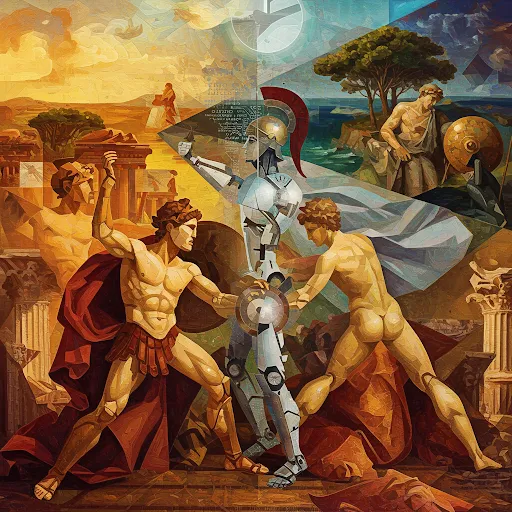
The Insight upon Love, Life, and Nature in the Aged-Old Cherished Verses of the Iliad and Odyssey by Homer: A Guideline for World Peace
Aged-old ancient texts, written centuries ago, remain deeply relevant in our contemporary world, particularly in fostering global peace and providing proper lines of guidance to leaders who grapple with the complexities of national and international conflicts.
Homer’s Iliad and Odyssey, two monumental epics that have endured for millennia, offer profound insights into the human condition, unveiling timeless lessons on love, life, nature, and the complexities of leadership for overcoming persistent crises of human civilisation.
By invoking the wisdom of these epics, we find not only moral clarity but also a blueprint for creating a more unified and peaceful world, transcending the often divisive ideologies that govern much of modern politics, and that have turned obsolete in today’s info-psychism era.
The intersection of these ancient insights with the transformative power of contemporary technology, especially artificial intelligence (AI), offers a novel approach to leadership and global cooperation to find innovative paths guiding us to a real global connection now.
Table of Contents
The Legacy of Homer: Iliad and Odyssey
Homer’s Iliad and Odyssey are not merely tales of war and adventure; they are deeply philosophical reflections on human nature, the costs of violence, and the complexities of the human spirit.
The Iliad, with its vivid portrayal of the Trojan War, highlights themes of rage, honor, and the disastrous consequences of unchecked pride. Achilles, the hero of the epic, becomes a tragic figure, consumed by anger and personal vengeance, leading to a cycle of destruction.
The Odyssey, on the other hand, offers a different lens, one of perseverance, love, and the longing for home. It is a journey of self-discovery, patience, and the redemptive power of loyalty, with Odysseus’s return to his wife, Penelope, symbolizing the triumph of enduring love and hope over adversity.
Through these stories, Homer provides a reflection on the darker and lighter aspects of human nature. His epics compel readers to consider the consequences of their actions, the importance of empathy, and the ultimate value of peace over war.
Today, these ancient works serve as crucial texts that offer leaders valuable lessons in overcoming conflict, embracing wisdom, and pursuing lasting reconciliation through a consolidated understanding of cooperation and world peace.
The Role of Love in the Iliad and Odyssey
Love, in Homer’s epics, is a dual force: both constructive and destructive. In the Iliad, love manifests in the fierce bonds between warriors and their families. Yet, this love is often tainted by the need for honour and pride.
Achilles’ love for his fallen friend, Patroclus, catalyzes his vengeful wrath, leading to further bloodshed and suffering. The tragic nature of love in the Iliad lies in its capacity to blind individuals to the larger consequences of their actions.
In contrast, love in the Odyssey is a redemptive force. Odysseus’s love for his wife Penelope and his longing for his home in Ithaca propel him through countless trials. This love is patient, selfless, and unwavering.
Penelope’s own loyalty serves as a mirror of her husband’s endurance. Their reunion symbolizes the triumph of love over the chaos of the world, an enduring beacon of hope.
These reflections on love are especially pertinent in today’s political and social landscape, where love for power or national interest often eclipses the need for genuine care for others.
Leaders must recognize that true love for their people, and humanity, should guide their decisions. A love that is selfless, empathetic, and focused on the collective good is necessary for creating lasting peace and progress of societies in a real sense.
Life’s Trials: The Balance of Conflict and Peace
The Iliad and Odyssey also explore life’s inherent struggles. The Iliad reveals the futility of endless warfare and how the cycle of violence perpetuates suffering, with no true victor in the end.
The warriors in the epic, driven by a sense of duty, fate, and honour, rarely question the rationale for their actions, leading to the tragic deaths of heroes like Hector and Achilles. This eternal conflict speaks directly to today’s endless wars, driven by political ideologies, personal ambitions, illusive senses of religion and nationality, and the glorification of power.
The Odyssey, by contrast, emphasizes the value of patience and wisdom. Odysseus’s journey is not merely one of physical travel, but of internal growth. The challenges he faces, his encounters with the Cyclops, the Sirens, and the temptations of Circe, are metaphors for the personal trials of life.
His survival depends not on brute strength, but on his capacity to reflect, adapt, and make wise choices. These qualities, often overshadowed in today’s aggressive political climates, remind us that peace is not achieved by force, but by introspection, wisdom, and a willingness to engage in dialogue.
For contemporary leaders, the lessons from these two epics are clear: the pursuit of peace requires moving beyond the cyclical nature of conflict, understanding that life’s trials are opportunities for growth, and taking responsibility for creating a world where the most vulnerable are protected so as to live life as a true human being of today’s world.
The Role of Nature: Wisdom and Renewal
In both epics, nature plays a profound role as a guide and symbol of renewal. In the Iliad, the natural world often mirrors the turmoil of human conflict. Yet, it also presents moments of respite and reflection.
In the Odyssey, nature acts as a spiritual and moral force. The gods, embodying various natural elements, guide and hinder Odysseus at different stages of his journey. Nature in the Odyssey serves as a reminder that the human experience is part of a larger, interconnected cosmos.
This perspective on nature holds immense significance in our modern world, particularly in discussions about environmental sustainability and global cooperation. Nature teaches us the importance of balance, interdependence, and the need to coexist with the world around us.
As we face pressing global challenges, climate change, resource depletion, and ecological degradation Homer’s portrayal of nature offers not only moral guidance but also practical wisdom. It is a reminder that peace with the environment is inextricably linked to peace among nations.
Relevance to Modern-Day Global Peace
The relevance of Homer’s works extends beyond the ancient world into the heart of modern geopolitical discourse. In today’s fractured world, rife with conflicts fueled by ideological, national, and economic divisions, the lessons of the Iliad and Odyssey offer a path forward.
By moving away from divisive ideologies whether they be fundamentalist, nationalist, or driven by political extremes, we can begin to embrace a global community that prioritizes unity, empathy, and shared human values in common.
Homer’s portrayal of the futility of endless warfare challenges modern-day leaders to reconsider the justification for conflict. The destructive consequences of pride, power, and blind loyalty to ideological causes are as relevant today as they were in ancient Greece.
The need for diplomacy, mutual respect, and international cooperation has never been greater. The time now is high to value and revisit all meanings of life through newer contextual advancements.
Challenging Divisive Ideologies: Insights for Modern Leaders
In the contemporary political sphere, the rise of extreme ideologies, be it in the form of fundamentalism, right-wing nationalism, or left-wing radicalism, echoes the very hubris and folly seen in the Iliad.
These ideologies often obscure the larger, more inclusive vision of humanity that is necessary for resolving global conflicts. Leaders today, much like the figures in Homer’s epics, must confront the limitations of their own ideologies and biases.
Homer’s wisdom suggests that true leadership lies not in perpetuating division but in transcending it. Leaders must prioritize peace, cooperation, and the well-being of all people.
The insight derived from the Iliad and Odyssey is that lasting peace can only emerge when leaders acknowledge their shared humanity and work towards collective good, rather than personal or nationalistic gain.
A Path to Global Peace: Practical Lessons for Today’s World
In a world where borders and divisions often seem insurmountable, Homer’s epics offer a vision of global unity. The ancient texts remind us that peace is not merely the absence of war, but the active creation of harmony.
Through collaboration, empathy, and wisdom, we can overcome the forces of division that currently plague our world. Modern technology, particularly AI and advanced computing, can play a transformative role in realizing this vision.
AI has the potential to facilitate global dialogue, foster understanding, and solve complex problems by analyzing data from diverse sources and offering solutions based on reason rather than emotion. AI can help leaders make more informed, compassionate decisions, using insights from Homer’s works to guide their actions.
By integrating technology with the wisdom of ancient texts, we can create a new form of leadership, one that is not driven by ego, fear, or power, but by the collective pursuit of peace, unity, and shared prosperity.
Conclusion
The Iliad and Odyssey remain as relevant today as they were in ancient Greece, offering timeless insights on love, life, nature, and leadership. These works invite us to reflect on the nature of conflict and peace, the role of love in human affairs, and the interconnectedness of all things.
For contemporary leaders, the lessons of these epics provide a moral compass for navigating the complexities of today’s world. Incorporating the wisdom of Homer’s epics into modern leadership, enhanced by the capabilities of AI and other transformative technologies, offers a powerful means to foster global cooperation and peace.
As we move towards a future marked by rapid technological advancements and shifting geopolitical dynamics, the insights found in these ancient texts can help guide us towards a more unified and compassionate world.
World leaders political, social, and, embrace the lessons of the Iliad and Odyssey. These texts challenge us to move beyond narrow ideologies, to prioritize peace over conflict, and to recognize the interconnectedness of all people.
We must look to the wisdom of the past, coupled with the innovative potential of the present, to create a future where peace, love, and understanding transcend borders and division proving curse to mankind today.

Next Read: shining eyes and smiling face