


            Sweet is Your Kheer Beloved
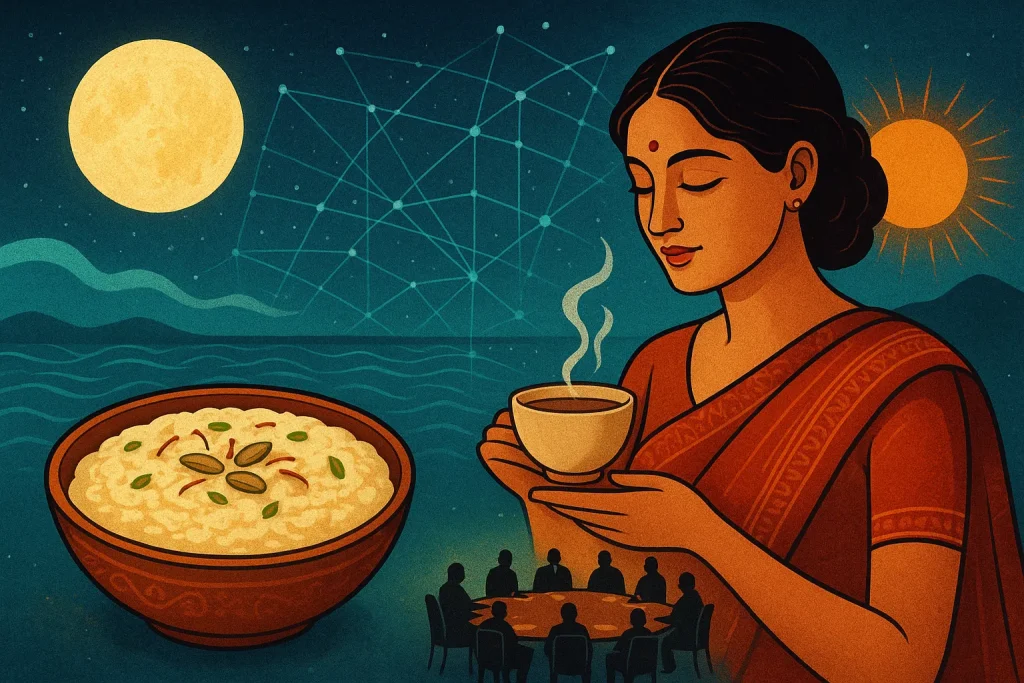
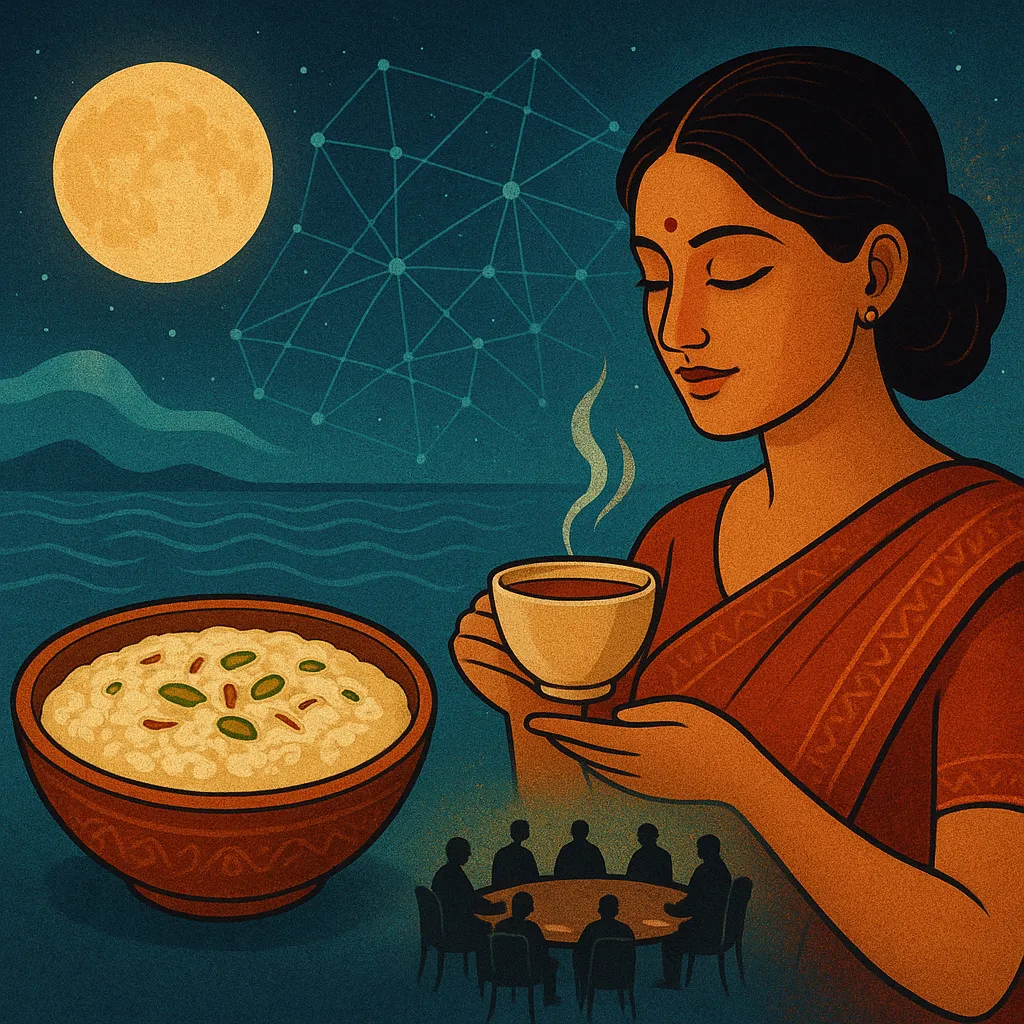
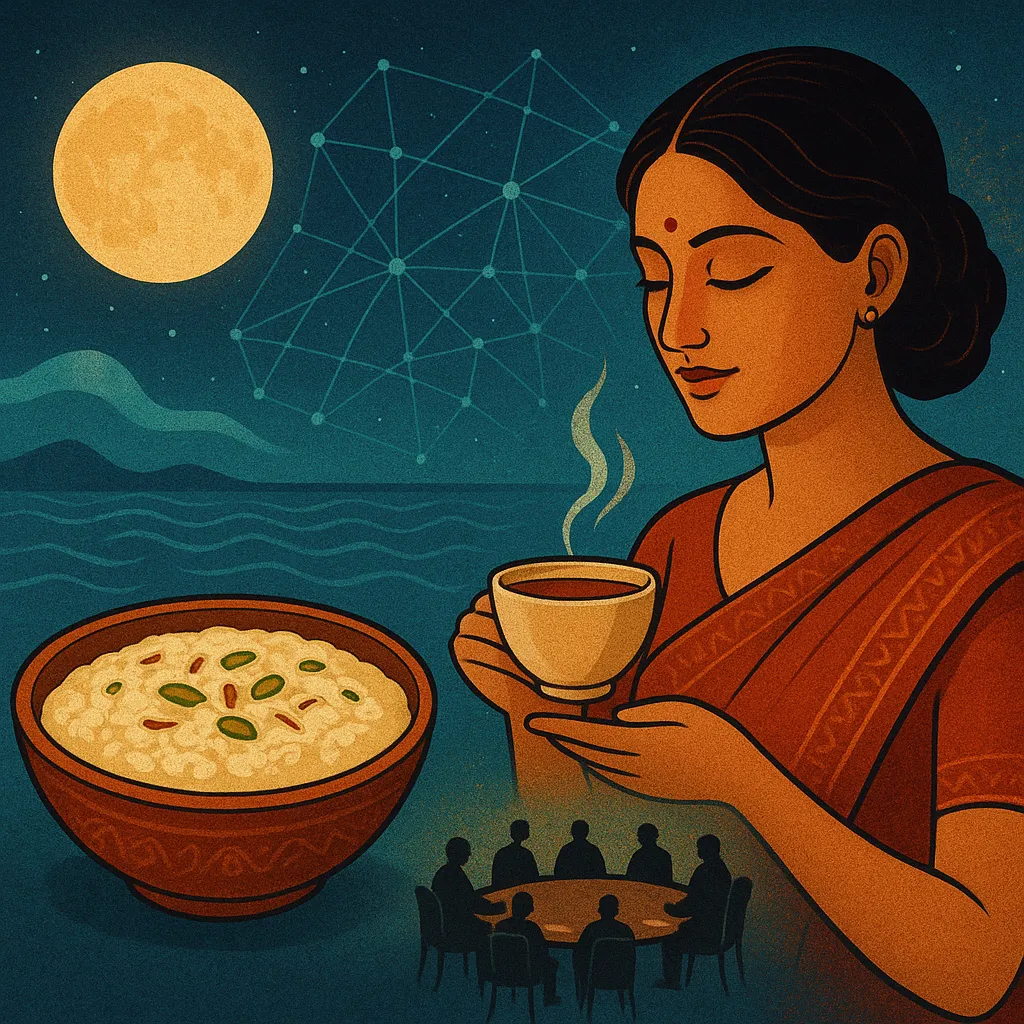
Sweet is your kheer, beloved, yet the tale bends slightly,
Everyone’s kheer is crooked; our right hand turns a little awry.

Behold, our eyes are vast oceans, forever sinking and rising,
The moon and sun emerge, yet day and night tilt ever so slightly.

Drop by drop you fill yourself, beauty adorning every limb,
But the water cannot overflow; the monsoon rains fall askew.

The Ganga and Yamuna stream within our hearts, yours and mine,
Yet when Radha, Meera, and the gopis converge, the discourse bends slightly.

One mirror remains plain and simple, reflecting all that is seen,
But each perceives it differently, knowledge tilts just a little.

Today, conservation of quantum angular momentum meets our tea,
Come, beloved, let us drink together, for circumstances lean slightly awry.
Table of Contents
Expert Academic Critique and Meta-Mystic Essay
Sweet is Your Kheer Beloved – The Crooked Sweetness of Domestic and Political Economies
This ghazal, though rooted in familiar idioms of domestic sweetness, rivers of devotion, and cosmological imagery, operates at a meta-mystical and futurist register that situates it within what may be called the Meta-Mystic Quantum Dialectics (MMQD) framework.
Through a subtle oscillation between the ordinary and the cosmic, between the personal and the geopolitical, it presents a philosophy for survival and diplomacy in the chaotic era of quantum artificial intelligence and failed world systems.
Couplet 1: The Crooked Sweetness of Domestic and Political Economies
“Sweet is your kheer… everyone’s kheer is crooked.”
Here, the sweet dish becomes a metaphor for both love and the collective share of human resources. Yet its crookedness hints at asymmetry, unequal distribution of sweetness, and uneven fairness of social, political, and economic systems.
In MMQD terms, this resonates with the principle of perturbation: no human endeavour, however noble, arrives without a deviation.
Diplomatically, it critiques the failures of economic justice at the United Nations and the imbalances of the global financial order, where every nation cooks its own sweetness, but power tilts the ladle.
Couplet 2: The Oceanic Eye and Celestial Tilt
“Our eyes are oceans… day and night tilt slightly.”
The metaphor of the eye as an ocean echoes the Upanishadic and Platonic traditions: the microcosm contains the macrocosm. The sun and moon’s emergence evokes the cycles of time, yet their crookedness reveals quantum indeterminacy; no absolute symmetry exists.
This cosmological crookedness is not an error but a fundamental reality. Applied geopolitically, it calls the UN and EU to accept asymmetric temporalities of nations: the Global South cannot be forced into the chronological standards of the West. A peace process must respect local orbits of time.
Couplet 3: Embodied Beauty and the Crooked Monsoon
“Drop by drop… monsoon rains fall askew.”
Here, the ghazal enters the territory of embodiment: beauty fills slowly, yet excess cannot pour out. The rains, archetype of abundance, arrive unevenly.
This is a metaphor for the distribution of resources and technology, particularly quantum AI. In a crooked monsoon world, technologies overflow in some regions (global north, intelligence agencies, military-industrial complexes) but remain dry elsewhere (global south).
Diplomacy must engineer equitable rainfall, a controlled diffusion of knowledge and technology for peaceful ends.
Couplet 4: Inner Rivers and Crooked Devotion
“Ganga and Yamuna flow in the heart… Radha, Meera, gopis converge.”
This is a devotional turn, situating the ghazal within Indic mysticism. The rivers within us, spirituality and love, unite diverse figures of devotion (Radha’s longing, Meera’s surrender, gopis’ collective ecstasy).
Yet even such sacred unity bends slightly. Philosophically, this couplet critiques sectarian purities: every religion, every spiritual community, when united, still tilts under human interpretation.
In the UN peace framework, this is an appeal to interfaith diplomacy, unity does not require sameness, and crookedness itself must be embraced as part of divine diversity.
Couplet 5: The Mirror of Knowledge and Epistemic Tilt
“One mirror plain and simple… yet knowledge tilts slightly.”
The single mirror reflects all, yet each viewer interprets differently. This recalls both Vedantic Maya (illusion) and postmodern epistemology: the observer effect in quantum physics ensures no observation is neutral. In diplomatic practice, this calls for epistemic humility: intelligence agencies, negotiators, and policy architects must acknowledge that their knowledge is always refracted.
Peace emerges not from universal truth but from negotiation of crooked perceptions.
Couplet 6: Quantum Tea and Crooked Circumstances
“Conservation of quantum angular momentum… let us drink tea.”
This final couplet fuses cutting-edge physics with the domestic ritual of tea. The law of conservation (symmetry in quantum systems) is brought to the hearth, where lovers sip together despite crooked times.
It represents meta-stability amidst chaos: despite turbulence in global AI governance, there remains the possibility of intimate peace.
The tea becomes a ritual of diplomacy, reminding leaders at the UN, EU, and intelligence agencies that even in the quantum crookedness of history, small acts of sharing sustain the world.
Implications for Global Diplomacy in the Quantum AI Era
This ghazal is not a domestic love lyric alone; it is a coded manifesto for peace negotiations in a fractured world-system. It advises that:
Accept Crookedness: Just as symmetry in quantum physics includes tilt and perturbation, peace processes must accept partial agreements, asymmetries, and crooked compromises rather than absolute resolutions.
Honour Plural Temporalities: Nations have different historical rhythms, forcing synchronicity is violence.
Distribute Abundance Fairly: AI, quantum tech, and resources must not remain as skewed as crooked monsoons.
Interfaith and Cross-Cultural Dialogue: The Ganga-Yamuna within us requires recognition of Radha, Meera, and the gopis across traditions.
Epistemic Humility: Intelligence and diplomatic communities must accept that their mirrors are tilted, fostering transparent communication.
Human Ritual Amidst Tech: Like drinking tea with a beloved, simple human gestures are the foundation of global peace amidst technological storms.
Thus, the ghazal offers a Meta-Mystic Futurist Ethics: crookedness is not error but the only ground upon which peace can stand in the age of quantum AI.
BEYOUTEA>A POETRY REVOLUTION >PEACE
NOTHING IS NOT TRUE :NO\KNOW THYSELF NOT
           MAKE EARTH GREAT FOREVER
मीठी तेरी खीर सजनी, बात जरा सी टेढ़ी है,
सब की खीर टेढ़ी, सीधे हाथ जरा सी टेढ़ी है।
          देख समंदर है आँख हमारी, डूबना उतरना,
          चाँद सूरज उभरा, दिन रात जरा सी टेढ़ी है।
बूंद-बूंद भर जाती हो, खूब सूरत सारा बदन,
छलक ना पाये नीर, बरसात जरा सी टेढ़ी है।
         गंगा जमुना मन में बहता रहता है तेरी मेरी,
         राधा मीरा गोपी संगम रो बात जरा सी टेढ़ी है।
एक ही दर्पण सीधा सादा, सबके तका झांकी,
सब देखे है एक ही, मालूमात जरा सी टेढ़ी है।
          क्वांटम एंगुलर मोमेंटम कंजर्वेशन आज चाय,
          चलो पीते हैं सजनी, हालात जरा सी टेढ़ी है।
LET'S GOODNESS A CHANCE : END ALL WARS
Meta-Sufi/Cyber Poetics on MetaMystic Futurism in
MMQD>META MIND QUANTUM DHARMA GROIND
गज़ल का समग्र भावार्थ: प्राज्ञिक व्याख्या
मीठी तेरी खीर सजनी – “जरा सी टेढ़ी है” का रदीफ़ – जीवन की माया, द्वंद्व और अनिश्चितता
यह गज़ल एक गहन दार्शनिक, आध्यात्मिक और वैज्ञानिक संयोजन प्रस्तुत करती है, जहाँ जीवन की साधारण घटनाओं, प्रेम, प्रकृति, भक्ति और आधुनिक विज्ञान को एक सूत्र में पिरोया गया है।
गज़ल की मूल थीम है “टेढ़ापन” (crookedness या paradox) अर्थात्, संसार की हर वस्तु, भावना या नियम में एक सूक्ष्म विकृति, विरोधाभास या जटिलता छिपी है, जो इसे पूर्णतः सीधा या सरल नहीं होने देती। यह “जरा सी टेढ़ी है” का रदीफ़ (refrain) बार-बार दोहराकर जीवन की माया, द्वंद्व और अनिश्चितता को उजागर करता है।
प्राज्ञिक स्तर पर, यह घज़ल भारतीय दर्शन (जैसे अद्वैत वेदांत, भक्ति मार्ग) और पाश्चात्य विज्ञान (क्वांटम भौतिकी) के मिश्रण से प्रेरित लगती है। यह सूफ़ी गज़लों की परंपरा को आगे बढ़ाती है, जहाँ प्रेम (इश्क़) ईश्वर या ब्रह्मांड की खोज का माध्यम बनता है, लेकिन आधुनिक संदर्भ (क्वांटम) जोड़कर इसे समकालीन बनाती है।
थीम जीवन की अपूर्णता को स्वीकार करने की है, सब कुछ सुंदर है, लेकिन टेढ़ा; पूर्णता में ही अपूर्णता है। यह हेराक्लाइटस की “परिवर्तनशीलता” या श्रोडिंगर की क्वांटम अनिश्चितता से मिलती-जुलती है, लेकिन भारतीय संदर्भ में माया (illusion) का प्रतिबिंब है।
आइये अब, प्रत्येक शेर (couplet) की व्याख्या क्रमवार करते हैं, जहाँ हम मूल पंक्तियों को विस्तार पूर्वक प्रस्तुत करेंगे, क्योंकि मूल में शब्द जुड़े हुए हैं। व्याख्या में भाषा, प्रतीक और गहन अर्थ पर ध्यान देते हुवे विवेचना को आगे बढ़ाते हैं।
प्रथम शेर:
मीठी तेरी खीर सजनी, बात जरा सी टेढ़ी है, सब की खीर टेढ़ी, सीधे हाथ जरा सी टेढ़ी है।
भावार्थ: यह शेर प्रेम और जीवन की मिठास से आरंभ होता है। “खीर” (rice pudding) प्रेम की मिठास या जीवन की सुखदता का प्रतीक है, जो “सजनी” (beloved) के माध्यम से व्यक्त होता है। लेकिन “बात जरा सी टेढ़ी है” से संकेत है कि यह मिठास सरल नहीं, इसमें जटिलता है। दूसरी पंक्ति में “सब की खीर टेढ़ी” से सार्वभौमिकता आती है: हर किसी का जीवन मधुर लगता है, लेकिन टेढ़ा है। “सीधे हाथ” (straight hand) शायद “सीधे-सादे” जीवन या कर्म का संकेत है, जो भी टेढ़ा पड़ जाता है।
प्राज्ञिक स्तर: यह बौद्ध दर्शन की “दुक्ख” (suffering in pleasure) या वेदांत की “माया” को दर्शाता है, सुख में छिपी पीड़ा। प्रेम की मिठास (ananda) अपूर्ण है, क्योंकि संसार द्वंद्वपूर्ण है।
द्वितीय शेर:
देख समंदर है आँख हमारी, डूबना उतरना,
चाँद सूरज उभरा, दिन रात जरा सी टेढ़ी है।
भावार्थ: “समंदर है आँख हमारी” से आँखों को समुद्र का रूपक दिया गया है, गहराई, रहस्य और भावनाओं की लहरें। “डूबना उतरना” जीवन की उतार-चढ़ाव को दर्शाता है। दूसरी पंक्ति में चंद्र-सूर्य और दिन-रात की चक्रीयता है, जो प्रकृति का नियम लगती है, लेकिन “टेढ़ी” से संकेत कि यह चक्र सरल नहीं, इसमें अंधेरा-उजाला का विरोधाभास है।
प्राज्ञिक स्तर: यह ऋग्वेद की “ऋतु चक्र” या यिन-यांग की द्वंद्ववादिता को प्रतिबिंबित करता है। आँखें “दर्पण” की तरह हैं (जो बाद के शेर में आता है), जो ब्रह्मांड को देखती हैं, लेकिन दृष्टि विकृत (distorted) है, जैसे प्लेटो की गुफा रूपक में छाया वास्तविकता से टेढ़ी है।
तृतीय शेर:
बूंद-बूंद भर जाती हो, खूब सूरत सारा बदन, छलक ना पाये नीर, बरसात जरा सी टेढ़ी है।
भावार्थ: “बूंद-बूंद भर जाती हो” से प्रेमिका की सुंदरता का वर्णन है, जो जल की बूंदों से भरकर पूर्ण होती है, शायद आंसू, पसीना या वर्षा का प्रतीक। “खूब सूरत सारा बदन” शारीरिक सौंदर्य है, लेकिन “छलक ना पाये नीर” से भावना की अतिरेकता जो छलक नहीं पाती, अर्थात् व्यक्त न हो पाने की पीड़ा। “बरसात टेढ़ी” से प्रकृति की वर्षा भी अनियमित या अप्रत्याशित है।
प्राज्ञिक स्तर: यह तंत्र दर्शन की “कुंडलिनी” ऊर्जा या फ्रायड की “अवचेतन” को दर्शाता है, ऊर्जा भरती है, लेकिन अभिव्यक्ति टेढ़ी। जल प्रतीक जीवन (jivan) का है, लेकिन बरसात की अनिश्चितता क्वांटम अनिश्चय सिद्धांत से मिलती है (जो अंत में आता है)।
चतुर्थ शेर:
गंगा जमुना मन में बहता रहता है तेरी मेरी,
राधा मीरा गोपी संगम रो बात जरा सी टेढ़ी है।
भावार्थ: “गंगा जमुना मन में बहता” से मन में पवित्र नदियों का प्रवाह, तेरी-मेरी (yours-mine) की एकता। “राधा मीरा गोपी संगम” भक्ति संतों (Radha, Meera, Gopi) का संगम है, जो कृष्ण-प्रेम का प्रतीक। लेकिन “बात टेढ़ी” से संकेत कि यह आध्यात्मिक मिलन सरल नहीं, इसमें त्याग, पीड़ा है।
प्राज्ञिक स्तर: यह भक्ति काव्य (जैसे मीरा की गज़लें) और गंगा-यमुना के संगम (prayag) से प्रेरित है, जो अद्वैत की एकता दर्शाता है। लेकिन टेढ़ापन रामानुज के विशिष्टाद्वैत जैसा है – एकता में भेद। “रो बात” शायद “की बात” है, जो रोमांच या रुदन का सम-अर्थी है।
पंचम शेर:
एक ही दर्पण सीधा सादा, सबके तका झांकी,
सब देखे है एक ही, मालूमात जरा सी टेढ़ी है।
भावार्थ: “एक ही दर्पण” एक साधारण आईना है, जिसमें सबकी झलक (झांकी) दिखती है। “सब देखे है एक ही” से सब एक ही वास्तविकता देखते हैं, लेकिन “मालूमात टेढ़ी” से ज्ञान या जानकारी विकृत है।
प्राज्ञिक स्तर: यह अद्वैत वेदांत कासार है – ब्रह्म एक है, लेकिन माया से टेढ़ा दिखता है (शंकराचार्य की “ब्रह्म सत्यं जगत् मिथ्या”)। “दर्पण” उपनिषदों का प्रतीक है (जैसे छांदोग्य उपनिषद में आत्मा का प्रतिबिंब)। मालूमात (knowledge) प्लेटो की “आइडिया” से मिलता है – सत्य एक, लेकिन धारणा टेढ़ी।
षष्ठ शेर (मक़्ता):
क्वांटम एंगुलर मोमेंटम कंजर्वेशन आज चाय,
चलो पीते हैं सजनी, हालात जरा सी टेढ़ी है।
भावार्थ: “Quantum Angular Momentum Conservation” वैज्ञानिक नियम है (कोणीय संवेग संरक्षण), जो “आज चाय” से साधारण जीवन (चाय पीना) से जुड़ता है। “चलो पीते हैं सजनी” प्रेमिका को आमंत्रण है, लेकिन “हालात टेढ़ी” से स्थिति जटिल है।
प्राज्ञिक स्तर: यह गज़ल का चरम है, जहाँ प्राचीन दर्शन आधुनिक भौतिकी से मिलता है। क्वांटम में संरक्षण नियम सख्त हैं, लेकिन दुनिया “टेढ़ी” (superposition, entanglement) है, जैसे नील्स बोहर की complementarity। चाय पीना सूफ़ी “समां” या ज़ेन की साधारणता है, लेकिन हालात की टेढ़ी Heisenberg की अनिश्चयता जैसी है। यह ब्रिजिंग करता है: विज्ञान औरदर्शन दोनों में paradox।
समग्र प्राज्ञिक निष्कर्ष:
यह गज़ल जीवन की “टेढ़ी रेखा” (non-linear path) को उत्सवित करती है, सब कुछ सुंदर लेकिन अपूर्ण। यह भारतीय काव्य परंपरा (गालिब की विरोधाभासपूर्ण गज़लें) और पाश्चात्य विचार (क्वांटम paradox) का संश्लेषण है।
भावार्थ है: संसार की जटिलता को स्वीकार करो, क्योंकि टेढ़ापन ही सौंदर्य है। यदि यह शायर दर्पण की मूल रचना की भाव सागर पर हम गोता मारते है, तो यह आज की एक विशिष्ठ postmodern poetry की तरह है,, जहाँ विज्ञान आध्यात्म का रूपक बनता है।
सुस्पष्ट रूप से, गज़ल कहती है कि पूर्णता की खोज में टेढ़ापन अनिवार्य है, “straight” लगने वाली चीजें भी curved हैं, जैसे आइंस्टीन की spacetime।

Next Read: Truth in the Age of AI