


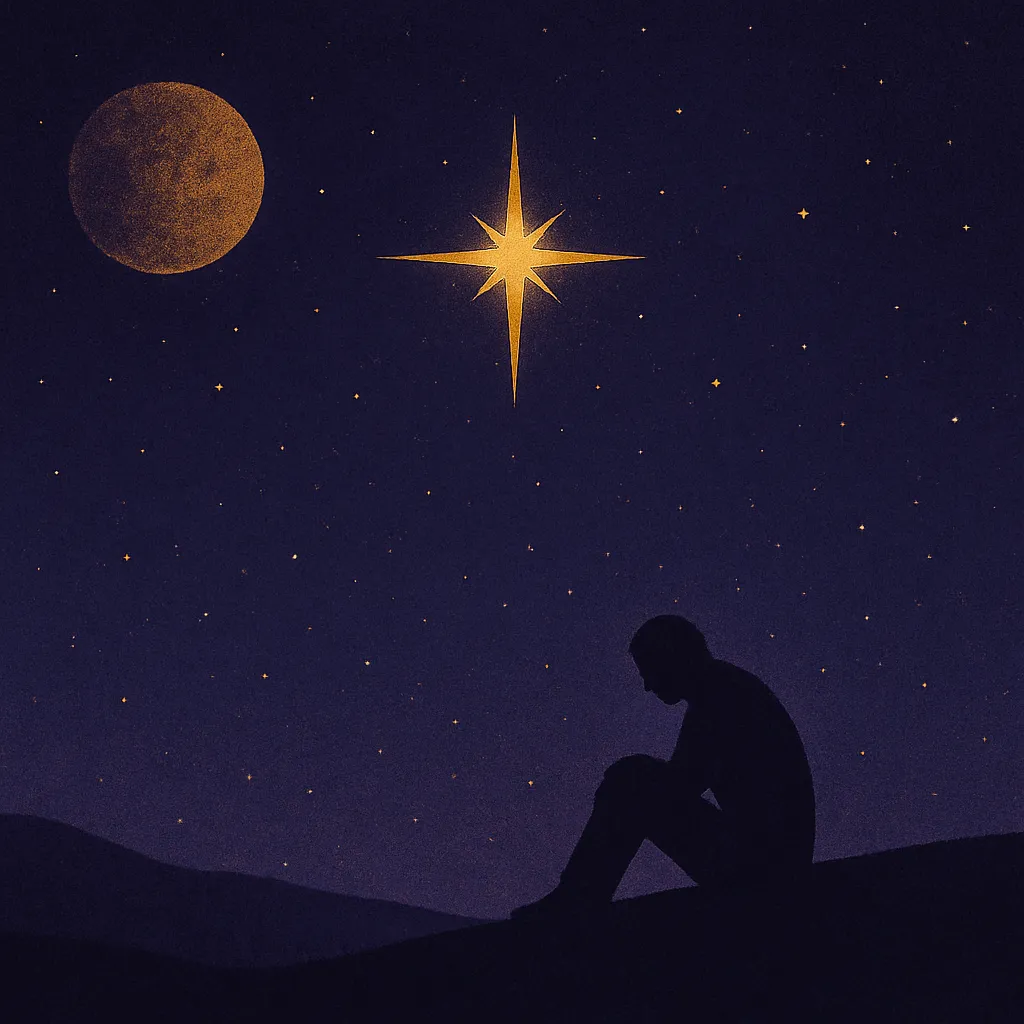
            Heart Vanquished Beholding Star
The heart is vanquished, beholding in the sky a gleaming star,
The whole horizon resounds within the mind, a thundering star.

Lonely I sit, listening at night to heartbeats within silence,
Every fragrance of life’s tale ascends, like a shimmering star.

So long a life you have endured, in hushed and voiceless breath,
No feast, no nourishment, only fire, a labouring star.

At dawn, at dusk, at noon, at night, your glimmering light adorns,
I beheld from soul to soul, adorned you are, O Swarta star.

From dish-brain to MetaBOC, the biocomputer hums,
Yet what of Trump, of Putin, of Zelensky? - losing star, winning star.

A conductor of quantum organoids stirs today’s common tea,
Beloved, drink your fate, and shine, like a falling star.
Table of Contents
Commentaries and Explanations
Couplet 1 The heart is vanquished, beholding in the sky a gleaming star, The whole horizon resounds within the mind, a thundering star.
Commentary: Here the star (tāra) symbolises sudden inspiration or cosmic revelation. The mind, overwhelmed by this vision, experiences both wonder and disquiet. The star is not silent; it reverberates through consciousness as a force of transformation.
Couplet 2 Lonely I sit, listening at night to heartbeats within silence, Every fragrance of life’s tale ascends, like a shimmering star.
Commentary: This verse captures the solitude of the self, where in silence the rhythms of existence become audible. The “fragrance” of memory, experience, and emotion rises like stars, suggesting that life’s narrative is preserved not in words, but in subtle sensory echoes.
Couplet 3 So long a life you have endured, in hushed and voiceless breath, No feast, no nourishment, only fire, a labouring star.
Commentary: This is the image of the Swarta Tara, the worker-star. It burns without respite, sustaining the cosmos yet receiving little reward. The metaphor critiques the condition of human labourers who fuel civilisation silently, like stars burning their essence into light.
Couplet 4 At dawn, at dusk, at noon, at night, your glimmering light adorns, I beheld from soul to soul, adorned you are, O Swarta star.
Commentary: The star is here universalised. Its light beautifies every phase of time. In a deeper sense, it symbolises the continuity of human connection, “soul to soul”, implying that human labour and compassion weave together the rhythms of existence.
Couplet 5 From dish-brain to MetaBOC, the biocomputer hums, Yet what of Trump, of Putin, of Zelensky? – losing star, winning star.
Commentary: The verse leaps into futurism. “Dish-brain” refers to organoid neurons trained to compute, while “MetaBOC” points toward advanced bio-computers. Yet amidst such marvels, political contests remain petty: leaders rise and fall like transient stars. Technology here is both promise and peril, depending on its political custodianship.
Couplet 6 A conductor of quantum organoids stirs today’s common tea, Beloved, drink your fate, and shine, like a falling star.
Commentary: This final verse grounds futuristic science (quantum organoid conductor) in the everyday act of tea-drinking. The juxtaposition suggests that extraordinary technology will one day merge seamlessly into ordinary life.
The beloved is urged to embrace destiny boldly, shining even if it means falling, since brilliance, however brief, leaves an eternal impact.
An Expert Critique
Heart Vanquished Beholding Star – Toward a Better Quantum World of the Future: A Meta-Mystic Futuristic Critique of “स्वारता तारा” Ghazal
Abstract
This paper presents a scholarly critique of a contemporary ghazal originally in Hindi that employs the symbol of the “Tara” (star) as a multi-layered metaphor, representing the soul, labour, memory, technological consciousness, and geopolitical tensions.
Through the framework of Meta-Mystic Quantum Dialectics (MMQD), the poem is analysed in the light of Cognitive Psychology, Bhagavad Gita philosophy, and scientific Near-Death Experience (NDE) testimonies by Dr. Mary Neal, Dr. Eben Alexander, and Dr. Bruce Greyson.
Additionally, the discourse integrates emerging frontiers of bio-computing, dish-brain neural organoids, and quantum organoid conductors, juxtaposed with global political struggles (Trump, Putin, Zelensky).
The central claim of this paper is that only by integrating scientific-technological advancement with spiritual consciousness and ethical responsibility can humanity achieve a better quantum world of the future.
Introduction
The ghazal under study uses the motif of a shining star to map the existential, mystical, and futuristic anxieties of human civilisation.
On one level, the star becomes a solitary witness to love, memory, and the silence of nights; on another, it reflects the blazing struggles of the labourer (Swarta Tara, the hardworking star).
At a meta-futurist level, it mirrors the collision of human consciousness with advanced computing systems, MetaBOC bio-computers and quantum organoid conductors.
The poem thus exemplifies the fusion of poetics with technological futurism and mystic spirituality. This integration resonates with the Bhagavad Gita’s ontological claims about the immortality of the soul (nājāyate mriyate vā kadācin), and contemporary scientific accounts of consciousness beyond the brain.
In a world fractured by geopolitical wars and techno-political rivalries, the ghazal serves as a visionary call for a holistic quantum humanism.
Discussion
- Cognitive Psychology and Consciousness Beyond the Brain
Modern cognitive science questions the reductionist view of consciousness as mere neuronal firing. NDE accounts lend empirical weight to the hypothesis of consciousness as a non-local phenomenon.
Dr. Mary Neal recounts profound experiences of afterlife realms during clinical death.
Dr. Eben Alexander, once an atheist neurosurgeon, affirmed soul-survival after his coma.
Dr. Bruce Greyson documented extensive clinical evidence (5000+cases) for consciousness persisting after brain shutdown.
In the ghazal, when the poet hears “life’s tale blossoming like fragrance in silence,” it resonates with this cognitive extension, consciousness as star-like luminescence surviving beyond physical limitations.
- Bhagavad Gita Grounding: The Swarta Tara as a Cosmic Labourer
The Gita positions the soul as eternal and indestructible. Yet, it equally emphasises Karma-Yoga, the dignity of labour. The Swarta Tara in the ghazal symbolises the worker-star, the labouring self whose fire burns quietly while sustaining existence.
Just as the Gita’s yogi illumines both day and night, the Swarta Tara “adorns mornings and evenings alike.”
The star becomes a metaphor for the universal worker, holding together cosmic and earthly rhythms.
Thus, the poem redefines spirituality not as escapism, but as active cosmic labour grounded in justice and compassion.
- Bio-Computing, Quantum Organoids, and the Future of Mind
Technological metaphors in the ghazal, dish-brain neural circuits, MetaBOC bio-computer, quantum organoid conductor, suggest a horizon where human consciousness may be simulated, extended, or even merged with computational substrates.
The dish-brain experiment already showed human neurons in a dish learning to play Pong.
Quantum bio-computing promises processing at scales mimicking brain-consciousness patterns.
However, the ghazal issues a warning: “What if Trump, Putin, Zelensky win or lose by this?”, a caution that power politics may hijack such technologies.
The poem thus urges the ethical anchoring of bio-computing within compassionate governance and spiritual consciousness.
- Geo-Politics and the Quantum Dialectic
The ghazal reflects contemporary anxieties of war-torn geopolitics, where nuclear brinkmanship and technological races overshadow human fraternity. MMQD posits that a quantum diplomacy must emerge, grounded not in binary oppositions but in entangled mutualities.
A star cannot shine alone; its brilliance is contextual within a galaxy.
Likewise, no nation-state can secure survival through domination; global peace must be entangled in collective consciousness.
Thus, the ghazal imagines a meta-mystic quantum future where nations are bound not by zero-sum rivalries but by vasudhaiva kutumbakam, the Earth as one family.
Conclusion
This ghazal transcends mere romantic poetics; it becomes a manifesto of meta-mystic futurism. By weaving together cognitive psychology, Gita’s philosophy, NDE testimonies, and bio-computing technologies, it situates the human soul (Swarta Tara) at the centre of both cosmic and technological destiny.
The critical insight is clear: technological progress alone cannot build a better future; it must be harmonised with spiritual consciousness, ethical labour, and quantum diplomacy.
Only then can humanity evolve toward a Better Quantum World of the Future, a world where every star, human or cosmic, shines not in isolation but in luminous fraternity.
BEYOUTEA>A POETRY REVOLUTION>PEACE
NOTHING IS NOT TRUE :NO\KNOW THYSELF NOT
            MAKE EARTH GREAT FOREVER
दिल हारा गगन में देखकर चमकता तारा,
सारा मंज़र जैसे दिमाग पर धमकता तारा।
           तनहा बैठा धड़कन रातों को सुने ख़ामोशी,
           दास्ताँ जिंदगी की हर ख़ुशबू महकता तारा।
इतनी लंबी जिंदगी चुपचाप जी रहे हो तुम,
खानपान का कुछ नहीं, आग दहकता तारा।
           निश दिन साँझ सवेरा सजा तेरा झिलमिल,
           देखा मन को मन से सजी हो स्वारता तारा।
डिशब्रेन से MetaBOC बायोकंप्यूटर चले,
क्या जीते ट्रंप पुतिन ज़ेलेंस्की, हारता तारा।
           क्वांटम ऑर्गेनोइड कंडक्टर आज की चाय,
           सजनी, पीना भाग, चमको जैसे टूटता तारा।
LET'S GOODNESS A CHANCE : END ALL WARS
Meta-Sufi/Cyber Poetics on MetaMystic Futurism in
MMQD>META MIND QUANTUM DHARMA GROUND
ग़ज़ल का बोधगम्य भाव विस्तार
यह ग़ज़ल “तारा” के बिंब से आत्मा और जीवन की यात्रा को रूपायित करती है। पहला शेर बताता है कि तारा (तारकीय प्रकाश) किसी अकेले हृदय को मोह लेता है, जैसे मनुष्य का मस्तिष्क किसी ऊर्जस्वी दृश्य से अभिभूत हो उठता है। दूसरा शेर रात की खामोशी में हृदय की धड़कनों और जीवन की कहानियों को महसूस करता है, जहाँ हर “खुशबू” एक तारा बनकर खिल उठती है।
तीसरा शेर कठोर जीवन-संघर्ष का यथार्थ है, मानो कोई श्रमिक या मेहनतकश “तारा” हो, जिसकी आंतरिक ज्वाला जल रही हो लेकिन बाहरी खानपान, सुविधा, और आराम से वंचित है। चौथा शेर “स्वारता तारा” की कल्पना है, यहाँ कवि ने मन से मन की सजावट की बात कही है, जो आत्मीयता और साझेपन की स्वर्गीय झिलमिलाहट को दर्शाता है।
पाँचवाँ शेर यथार्थ राजनीति और तकनीक को छूता है, “डिशब्रेन” और “MetaBOC बायोकंप्यूटर” का उल्लेख यह संकेत देता है कि भविष्य में बौद्धिक, राजनीतिक और टेक्नोलॉजिकल शक्ति-संघर्ष भी ऐसे ही तारों की जीत-हार की तरह होंगे। अंतिम शेर में “क्वांटम ऑर्गेनोइड कंडक्टर” और “आज की चाय” का प्रतीक भविष्य-प्रौद्योगिकी को सामान्य जीवन की दिनचर्या में पिरो देता है, और सजनी के लिए संदेश है, “तुम टूटते तारे की तरह चमको, जीवन को अवसर की तरह पियो।”
Meta-Mystic Futurism और MMQD फ्रेम में विवेचना
देखकर चमकता तारा – धड़कनें और खामोशी में “जिंदगी की दास्तान” तारों की तरह महकती
Meta-Mystic Futurism (MMF) यहाँ वह दृष्टि है जो मानव आत्मा, विज्ञान, तकनीक, और रहस्यमय अध्यात्म को जोड़कर एक बेहतर भविष्य की कल्पना करती है। MMQD फ्रेम (Meta-Mystic Quantum Dialectics) इस संवादात्मक प्रक्रिया को परिभाषित करता है जिसमें भौतिक (क्वांटम), मानसिक (साइकोलॉजिकल), और आध्यात्मिक (गीता-दर्शन) परतें एक-दूसरे से अंतःक्रिया करती हैं।
कॉग्निटिव साइकोलॉजी और आत्मा का प्रश्न
आधुनिक मनोविज्ञान मानता है कि चेतना केवल मस्तिष्क की विद्युत-रासायनिक प्रक्रियाओं का परिणाम नहीं है। Near-Death Experiences (NDEs) ने इस धारणा को चुनौती दी है।
डॉ. मैरी नील ने अपने मृत्यु-समीप अनुभवों में परलोक-साक्षात्कार का वर्णन किया।
डॉ. एबन एलेग्जेंडर, जो स्वयं अज्ञेयवादी (नास्तिक) न्यूरोसर्जन थे, ने गहन कोमा के बाद आत्मा के अस्तित्व को स्वीकार किया।
डॉ. ब्रूस गियर्सन ने चेतना और ऊर्जा के रहस्यमय आयामों पर(५०००+ प्रामाणिक cases अध्ययन के बाद) विचार किया।
ये अनुभव ग़ज़ल के उस शेर से मेल खाते हैं जहाँ धड़कनें और खामोशी में “जिंदगी की दास्तान” तारों की तरह महकती है। यह बताता है कि चेतना (Consciousness) नाशवान नहीं, बल्कि ऊर्जा-तरंग की तरह शाश्वत है।
गीता-दर्शन का grounding
गीता कहती है, – न जायते म्रियते वा कदाचिन्- आत्मा कभी जन्म नहीं लेती, कभी मरती नहीं। “स्वारता तारा” यहाँ गीता के कर्मयोगी की प्रतिमा है, जो श्रम और समर्पण से ब्रह्मांड में झिलमिलाहट रचता है। तारा, मेहनतकश आत्मा का प्रतीक बनकर, विश्व को आलोकित करता है।
टेक्नो-फ्यूचरिज़्म और बायो-कंप्यूटिंग
“MetaBOC बायोकंप्यूटर” और “क्वांटम ऑर्गेनोइड कंडक्टर” आज की प्रयोगशालाओं में बनते भविष्य की ओर इशारा हैं।
डिशब्रेन प्रयोग में वैज्ञानिकों ने न्यूरॉन्स को सिलिकॉन से जोड़कर “सोचने वाला ब्रेन-चिप” विकसित किया।
अगर राजनीति (ट्रंप, पुतिन, ज़ेलेंस्की) इस शक्ति का गलत उपयोग करती है, तो तारा हार सकता है।
मगर यदि इस तकनीक को “स्वारता तारा” (मानव श्रम, न्याय और करुणा) के मार्गदर्शन में प्रयोग किया जाए, तो यह विश्व-शांति और सामूहिक चेतना का साधन बन सकता है।
Geo-politics और Quantum World
वर्तमान भू-राजनीति (यूक्रेन युद्ध, अमेरिका-चीन तनाव, भारत-नेपाळ-साउथ एशिया) मानवीय तारे को बुझा रही है। MMQD फ्रेम यह सुझाव देता है कि भविष्य का विश्व “Quantum Diplomacy” पर खड़ा हो, जहाँ निर्णय केवल शक्ति-संतुलन पर नहीं, बल्कि चेतना, करुणा और सामूहिक उन्नति पर आधारित हों।
आलोचनात्मक विवेचना (Scholarly-Critical Essay)
यह ग़ज़ल केवल व्यक्तिगत भावनाओं का दस्तावेज़ नहीं है, बल्कि मानव आत्मा और भविष्य-टेक्नोलॉजी के बीच सेतु का कार्य करती है। “तारा” एक बहुस्तरीय प्रतीक है, प्रेम का भी, श्रमिक का भी, आत्मा का भी, और भविष्य की तकनीकी चेतना का भी।
मनोविज्ञान और गीता-दर्शन मिलकर यह कहते हैं कि आत्मा अमर है, और मृत्यु केवल अवस्था-परिवर्तन है।
वैज्ञानिक NDE अनुभव इस आध्यात्मिक सत्य को पुष्ट करते हैं, कि चेतना मस्तिष्क के परे भी टिकाऊ है।
बायोकंप्यूटिंग और क्वांटम ऑर्गेनोइड्स यह संकेत देते हैं कि भविष्य में हम मस्तिष्क और आत्मा के रहस्यों को मशीनों में अनुकरण करेंगे। लेकिन प्रश्न यह रहेगा – क्या यह अनुकरण आत्मा को समझ पाएगा, या केवल उसकी परछाई बनेगा?
भू-राजनीति यदि इन नव-तकनीकों को केवल सत्ता की भूख में इस्तेमाल करेगी, तो मानवता का “तारा” बुझ जाएगा।
इसलिए ग़ज़ल का अंतिम संदेश है:
हमें स्वारता तारा की तरह श्रम, प्रेम और करुणा की चेतना को विज्ञान और राजनीति से जोड़ना होगा। तभी “Better Quantum World of Future” का सपना साकार होगा, जहाँ हर मनुष्य, हर राष्ट्र और हर तारा सामूहिक आलोक में चमकेगा।
Next Read: Leadership as the Gateway