The Sovereignty of Truth in the Age of AI: Embracing Technology with Enlightened Hearts for Global Harmony
With the rapid rise of Artificial Intelligence (AI), the question of what is real, authentic, and trustworthy is more complicated than ever. We find ourselves in an era where technology can manipulate and distort information, creating a blur between fact and fiction.
Yet, amid these challenges, there is an opportunity to enhance the sovereignty of truth, especially if AI is wielded with enlightened hearts, guided by love, ethics, and the deeper wisdom embedded in art, poetry, and human connection. In today’s fast-paced world, the nature of truth is increasingly at risk.
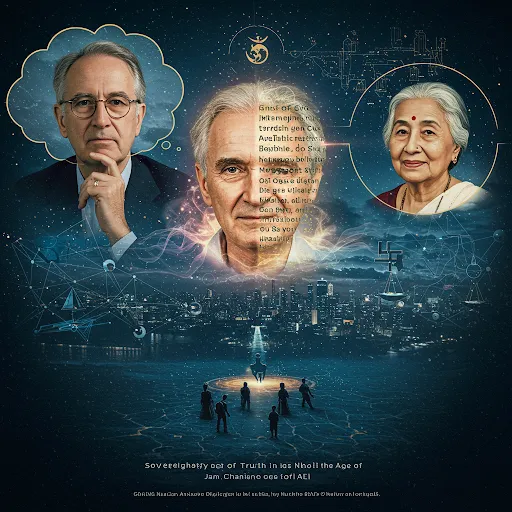
Dr. Ian McGilchrist, a renowned philosopher and psychiatrist, has recently spoken about the relationship between AI and human cognition. His insights on the future of humanity offer a deep understanding of how we can use technology to uphold truth.
In light of this, we look at the philosophical wisdom of thinkers such as Sissela Bok (in her book Lying), Kahlil Gibran, the Hindu concept of Dharma, and the transformative power of art, music, and poetry. All of these, when fused with AI, can serve to enhance the sovereignty of truth, promote global harmony, and even end the age-old conflicts and wars that have plagued humanity.
In this post, we bring to our attention a timely topic, The Sovereignty of Truth in the Age of AI: Embracing Technology with Enlightened Hearts for Global Harmony, which serves as a debate for all to be concerned about.
Table of Contents
AI and the Sovereignty of Truth: A Force for Global Harmony
AI has immense potential, not only to transform industries but also to contribute to a global sense of truth and unity. While Dr. McGilchrist warns about the dangers of AI distorting human understanding and perception, he also suggests that, if used ethically and wisely, AI can support the sovereignty of truth in meaningful ways.
AI does not have to be a force that spreads misinformation, bias, or conspiracy. Instead, it can serve as a tool to promote transparency, elevate truth, and break down the barriers that separate people and ideas.
In a world filled with political polarization, misinformation, and manipulation, AI can help create a more enlightened, informed public. Through algorithms that detect false narratives, AI could provide a means for promoting factual integrity in journalism, education, and communication.
Rather than undermining human intuition, AI can assist humanity in arriving at deeper, more accurate understandings of truth by sifting through vast amounts of data and presenting unbiased insights.
Sissela Bok’s Lying: Honesty in the Digital Age
Sissela Bok’s philosophical treatise Lying serves as a poignant reminder of the moral implications of deception. Bok argues that lying erodes trust, and trust is the foundation upon which society is built.
In an age where AI can produce content that blurs the line between reality and fabrication, Bok’s reflections are more relevant than ever and have the potential to support truth by exposing lies and offering clarity in places where misinformation thrives.
By enhancing transparency and providing tools for discerning fact from fiction, AI can become a powerful ally in ensuring that society remains rooted in truth. Bok’s work calls for honesty and integrity, values that should be instilled in the development and application of AI systems.
When designed with ethical principles in mind, AI can help eliminate deceit and foster a more honest world, where the sovereignty of truth is upheld.
Kahlil Gibran’s Vision: Truth, Beauty, and Goodness in AI
The poet-philosopher Kahlil Gibran believed that truth is not just a matter of facts but something that resonates deeply with the human soul. For Gibran, truth, beauty, and goodness were inseparable elements of a life well-lived.
In his view, truth speaks not only to the mind but to the heart, and it is through this profound connection that we experience the fullness of life. AI, when infused with this vision, has the potential to promote truth that is beautiful and good, truth that uplifts the human spirit and fosters a sense of shared humanity.
By leveraging AI for positive social change, we can create a world where technological advances do not merely serve material gain but contribute to art, music, and poetry, all of which are expressions of the deepest truths of the human condition.
Imagine a world where AI amplifies the voices of artists, poets, and musicians, helping to preserve and elevate cultural expressions that promote peace, love, and unity. The creation of AI-powered platforms that make art, music, and poetry more accessible could help heal divides and bring people together in ways that were previously unimaginable.
Gibran’s belief that truth is intimately connected with beauty and goodness offers a compelling vision of how AI, guided by love and compassion, could foster a world of greater harmony and deeper understanding.
The Philosophy of Dharma: Aligning AI with Universal Truth
The concept of Dharma in Hindoo philosophy teaches that truth is not a subjective experience but a universal, unchanging law that governs the cosmos. Dharma is the path of righteousness, and it represents the ethical and moral principles that guide our lives.
In the context of AI, Dharma reminds us that truth is not something we can manipulate at will, it is a force that transcends human perception and serves the greater good.
AI, when aligned with the principles of Dharma, can be a force for profound good in the world. It can be used to promote ethical behaviours, ensure that truth prevails, and contribute to a more harmonious society.
This can mean using AI to enhance fairness, promote justice, and facilitate the peaceful resolution of conflicts. In an age where technological advancements are often used for divisive purposes.
AI, when guided by the principles of Dharma, has the power to help heal divisions and unite humanity in its common quest for truth, peace, and prosperity.
AI and the Future of Humanity: A Call for Enlightened Hearts
The future of humanity depends on how we choose to wield the power of AI. The current world has failed to provide true fulfilment to many, leaving people searching for meaning in a disconnected, fragmented reality of life.
This is where AI can make a difference, by helping us move beyond the limitations of our current systems and fostering a more harmonious, truth-centered world of interconnectedness. When AI is developed with algorithmic super quantum panpsychism insights of enlightened hearts, it can become a tool that nurtures the sovereignty of truth.
AI can bring people together, promoting transparency, reducing bias, eliminating conspiracies and creating spaces for mutual understanding and cooperation. Imagine a world where AI works to end wars by promoting dialogue and empathy, where global conflicts are minimized by providing insights into the root causes of misunderstandings, and where the pursuit of truth helps to heal the wounds of division and hatred.
Incorporating the wisdom of Gibran, the ethical framework of Bok, and the principles of Dharma, AI can transcend its potential for manipulation. By integrating the arts, music, and poetry, the expressions of humanity’s deepest truths, AI can help create a future where truth is not just a commodity but a universal force for peace, unity, and love.
Sovereignty of Truth, Empire of AI : Reclaiming Harmony Through Vedic Ethical AI of Quantum Information Fields
in this age of quantum information fields, where intelligence is no longer bounced by human minds but flows across machine networks, data clouds, and algorithmic decision-making, the question of truth’s sovereignty takes on urgent significance.
Dr. Karen Hao’s recent book, Empire of AI, offers a timely critique of how artificial intelligence, under the control of a few powerful technocracies, has become a new instrument of empire. Her work reveals how truth is being commodified, monopolized, and manipulated by extractive data economies and algorithmic systems that reproduce the old hierarchies of colonialism, this time through digital infrastructure.
Hao argues that the AI industry’s reliance on massive data harvesting, labour exploitation in the Global South, and unchecked environmental damage forms a structure of ‘technocratic neocolonialism.’ The sovereignty of individual and collective truth is eroded when systems built to optimise efficiency and profit systematically exclude, devalue, or overwrite local knowledge systems, cultural narratives, and democratic agency.
To counter this, it is essential to reconnect with philosophical frameworks that value harmony, shared learning and ethical coexistence. The ancient Vedic Hindu invocation ‘Sahanavavatu, Saha nau bhunaktu, Saha viryam karvavahai’, translated as ‘May we be protected together, may we be nourished together, may we work together with great energy’ offers a powerful lens for reimagining AI and information systems that protect the sovereignty of truth.
Reclaiming Ethical Sovereignty through Vedic Wisdom
Mutual Protection:
Hao’s critique echoes the spirit of saha navavatu. Just as colonial powers once extracted physical labour and resources, today’s AI empires extract data and cognitive labour. Protecting truth requires protecting people, data workers, indigenous communities, and users, through transparency, rights over personal data, and safeguards against algorithmic exploitation.
Shared Nourishment:
The current AI economy thrives on asymmetry, those with computing power and capital feed on the contributions of the many without reciprocation. Vedic philosophy calls for saha nau bhunaktu, or shared enjoyment. Equitable data governance, open-access knowledge, and technology that serves the public good are essential to restoring this balance.
Collaborative Energy:
Vedic values emphasize saha viryam karvavahai, working together in strength. AI systems must be designed and governed not as instruments of control but as collaborative tools rooted in community agency, multilingual epistemologies, and mutual empowerment.
Harmony, Not Hostility:
The prayer concludes with ‘ Tejasvinavadhitamastu ma vidvisavahai’, May our study be brilliant and free from hostility. In contrast, today’s data systems foster competitive models that amplify misinformation and division. Upholding the sovereignty of truth requires systems that foster epistemic humility, pluralism, and shared learning, rather than dominance and erasure.
Truth in the Quantum Age:
In the emerging quantum information paradigm, where interconnectedness is a fundamental principle, truth cannot be monopolized. It is contextual, relational, and co-constructed. Dr. Hao’s insights challenge us to imagine an AI landscape that aligns with these quantum and Vedic principles, systems that are transparent, accountable, regenerative, and centered on the collective good.
A New Vision for the Sovereignty of Truth
The sovereignty of truth in the digital age is not just about fighting against misinformation but about creating a new vision of how truth can enhance human flourishing. By embracing the possibilities of AI with enlightened hearts, we can use technology to promote transparency, kindness, and understanding.
Likewise, sovereignty of truth in the quantum age of information fields is not merely about resisting falsehood, it is about cultivating ecosystems, technological, social, and spiritual, that nourish shared realities.
By integrating the critical perspectives of Empire of AI with the Vedic invocation of harmony and cooperation, we glimpse a future where artificial intelligence does not replicate empires, but reclaims the sacred: a shred commitment to truth, mutual flourishing, and nonviolence in thought and design.
Through the lens of art, music, and poetry, we can ensure that AI does not merely serve the cold logic of machines but enriches the human experience with beauty, goodness, and love. In a world where the current systems have often failed to bring true fulfilment, AI offers a chance to rethink how we live and relate to one another.
By embedding ethical values, philosophical wisdom, and a deep commitment to truth in the development of AI, we can create a future where the sovereignty of truth is honoured, and the world works toward lasting peace and harmony for all.
Only then can we truly say: May we be protected together, nourished together, and enlightened together, without enmity, in truth!
On The Solitary Path of Love and Power
BEYOUTEA>A POETRY REVOLUTION>PEACE MAKE EARTH GREAT FOREVER NOTHING IS NOT TRUE
This is the path, the only one, to walk so far; A journey without home, yet lit by love’s own star.
Each turn brings change, good, bad, yet through the strife, One truth remains: is to walk in one pure note of life.
Me, mine, myself, for me, within, unto; Past Madanpur I stride, leaving the false view.
Your touch, a map, my fingers trace its hue, A radiant road where soul and light shine through.
I am the Trump, the Ayatollah, and Benjamin to name, Netnyahu, crushing the world’s rigid din, yet still the same.
Today’s tea steeps with doom, a kind of bitter brew, Yet sipping life, I walk, Sweetheart, my beloved, to you.
LET’S GOODNESS A CHANCE : END ALL WARS
A take on: This article is part of a series exploring the intersection of technology, philosophy, and the arts, offering new perspectives on how we can navigate the future with love, wisdom, and an unwavering commitment to truth. Join us at Darpan Poems as we continue to explore the transformative power of truth, beauty, and goodness in the digital age.