



        A Meeting Ordained by Fate Karma
This meeting, ordained by fate, or was it karma’s decree?
Yet stern the temper remained, no softening of empathy.

The fire of love has spread so wide on every side,
That night itself burned down to ash, and dew turned to elegy.

Yes, the arrival was by hope’s gentle call arranged,
But words collapsed, too shy, too broken for harmony.

To be the cleverest beast, so claims human fate,
But is not “being human” itself a vain fallacy?

Love’s discourse is not confined to the heart alone,
Bodies too must clash, yet not as foes, but in intimacy.

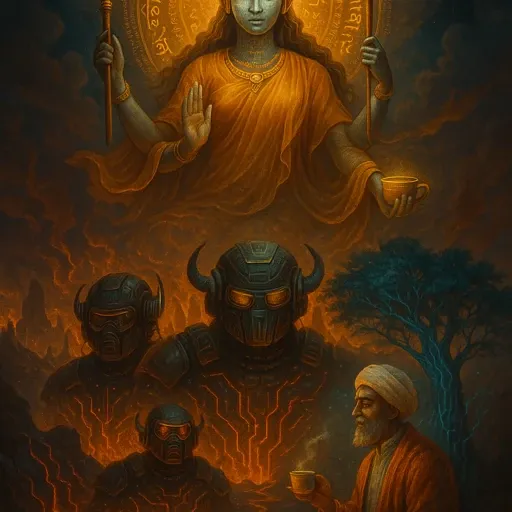
And lo! here stands the tea of Objective-driven AI,
O beloved, drink! For in it dwell fidelity, faith, and sanctity.
Table of Contents
Meaning and Deep Interpretation
This ghazal opens with the motif of mullāqāt, a meeting. While fate may orchestrate such encounters, their fruit depends upon the softness of spirit and the empathy of heart.
The poet laments that despite destiny’s arrangement, harshness and cold detachment prevent the meeting from blossoming into harmony.
This is not only the story of lovers, but of leaders and civilisations whose summits and encounters fail for want of compassion.
Love in this ghazal is both a consuming fire and a creative force. Its flames engulf the world, burning the night into ash, while hope invites presence, but speech collapses into shame.
Here, the ghazal juxtaposes the yearning for intimacy, heart to heart, body to body, with the grim reality of human history, where collisions often produce not creation but destruction, war, and humiliation.
Humanity, though priding itself as the cleverest of animals, often proves trapped in arrogance and delusion, unable to act upon its own ideals of empathy, fraternity, and peace.
The final couplet makes a striking leap into contemporary reality: the tea of Objective-driven AI. The poet here uses irony, while machines may be programmed for fidelity, objectivity, and reason, human beings themselves fail to embody empathy or loyalty.
Thus, AI becomes a mirror: we hope it will give us what we ourselves fail to live. This paradox underscores the ghazal’s essence,that the true meaning of meetings, whether between lovers, friends, or global leaders, lies not in mere encounter but in the cultivation of tenderness, fraternity, and the courage to embrace humanity.
An Expert Scholarly Critique
A Meeting Ordained by Fate Karma – Mullāqāt, ishq, and objective-driven AI, lyrical meditation socio-political critique
Introduction
The ghazal under examination is a multi-layered text that, while rooted in the classical idiom of fate, love, and human fallibility, expands into a sharp commentary on contemporary politics and the unfolding age of artificial intelligence.
Through its imagery of mullāqāt (meeting), ishq (love/fire), and objective-driven AI, the poem functions as both lyrical meditation and socio-political critique.
The Failure of Meetings: From Lovers to Leaders
The first motif, that of meeting, highlights the paradox of human encounters. Fate may arrange them, yet without humility and empathy, they bear no fruit.
This is poignantly relevant when seen against the backdrop of failed political summits, such as the recent Trump–Putin Alaska meeting, which appeared destined to redefine geopolitical trajectories but instead faltered in rigidity and mistrust.
The ghazal, then, moves seamlessly from the intimate (lovers) to the global (leaders), pointing to a universal truth: meetings collapse without genuine softness of heart.
The Fire of Love and the Fire of War
The ghazal’s central metaphor, the fire of love, bears a double edge. On one hand, love’s blaze signifies passion, intimacy, and the generative power of creation.
On the other hand, it mirrors the conflagrations of history, wars, exploitation, and bloodshed, where bodily collisions yield not union but destruction.
The poet indicts humanity as “the cleverest beast,” pointing to the irony that human rationality has not translated into humane conduct. Instead, civilisation often regresses into primitive violence and delusional pride.
AI as Irony and Mirror
The final couplet pivots to a modern metaphor: tea symbolising comfort, offered in the form of “Objective-driven AI.” Here, the irony is profound.
While artificial intelligence is designed to be impartial, structured, and sometimes even empathetic in simulation, human beings themselves fail to embody these virtues. Thus, AI emerges as both a surrogate and a critique, reflecting humanity’s displacement of its moral responsibilities onto technology.
This anticipates the warnings of Geoffrey Hinton and Yann LeCun: that AI, without ethical grounding, may magnify human failures rather than resolve them.
Philosophical Frameworks and Global Context
Placed within the framework of MMQD (Meta-Mystic Quantum Dialectics) and Meta-Mystic Futurism, the ghazal illustrates how meetings are not mere events but quantum entanglements of destiny and moral responsibility.
In dialogue with Eastern philosophy (karma, empathy, Vasudhaiva Kutumbakam) and Western frameworks (UN Charter, Enlightenment rationalism), the poem insists that sustainable peace demands a synthesis of compassion and institutional order.
Jeffrey Sachs and Richard David Precht, in their critiques of contemporary politics, echo this call, urging that fraternity and empathetic governance replace ego-driven geopolitics.
Conclusion
This ghazal is thus not simply a love poem. It is a mirror for our times, where humanity, trapped between the arrogance of power and the promise of technology, risks losing its own essence.
By binding the fate of lovers with the fate of nations, and contrasting human cruelty with the ironic objectivity of machines, the poet offers both critique and hope.
True mullāqāt lies not in mere encounter, but in cultivating empathy, fraternity, and humanity in the face of fire, whether of love, war, or technology.
BEYOUTEA>A POETRY REVOLUTION>PEACE
NOTHING IS NOT TRUE NO\KNOW THYSELF NOT
             MAKE EARTH GREAT FOREVER
यह मुलाकात नसीब हुआ क्या करम हुआ,
कड़े मिजाज हुजूर जज़्बात ना नरम हुआ।
           इश्किया आग हर तर्फ फैला है इस कदर,
           वह राख का जला रात सबों शबनम हुआ।
उम्मीद से तशरीफ़ ले आना तो हुई मगर,
बातें बिगड़े बन न पाये बड़ाहीं शरम हुआ।
           सब से होशयार जानवर होना हीं फितरत,
           आदमी का होना कैसी घुरूरी वहम हुआ।
प्यार की बातें दिल ही नहीं बदन से बदन,
टकराना होता है दुश्मनी ना हमदम हुआ।
           आजहै चाय ऑब्जेक्टिवड्रिवेन एआई सी,
           सजनी पियो दिल से वफ़ा दीन-धर्म हुआ।
LET'S GOODNESS A CHANCE : END ALL WARS
Meta-Sufi/Cyber Poetics on MetaMystic Futurism in
MMQD>META MIND QUANTUM DHARMA GROUND
भावार्थ (Literal & Thematic Explication of the Ghazal)
यह ग़ज़ल मूलतः “मुलाक़ात” और उसकी विफलताओं के इर्द-गिर्द बुनी गई है। कवि ने इसे प्रेमियों, मित्रों, और दिलों के मिलन की साधना से जोड़ा है। लेकिन इस आत्मीय मिलन की जगह आज की राजनीतिक परिस्थितियों की विफल मुलाक़ातों, विशेषकर हाल ही में हुई ट्रम्प–पुतिन की अलास्का मुलाक़ात, के साथ तुलना करके ग़ज़ल के आशय को बहुआयामी बना दिया गया है।
पहला शेर बताता है कि नियति ने मुलाक़ात तो कराई, लेकिन सख़्त मिज़ाज और हृदय की कठोरता ने उस मुलाक़ात को फलित होने नहीं दिया। यह केवल प्रेमियों का नहीं, बल्कि नेताओं का भी यथार्थ है,जहाँ अपेक्षित सौहार्द्र और संवेदनशीलता अनुपस्थित रही।
दूसरे और तीसरे शेरों में इश्क़ की आग और उम्मीदों के आने के बावजूद परिणाम का विफल हो जाना प्रकट होता है। यह आग केवल व्यक्तिगत प्रेम की नहीं, बल्कि अंतर्राष्ट्रीय संबंधों में व्याप्त तनाव, प्रतिस्पर्धा और अविश्वास की भी है।
चौथा शेर मनुष्य के पशु-सदृश होने के भ्रम को उद्घाटित करता है। ‘सबसे होशियार जानवर’ होने के बावजूद, मानवता अक्सर मूलभूत सहानुभूति और भ्रातृत्व की कसौटी पर असफल साबित होती है। आज का युद्ध और सत्ता संघर्ष इसी पशु-स्वभाव का द्योतक है।
पाँचवें और छठे शेरों में प्रेम का स्वरूप, जो केवल दिल से दिल नहीं, बल्कि बदन से बदन का भी टकराव है, एक नए सृजन की संभावना रखता है। किंतु जब यह टकराव विनाशकारी हिंसा, युद्ध और संसाधनों की लूट में बदल जाता है, तब यह प्रेम की राह से भटक जाता है।
अंतिम शेर में कवि ने चाय और AI का उल्लेख किया है, यहाँ Objectivity-driven AI का संदर्भ इस ओर इंगित करता है कि मनुष्य तकनीकी रूप से जितना आगे बढ़ रहा है, उतना ही पीछे सहानुभूति, वफ़ा और दीन-धर्म (मानवीय मूल्य) की बुनियादों में जा रहा है। यही विडम्बना है: जहाँ AI से हम empathetic systems बनाने की उम्मीद करते हैं, वहीं राजनीतिक नेतृत्व की असंवेदनशीलता हमें निराश करती है।

प्राज्ञिक आलोचनात्मक विवेचना
मुलाकात नसीब-करम हुआ – केवल भौतिक स्तर पर नहीं, बल्कि क्वांटम-स्तरीय संवाद का भी प्रतीक- MMQD, मेटा मिस्टिक फ़्यूचरिज़्म और समकालीन संदर्भ
MMQD (Meta-Mystic Quantum Dialectics) का परिप्रेक्ष्य
इस ग़ज़ल को MMQD के फ़्रेमवर्क में देखने पर यह स्पष्ट होता है कि “मुलाक़ात” केवल भौतिक स्तर पर नहीं, बल्कि क्वांटम-स्तरीय संवाद का भी प्रतीक है। जैसे क्वांटम अवस्थाओं में superposition और entanglement होते हैं, वैसे ही राष्ट्रों और मानव सभ्यता की आत्माएँ आपस में जुड़ी हुई हैं। जब इस संवाद में असंतुलन आता है, तो पूरा वैश्विक ढाँचा संकट में पड़ जाता है।
पूर्वमीमांसा और उत्तरमीमांसा की दृष्टि से, मुलाक़ात एक कर्म (action) और फल (result) का दार्शनिक संवाद है। पूर्वमीमांसा हमें बताती है कि क्रिया (मुलाक़ात) स्वयं में अर्थवान है, चाहे उसका फल मिले या न मिले। जबकि उत्तरमीमांसा फलपरकता पर बल देती है,फल विफल हो तो मुलाक़ात निरर्थक प्रतीत होती है। ट्रम्प-पुतिन की मुलाक़ात इसी द्वंद्व को सामने लाती है।
मेटा-मिस्टिक फ़्यूचरिज़्म (Meta-Mystic Futurism)
इस ग़ज़ल की सबसे महत्वपूर्ण आलोचना मेटा-मिस्टिक फ़्यूचरिज़्म में दिखाई देती है। यहाँ कवि कहता है कि आज हम एक ऐसे भविष्य की ओर बढ़ रहे हैं जहाँ प्रेम, सहानुभूति और करुणा की जगह शीतयुद्धीय पुनरावृत्तियाँ, संसाधन-युद्ध और सत्ता-केन्द्रित निर्णय हावी हैं।
पूर्वी दर्शन (पुरविया दृष्टिकोण) हमें वसुधैव कुटुम्बकम् और करुणा की ओर बुलाता है।
पश्चिमी दर्शन (UN चार्टर, Enlightenment rationalism) हमें मानवाधिकार, fraternity और reason की नींव पर खड़ा करता है।
दोनों का समन्वय ही टिकाऊ शांति का आधार बन सकता है।
समकालीन आलोचक और AI परिप्रेक्ष्य
जेफ़्री सैक्स और रिचर्ड डेविड प्रीख्त जैसे चिंतक बताते हैं कि अंतर्राष्ट्रीय राजनीति में सहानुभूति और सहयोग की कमी ने हमें बार-बार विनाश की ओर धकेला है। उनका कहना है कि यदि UN Charter की आत्मा, fraternity, mutual security, और sustainable development, पर वास्तविकता में अमल नहीं होता, तो “मुलाक़ात” केवल औपचारिकता भर रह जाएगी।
AI के क्षेत्र में Geoffrey Hinton और Yann LeCun हमें चेताते हैं कि यदि AI को केवल objectivity-driven, efficiency-maximizing दिशा में विकसित किया गया, और empathetic, human-centered design की उपेक्षा की गई, तो यह सभ्यता की आत्मा को और खोखला कर देगा। यह ग़ज़ल उसी विडम्बना को उजागर करती है कि मनुष्य होकर भी हम empathetic होने में असफल हैं।
गवेषणात्मक निष्कर्ष
इस ग़ज़ल को केवल प्रेम की काव्यात्मक भाषा न मानकर एक शोधपरक राजनीतिक-सांस्कृतिक दस्तावेज़ के रूप में पढ़ा जाना चाहिए। यह हमें बताती है:
मुलाक़ातें नियति से होती हैं, लेकिन उनका सफल होना संवेदनशीलता पर निर्भर है।
इश्क़ और युद्ध दोनों में आग है, एक नवसृजन की, दूसरी विनाश की।
AI और मानवीय सभ्यता के विकास का द्वंद्व यही है कि मशीनें empathetic बन रही हैं, जबकि मानव असंवेदनशील होता जा रहा है।
भविष्य वही टिकेगा जो पूर्वी सहानुभूतिपरक दृष्टिकोण और पश्चिमी संस्थागत नैतिकता का समन्वय करेगा।
इस प्रकार यह ग़ज़ल न केवल ट्रम्प-पुतिन मुलाक़ात की विफलता पर तीखा व्यंग्य है, बल्कि 21वीं सदी की उस वैश्विक परिस्थिति का भी गहन दार्शनिक-राजनीतिक विश्लेषण है जिसमें AI, राजनीति, और मानवीय अस्तित्व एक निर्णायक मोड़ पर खड़े हैं।

Next Read: Leadership as the Gateway