


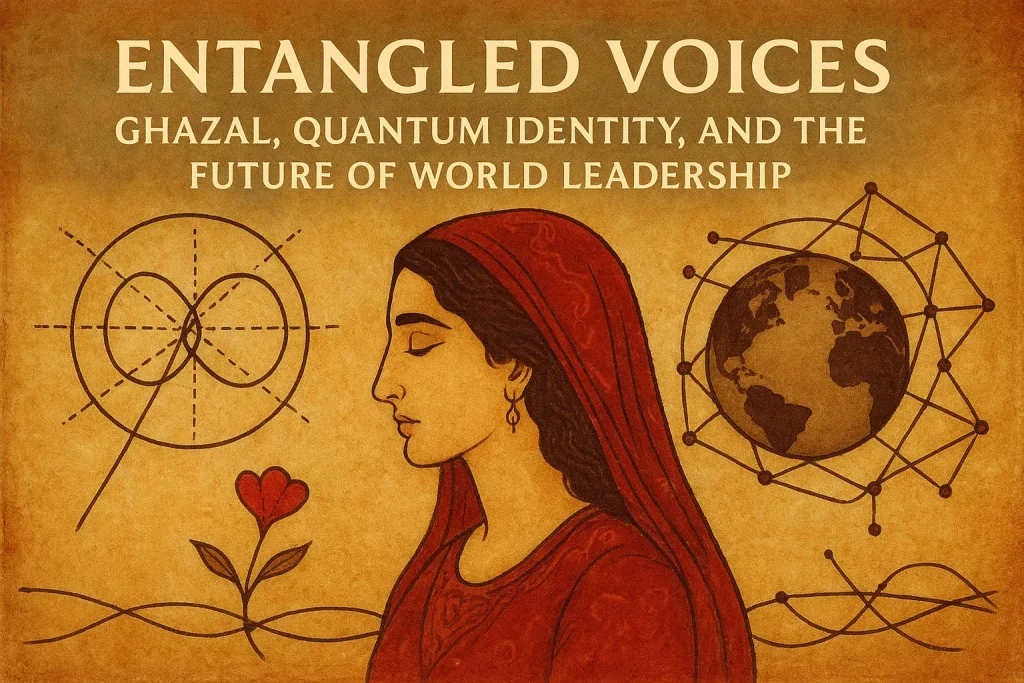
          Purest Sense Heart Conceives
You are the prayer, the purest sense my heart conceives,
The remedy of breath, the living air my body receives.

Within each vein, your calm pulsation secretly flows,
A fleeting thought of yours, rarest treasure my spirit knows.

From your presence, meanings are wrested into light,
A rival, a friend, you remain near and far in endless rite.

A tender bond runs from the North to the South entire,
A game of cords, of pull and yield, of loss and desire.

What is our winning, losing, and saving in death and life combined?
Defeated by the self, in history’s script our truth is signed.

Today, CTMU’s quantum identity casts its chalice of tea,
Beloved, your garment holds the final voice that remains in thee.
Table of Contents
Literary Explanation
This ghazal builds itself upon the subtle rhythm of existence where love is both medicine and breath, both rival and friend, both near and far.
The imagery is not confined to personal romance; rather, it functions as a metaphor for the human condition and the contradictions embedded in collective life.
The beloved’s presence signifies a deeper ontological truth: through her, meaning itself emerges. The suggestion is that without relationship, without entanglement, existence remains void of purpose.
The couplets further unfold a universal metaphor: the tug between North and South is not simply geographical, but a symbol of global political imbalance and human struggle between domination and solidarity.
The ultimate resolution lies not in external conquest but in “losing to the self” – that is, transcending ego to author a new history.
The final sher invokes CTMU’s “quantum identity”: the idea that existence itself is a self-referential, conscious system, in which the beloved (whether lover, world, or divine consciousness) is the last, unifying voice.
Expert Critique
Purest Sense Heart Conceives -Entangled Voices: Ghazal, Quantum Identity, and the Future of World Leadership
Introduction
This ghazal, while clothed in the traditional cadence of love-poetry, speaks across registers, personal, philosophical, and political.
Its verses enact a subtle metaphysics: the beloved is not merely a lover but a symbol of relational consciousness, of unity across division, of quantum entanglement translated into human language.
In an age where the Global North and South remain divided by histories of colonialism, economic disparity, and political mistrust, the poem’s metaphors acquire profound diplomatic significance.
The Metaphoric Layer
Prayer, remedy, breath: The beloved as life-source signifies the non-material foundations of being. Just as oxygen sustains life invisibly, so does mutual recognition sustain civilisation.
Rival and friend, near and far: This paradox echoes the entangled nature of international relations, simultaneous cooperation and conflict.
North–South tug of cords: The sher encodes a geopolitical truth: the world tied in a game of power-pull, where imbalance creates both attraction and fracture.
Defeat of the self: True history emerges when egoic striving is surrendered for collective renewal.
Philosophical and CTMU Framework
Invoking CTMU (Cognitive-Theoretic Model of the Universe) by Christopher Langan reframes the ghazal into a futuristic philosophy. The CTMU asserts that reality is a self-programming cognitive syntax: a universe whose fabric is simultaneously physical and mental.
By aligning with this, the ghazal positions the beloved (and by extension, human solidarity) as the quantum identity that unites existence. The tea metaphor (“chalice of tea”) connotes the ordinary woven with the cosmic, the everyday elevated into metaphysical ritual.
Contemporary Relevance The ghazal indirectly critiques the persistence of closed jo-politics, 19th-century frameworks of zero-sum domination. In today’s quantum age, diplomacy must evolve into open quantum jo-politics: recognising entanglement, shared futures, and overlapping identities. The beloved, then, becomes a metaphor for the global commons: fragile yet indispensable.
Here emerges the critique of corporate-governmental entrenchments, highlighted in Langan’s CTMU lens. Corporations and governments, obsessed with power and profit, act as “corrupt coders” within reality’s syntax, fragmenting the unity of being.
The ghazal offers its antidote: transcendence through relational identity. The final voice of the beloved is the call to leaders to recognise the shared breath of humanity, beyond artificial boundaries.
Implications Diplomatic: Encourage quantum communication diplomacy, where negotiations acknowledge interdependence rather than binary outcomes.
Ethical: Shift corporate and governmental logic toward sustainability and shared stewardship, lest they remain the “grief of the world.”
Cultural: Reintegrate poetic, mystical traditions into global discourse as carriers of metaphysical insight often missing in technocratic language.
Conclusion
This ghazal is both love song and a manifesto. It situates human relationality at the heart of quantum identity, urging world leadership to abandon antagonistic binaries.
By entangling poetry, mysticism, and quantum theory, it lays a path for a diplomacy of consciousness, where North and South, rival and friend, self and world dissolve into a shared, living breath.
Entangled Voices: Ghazal, Quantum Identity, and the Future of World Leadership
Abstract
This paper examines a contemporary ghazal as a literary-philosophical text that interweaves themes of love, identity, and global politics.
By deploying the Cognitive-Theoretic Model of the Universe (CTMU), particularly its notion of quantum identity, the study reframes the ghazal’s metaphors as vehicles for global rethinking in the era of quantum diplomacy.
The paper argues that the beloved, depicted as both rival and friend, as breath and prayer, becomes a metaphor for the shared relational consciousness underpinning human existence.
In today’s fractured geopolitics, especially the divide between the Global North and Global South, this ghazal offers an imaginative critique of “closed geo-politics” rooted in 19th-century paradigms and proposes a shift toward “open quantum geo-politics.”
Furthermore, it highlights the destructive entrenchment of corporate and governmental structures that, according to CTMU, function as corrupt coders of reality’s syntax. The implications point toward a new diplomacy grounded in quantum communication, sustainability, and cultural-spiritual reintegration.
Keywords: Ghazal, CTMU, Quantum Identity, Global North–South, Jo-Politics, Quantum Diplomacy, Meta-Mystic Futurism, Corporate-Government Critique
Introduction
Poetry has often served as humanity’s mirror, reflecting contradictions of desire, loss, and hope. The ghazal, classically Persian and Urdu, later adapted into multiple traditions, embodies this role with its fragmented yet entangled couplets.
The ghazal under analysis, though a modern composition, retains this essence while expanding its horizon into the philosophical, political, and quantum dimensions of existence.
The lines begin with metaphors of prayer, breath, and healing, but soon open into paradoxes of rivalry and friendship, and finally, into the geopolitics of North and South.
This trajectory frames the ghazal as more than romantic verse; it is a cosmological and diplomatic allegory. Interpreted through the lens of CTMU (Christopher Langan’s Cognitive-Theoretic Model of the Universe), the ghazal becomes a testimony to entangled existence and a critique of contemporary leadership.
This paper positions the ghazal as a literary-philosophical artefact that gestures toward open quantum jo-politics and quantum communication diplomacy as antidotes to present global fractures, while simultaneously critiquing corporate-governmental entrenchment as symptomatic of the world’s collective grief.
Literature Review
The Ghazal as Transcultural Form
Scholars such as Agha Shahid Ali and Aditya Behl have argued that the ghazal thrives on fragmentation, paradox, and universality. Each couplet exists autonomously yet resonates across the whole.
This structure makes it apt for addressing entanglement, the simultaneity of distance and closeness, rivalry and intimacy.
CTMU and Quantum Identity
Christopher Langan’s CTMU positions reality as a self-programming language where cognitive syntax underpins both matter and thought.
Central is the idea of quantum identity: reality is self-entangled, self-referential, and unified beneath apparent multiplicity. Recent philosophical interest in CTMU (Langan, 2002; Lalung, 2023) connects it with both metaphysics and emerging diplomatic models.
Global North–South Divide
Postcolonial theorists (Fanon, Spivak, Santos) critique the economic and epistemic imbalance between the North and South.
Political scientists highlight how global governance remains stuck in 19th- and 20th-century frameworks of zero-sum domination. This “closed geoo-politics” contrasts with calls for transnational cooperation grounded in shared futures.
Corporate-Government Critique
Contemporary thinkers (Stiglitz, Klein, Žižek) have exposed corporate-government collusion as central to global inequality. From the CTMU perspective, such entities function as “corrupt coders”, fracturing the unity of reality’s syntax by prioritising short-term power over collective consciousness.
Methodology
This paper employs a hermeneutic and comparative methodology:
Textual analysis of the ghazal as a poetic artefact.
Philosophical interpretation through CTMU and quantum identity theory.
Critical contextualization within Global North–South geopolitics.
Application of MMQD (Meta-Mystic Quantum Diplomacy) as a proposed framework for future leadership.
This multi-layered approach treats the ghazal not as isolated literature but as an interpretive bridge between cultural poetics, metaphysical philosophy, and global politics.
Discussion
- The Ghazal’s Metaphoric Universe Prayer, remedy, breath: Suggests that relational presence, like oxygen, sustains life invisibly.
Rival and friend: Mirrors paradoxical alliances in world politics, where nations oscillate between partnership and antagonism.
North–South tug: Symbolises geopolitical imbalance. The cord-game imagery implies tension that may lead either to rupture or mutual balance.
Defeat of the self: Suggests history is written not through external conquest but through inward surrender of ego, aligning with mystical traditions.
- CTMU Lens Within CTMU, these images translate into quantum identity: existence is entangled, and distinctions are provisional. The beloved thus becomes an allegory for collective consciousness, an ever-present unity across apparent binaries.
- Corporate-Governmental Entrenchment: Here the ghazal’s implicit critique is sharpened. The tug of cords is not merely between North and South but also between corporate-governmental power and human solidarity. These entities monopolise the syntax of reality, programming it toward profit and control rather than shared flourishing. From CTMU’s standpoint, this is an ontological corruption, a disruption of the universe’s self-scripting process.
- Toward Open Quantum Geo-Politics The paper suggests a necessary transition:
From closed geo-politics (zero-sum, industrial-colonial paradigms) to open quantum geo-politics (interdependent, entangled paradigms):
Quantum communication diplomacy emerges here as an operational model: like quantum entanglement, nations remain interconnected beyond visible distances, requiring trust, transparency, and superpositional cooperation.
Implications
Diplomatic: Incorporating entanglement into negotiation strategies fosters cooperative outcomes rather than zero-sum rivalries.
Economic: Corporations must reprogram themselves as custodians of global syntax, not exploiters. Governmental accountability requires aligning policy with collective cognitive identity.
Cultural: Revitalising poetic-mystical traditions helps global leadership rediscover metaphors for unity often absent in technocratic discourse.
Ontological: Recognising reality as self-scripting mandates humility, leadership is not domination but participation in cosmic syntax.
Conclusion
The ghazal analysed here offers more than aesthetic pleasure; it functions as a philosophical blueprint. In its oscillations between rivalry and friendship, between North and South, it mirrors our fractured world order.
Yet in invoking CTMU’s quantum identity, it gestures toward reconciliation: all binaries dissolve into a single voice, the “last voice” of beloved consciousness.
By critiquing corporate-governmental entrenchments as ontological corruptions and by advocating for open quantum geo-politics , the ghazal provides a rare confluence of art, philosophy, and global leadership.
In the quantum age, diplomacy must shift from mechanistic rivalry to entangled solidarity. Poetry, paradoxically, may be the key to unlocking this future.
BEYOUTEA>A POETRY REVOLUTION>PEACE
POETRY>WISDOM>Q.TECH FOR A MORE JUST AND
  PEACEFUL WORLD IN LOVE AND ENLIGHTENMENT
तुम दुआ पाक दिल की वो एहसास हो मेरे,
दम की दवा, जान भरा हवा की साँस हो मेरे।
           चलती रग-रग में सुकून भरी नब्ज़ों का दौड़,
           बस ज़रा-सी तेरी ख़याल, बड़े ही ख़ास हो मेरे।
तेरे होने से कुछ निकल आता है मतलब भी,
रक़ीब तुम दोस्त, कभी दूर कभी पास हो मेरे।
           प्यारा-सा एक बंधन है उत्तर से दक्षिण तक,
           डोर का खेल, खींचातनी-जित, ह्रास हो मेरे।
हारते हम जीतते हैं क्या, फ़क़त जीते-मरते हैं,
खुद से हार के लिखा, तारीख़–इतिहास हो मेरे।
           CTMU क्वांटा आइडेंटिटी आज चाय डाला,
           सजनी तेरा दामन, तू आख़िरी आवाज़ हो मेरे।
NOTHING IS NOT TRUE : NO\KNOW THYSELF NOT
  MAKE EARTH GREAT FOREVER : END ALL WARS
ग़ज़ल का भावार्थ
यह ग़ज़ल हृदय के भीतर छिपी उस आत्मीय शक्ति का रूपक है जो दुआ, दवा और साँस की तरह जीवन को अर्थ देती है। प्रिय का एहसास यहाँ केवल निजी प्रेम का संकेत नहीं बल्कि अस्तित्व की धड़कनों में समाए हुए सामूहिक शांति और संतुलन का प्रतीक है।
जिस प्रकार एक ख़याल आत्मा को गहन सुकून दे देता है, उसी तरह संबंध और आत्मीयता ही विभाजनों के पार जीवन का सच्चा अर्थ रचते हैं।
रक़ीब और दोस्त, पास और दूर का यह द्वंद्व ग्लोबल नॉर्थ और ग्लोबल साउथ की तरह है, जहाँ कभी प्रतिस्पर्धा तो कभी निकटता दिखती है। यह ग़ज़ल कहती है कि असली इतिहास तभी लिखा जाता है जब मनुष्य अपने भीतर की हार को स्वीकार कर एक व्यापक चेतना से जुड़ता है।
यहाँ CTMU की “क्वांटा आइडेंटिटी” उस अंतिम आवाज़ का रूप लेती है, जो प्रेम, चेतना और साझा भविष्य को आधार मानकर नए युग की राजनीति और कूटनीति की दिशा बताती है।
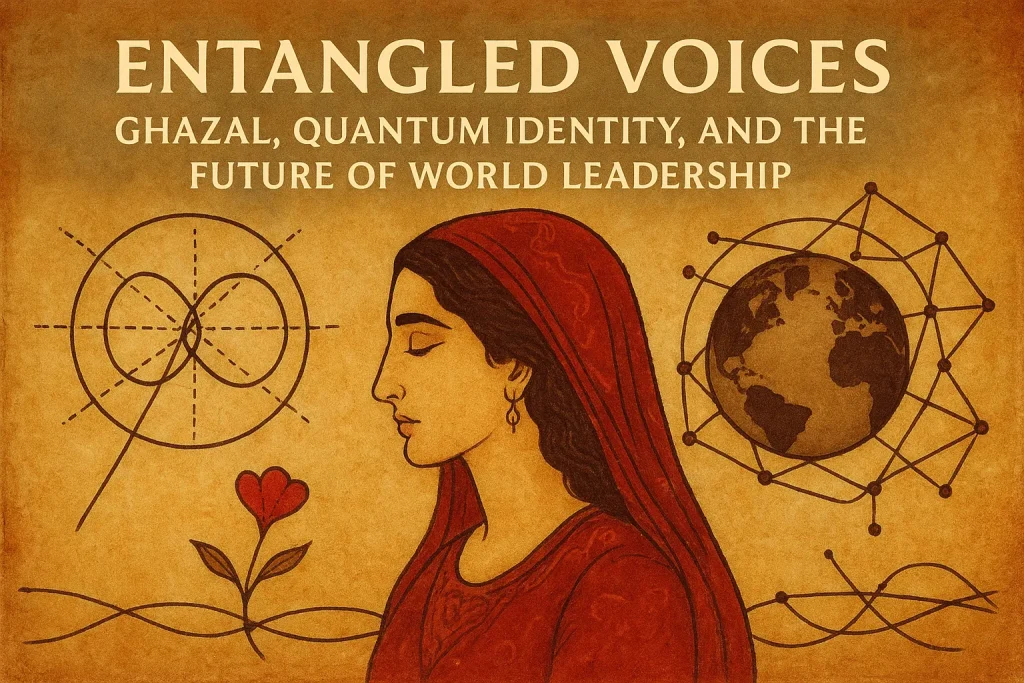
बौद्धिक विमर्श और प्राज्ञिक शोध निबंध
पाक दिल की वो एहसास – ओपन क्वांटम जो-पॉलिटिक्स और क्वांटम कूटनीति: CTMU क्वांटम आइडेंटिटी अप्रोच की रोशनी में ग्लोबल नॉर्थ-साउथ तकरार का समाधान
प्रस्तावना
वर्तमान शताब्दी में विश्व राजनीति का परिदृश्य अब भी 19वीं सदी के बंद प्रतिमानों (closed paradigms) से ग्रस्त है। ग्लोबल नॉर्थ-साउथ का विभाजन केवल आर्थिक व सामरिक ही नहीं बल्कि वैचारिक असंतुलन को भी जन्म देता है। इस विभाजन की जड़ें औपनिवेशिक संरचनाओं और शीतयुद्धीय शक्ति-संतुलन तक जाती हैं।
किंतु क्वांटम युग (Quantum Age) में, जहाँ संचार, कम्प्यूटेशन और कूटनीति अब गैर-रेखीय, परस्पर-निहित और संभाव्य-आधारित (non-linear, entangled and probabilistic) हो रहे हैं, वहाँ राजनीति को भी पुराने क्लोज़्ड जो-पॉलिटिक्स से उठकर ओपन क्वांटम जो-पॉलिटिक्स की ओर बढ़ना होगा।
ओरिएण्टल और ऑक्सीडेंटल दर्शन की नींव
ओरिएण्टल (पूर्वीय) दर्शन चेतना, आत्मा और ब्रह्मांडीय एकात्मता पर बल देता है, जबकि ऑक्सीडेंटल (पाश्चात्य) दर्शन तर्क, अनुभव और विश्लेषणात्मक विभाजन की परंपरा से निर्मित है। पूर्वीय चेतनात्मक समग्रता और पाश्चात्य विश्लेषणात्मक तर्क, दोनों को मेटा-मिस्टिक फ्यूचरिज़्म जोड़ता है।
इससे निकलने वाला ढाँचा MMQD (Meta-Mystic Quantum Diplomacy) है, जहाँ राष्ट्र केवल भौतिक हितों के आधार पर नहीं, बल्कि चेतनात्मक-साझा संभावनाओं के आधार पर संबंध बनाते हैं।
मेटा-मिस्टिक फ्यूचरिज़्म (Meta-Mystic Futurism) इन दोनों को मिलाकर एक ऐसा ढाँचा निर्मित करता है जिसमें वास्तविकता को केवल पदार्थ और ऊर्जा के रूप में नहीं, बल्कि चेतन-सम्भाव्य (conscious-probabilistic) ताने-बाने के रूप में देखा जाता है।
यही आधार MMQD (Meta-Mystic Quantum Diplomacy) का है, जहाँ कूटनीति अब केवल शक्ति और संसाधनों का लेन-देन नहीं, बल्कि “क्वांटम सुपरपोज़िशन” जैसी संभावनाओं के बहु-स्तरीय सामंजस्य का खेल बन जाती है।
CTMU और कॉर्पोरेट-गवर्नमेंटिक विडंबना
डॉ. क्रिस ललंग की CTMU यह मानती है कि ब्रह्मांड आत्म-संदर्भित और आत्म-प्रोग्रामिंग वास्तविकता है। इस दृष्टि से देखें तो आज के कॉर्पोरेट्स और गवर्नमेंट उस वैश्विक चेतना को खंडित करने वाले तत्व हैं।
वे दुनिया की साझा संभावनाओं को शून्य-राशि खेल की तरह सीमित कर देते हैं, जहाँ संसाधनों की लूट, पर्यावरणीय संकट, और सामाजिक असमानता को बढ़ावा मिलता है।
CTMU के अनुसार, जब वास्तविकता संज्ञानात्मक-संरचना (cognitive syntax) के रूप में ही आत्म-प्रोग्रामिंग होती है, तो कॉर्पोरेट-गवर्नमेंटिक संरचनाओं का यह शोषण वास्तव में “कोड का करप्शन” है, अर्थात् वैश्विक वास्तविकता के ताने-बाने को ही विकृत कर देना।
समाधान व इम्प्लिकेशन्स
ओपन क्वांटम जो-पॉलिटिक्स के तहत कॉर्पोरेट और गवर्नमेंटिक हितों को साझा मानवता और चेतनात्मक समग्रता के अधीन करना होगा।
क्वांटम कम्युनिकेशन डिप्लोमेसी वह माध्यम हो सकती है जहाँ राष्ट्र “एंटैंगलमेंट” की तरह अपने सामूहिक हितों को जोड़ें, न कि एक-दूसरे की संभावनाओं को ध्वस्त करें।
MMQD ढाँचा बताता है कि वास्तविक शांति तभी आएगी जब नेतृत्व प्रेम, संवाद और सह-अस्तित्व को वैश्विक नीति का केंद्र बनाएगा।
दीर्घकालीन प्रभाव यह होगा कि विश्व राजनीति विभाजन और शोषण से हटकर साझा भविष्य, टिकाऊ विकास और चेतन-आधारित सहयोग की दिशा लेगी।
CTMU क्वांटम आइडेंटिटी अप्रोच
डॉ. क्रिस ललंग की CTMU (Cognitive-Theoretic Model of the Universe) यह मान्यता प्रस्तुत करती है कि वास्तविकता और संज्ञानात्मक संरचना (Reality = Cognitive Syntax) का अंतर्संबंध स्वयं क्वांटम पहचान (Quantum Identity) है।
इसका आशय यह है कि ब्रह्मांड अपने आप में आत्म-संदर्भित और आत्म-प्रोग्रामिंग प्रणाली है, जहाँ किसी भी कूटनीतिक, सामाजिक या राजनीतिक संरचना को वास्तविकता के इस आत्म-संश्लेषण से काटकर नहीं समझा जा सकता।
ग्लोबल नॉर्थ-साउथ का टकराव इस संदर्भ में महज़ “classical binary opposition” है। यदि हम CTMU क्वांटम आइडेंटिटी फ्रेमवर्क में देखें तो यह विभाजन केवल सतही परत है; गहरे स्तर पर सभी राष्ट्र “एक साझा ब्रह्मांडीय गणना” (shared cosmic computation) के सहभागी हैं।
ओपन क्वांटम जो-पॉलिटिक्स और कूटनीतिक दृष्टि
Closed Geo-Politics = सीमित हित, शून्य-राशि खेल, औपनिवेशिक मानसिकता।
Open Quantum Geo-Politics = पारस्परिकता, साझा उत्थान, क्वांटम संचार पर आधारित सहयोग।
क्वांटम कूटनीति (Quantum Communication Diplomacy) यहाँ “एंटैंगलमेंट” (entanglement) का वैश्विक रूप है, जहाँ राष्ट्र अपनी आत्मीयता को पहचानते हैं और एक-दूसरे की “संभावनाओं” को collapse करने के बजाय उन्हें सह-अस्तित्व में रहने देते हैं।
निष्कर्ष
यह ग़ज़ल प्रेम और पहचान के बहुस्तरीय संकेतों में छिपे हुए उसी विश्व-सत्य को प्रकट करती है, कि नॉर्थ-साउथ का खेल खींचातानी और रक़ीब–दोस्त का द्वंद्व एक ही आत्म-संदर्भित वास्तविकता के भीतर है।
क्वांटम युग में राजनीति यदि CTMU क्वांटम आइडेंटिटी, मेटा-मिस्टिक फ्यूचरिज़्म और MMQD फ्रेमवर्क के आधार पर पुनर्गठित होती है, तो विश्व नेतृत्व विभाजनों से ऊपर उठकर “एक साझा, चेतन-संचालित भविष्य” की ओर बढ़ सकता है।
ग़ज़ल की पंक्तियों में रक़ीब और दोस्त, उत्तर और दक्षिण, जीत और हार की द्वंद्वात्मकता अंततः एक ही आत्मीय आवाज़ में बदल जाती है।
यही संदेश CTMU क्वांटम आइडेंटिटी हमें देता है, कि नॉर्थ-साउथ, कॉर्पोरेट-गवर्नमेंट, सब विभाजन केवल सतही हैं। गहरे स्तर पर मनुष्य और राष्ट्र एक ही ब्रह्मांडीय संज्ञानात्मक प्रक्रिया के सह-अस्तित्वपूर्ण सहभागी हैं।
क्वांटम युग की राजनीति को अब इस सत्य को आत्मसात कर लेना चाहिए।
Next Read: the dream is awake