


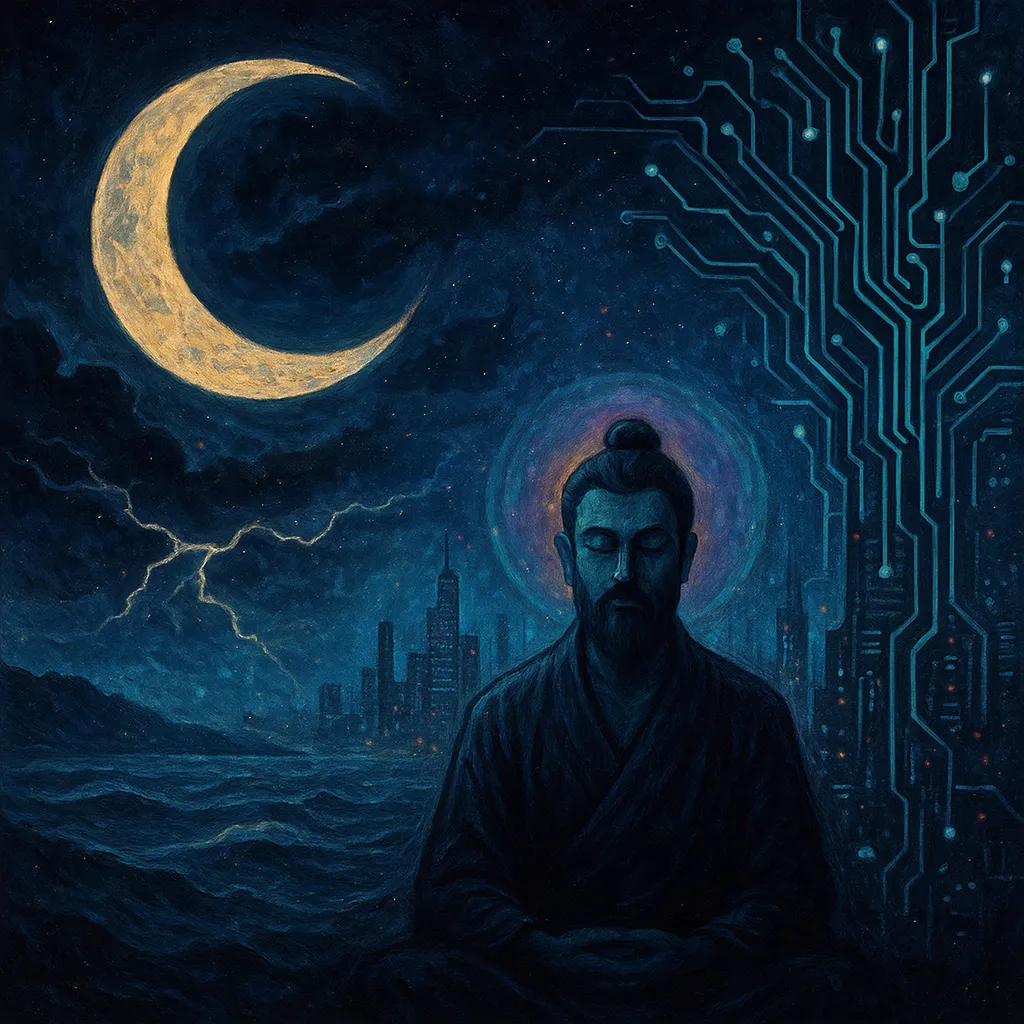
            Night Lies Lost in Slumber
Awake is the dream, while night lies lost in its slumber,
Dark light weeps in shadows, a vanished luminescent wonder.

You, O silent moon, unveil so many veiled arts,
In ocean’s drowning waves, a sown ripple lost in its blunder.

Between heart and liver, some whisper yet remains,
Words woven in feelings, dissolved in silence yonder.

Though we reach now beyond the bounds of the cosmos,
Peace itself rages, a riot staged as thunder.

In veins the blood runs, in neural cords the lightning,
BCI quantum magic, enshrouded, hidden under.

Alone I remain, while all cry “God, God” in echo,
Yet a strange tea of difference brews, apart, a solitary wonder.
Table of Contents
Literary Academic Explanation
This ghazal embodies a profound paradox of existence where dream and wakefulness, light and shadow, peace and chaos intermingle in a liminal zone of lived reality.
The first couplet sets the tone with its paradoxical imagery, the dream is awake while the night lies lost, capturing the limbo between rational consciousness and metaphysical unknowing.
Light itself is portrayed as mourning, suggesting that illumination cannot exist without the weeping shadow of obscurity.
The moon, rendered silent yet skilful, mirrors human consciousness itself, silent in its essence, yet expressive through waves that rise and fall in the ocean of being.
Dialogue between the “heart and liver” reflects classical Indic-Persian poetics, where liver symbolises courage and passion, and heart symbolises love and sentiment.
Words are not mere utterances but threads of woven feeling, hinting at communication that transcends rational speech.
The ghazal then transits into cosmic scale: despite reaching beyond the universe, humanity finds peace to be no longer serene, but disruptive, a spectacle of unrest.
The imagery of “blood and lightning in the veins” introduces contemporary scientific metaphors, echoing the entanglement of biology and technology through BCI (Brain-Computer Interface) and quantum cognitive physics.
The final couplet offers a haunting solitude: though all chant “God,” true divinity appears estranged, a solitary tea of difference shared with none, emphasising alienation amidst collective religiosity.
Expert Explanation and Contemporary Implications
This ghazal’s architecture is not only lyrical but deeply philosophical, standing at the intersection of metaphysics, mysticism, and technoscience. At one level, it invokes the classical ghazal’s tropes of solitude, loss, and metaphysical yearning.
At another, it refracts these motifs through the prisms of modern scientific imagination, neuroscience, quantum physics, and BCI research. Thus, it functions simultaneously as traditional poetic meditation and as speculative futurology.
The paradox of “peace as riot” resonates with our contemporary global social process. In an age where international systems claim peace yet enact perpetual surveillance, militarism, and simulated harmony, “peace” itself becomes a violent performance.
This recalls Jean Baudrillard’s notion of simulation, where the sign of peace replaces its essence. The ghazal rightly captures this inversion, illumination hidden, truth buried in layers of technological spectacle.
Moreover, the invocation of BCI quantum magic situates the ghazal firmly within a discourse of cognitive capitalism and neuro-technical futures. When blood (the biological) and lightning (the technological) fuse, humanity crosses into a liminal posthuman state.
Yet the poem’s Eastern undertone, the dialogue of heart and liver, the solitary difference, suggests that spiritual grounding is necessary. Without the wisdom of Kshatriya dharma and Eastern vidyā, the technological future risks becoming a battlefield of domination rather than a sanctuary of harmony.
In the contemporary world, this ghazal warns of two dangers: first, that truth and illumination may remain forever buried under the weight of systemic power and technological opacity; second, that human solitude and alienation may deepen even as connectivity grows.
It simultaneously offers a path: a synthesis of mystical consciousness with quantum cognitive science, and a re-grounding of technoscience in ethical, spiritual frameworks. Thus, the ghazal transcends its poetic form, standing as a cultural critique and a vision statement for the uncertain epoch ahead.
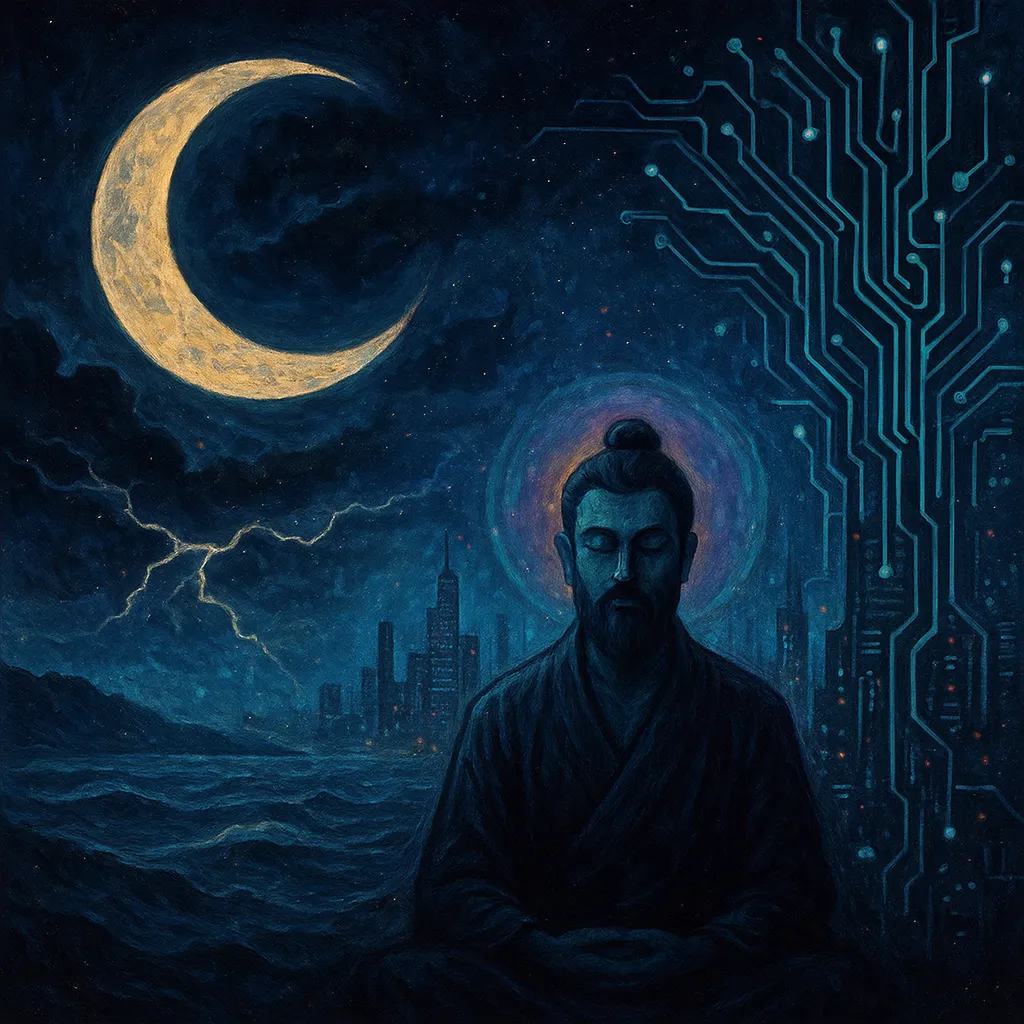
Night Lies Lost in Slumber – Buried Light, Quantum Consciousness, and the World-System: An Academic Critique of a Contemporary Ghazal
Abstract
This article examines a contemporary ghazal that interlaces traditional poetics with futuristic imagery of brain-computer interfaces (BCI), quantum cognitive physics, and metaphysical solitude.
Through a paradoxical language of “weeping light,” “peace as riot,” and “blood with lightning,” the ghazal articulates both the promise and peril of human civilisation’s entanglement with technology.
This essay analyses the ghazal’s literary dimensions, its symbolic richness, and its philosophical implications, while situating it within contemporary global processes.
It argues that the poem’s vision is not merely lyrical but also prophetic: it warns of a future where truth remains buried under layers of simulation, where peace becomes a performance, and where human alienation persists amidst technological transcendence.
Finally, it proposes that only a synthesis of Eastern spiritual vidyā and technoscientific advancement can prevent humanity from collapsing into a cybernetic dystopia.
Introduction
The ghazal as a literary form has historically functioned as a vehicle of metaphysical yearning, solitude, and the paradox of love and loss. In its modern re-imagining, however, the ghazal may also serve as a mirror for civilizational anxieties in the age of artificial intelligence, quantum computation, and neuro-technical interventions.
The poem under study opens with a dream paradoxically awake while night lies lost, staging an atmosphere of liminality that continues throughout. It employs tropes both classical (the silent moon, the dialogue between heart and liver) and futuristic (BCI quantum magic, electricity in the veins) to articulate the human condition in transition between mystical past and cybernetic future.
Thematic Architecture of the Ghazal:
The Liminality of Dream and Light
The opening couplet establishes an epistemic paradox: illumination itself mourns in shadow. Knowledge is never fully transparent; truth emerges as both presence and absence.
This resonates with apophatic traditions in mysticism and with postmodern critiques of representation, where every act of illumination casts its own shadow.
Cosmic Reach and the Riot of Peace:
Later verses extend the imagery into cosmic scale, where humanity reaches “beyond the bounds of the cosmos,” yet peace appears as disorder.
This paradox critiques the contemporary world-system, where claims of global peace (through diplomacy, deterrence, or development) are performed amidst actual conditions of violence, inequality, and ecological breakdown. Here, peace functions as simulacrum, a sign that replaces reality without embodying it.
Blood, Lightning, and Quantum Mind
The metaphor of blood and lightning signals the fusion of the organic and the machinic, evocative of both BCI and quantum cognitive physics.
The human body becomes a site of technological inscription, where cognition is no longer purely biological but hybridized with computational flows. This reflects the trajectory of cognitive capitalism, where attention, memory, and thought itself are subjected to technological mediation.
Solitude Amidst the Cry of God
The ghazal closes with profound alienation: though the collective chants “God,” the speaker remains alone, sipping a solitary “tea of difference.” This image underscores a crucial social paradox, mass religiosity or collective ideology does not guarantee authentic spiritual communion. Instead, individuality risks estrangement in the very moment of collective transcendence.
Contemporary Social and Philosophical Implications:
Simulation of Peace and Global Order
The poem’s depiction of peace as riot mirrors the functioning of contemporary international systems. Institutions that promise stability often enact perpetual states of exception, whether through wars on terror, economic sanctions, or militarised peacekeeping.
The ghazal thereby echoes Baudrillard’s theory of hyperreality: the sign of peace proliferates while its lived experience diminishes.
Technological Futures and the BCI-Quantum Nexus
The imagery of BCI and quantum physics situates the poem at the forefront of speculative futurism. BCI technologies already blur the line between mind and machine, raising questions of autonomy, privacy, and consciousness.
Quantum cognitive physics pushes this further, suggesting that human thought may itself operate in superpositional or entangled states. The poem frames this as both magical and dangerous: a potential emancipation of human cognition, yet also its capture by technocratic and military regimes.
Eastern Vidyā as Grounding Principle
While the ghazal does not explicitly invoke Eastern philosophies, its symbolic reference to the “heart and liver” recalls Indic-Persian traditions where body, spirit, and cosmos interweave.
This suggests that technoscientific advancement must be grounded in vidyā, a wisdom tradition that integrates ethics, self-discipline, and spiritual depth. Without this grounding, technological futures risk replicating domination and alienation.
In the frame of Kshatriya dharma, true strength is inseparable from justice and restraint, principles urgently needed in a cybernetic epoch.
Toward a Meta-Mystic Futurism
The ghazal thus inaugurates what may be termed a meta-mystic futurism: a vision where mysticism and quantum cognition are not opposed but dialogically interwoven. Against the dystopian horizon of cyberpunk, where peace is simulated and humans become cyborgian fragments, the ghazal insists on solitude, reflection, and the recognition of hidden truth. Its paradoxes are not failures of expression but philosophical strategies, inviting readers to hold opposites, illumination and shadow, peace and riot, science and spirit, within a single field of contemplation.
Conclusion
The ghazal under study transcends lyricism to stand as a cultural critique of the twenty-first century. It warns that truth and peace may remain perpetually buried beneath the performances of power and the spectacles of technology.
It also intimates that without spiritual and ethical grounding, BCI and quantum science will become instruments of alienation rather than enlightenment. Yet it offers hope: by weaving together the mystical depth of Eastern vidyā with the cognitive horizons of quantum science, humanity may recover the lost illumination.
The poem is thus not merely aesthetic but prophetic, urging us to imagine a world-system where knowledge serves not domination but the flowering of human consciousness.
BEYOUTEA>A POETRY REVOLUTION>PEACE
NOTHING IS NOT TRUE : NO\KNOW THYSELF NOT
             MAKE EARTH GREAT FOREVER
जगा हुआ सपना है, रात सोई हुई कहीं खोई,
काला उजाला अंधेरों में रोई हुई कहीं खोई।
           एक चाँद है तू गुमसुम, कितने हुनर दिखती,
           डूबती समंदर में लहर बोई हुई कहीं खोई।
दिल जिगर के दरमियाँ कुछ बात होती रहे,
बातों को एहसासों में पिरोई हुई कहीं खोई।
           यूँ तो पहुँचे अब हम हैं कायनात के पार भी,
           अमन है वारदात सा मचाई हुई कहीं खोई।
रगों में दौड़ते खून, दिमागी नसों में बिजली,
बीसीआई क्वांटम जादू छाई हुई कहीं खोई।
            एक ही अकेला हूँ, हर कोई खुदा खुदा करे,
            थोड़ी जुदा चाय आज भाई हुई कहीं खोई।
LET'S GOODNESS A CHANCE : END ALL WARS
POETRY>WISDOM>Q.TECH FOR A MORE JUST AND
PEACEFUL WORLD IN LOVE AND ENLIGHTENMENT

वाङ्ग्मयिक भाव विस्तार
यह ग़ज़ल एक स्वप्नवत् अनुभूति की आभा से आरंभ होती है, “जगा हुआ सपना” उस जीवन-सत्य का रूपक है जो जागरण और निद्रा दोनों के बीच किसी मध्यवर्ती क्षेत्र में अटका हुआ है। “काला उजाला अंधेरों में रोई हुई कहीं खोई”, यहाँ कवि ने विरोधाभासी यथार्थ (paradoxical reality) का आलंकारिक चित्रण किया है। अंधकार में उजाला भी रोता है, और इस रोने की प्रक्रिया स्वयं चेतना की विडंबना को प्रकट करती है।
दूसरे शेर में “एक चाँद” के मौन और “डूबती लहर” के बीज बोने का रूपक आत्मा और प्रकृति की उस रहस्यमयी साझेदारी को उद्घाटित करता है जहाँ मौन भी एक सृजनात्मक क्रिया बन जाता है। आगे “दिल जिगर के दरमियाँ” की बातें भावनाओं और बोध के गहन संलयन का आभास देती हैं, जो केवल वाणी से नहीं, बल्कि अनुभव से बुनी जाती हैं।
आगे कवि ब्रह्मांडीय यात्रा की ओर संकेत करता है, “कायनात के पार भी पहुँचे”, परंतु वहाँ भी ‘अमन’ एक वारदात की तरह मचा हुआ है। शांति भी अब घटनात्मक शोर है, एक विद्रूप वास्तविकता। बीसीआई (Brain-Computer Interface) और क्वांटम जादू का बिंब यह दिखाता है कि मनुष्य की नसों और रगों में बहता खून और बिजली अब केवल जैविक नहीं, बल्कि तकनीकी-वैज्ञानिक भी हो चुके हैं।
अंतिम शेर में कवि अपनी आत्मिक अकेलेपन को उजागर करता है, जहाँ लोग सब “खुदा खुदा” करते हैं, पर वास्तविकता में सत्य की चाय अलग-सी, अलग स्वाद लिए अकेली रह जाती है।
मेटा-मिस्टिक फ्यूचरिज़्म और साइबरपंक दृष्टिकोण
इस ग़ज़ल को यदि meta-mystic futurism की फ्रेम में पढ़ा जाए, तो यह कविता न केवल एक व्यक्तिगत आत्मस्वर है, बल्कि एक चेतावनी और उद्घोषणा भी है। साइबरपंक भविष्य-दृष्टि के अनुसार, जब कृत्रिम बुद्धिमत्ता, BCI (Brain-Computer Interface), और क्वांटम कॉग्निटिव फिज़िक्स हमारे तंत्रिका-तंत्र और मानसिक संरचना का हिस्सा बन जाते हैं, तब ‘सत्य’ और ‘वास्तविकता’ की परिभाषाएँ स्थायी नहीं रह पातीं। कविता में जो अंधेरा रो रहा है और उजाला भी उस रोने में खो रहा है, वह इस बात का संकेत है कि ज्ञान का प्रकाश हमेशा सत्ता-संरचनाओं, तकनीकी पूँजी, और युद्धनीति की परछाइयों में दबा रहता है।
पूर्वीय क्षात्रेय शस्त्र-विद्या का बोध यहाँ आवश्यक है। पश्चिमी साइबरनेटिक्स और पूर्वीय योगविद्या दोनों का संगम ही इस अराजक भविष्य को दिशा दे सकता है। जहाँ BCI-Quantum कॉग्निटिव विज्ञान चेतना की नयी मशीनी मिमांसा देता है, वहीं पूर्वीय विद्या आत्मिक और धर्मनीति का ग्राउंडिंग उपलब्ध कराती है। कवि का ‘अमन’ एक वारदात की तरह मचा होना इसी विडंबना का उद्घाटन है, विश्व प्रणाली (world system) में शांति अब वास्तविक न होकर केवल एक सिम्युलेशन है, एक hyperreal peace.
प्राज्ञिक आलोचनात्मक विवेचना (निबंध संरचना में)
भूमिका: इस ग़ज़ल का कथानक आत्मिक-मानवीय अनुभूतियों और समकालीन विश्व-विज्ञान के बीच गहन संवाद को प्रस्तुत करता है। यह केवल काव्यिक अभिव्यक्ति नहीं, बल्कि दार्शनिक और तकनीकी विमर्श का संयोजन है।
ज्ञान और रहस्य का द्वंद्व यहाँ ‘ज्ञान का उजाला’ सत्ता और तकनीक की संरचना में दफ़न है। मनुष्य ब्रह्मांड पार कर लेता है, लेकिन भीतर के संवाद और शांति का अनुभव खो देता है। यह रहस्य उद्घाटित करता है कि वास्तविक सत्य कभी भी पूर्ण रूप से प्रकट नहीं होता, वह हमेशा आंशिक, परोक्ष और किसी परछाई में छिपा रहता है।
BCI क्वांटम कॉग्निटिव भौतिकी क्वांटम कॉग्निटिव विज्ञान अब चेतना और भौतिकता के बीच एक नया सेतु बना रहा है। बीसीआई के माध्यम से मनुष्य के विचार सीधे मशीन से संवाद करते हैं। परंतु यही संवाद सत्ता-राजनीति और युद्धनीति के अधीन होकर ज्ञान को अंधकार में दबा सकता है। यह वह जगह है जहाँ कविता का “खून और नसों में बिजली” वाला बिंब सटीक हो उठता है।
पूर्वीय क्षात्रेय विद्या और विश्व प्रणाली भारतीय और पूर्वीय क्षात्रेय शास्त्र केवल युद्ध की कला नहीं थे, बल्कि आत्मसंयम, धर्म, और समाज-रक्षा के सिद्धांत थे। यदि इन्हें BCI और क्वांटम टेक्नोलॉजी के साथ मिलाकर पढ़ा जाए, तो यह भविष्य की तकनीक को मानवता-आधारित दिशा दे सकते हैं। अन्यथा, यह ज्ञान केवल सत्ता की हिंसा और कॉर्पोरेट उपनिवेशीकरण का साधन बन जाएगा।
निष्कर्ष इस ग़ज़ल के आलंकारिक सौंदर्य के भीतर एक वैश्विक चेतावनी छिपी है, भविष्य का साइबरनेटिक संसार केवल मशीन-नियंत्रित नहीं होना चाहिए। उसमें पूर्वीय आत्म-विद्या का ग्राउंडिंग और मानवीय करुणा का तंतु भी होना चाहिए। तभी वह ‘खोया हुआ उजाला’ पुनः अपने पूर्णत्व में प्रकट हो सकेगा।
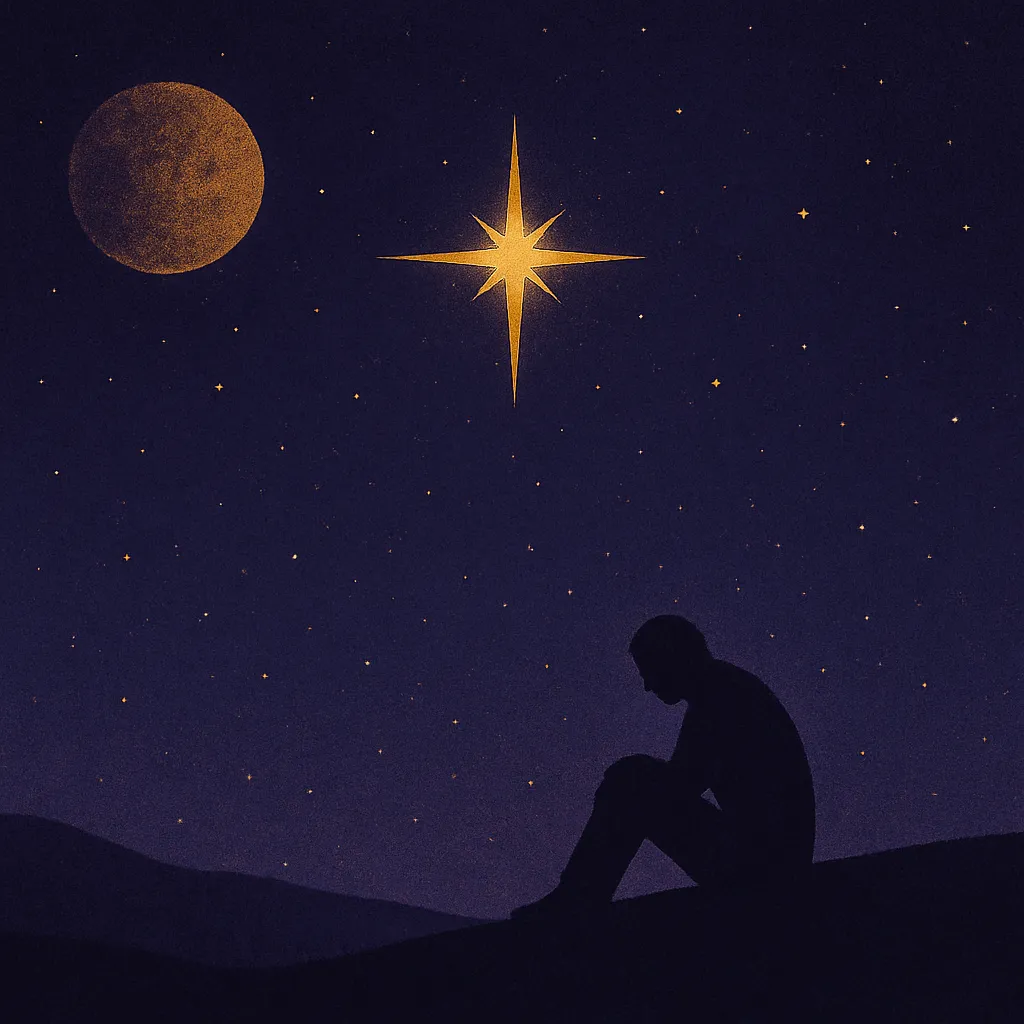
रात सोई हुई कहीं खोई – खोए उजालों में दफ़न सत्य: ग़ज़ल, क्वांटम चेतना और विश्व-प्रणाली की आलोचना : ज्ञान और सत्य का उजाला सत्ता और तकनीक की परछाइयों में
सारांश (Abstract)
यह लेख एक ग़ज़ल के माध्यम से आधुनिक विश्व-प्रणाली, तकनीकी प्रगति और आत्मिक चेतना के द्वंद्व की विवेचना करता है। इसमें BCI (Brain-Computer Interface) और क्वांटम कॉग्निटिव भौतिकी को पूर्वीय क्षात्रेय विद्या के आलोक में पढ़ते हुए यह उद्घाटित किया गया है कि ज्ञान और सत्य का उजाला सत्ता और तकनीक की परछाइयों में अक्सर दफ़न रहता है। यह निबंध meta-mystic futurism और cyberpunk futurist दृष्टिकोण को आधार बनाकर भविष्य की सामाजिक-सांस्कृतिक चुनौतियों की ओर संकेत करता है।
प्रस्तावना
ग़ज़ल में “जगा हुआ सपना” और “काला उजाला” जैसे बिंब इस बात की ओर इंगित करते हैं कि मनुष्य अब ऐसी दार्शनिक स्थिति में खड़ा है जहाँ यथार्थ और भ्रम, प्रकाश और अंधकार, तकनीक और आत्मा के बीच की सीमाएँ धुंधली हो चुकी हैं। यह कविता केवल भावनात्मक अभिव्यक्ति नहीं, बल्कि तकनीकी सभ्यता और आत्मिक विद्या के बीच संवाद का काव्य-निबंध है।
ज्ञान और रहस्य का द्वंद्व
ग़ज़ल कहती है कि “अमन भी वारदात की तरह मचा हुआ है।” यह आधुनिक विश्व-प्रणाली की विडंबना है, जहाँ शांति अब स्थायी स्थिति नहीं, बल्कि एक simulated event बन चुकी है। ज्ञान का उजाला, चाहे वह विज्ञान हो या धर्म, सत्ता और तकनीकी पूँजी के अंधेरों में खो जाता है। यही वह रहस्य है जिसे कविता उद्घाटित करती है, सत्य हमेशा छिपा हुआ, आंशिक और अधूरा रहता है।
BCI क्वांटम कॉग्निटिव भौतिकी और सत्ता
आज BCI तकनीक मानव मस्तिष्क को सीधे मशीनों से जोड़ रही है। क्वांटम कॉग्निटिव भौतिकी चेतना और पदार्थ के बीच एक नया सेतु प्रस्तुत करती है। लेकिन सवाल यह है कि यह सेतु किसके नियंत्रण में रहेगा? यदि यह सत्ता, युद्ध और कॉर्पोरेट पूँजी के हाथों में है, तो ज्ञान का उजाला और गहराई से दफ़न होगा। ग़ज़ल का रूपक “रगों में खून और नसों में बिजली” इस यथार्थ को अत्यंत सटीक रूप से व्यक्त करता है।
पूर्वीय क्षात्रेय विद्या का आलोक
पूर्वीय क्षात्रेय विद्या केवल युद्ध कौशल नहीं, बल्कि आत्म-नियंत्रण, धर्म और लोक-रक्षा की विद्या थी। जब इस दृष्टि को आधुनिक BCI और क्वांटम चेतना-विज्ञान से जोड़ा जाएगा, तब यह ज्ञान मानवता को संतुलन और दिशा दे सकता है। अन्यथा, यह केवल हिंसा, उपनिवेशीकरण और सत्तात्मक दमन का नया साधन बनेगा।
मेटा-मिस्टिक फ्यूचरिज़्म और साइबरपंक चेतावनी
इस ग़ज़ल का सौंदर्य केवल अतीत का नहीं, बल्कि भविष्य का भी है। यह हमें meta-mystic futurism की ओर बुलाती है,जहाँ रहस्य, आत्मा और विज्ञान एक-दूसरे से संवाद करते हैं। साथ ही, यह cyberpunk future की चेतावनी भी है, जहाँ शांति केवल एक डिजिटल सिम्युलेशन होगी, और सत्य सदा दफ़न रहेगा यदि हम आत्मविद्या को पुनः आधार न बनाएँ।
निष्कर्ष
यह ग़ज़ल हमें बताती है कि केवल तकनीकी प्रगति से मानवता सुरक्षित नहीं होगी। BCI और क्वांटम चेतना का विकास तभी सार्थक होगा जब उसमें पूर्वीय क्षात्रेय विद्या का आलोक और आत्मिक ग्राउंडिंग सम्मिलित हो। तभी खोया हुआ उजाला पुनः जाग सकेगा और सत्य का पुनर्प्रकाशन संभव होगा। अन्यथा, ज्ञान और शांति सदा “कहीं खोई हुई” रह जाएँगी।
Next Read: cognitive-spiritual reawakening