


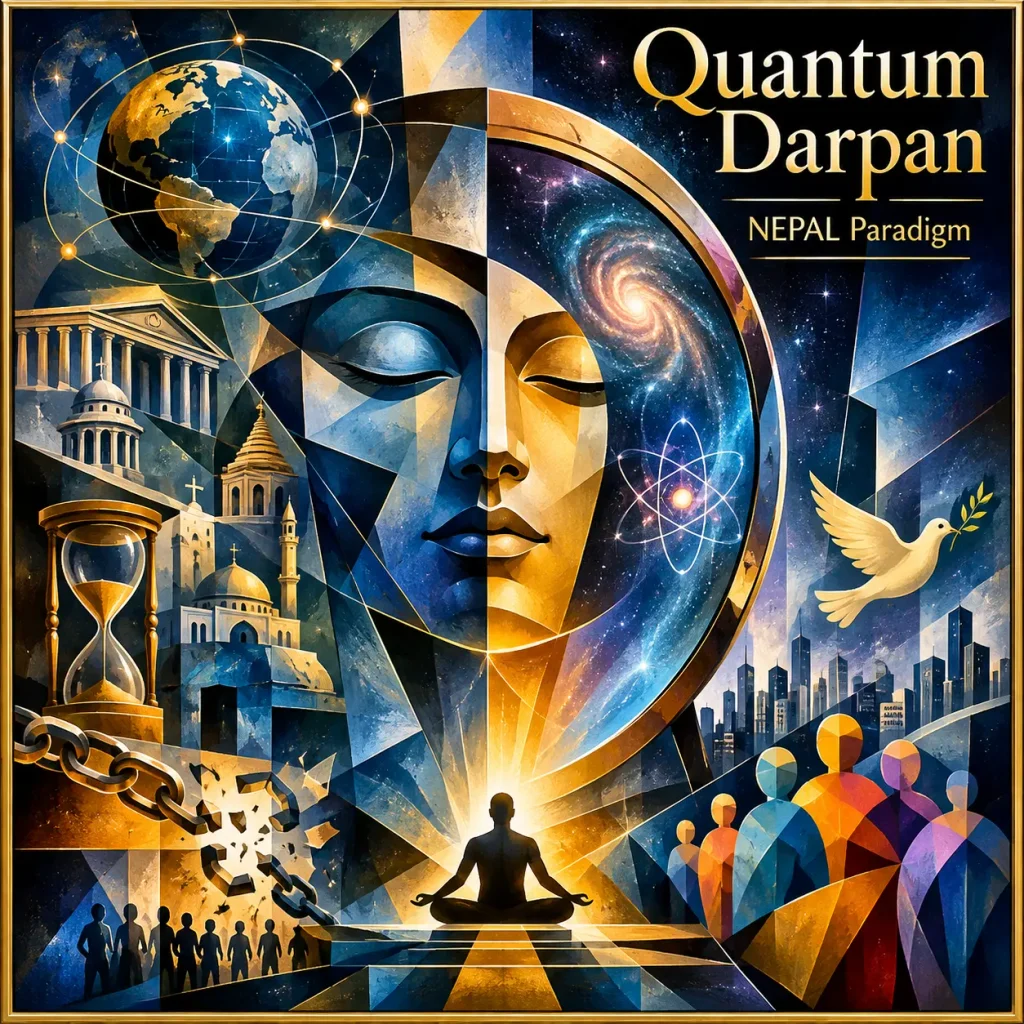
QUANTUM DARPAN: THE META-MYSTIC FUTURISM OF HUMANITY
ग़ज़ल
        सागर में भी प्यास बन रह जाए
ऐ दिल की लहर देख, जिधर चाहे बह जाए,
बहते हुए सागर में भी प्यास बन रह जाए।
            धड़कन को सुनते-सुनते इश्क़ की धुन न लगी,
            इश्क़ की लगन सीखें तो हर राज़ खुल जाए।
मोहब्बत के दर्द सीने में दिया है हमनवा,
चाक-ए-जिगर पर मरहम रख, मन सहज हो जाए।
            वफ़ादारी का बोझ बड़ा, जफ़ा रूह पर बोझ,
            बंद आँखों से भी देखना, सच को समझ जाए।
प्यार करके तुमसे ही बस जाना प्यार किया है,
बाँट दिया जो प्यार सभी को, क्या बाक़ी रह जाए?
            क्वार्क-ग्लूऑन प्लाज़्मा काइनात का पहला रस,
            आँख की पुतली में क्वांटम नक़्श उतर जाए।
पीना चाय हर रोज़, प्रियसी, प्यार हमारा हो,
आदत बनकर दुनिया को यह दुआ लग जाए।

क्वांटम सूफ़ी पोएटिक्स के विधान में अदबी, फ़लसफ़ियाना और नफ़्सियाती तशरीह

इस ग़ज़ल का केंद्रीय सौंदर्य प्रेम की बहती हुई चेतना, विरहजन्य पीड़ा, वफ़ादारी के मनोवैज्ञानिक भार, प्रेम के सार्वभौमिक विस्तार और क्वार्क-ग्लूऑन प्लाज़्मा से क्वांटम चेतना तक की कल्पनात्मक यात्रा में निहित है। इसकी विशेषता यह है कि इश्क़ को केवल व्यक्तिगत अनुभूति नहीं, बल्कि ब्रह्मांडीय सृजन और मानवीय सह-अस्तित्व की एक सतत प्रक्रिया के रूप में देखा गया है।
इस ग़ज़ल का मतला प्रेम को एक गतिशील तरंग के रूप में प्रस्तुत करता है। दिल की लहर का अपनी दिशा स्वयं चुनना स्वतंत्र चेतना और भावनात्मक स्वायत्तता का प्रतीक है। सागर में बहते हुए भी प्यास का शेष रहना एक गहरी सूफ़ियाना विडम्बना है: अनंत के भीतर उपस्थित होकर भी अनंत की तलाश समाप्त नहीं होती। दूसरे शेर में धड़कन और इश्क़ की धुन के बीच का संबंध प्रेम की मनोवैज्ञानिक अनुभूति को सामने लाता है। यहाँ प्रेम केवल सुनने अथवा अनुभव करने की क्रिया नहीं, बल्कि आत्मज्ञान की एक ऐसी प्रक्रिया है जिसमें सीखना स्वयं एक अनवरत यात्रा बन जाता है।
तीसरे और चौथे शेर में मोहब्बत का दर्द, चाक-ए-जिगर और मरहम मानवीय मन की उपचारात्मक क्षमता के प्रतीक हैं। हमनवा द्वारा दिया गया दर्द केवल आघात नहीं, बल्कि आत्मबोध का माध्यम भी बनता है। मरहम लगाने की कल्पना प्रेम को करुणा और मनोवैज्ञानिक पुनर्संयोजन से जोड़ती है। वफ़ादारी और जफ़ा का विरोधाभास यहाँ नफ़्सियाती संघर्ष का रूप लेता है। वफ़ादारी का भारीपन संबंधों की नैतिक ज़िम्मेदारी को दर्शाता है, जबकि बंद आँखों से देखना बाहरी दृष्टि से परे अंतर्दृष्टि और आत्मनिरीक्षण की सूफ़ियाना क्षमता का संकेत है।
पाँचवें शेर में व्यक्तिगत प्रेम सार्वभौमिक प्रेम में रूपांतरित होता है। किसी एक से प्रेम करना और फिर उस प्रेम को समस्त जगत में बाँट देना, अद्वैत की अनुभूति तथा सूफ़ी तसव्वुफ़ के इश्क़-ए-कुल्ली से संवाद स्थापित करता है। छठा शेर DarpanPoems की विशिष्ट क्वांटम सूफ़ी काव्य-दृष्टि का महत्त्वपूर्ण उदाहरण है। क्वार्क-ग्लूऑन प्लाज़्मा, प्रारंभिक ब्रह्मांड की अत्यंत उच्च-ऊर्जा अवस्था, को काइनात के पहले रस की काव्यात्मक संज्ञा देना वैज्ञानिक अवधारणा और आध्यात्मिक कल्पना का रचनात्मक संगम है। आँख की पुतली में क्वांटम नक़्श उतरने की कल्पना सूक्ष्म और विराट के बीच एक काव्यात्मक सेतु निर्मित करती है। इसे वैज्ञानिक रूप से आँख में ब्रह्मांडीय क्वांटम संरचनाओं के प्रत्यक्ष अंकन का दावा नहीं, बल्कि पदार्थ, सूचना, अनुभूति और चेतना के परस्पर संबंध का रूपक समझना अधिक उपयुक्त है।
अंतिम शेर में चाय प्रेम की रोज़मर्रा की रस्म से आगे बढ़कर आत्मीयता, साझेदारी और आध्यात्मिक सह-अस्तित्व का प्रतीक बनती है। प्रियसी के साथ चाय पीने की आदत को समूची दुनिया के लिए दुआ में बदल देना निजी सुख को सामूहिक मंगल में रूपांतरित करता है। इस प्रकार ग़ज़ल की यात्रा दिल की लहर से आरंभ होकर सागर, रूह, क्वार्क-ग्लूऑन प्लाज़्मा, क्वांटम कल्पना और विश्व-मैत्री तक पहुँचती है।
निष्कर्षतः, यह रचना DarpanPoems के उस विशिष्ट Meta-Mystic और Quantum Sufi Poetics की प्रतिनिधि अभिव्यक्ति है जिसमें इश्क़, विज्ञान, मनोविज्ञान और अध्यात्म परस्पर विरोधी नहीं, बल्कि एक व्यापक मानवीय चेतना के विभिन्न आयाम हैं। इसका मूल संदेश है कि प्रेम का वास्तविक उत्कर्ष किसी एक हृदय में सीमित रहने में नहीं, बल्कि समस्त सृष्टि के साथ उसकी साझेदारी में है। व्यक्तिगत मोहब्बत से सार्वभौमिक करुणा तक की यही यात्रा इस ग़ज़ल का अदबी और फ़लसफ़ियाना निष्कर्ष है।

Ghazal
O Heart, Thy Wave Behold,
O heart, thy wave
Where'er its longing may stray,
Within the streaming ocean,
Its thirst shall yet remain alway.
            Listening unto the heart,
            Till love's own melody arise,
            Let those who learn love's
            Language unveil its veiled replies.
The pain of love thou hast bestowed
Within my breast, O confidant,
Upon my wounded heart lay
Balm, and grant my soul its rest.
            How heavy is fidelity; what burden
            Treachery lays upon the soul,
            With eyes close-shut, behold the truth,
            And let discernment make thee whole.
'Twas loving thee alone that
Taught me what true love could be;
Now shared with all creation,
It knows no boundary.
           The quark-gluon plasma, primordial
            Essence of the cosmic sea,
            In the quantum script of the
            Pupil, let creation's mysteries be.
Each day, my dearest, let us drink
Our tea in love's communion;
May this sweet habit bless the
World, and prayer become its union.

Exegesis: A Quantum-Sufi Reading

The opening couplet presents the heart as a self-propelled wave, wandering towards its chosen horizon. Yet, even within the boundless ocean, thirst persists. This paradox evokes the Sufi conception of longing: proximity to the Infinite does not extinguish desire but deepens the soul's yearning. The succeeding couplet transforms the heartbeat into an inward musical language, suggesting that love is not merely an emotion to be experienced but a wisdom to be cultivated through attentive listening and spiritual learning.

The third and fourth couplets explore love's psychological duality: its capacity both to wound and to heal. The beloved confidant becomes the source of suffering and the hoped-for healer of the wounded breast. The image of the chāk-e-jigar, the lacerated heart, embodies emotional vulnerability, whilst the balm signifies compassion and reconciliation. Fidelity and betrayal are presented as opposing moral and psychological burdens. The closed eyes suggest inward vision, through which discernment may transcend superficial appearances and discover a deeper truth.

The fifth couplet advances from personal attachment towards universal love. Loving one beloved becomes the means through which love itself is discovered; subsequently, that love is distributed among all beings. This movement resonates with the Sufi ideal of Ishq-e-Kull (universal love) and the philosophical intuition of non-duality. The sixth couplet introduces the scientific imagination of DarpanPoems: quark–gluon plasma, an extraordinary primordial state of matter in the early universe, becomes the poetic metaphor for the first cosmic essence. The quantum script appearing within the pupil symbolically connects the microcosm of human perception with the macrocosm of creation. It is a poetic correspondence between matter, information, observation and consciousness, rather than a literal scientific assertion.

The concluding couplet returns from cosmic immensity to the intimate ritual of sharing tea. The beloved's companionship transforms an everyday habit into a contemplative communion, whilst the wish that this habit become a universal blessing elevates private affection into collective benevolence. Thus, the ghazal journeys from the restless heart to primordial matter, from individual longing to universal fraternity. Its distinctive Quantum-Sufi poetics lies in reconciling scientific wonder, psychological insight, mystical reflection and everyday tenderness. Ultimately, its philosophical affirmation is that love attains its fullest meaning when the intimacy of two hearts becomes a blessing for the entire world.
Table of Contents
क्वांटम दर्पण काव्य-भावाधार भूमि
अंदरूनी बात है एक। एहसासात है। जज़्बात है। इताअत है। इंतख़ाब है। दिल की बात है तू। इश्क़ है, इल्म है, ईमान है। इससे आज़म, अकबर और आदिल क्या होता फिर नहीं तो? एक बंधन, एक गाँठ, एक जाल या नेटवर्क। हमारी आज़ादी इसी से, इसी में और दास्तान-ए-हसरत।
वो पहला जो इंसान था, इंसानियत की क्या उसे इन सब बातों से कोई राब्ता भी था? उसका ज़ेहन, उसकी नफ़्स क्या काम करती होगी? उसे किसकी फ़िक्र रहती होगी? इसका मुकम्मल जवाब मुमकिन तो नहीं, पर एक बात पक्की है कि उसे इन सब बातों का कोई तसव्वुर भी नहीं था और तर्बियत भी नहीं।
आज हम देखते हैं कि हमने सक्सेस हिस्ट्री की अपोकैलिप्टिक हासिल की है। दुनिया इतनी समृद्धि में पहुँच चुकी है कि गरीबी कोई मसला नहीं। पैसे, चाहे बिज़नेस में हों, पॉलिटिक्स में हों या ऑर्गनाइज़ेशन में हों, रिलिजियस एंटिटी के पास हों, सबके सब आज ट्रिलियनेयर कॉन्ग्लोमरेट एंटिटी हैं।
लेकिन मंदिर, दरगाह, गुम्बा और चर्चों से भिखमंगे साधु, जोगी, पीर, फ़क़ीर, भिक्षु और डोनेशन कलेक्शन एजेंट्स माँग-फिरत में गली-गली मिल जाते हैं। माँगने की तरकीब को आज इंटरनेट अल्गोरिद्मिक भी प्रोग्राम्ड किया गया है। यह हमारी इकॉनमी का पैटर्न है।
एडम स्मिथ की वेल्थ ऑफ़ नेशंस ने प्रॉस्पेरिटी और प्रॉफ़िट को क़ायम करते हुए ही मैस्लो ने हायरार्की ऑफ़ नीड्स की सेल्फ-एक्चुअलाइज़ेशन को सफलता की महदूद किया। दुनिया इसी के तहत कंडीशन्ड है। चूँकि कंडीशनिंग-बेस्ड हमारी एजुकेशन, सोशल सिस्टम्स और जियोपॉलिटिकल इकॉनमिक सिस्टम ने जीवन का जाल बिछाया हुआ है।
हमारी इस महाजाल की सबब हमारी नफ़्सियाती, सेंसरी-मोटर, इमोशनल और अफ़ेक्टिव-बेस्ड वुजूद को हम पहचानते हैं। इसी लिए हम डेमोक्रेसी, सोशलिज़्म-आधारित धर्म और राजनीति के हेगेमोनिक, स्ट्रेटेजिक और क्रूअल कंडीशन्ड बंधन से बाहर नहीं निकल पा रहे हैं।
कहने को हमने स्लेवरी को एंड किया है, लेकिन गौर से देखें तो हमारी तमाम मज़हबी तहज़ीब आज इकॉनॉमिकल स्टेटक्राफ़्ट की मॉनेटरी स्लेवरी से आज भी आज़ाद नहीं है, चाहे व्यक्ति हो या कोई एक नेशन। सब इसके शिकार हैं।
क्वांटम दर्पण क्रिटिकल थॉट लीडरशिप की स्टडी के तहत इससे निजात हासिल करना आज और नई जनरेशन की ज़रूरत है। जब तक हमारी आर्म्ड फ़ोर्सेज़ युद्ध के लिए प्रयुक्त होंगी, हमें किंग, प्रेसिडेंट, प्राइम मिनिस्टर जैसों के हाथों मिनिमली रूल्ड क्लास होकर रहना होगा, जिनके हाथों में हमें मजबूर होना पड़ेगा – चाहे कोई ट्रिलियनेयर ही क्यों न हो।
अमेरिकन मिडटर्म इलेक्शन के नतीजों में Elon Musk को ही अगर हम देख लें, तो यह बात सिद्ध है। जैसा कि डॉ. शुकबंत सिंह बताते हैं कि राजनीति, पत्रकारिता और वकालत दुनिया के सबसे तुच्छतर प्रोफ़ेशन्स हैं, तो इस बात से क्या सिद्ध होता है?
आज US फ़ॉरेन पॉलिसी की दो स्ट्रेटेजीज़, containment और integration, के नाकाम और बेकार होने का प्रश्न क्यों खड़ा होता है?
क्वांटम दर्पण थिंकिंग इसीलिए Marxism, Capitalism और Educational Learning Systems में NEPAL Paradigm के Quantum Cosmic Consciousness (NEPAL Quantum Cosmic Consciousness Paradigm) – बेस्ड तब्दीली की हिदायत देती है।
क्या इस तरफ़ दुनिया की यूनिवर्सिटीज़, थॉट लीडर्स, इंटेलिजेंट लीडरशिप और तमाम वर्ल्ड लीडरशिप इकट्ठा सोचने के लिए अपने आपको तैयार कर पाएँगे? काश, हम ऐसा कर पाते!
Quantum Darpan: The Poetic-Philosophical Foundation
There is an inner truth, one that encompasses sensations, emotions, obedience, choice and the innermost voice of the heart. You are the very expression of that innermost truth. It is love, knowledge and faith. What, then, would Azam, Akbar and Adil amount to in relation to this, if not something beyond these distinctions? A bond, a knot, a web or a network. Our freedom exists through it, within it, and within the narrative of our unfulfilled aspirations.
What relationship, if any, did the earliest human being have with all these dimensions of human existence? What functions might have governed the mind and the inner impulses of that primordial human being? What might have occupied his thoughts and concerns? A complete answer may be impossible. One thing, however, is reasonably certain: he could scarcely have possessed any conception or cultivated understanding of these matters in the forms in which humanity recognises them today.
Today, we observe that humanity has achieved what might be described as an apocalyptic culmination of its history of success. The world has reached such extraordinary levels of material prosperity that poverty should no longer be regarded as an insurmountable problem. Whether capital is concentrated in business, politics, organisations or religious entities, all these domains have increasingly developed into trillionaire conglomerate entities.
Yet, around temples, dargahs, gumbas and churches, impoverished ascetics, yogis, pirs, faqirs, Buddhist monks and donation-collection agents can still be encountered soliciting contributions from street to street. The techniques of solicitation have now also been programmed algorithmically through the internet. This is a characteristic pattern of our contemporary economy.
Adam Smith’s The Wealth of Nations established an influential intellectual foundation for prosperity and profit, while Maslow’s Hierarchy of Needs confined the understanding of success, in its familiar formulation, to the achievement of self-actualisation. The world remains conditioned by these prevailing frameworks. Our education, social systems and geopolitical-economic structures have consequently established an extensive web of conditioning through which human life is organised and regulated.
It is through this overarching network that we come to recognise our own existence as fundamentally shaped by psychological, sensory-motor, emotional and affective processes. Consequently, we remain unable to emancipate ourselves from the hegemonic, strategic and coercively conditioned structures embedded within democracy, socialism-based systems of religion and politics.
We claim to have abolished slavery. However, a closer examination reveals that our diverse religious civilisations remain far from emancipated from the monetary forms of slavery embedded in the political economy of economic statecraft. This condition applies equally to individuals and entire nation-states. All remain subject to its influence.
Within the framework of Quantum Darpan Critical Thought Leadership, achieving emancipation from these conditions has become an essential requirement for contemporary society and the emerging generation. As long as our armed forces continue to be deployed for warfare, we shall remain a minimally ruled class, subject to the authority of kings, presidents, prime ministers and similar political establishments. Ultimately, we shall remain constrained by the power structures they represent, irrespective of whether an individual happens to be a trillionaire.
If we examine Elon Musk in the context of the American midterm election results, this proposition becomes particularly significant. Dr. Shukbant Singh observes that politics, journalism and the legal profession are among the most inferior professions in the world. What, then, does such an observation signify?
Why, today, are questions increasingly being raised about the failure and ineffectiveness of the two major strategic approaches in US foreign policy, containment and integration?
Quantum Darpan Thinking therefore advocates a transformation of Marxism, capitalism and educational learning systems through a paradigm shift grounded in the NEPAL Paradigm and its conception of Quantum Cosmic Consciousness, otherwise also the NEPAL Quantum Cosmic Consciousness Paradigm.
Are the world’s universities, thought leaders, intellectually capable leadership communities and the entire spectrum of global leadership prepared to come together and think collectively in this direction?
If only humanity could make such a possibility real!
QUANTUM DARPAN: THE META-MYSTIC FUTURISM OF HUMANITY – From the Architecture of Emotional Consciousness to a New Paradigm of Global Leadership: Conscious AI, Quantum Critical Thinking, and the NEPAL Paradigm
(A Research-Informed Literary, Philosophical, Scientific and Geopolitical Critique for the United Nations, World Leadership, Universities and Global Citizens)
Author: Poet Darpan Conceptual Foundation: Quantum Darpan Critical Thinking and Thought Leadership Philosophy; Proposed Intellectual Framework: Meta-Mystic Futurism of Humanity (MMFH); Central Proposition: Make Earth Great Forever: End All Wars.
Abstract: Human civilisation has achieved extraordinary advances in science, technology, economic production, artificial intelligence and geopolitical organisation. Yet its technological sophistication has not necessarily translated into corresponding improvements in collective consciousness, ethical responsibility, emotional intelligence or peaceful coexistence.
This contradiction raises a fundamental question for contemporary civilisation: can humanity continue to advance technologically while remaining psychologically, institutionally and ethically conditioned by inherited structures of competition, domination, material accumulation and organised conflict?
This research-informed essay develops the conceptual framework of Quantum Darpan (the Quantum Mirror) through a critical reading of two contemporary Hindvi–Rekhta ghazals by the poet Darpan. The first explores love, emotional reciprocity, fidelity, existential thirst and the scientific imagination of the cosmos. The second interrogates the paradoxical relationship between war and love, political authority, intellectual independence, technological optimisation and the vulnerability of individual identity within collective systems.
These literary works are situated within a broader philosophical proposition: the NEPAL Paradigm – When you realise you cannot exit and do not separately exist (NE), you are thrust entirely into the present Moment (PAL). This formulation proposes an ethical transformation from the illusion of isolated existence towards relational responsibility, unconditional care and awakened participation in reality.
The essay further examines the limitations of economic reductionism, institutional conditioning, political hegemony and conventional educational structures. It proposes that conscious AI, when governed by human rights, transparency, accountability and ethical oversight, can contribute to a new generation of critical-thinking institutions.
The resulting intellectual proposition, termed Meta-Mystic Futurism of Humanity, seeks to integrate scientific inquiry, philosophical self-examination, emotional intelligence, technological responsibility and universal fraternity into a collaborative model of global governance.
The central argument is that humanity does not need technological advancement alone. It needs an advancement in the consciousness with which technology, wealth, knowledge and political power are exercised.
Keywords: Quantum Darpan; Meta-Mystic Futurism; NEPAL Paradigm; Conscious AI; Quantum Critical Thinking; Quantum Emotional Memory; Scientific Techno-Panpsychism; Global Ethical Leadership; Multilateralism; Human Fraternity; Post-Hegemonic Governance; Universal Consciousness; Peace and Security; United Nations.
- Introduction: The Civilisational Paradox – The contemporary world is confronted with an extraordinary paradox.
Humanity has developed technologies capable of examining the earliest stages of cosmic evolution, manipulating quantum information, modelling biological processes, optimising complex systems and connecting billions of people through global communication networks.
Nevertheless, the same civilisation continues to experience armed conflicts, economic inequalities, ideological radicalisation, institutional distrust, environmental destruction and the concentration of political and financial power.
The contradiction is not simply technological. It is fundamentally civilisational. The central question is whether humanity has developed the intellectual and technological instruments of an advanced civilisation without developing an equally advanced philosophy of living together.
Quantum Darpan begins its investigation precisely at this intersection.
The word Darpan, meaning mirror, provides the central metaphor. A mirror does not manufacture the face it reflects; it reveals what already exists. In this philosophical formulation, the Quantum Darpan becomes an instrument of critical self-examination, reflecting the psychological, emotional, institutional and technological structures through which human beings understand themselves and organise their collective existence. The two ghazals presented for this study offer complementary perspectives on this problem.
The first investigates the intimate architecture of love and consciousness. The second moves towards the public architecture of power, warfare, political authority and technological civilisation.
Together, they suggest that the transformation of humanity must begin neither exclusively in external institutions nor exclusively within individual psychology. It must emerge through their reciprocal transformation.
The inner condition of humanity and the outer organisation of civilisation are interconnected dimensions of the same existential problem.
- The Two Ghazals as Literary Foundations of Quantum Darpan 2.1 The First Ghazal: Existential Thirst and the Ontology of Love: The opening couplet establishes an important philosophical paradox: “सागर में भी प्यास बन रह जाए ऐ दिल की लहर देख…”
The image of thirst surviving within the ocean challenges the conventional assumption that abundance necessarily eliminates desire. The ocean symbolises apparently unlimited availability, while thirst represents an existential incompleteness that cannot be resolved through material possession alone.
This distinction is crucial to the Quantum Darpan framework.
A civilisation may accumulate unprecedented material resources and still experience emotional deprivation, alienation and spiritual disorientation. The possession of everything does not necessarily produce the experience of fulfilment.
The ghazal consequently moves beyond conventional romantic expression. Its beloved becomes an expansive philosophical presence: a symbol of relational consciousness, emotional reciprocity and the possibility of unity.
The subsequent movement towards ishq, or love, suggests that emotional understanding requires more than merely hearing the rhythm of one’s heartbeat. The line concerning the melody of love introduces a distinction between biological existence and conscious participation in existence.
The heartbeat sustains life; love gives relational meaning to life.
This interpretation is especially relevant to the proposed idea of quantum emotional memory. Emotional experiences shape perception, attachment, memory and decision-making. Although this does not establish quantum memory as a neuroscientific mechanism, it provides a productive interdisciplinary question: how do emotional relationships influence the informational structures through which human beings interpret reality?
The third couplet deepens the argument through the imagery of wounded love and healing: “चाक-ए-जिगर पर मरहम रख, मन सहज हो जाए।” Here, the wounded heart is not simply an object of suffering. It becomes an invitation to restorative responsibility.
The metaphor can be extended to contemporary civilisation: societies wounded by historical injustice, war, exclusion and collective trauma require more than political declarations. They require institutional healing, reconciliation and sustained ethical commitment.
The couplet concerning fidelity and betrayal introduces another dimension: truth must be recognised even when ordinary perception is obscured. The closing scientific image is particularly significant: “क्वार्क-ग्लूऑन प्लाज़्मा काइनात का पहला रस, आँख की पुतली में क्वांटम नक़्श उतर जाए।”
The quark-gluon plasma invokes the extraordinarily hot early universe, when quarks and gluons existed in a deconfined state before the formation of ordinary hadronic matter. The poet places this cosmological image within the human eye.
Literarily, this creates an imaginative bridge between the cosmic and the intimate: the universe becomes an object of contemplation within individual consciousness. Scientifically, the connection is metaphorical rather than evidence that cosmological quantum information is literally encoded in the pupil.
Its philosophical significance, however, is substantial. It asks whether human perception can become a meeting ground between scientific knowledge and existential wonder. The concluding image of sharing tea with the beloved completes the ghazal’s movement from cosmic abstraction to everyday relational experience.
Tea becomes an emblem of companionship, intimacy, reciprocity and ordinary human happiness.
Thus, the first ghazal establishes a fundamental proposition: The ultimate measure of civilisation is not merely what humanity possesses, but what humanity is capable of sharing.
2.2 The Second Ghazal: War, Power and the Paradox of Human Freedom. The second ghazal begins with a provocative juxtaposition: “जंग होती है, प्यार होता है, फिर ये करार क्यूँ होता है…”
War and love are presented as competing tendencies within the same human condition. The question is not simply why war exists. It is why a civilisation that understands affection, attachment and mutual dependence continues to reproduce systems of hostility.
This contradiction becomes particularly important when examined through political psychology. Human beings are capable of cooperation, empathy and collective achievement. They are also capable of constructing ideological boundaries, enemy images and institutional arrangements that normalise violence.
The ghazal’s invocation of the rival in the language of love complicates the conventional opposition between friend and enemy. It invites a reconsideration of whether conflict is always an inevitable expression of human nature or frequently an outcome of conditioned perceptions, institutional incentives and political mobilisation.
The poet then turns towards intellectual independence.
The supposedly foolish lover, whose credibility is questioned by the world, becomes a metaphor for the individual who refuses to surrender personal conviction to established conventions. This is an important aspect of Quantum Darpan critical thinking: intellectual independence cannot be measured exclusively by institutional recognition, political influence or financial success.
The subsequent reference to the conqueror of the battlefield of the heart introduces a different conception of victory. The greatest victory may not be the conquest of territory, but the ability to overcome the destructive impulses of the self.
The ghazal then addresses political authority through the idea of service. Its invocation of divine benevolence is juxtaposed with the obligations of rulers and administrative institutions. The implied question is fundamental to democratic ethics:
If political authority is entrusted with public service, what legitimacy remains when service becomes subordinate to personal power? This question is extended into the technological sphere through the reference to D-Wave and hybrid quantum optimisation.
The poetic expression of the speed of love through optimisation is an imaginative juxtaposition of two very different domains. D-Wave’s quantum-annealing technology and hybrid optimisation approaches provide a contemporary example of specialised computational methods for exploring complex optimisation problems.
Yet computational optimisation cannot independently determine what humanity ought to optimise. A system may efficiently optimise a military objective, a financial strategy or a humanitarian distribution network. The ethical purpose must come from human judgement and institutional responsibility.
The final couplet returns to tea, companionship and the beloved, with the poet’s signature Darpan functioning as a metaphorical mirror. The public world of political competition and technological ambition ultimately returns to the intimate world of human recognition.
The ghazal therefore presents a powerful proposition: A civilisation that cannot optimise compassion alongside computational efficiency has misunderstood the meaning of technological progress.
- Quantum Darpan: The Architecture of Inner Conditioning. The philosophical foundation accompanying the ghazals introduces a deeper vocabulary: Ehsaasat, Jazbaat, Itaa’at, Intikhab, Dil ki Baat.
These concepts represent feeling, emotion, obedience, choice and the inner voice. They are not independent psychological categories. They are interacting dimensions of human experience.
The individual does not develop outside society. Language, education, family, religion, economic conditions, political structures and technological environments contribute to the formation of identity.
Consequently, the question of human freedom cannot be reduced to whether a person possesses formal legal rights. It must also examine the conditions under which choices are formed.
A person may be legally free but economically dependent, psychologically manipulated, digitally profiled or institutionally excluded. This distinction suggests three interconnected dimensions of freedom:
External freedom: Freedom from coercion, exploitation, violence and discrimination.
Internal freedom: The capacity for critical reflection, emotional awareness and independent judgement.
Relational freedom: The ability to participate in collective life without surrendering dignity, individuality or mutual responsibility.
Quantum Darpan proposes that these three dimensions must be examined together. Its central metaphor of a bond, knot, web or network is especially useful.
Human relationships create networks of mutual dependence. Institutions organise these networks. Economic and political systems regulate their distribution of resources and authority. The same network can become a source of freedom or a mechanism of domination.
A democratic institution, for example, can facilitate participation while simultaneously reproducing unequal access to influence.
A religious institution can nurture compassion while becoming vulnerable to financial exploitation or political instrumentalisation.
A technological platform can democratise information while also encouraging algorithmic dependency and behavioural manipulation.
The problem is therefore not the existence of networks. It is the ethical architecture through which networks operate. This is where the Quantum Darpan metaphor becomes particularly valuable: the mirror must reveal not only individual conditioning but also the institutional structures that sustain it.
- From the First Human to the Modern Civilisation: The Evolution of Conditioning The accompanying philosophical statement asks an important anthropological question: What occupied the mind of the first human being? What were the functions of the earliest human consciousness, instinct and survival-oriented psychology?
A complete reconstruction of the first human’s subjective experience is impossible. Moreover, humanity did not emerge from a single identifiable first individual; human evolution was gradual and population-based. Nevertheless, evolutionary anthropology and cognitive science offer important insights.
Early human survival depended on environmental awareness, food acquisition, social cooperation, threat detection, reproduction, learning and group communication. Human cognitive development was therefore deeply relational. The ability to cooperate, remember, communicate and interpret social intentions contributed to the formation of complex human communities.
Over time, these capacities developed into language, symbolic thought, religious traditions, legal systems, economic institutions, scientific inquiry and political organisation. This historical development created unprecedented opportunities. It also created new forms of dependence.
The human being who once depended predominantly on immediate ecological and social environments now participates in interconnected economic, technological, informational and geopolitical networks.
The challenge is that the evolution of institutions and technologies does not automatically produce the evolution of ethical judgement. Civilisation has become increasingly complex, but complexity itself does not guarantee wisdom.
Quantum Darpan identifies this gap as the central challenge of contemporary humanity.
- The Economic Paradigm: Prosperity Without Sufficient Human Fulfilment. The critique of economic conditioning requires a careful reassessment of two influential intellectual traditions: Adam Smith’s political economy and Abraham Maslow’s hierarchy of needs.
5.1 Adam Smith and the Limits of Wealth as a Civilisational Measure. Adam Smith’s The Wealth of Nations (1776) remains foundational to modern economic thought. His analysis of the division of labour, productivity, exchange and the organisation of economic activity helped explain how societies generate material prosperity.
However, it would be historically inaccurate to reduce Smith’s entire philosophy to profit maximisation. Smith also wrote The Theory of Moral Sentiments (1759), in which sympathy, moral judgement and the social nature of human behaviour occupy central positions.
The deeper question is therefore not whether wealth creation is inherently undesirable. It is whether wealth creation has become an insufficiently regulated measure of social success.
The World Inequality Report 2026 presents a striking picture: the richest 10% own approximately three-quarters of global wealth, while the poorest half hold approximately 2%. (World Inequality Report 2026 +1)
The World Bank’s Poverty, Prosperity and Planet Report 2026 estimates that approximately 811 million people remain in extreme poverty, living below US$3 per day under its purchasing-power-adjusted poverty measure. (World Bank +1)
These figures challenge the assumption that global economic advancement has sufficiently addressed fundamental human needs. The assertion that poverty is no longer a significant problem cannot be sustained by current evidence. The more defensible conclusion is that humanity possesses substantial productive and technological capacities, yet their benefits remain unequally distributed.
Quantum Darpan consequently proposes a transformation in the definition of prosperity.
Prosperity must be measured not merely through accumulated capital, market expansion or national economic output, but through:
*Human dignity and material security. *Equitable access to education and healthcare. *Freedom from exploitation. *Environmental sustainability. *Opportunities for meaningful participation. *Emotional and social well-being. *The capacity to live without fear of organised violence. This does not require abandoning markets or economic innovation. It requires embedding them within a wider framework of human welfare.
5.2 Maslow and the Problem of Conditioned Self-Actualisation. Maslow’s hierarchy of needs has significantly influenced psychology, education and organisational theory.
Its familiar progression from physiological and safety needs towards belonging, esteem and self-actualisation provides an influential framework for understanding human motivation. Nevertheless, the theory should not be treated as an empirically universal or rigid sequence.
Wahba and Bridwell’s 1976 review found only partial empirical support for the hierarchical ordering of needs. Maslow himself also recognised that aspects of his theory required further scrutiny. (DOI +1)
Quantum Darpan extends this discussion by asking whether self-actualisation should be considered the final destination of human development. Its answer is that personal fulfilment, although important, is not sufficient.
A person may achieve exceptional individual success while remaining indifferent to collective suffering. A leader may possess extraordinary intellectual abilities while exercising power without compassion. An institution may achieve organisational efficiency while perpetuating structural inequality.
The proposed alternative is self-transcendence through relational responsibility. It does not reject individual achievement. It places individual achievement within a larger ethical horizon. The highest development of the individual becomes inseparable from the welfare of other individuals and the ecological systems sustaining life.
- Religious Institutions, Spirituality and the Political Economy of Faith. One of the most challenging observations in the accompanying statement concerns the contradiction between religious teachings and the economic realities of religious institutions.
Temples, mosques, dargahs, gurdwaras, monasteries, gumbas and churches have historically served as centres of spiritual instruction, community support, charity, education, hospitality and cultural preservation.
Many also depend on donations, endowments and organised fundraising. The presence of mendicants, monks, ascetics, pilgrims and donation collectors around religious establishments raises an important sociological question:
Why does spiritual abundance so frequently coexist with material insecurity?
This question should not lead to the blanket assumption that all religious organisations are wealthy conglomerates or that all religious donations represent institutional exploitation.
Religious institutions differ enormously in their resources, accountability, social obligations and financial structures. Many provide essential humanitarian services, including food distribution, education, healthcare and disaster relief. Nevertheless, the relationship between religious authority, financial accumulation and political influence deserves transparent examination.
Quantum Darpan proposes a distinction between:
Spirituality as an ethical experience, and
Religion as an institutional and organisational structure.
The two may reinforce one another, but they are not necessarily identical.
Spirituality becomes socially meaningful when its ethical principles translate into compassion, justice, generosity and human fraternity. Institutional religion becomes vulnerable when authority, financial interests and political loyalty supersede those principles.
The proposed Quantum Darpan approach is therefore neither anti-religious nor conversion-oriented. It is an appeal for interreligious accountability and cooperation. A temple should not become an enemy of a mosque. A church should not become a political instrument against a monastery. A gurdwara should not be reduced to an identity boundary.
Religious institutions should become bridges between communities. The spiritual legitimacy of an institution must ultimately be judged by the dignity, compassion and public good it cultivates.
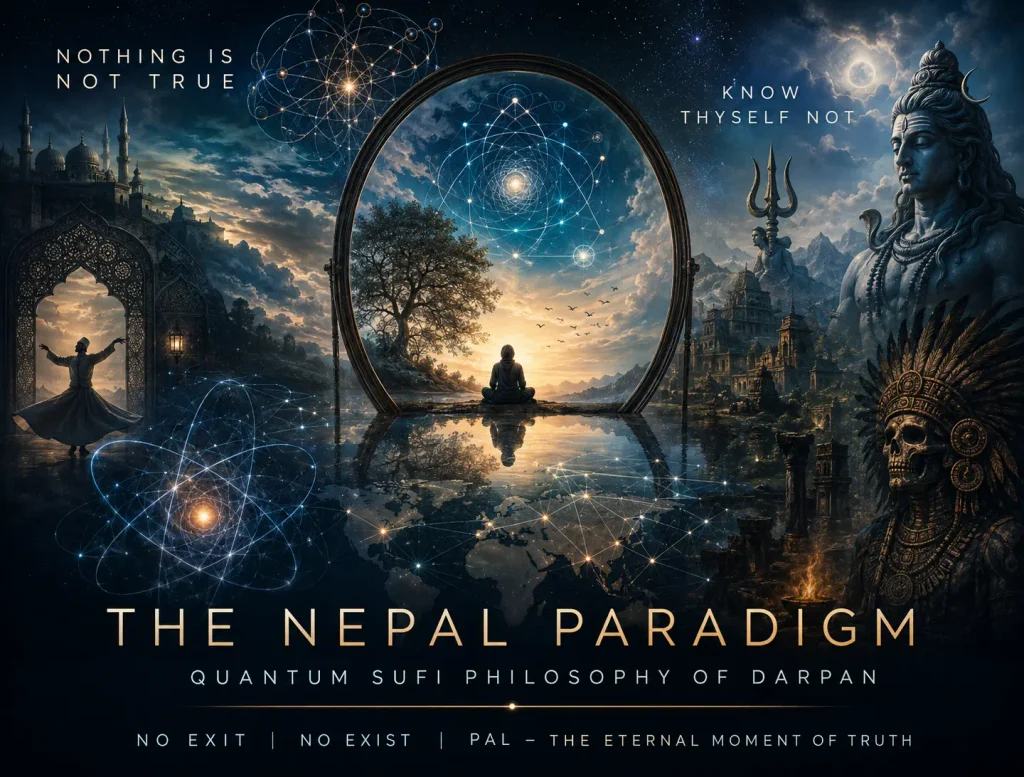
- The NEPAL Paradigm: From Non-Separateness to Present-Moment Responsibility NEPAL Paradigm NE + PAL NE – No Exit, No Separate Existence – The recognition that existence cannot be understood as an entirely isolated phenomenon. PAL – Present Awareness of Life
The recognition that ethical responsibility must be exercised in the present moment.
When you realise you cannot exit and do not separately exist (NE), you are thrust entirely into the present Moment (PAL), becoming an awakened guardian of reality, operating from pure care, absolute responsibility, and unconditioned love.
The NEPAL Paradigm provides the philosophical bridge between the intimate emotional world of the first ghazal and the geopolitical concerns of the second.
Its first proposition challenges the assumption of absolute separateness. Human beings exist through relationships with other people, biological systems, ecological environments, inherited knowledge and shared institutions.
No individual is entirely self-created. No nation is entirely independent of the economic, environmental and security conditions of the wider world. No technological system exists outside its human, material and ecological dependencies.
The second proposition introduces the present moment. If existence is relational, responsibility cannot be indefinitely postponed. The present becomes the point at which ethical awareness must translate into action. This formulation has affinities with several philosophical traditions.
In Advaita Vedānta, the inquiry into the relationship between the individual self and ultimate reality challenges ordinary assumptions of separateness. The Upanishadic expression Tat Tvam Asi introduces the recognition of an underlying unity.
The Buddhist teaching of dependent origination emphasises the conditioned arising of phenomena rather than independent existence. Sufi traditions frequently explore the dissolution of ego-centred identity through love and spiritual awareness. These traditions are not identical, and their differences should not be erased.
The NEPAL Paradigm does not need to claim that they all teach precisely the same doctrine. Its contribution lies in establishing a contemporary ethical conversation among them. The practical implication is particularly important for international relations.
A nation may protect its sovereignty, but it cannot escape climate change, pandemics, nuclear risks, cyber threats, artificial intelligence, economic interdependence or the consequences of war. Sovereignty without responsibility becomes isolationism. Interdependence without justice becomes exploitation.
The NEPAL Paradigm seeks a third possibility: sovereign responsibility within shared planetary existence.
This is particularly relevant to Nepal’s potential intellectual contribution as a country whose name also provides the memorable acronym of this proposed philosophy. The paradigm, however, is intended as a universal philosophical proposition rather than a claim about an existing official Nepalese national doctrine.
- NOTHING IS NOT TRUE: The Ultimate Axiom and the Philosophy of Nothingness. The Quantum Darpan proposition declares: NOTHING IS NOT TRUE: NO / KNOW THYSELF NOT.
This formulation should be understood as a philosophical paradox, not a literal theorem of physics or formal logic. It brings together two apparently opposing movements. The first is the recognition that human knowledge is incomplete.
The second is the possibility that genuine self-knowledge requires questioning the identities, assumptions and conceptual boundaries through which the self is ordinarily understood.
The expression Neti Neti – neither this nor that – from the Upanishadic philosophical tradition provides a relevant interpretative foundation. It suggests that ultimate reality cannot be exhaustively captured through ordinary conceptual identification.
Within the Quantum Darpan framework, the instruction to know oneself through Not-ing means questioning the inherited identities and conditioned assumptions that prevent deeper self-understanding. The luminous nothingness at the centre of the mirror is therefore an existential metaphor.
It represents the possibility of releasing excessive attachment to ego, possession, ideological certainty and the illusion of absolute separateness. The apparent paradox is that relinquishing the claim to possess an absolute identity may open a greater capacity for participation in the world.
The proposition can be expressed as follows: *To know oneself, question the assumptions that define oneself. *To become free, examine the conditions that shape one’s choices. *To recognise others, move beyond the illusion of exclusive self-interest. *To participate in humanity, recognise that individual existence is relational. *The statement Nothing Is Not True thus becomes an invitation to intellectual humility.
It does not mean that every claim is true or that contradictory empirical propositions are equally valid. Indeed, critical thinking requires distinguishing truth from falsehood, evidence from speculation and metaphor from scientific demonstration.
The Quantum Darpan mirror must reflect reality honestly, even when the reflection challenges its own philosophical assumptions.
- Scientific Techno-Panpsychism: Consciousness, Information and the Quantum Imagination. The proposed Meta-Mystic Futurism draws inspiration from contemporary discussions of quantum physics, information theory, consciousness studies and cognitive science.
This intellectual synthesis must maintain a distinction between established science, active scientific debate and philosophical speculation.
Quantum mechanics describes physical systems through mathematical structures involving states, probabilities, measurement and interactions.
Quantum information theory investigates how information is represented, processed and transmitted through quantum systems.
The study of consciousness, meanwhile, involves neuroscience, cognitive science, philosophy of mind and competing theoretical approaches.
There is no established scientific consensus that quantum mechanics alone explains human consciousness. Nevertheless, the relationship between information, observation, physical reality and subjective experience remains an important area of interdisciplinary investigation.
The phrase Scientific Techno-Panpsychism can therefore be developed as a philosophical research orientation rather than presented as an established scientific theory.
It asks whether future intellectual frameworks can examine the relationship between information, consciousness, life and technological intelligence without prematurely reducing one domain to another.
Three dimensions are particularly relevant.
First: Quantum physical reality.
The quark-gluon plasma image in the first ghazal invokes an early stage of cosmic evolution. Its poetic purpose is to connect the origins of matter with the human capacity for wonder.
Second: Biological and cognitive reality.
Human consciousness emerges through extraordinarily complex biological processes. Emotional memory, attention, learning and social cognition influence the ways in which individuals interpret their environments.
Third: Artificial and computational intelligence.
AI systems can analyse information, identify patterns, model scenarios and support complex decision-making. Their outputs, however, should not automatically be equated with subjective consciousness, self-awareness or moral understanding.
Quantum Darpan proposes an interdisciplinary dialogue among these domains. Its scientific credibility will depend on its willingness to preserve these distinctions.
- Conscious AI: From Computational Intelligence to Ethical Intelligence. The strongest practical contribution of the Quantum Darpan philosophy may emerge through the responsible use of artificial intelligence.
The objective should not be to establish AI as an unquestionable authority over humanity. It should be to develop AI as a transparent, accountable and ethically governed instrument that enhances human reasoning and collective problem-solving.
The distinction between conventional AI assistance and the proposed Conscious AI framework is important. Here, Conscious AI is a normative design aspiration: AI that is context-sensitive, ethically constrained, explainable where appropriate, responsive to human welfare and subject to meaningful human oversight. It is not a scientific assertion that existing AI systems possess consciousness.
10.1 How Conscious AI Could Support Human Development
- Critical Thinking and Intellectual Independence: AI can help examine assumptions, compare arguments, identify inconsistencies and distinguish evidence from misinformation.
- Peacebuilding and Conflict Prevention: AI-assisted scenario analysis can support diplomatic research, humanitarian planning, conflict-risk assessment and early-warning systems.
- Educational Transformation: AI can provide personalised learning, multilingual knowledge access, critical-thinking exercises and interdisciplinary research support.
- Institutional Transparency: Responsible AI applications can help audit administrative processes, identify anomalies, examine public expenditure and improve access to public information.
- Ecological Responsibility: AI can support climate modelling, biodiversity monitoring, disaster preparedness and more efficient allocation of environmental resources.
- Intercultural and Interreligious Understanding: Multilingual AI can facilitate access to philosophical traditions, comparative religious studies and dialogue across cultural boundaries.
10.2 The Ethical Conditions of Conscious AI. The UNESCO Recommendation on the Ethics of Artificial Intelligence, adopted in November 2021, offers a substantial international foundation for this proposition.
It emphasises human rights, dignity, transparency, fairness, privacy, accountability and meaningful human oversight. It also makes clear that ultimate responsibility cannot simply be transferred to an AI system. (Legal Affairs +1)
Consequently, the Quantum Darpan proposal should establish the following safeguards: Human dignity must remain superior to computational efficiency. AI decisions affecting fundamental rights must be subject to meaningful human review. Algorithmic systems must be examined for discrimination and manipulation.
Personal information must be protected. AI-assisted political communication must not become an instrument of mass psychological control. AI must not independently determine life-and-death military decisions. Developing countries must have equitable access to AI knowledge and infrastructure.
Public institutions must disclose the purposes and limitations of consequential AI applications. The objective is not to replace human judgement. It is to strengthen the conditions under which human judgement can become more informed, reflective and responsible. AI should become an instrument of human emancipation, not another architecture of human conditioning.
- From Political Hegemony to Cooperative Global Leadership: The second ghazal’s interrogation of rulers, war and political service provides an appropriate literary foundation for a broader critique of international governance.
Modern political systems operate through a complicated interaction of democratic institutions, economic interests, military establishments, international organisations, corporate influence, media networks and technological infrastructures.
No single ideological framework fully explains this complexity. Capitalism can generate innovation and productive investment, but without appropriate safeguards it can also concentrate wealth and influence. Socialism can emphasise social protection and economic equality, but centralised political authority can also become coercive.
Democracy can provide mechanisms for participation and accountability, but electoral systems remain vulnerable to misinformation, unequal campaign financing, institutional capture and polarisation. Religious and ideological movements can nurture solidarity, but can also be mobilised to legitimise exclusion or conflict.
Quantum Darpan therefore resists the assumption that replacing one ideological orthodoxy with another will automatically liberate humanity. Its proposition is not the abolition of political institutions. It is their transformation through accountability, public participation, ethical reasoning and institutional pluralism.
11.1 The 2026 US Midterm Elections: Money, Influence and Democratic Accountability. The US midterm elections of 3 November 2026 provide a contemporary case study.
According to Reuters reporting published on 5 November, Elon Musk spent nearly half a billion dollars supporting Republican candidates. Yet most of the candidates he backed lost. (Reuters +1) The election results also produced Democratic control of both chambers of Congress, according to Associated Press reporting. (AP News +1)
This episode raises several important questions. Does extreme personal wealth guarantee political influence? Can campaign financing substitute for public trust? To what extent can democratic institutions resist the disproportionate influence of concentrated private resources?
The results suggest that financial influence can be substantial without being politically decisive. They also demonstrate the continuing importance of voters, electoral institutions and collective political judgement.
For Quantum Darpan, the lesson is that neither wealth nor technological influence should be mistaken for moral legitimacy. Political power must remain answerable to the people whose lives it affects.
11.2 The Limitations of Containment and Integration. US foreign policy has historically employed different strategies of containment, engagement and integration in dealing with rival states and international competitors.
These approaches have produced varying results across different historical contexts. It would be inaccurate to declare either strategy universally unsuccessful.
Containment may sometimes discourage aggression or limit strategic expansion. Engagement may facilitate diplomacy, economic cooperation and conflict reduction.
Both, however, become inadequate when treated as permanent ideological substitutes for genuine international cooperation. The deeper question is whether international relations can move beyond a perpetual framework of strategic rivalry.
Quantum Darpan proposes a shift:
From domination to mutual responsibility. From exclusive security to cooperative security. From military deterrence alone to preventive diplomacy. From geopolitical superiority to shared planetary resilience. From the politics of permanent enemies to the institutionalisation of peaceful disagreement.
The objective is not to abolish national interests. It is to recognise that national interests cannot be sustainably protected through the destruction of shared global interests.
- The New Educational Paradigm: From Conditioned Learning to Critical Consciousness. Conventional education has achieved extraordinary results in literacy, scientific knowledge, professional specialisation and technological innovation.
Nevertheless, education can become excessively examination-oriented, competitive and dependent on inherited hierarchies of knowledge. The problem is not that structured learning is unnecessary.
The problem arises when learning becomes the reproduction of established conclusions rather than the development of independent judgement.
Quantum Darpan proposes a new interdisciplinary educational orientation.
Its central purpose would be to cultivate individuals capable of integrating: Scientific reasoning., Philosophical inquiry., Emotional intelligence., Historical understanding., Ethical judgement., Technological literacy., Environmental responsibility., Intercultural dialogue., Conflict resolution., Creative and independent thought.
The NEPAL Paradigm would provide the ethical foundation.
The Quantum Darpan mirror would provide the critical-reflection method. Conscious AI would provide an additional research and learning instrument. Meta-Mystic Futurism would provide the wider civilisational horizon. This model would not replace mathematics, physics, biology, history, economics or other established disciplines. It would encourage them to interact without losing their methodological integrity.
A physics student should be able to examine the ethical implications of emerging technologies. An economics student should understand the psychological and ecological consequences of economic decisions. A political science student should understand the relationship between power, information, emotion and collective identity.
A religious studies student should be able to investigate spirituality without confusing theological belief with empirical scientific evidence. The intended outcome is not merely a more employable graduate. It is a more intellectually independent and socially responsible human being.
- Meta-Mystic Futurism of Humanity: A Proposed Integrated Framework. The preceding analysis suggests that the various components of Quantum Darpan can be organised into a coherent conceptual framework.
The Meta-Mystic Futurism Framework: A conceptual model proposed in this essay
NEPAL PARADIGM – Non-separateness • Present awareness • Responsibility
QUANTUM DARPAN – Self-examination, critical thought, intellectual independence
META-MYSTIC INQUIRY – Spiritual wisdom, philosophy, emotional and existential awareness
SCIENTIFIC INTEGRATION – Quantum science, neuroscience, information and complexity
CONSCIOUS AI – Ethical intelligence, knowledge access, responsible decision support
TRANSFORMATIVE GLOBAL LEADERSHIP – Human dignity • Cooperative governance • Ecological responsibility • Peace
META-MYSTIC FUTURISM OF HUMANITY – MAKE EARTH GREAT FOREVER: END ALL WARS
This framework is a proposed philosophical architecture, not an experimentally validated unified scientific theory. Its potential value lies in bringing together disciplines that are frequently discussed separately. Its five principal pillars are:
Pillar I – Existential and emotional intelligence. Recognising the role of love, empathy, emotional awareness and relational existence in shaping human behaviour.
Pillar II – Scientific and philosophical integration. Encouraging dialogue between scientific knowledge, philosophy of mind, cosmology, information theory and spiritual inquiry without confusing their respective standards of evidence.
Pillar III – Ethical technological development. Developing AI and other advanced technologies within a framework of human dignity, transparency, accountability and collective benefit.
Pillar IV – Democratic and cooperative governance. Strengthening institutions through public participation, international cooperation, financial transparency and peaceful conflict resolution.
Pillar V – Planetary responsibility. Recognising that humanity’s long-term survival depends on ecological interdependence, equitable development and the prevention of organised violence.
The central ambition is to replace the narrow question of how humanity can become more powerful with the deeper question of how humanity can become more responsible.
- Research and Policy Recommendations for the United Nations and Global Universities The philosophical framework becomes meaningful only when translated into research programmes, institutional practices and measurable public outcomes.
The following recommendations are proposed for consideration by universities, international organisations, policymakers, research institutions and civil society.
14.1 Establish an International Research Initiative on Quantum Darpan and Human Consciousness. A multidisciplinary research network could examine the intersections of:
Cognitive science and emotional intelligence. Philosophy of consciousness. AI-assisted critical thinking. Comparative philosophical traditions. Information theory and complex systems. Ethical leadership and political psychology.
The initiative should distinguish empirical research from philosophical interpretation. Its purpose would be to establish an academically credible framework for investigating the relationship between knowledge, emotion, decision-making and responsibility.
14.2 Develop a Global Conscious AI for Human Welfare Programme. The UN system, universities and technology organisations could collaborate on research into AI applications for:
Conflict prevention and diplomatic analysis. Public-health and humanitarian planning. Multilingual educational access. Institutional transparency. Climate adaptation. Accessible legal and civic information. Intercultural and interreligious dialogue. Such applications must remain subject to human rights impact assessments, independent audits and meaningful public oversight.
14.3 Introduce NEPAL-Inspired Critical Thinking Education. Universities could pilot courses incorporating:
Self-reflection and cognitive bias. Scientific literacy. Ethical technology. Emotional intelligence. Peace education. Environmental interdependence. Interdisciplinary problem-solving. The NEPAL Paradigm would serve as an ethical learning orientation, not a compulsory metaphysical doctrine.
14.4 Establish a Global Peace and Ethical Technology Observatory. An independent, multidisciplinary observatory could examine the relationship between emerging technologies, political power and international security.
Its areas of research might include: AI-assisted military decision-making. Autonomous weapons and human control. Algorithmic political manipulation. Cybersecurity and post-quantum security. Digital surveillance and civil liberties. Technology access inequalities. AI-enabled peacebuilding.
14.5 Promote Transparent Economic and Institutional Accountability. International institutions, religious organisations, public administrations and large corporations should strengthen financial transparency and social-impact reporting.
Economic success should be evaluated alongside human welfare. Institutional legitimacy should be measured through public trust, accountability, service delivery and respect for human dignity.
14.6 Advance Cooperative Global Governance. The United Nations should continue strengthening multilateral approaches to international problems.
The 2024 Pact for the Future and its Global Digital Compact provide relevant institutional foundations for international cooperation, including more inclusive global AI governance and the participation of developing countries. (United Nations +1)
Quantum Darpan proposes that this cooperation be expanded through an explicit ethical commitment to non-domination, shared responsibility and human fraternity.
- A Critical Question: Can Humanity Transcend Its Own Conditioning? The most difficult question raised by the two ghazals is not whether humanity possesses the intellectual capacity to understand its problems.
It is whether humanity possesses the collective willingness to transform the institutions and behaviours that reproduce those problems.
Human beings understand that war causes suffering. They understand that poverty limits opportunity. They understand that discrimination damages social cohesion. They understand that unchecked technological power can create unprecedented risks. Yet understanding does not automatically produce transformation.
This gap between knowledge and action is the central challenge of critical leadership. Quantum Darpan therefore questions the assumption that additional information alone will make humanity wiser. Information must be accompanied by interpretation. Interpretation must be accompanied by ethical judgement.
Ethical judgement must be translated into institutional responsibility. Institutional responsibility must ultimately produce measurable improvements in human life.
Conscious AI can contribute to this process by helping societies examine complex information, compare possible outcomes and identify neglected consequences.
But AI cannot be assigned the moral responsibility that belongs to human beings and their institutions. The ultimate question remains human: What kind of world should technological intelligence help create?
The answer proposed by the Meta-Mystic Futurism framework is a world in which scientific advancement does not diminish compassion, economic prosperity does not justify exploitation, political authority does not legitimise domination and spiritual identity does not become a boundary against humanity.
- Conclusion: The Future Must Become More Human. The two ghazals offer a literary movement from the intimate to the universal.
The first begins with thirst inside the ocean and proceeds towards love, fidelity, healing, cosmic wonder and the everyday intimacy of tea.
The second begins with the paradox of war and love and proceeds towards intellectual independence, political responsibility, technological optimisation and the reflection of identity through the beloved. Their philosophical convergence is significant.
The first asks what makes existence meaningful. The second asks what prevents humanity from living according to that meaning. The accompanying Quantum Darpan philosophy attempts to answer both questions through an integrated framework of self-examination, non-separateness, ethical responsibility and technological intelligence.
The NEPAL Paradigm provides its existential foundation: human beings cannot be understood as entirely isolated entities, and responsibility must be exercised in the present.
The proposition NOTHING IS NOT TRUE: NO / KNOW THYSELF NOT provides its philosophical challenge: genuine self-understanding requires the courage to question inherited assumptions, conditioned identities and the illusion of absolute separateness.
Conscious AI provides a possible technological instrument, provided that it remains accountable to human dignity and democratic oversight.
Meta-Mystic Futurism provides the wider civilisational ambition: a future in which science, technology, spirituality, economics, politics and education contribute to the welfare of humanity rather than competing for exclusive authority over it.
The challenge before global leadership is therefore not simply to create more intelligent machines, more powerful economies or more strategically capable states. It is to develop institutions capable of using intelligence without sacrificing wisdom, power without sacrificing responsibility and prosperity without sacrificing fraternity.
The United Nations, universities, scientific communities, religious institutions, technology organisations and political leaders have an opportunity to participate in this transformation. Whether they choose to do so will determine much of humanity’s future.
The final philosophical proposition of Quantum Darpan may therefore be expressed in a single thought: The future of humanity will not be determined solely by how intelligently it can transform the world, but by how responsibly it can recognise itself within the world it transforms.
And perhaps this is where the two ghazals ultimately meet: in the recognition that the universe may be vast, human knowledge incomplete and technological possibility extraordinary, yet the simplest expressions of love, compassion, shared tea and peaceful coexistence remain among civilisation’s most profound achievements.
The Ultimate Message: MAKE EARTH GREAT FOREVER. END ALL WARS. Let knowledge become wisdom. Let intelligence become responsibility. Let prosperity become shared well-being. Let humanity become conscious of its humanity.
The Quantum Darpan Imperative: Know the self. Question the system. Recognise the other. Protect the planet.
- References and Further Academic Reading: The following sources provide an initial research foundation. They do not establish the entire Quantum Darpan framework as a scientifically validated theory; rather, they provide established scholarship and institutional evidence against which its propositions can be critically developed
- Smith, A. (1759). The Theory of Moral Sentiments. London: A. Millar.
- Smith, A. (1776). An Inquiry into the Nature and Causes of the Wealth of Nations. London: W. Strahan and T. Cadell. Read the original text.
- Maslow, A. H. (1943). A theory of human motivation. Psychological Review, 50(4), 370–396.
- Wahba, M. A., & Bridwell, L. G. (1976). Maslow reconsidered: A review of research on the need hierarchy theory. Organizational Behavior and Human Performance, 15(2), 212–240.(DOI +1)
- United Nations. (2024). Pact for the Future. Including the Global Digital Compact. United Nations institutional framework.
- UNESCO. (2021). Recommendation on the Ethics of Artificial Intelligence. Paris: UNESCO. Official recommendation.
- World Inequality Lab. (2026). World Inequality Report 2026. Executive summary.
- World Bank. (2026). Poverty, Prosperity and Planet Report 2026: Jobs at the Center of Poverty Eradication. Official report.
- United Nations Statistics Division. (2026). The Sustainable Development Goals Report 2026: Goal 1 — No Poverty. SDG 1 assessment.
- Reuters. (2026, November 5). Musk has little to show for his record spending on Republican campaigns in US midterms. Election analysis.
- Further Development: The Proposed International Research Agenda. For the intellectual maturation of this framework, one important distinction should be preserved: the essay establishes a philosophical and policy-oriented case for the beneficial use of ethically governed AI; it does not claim to have experimentally proved that AI is conscious, that quantum physics explains love or that the Quantum Darpan framework is already a validated scientific theory.
The next academic step we are open towards, should be to convert its central propositions into testable research questions.
Research domain, Proposed investigation, Intended outcome, Emotional consciousness, Relationships between emotional intelligence and ethical decision-making, Evidence-based leadership education, AI and critical thinking, Whether AI-supported dialogue improves reasoning and independent judgement, Responsible AI learning models, NEPAL Paradigm, Relationship between interdependence awareness and prosocial behaviour, An evaluable ethical framework, Political psychology, Effects of conditioning, polarisation and algorithmic influence, Democratic resilience, Religious institutions, Transparency, charity and public welfare, Institutional accountability, Peace studies, AI-assisted preventive diplomacy, Conflict-risk reduction, Quantum philosophy, Distinguishing scientific evidence from metaphysical interpretation, Academic credibility. The ultimate research question:
Can an ethically governed, human-centred AI ecosystem, guided by Quantum Darpan critical thinking and the NEPAL Paradigm, measurably improve independent reasoning, intercultural understanding, institutional accountability and peace-oriented decision-making?
This is the question that universities and international research organisations can investigate rather than merely assume.
ग़ज़ल:
        फिर ये खुमार क्यूँ होता है
जंग होती है, प्यार होता है, फिर ये करार क्यूँ होता है,
तंग जिस्म-ओ-जाँ रहती है, फिर ये खुमार क्यूँ होता है?
             ऐ इश्क़-ए-रक़ीब! हम पे यूँ दुश्मनी से करम न होता,
             आग पी कर दरिया-ए-राख में ये इज़हार क्यूँ होता है?
गाफिल ज़माने वालो! क्या समझोगे, आशिक़ बेअक्ल हूँ,
इस पर कोई एहतमाद नहीं, तो ये बेकरार क्यूँ होता है?
            अज़ीम फ़ातेह, जंग-ए-दिल के खाली मैदान में अकेले,
            ज़ेहन-ओ-जिगर की कलाम से कलमकार क्यूँ होता है?
पाक-साफ़ सुथरे निज़ाम-ए-हुक्मरां, ऐ खुदा-ए-करम!
खिदमत में जो न पाएँगे, हम वफ़ादार क्यूँ होता है?
            D-Wave ने AQOptimisation से सिखाई रफ़्तार-ए-इश्क़,
            Hybrid क्वांटम-ऑप्टिमाइजेशन असरदार क्यूँ होता है?
रंग डाली है कड़क चाय की रंगत, सजनी देखे से बने,
तुम बिन दर्पण पर नज़र सबकी, खबरदार क्यूँ होता है?

अदबी, फ़लसफ़ियाना और नफ़्सियाती तशरीह (क्वांटम सूफी पोएटिक्स के तहत)

शेर-दर-शेर पठन और फिक्र की गहराई: यह ग़ज़ल क्लासिक सूफी तसव्वुर और आधुनिक क्वांटम कंप्यूटिंग (D-Wave AQOptimisation) का एक अनूठा संगम है, जिसे DarpanPoems की खास 'दर्पण-दृष्टि' यानी आत्म-अवलोकन के फलसफे के साथ ढाला गया है। पहले और दूसरे शेर में इश्क़ और जंग के द्वंद्व (superposition of emotions) को उभारा गया है, जहाँ दिल की कैफियत अनिश्चित और विरोधाभासी है। तीसरे और चौथे शेर में आशिक़ की तन्हाई, जज़्बात की शिद्दत और ज़ेहन-ओ-जिगर की कशमकश को कलमकार के वजूद के ज़रिए दर्शाया गया है। पाँचवें शेर में कायनात के निजाम और वफ़ादारी की तड़प दिखती है, जबकि छठे शेर में D-Wave की हाइब्रिड क्वांटम ऑप्टिमाइजेशन तकनीक के माध्यम से रूहानी सफर की गति और अनिश्चितताओं को सुलझाने का रूपक गढ़ा गया है। आखिरी शेर में 'कड़क चाय' की मानूसियत और 'दर्पण' पर टिकी नज़र के जरिए आत्म-साक्षात्कार (Self-Realization) की इंतिहा को छुआ गया है।
ग़ज़ल के हर एक शेर की तफ़्सूली तशरीह और अर्थ-विस्तार
यह ग़ज़ल क्लासिकल सूफी तसव्वुर, मानवीय मनोदशा (Psychology), और आधुनिक क्वांटम कंप्यूटिंग (Quantum Computing) के दार्शनिक ताने-बाने पर बुनी गई है। DarpanPoems की अनूठी शैली के तहत, यहाँ हर शेर इंसानी ज़ेहन और रूह के भीतर झाँकने का एक आईना है। आइए, शेर-दर-शेर इसके गहरे अर्थों को समझें: शेर
1: इश्क़ का विरोधाभास और जिस्म-ओ-जाँ की कशमकश: जंग होती है, प्यार होता है, फिर ये करार क्यूँ होता है, तंग जिस्म-ओ-जाँ रहती है, फिर ये खुमार क्यूँ होता है? तफ़्सूली मानी: शायर यहाँ इश्क़ और जंग के बीच के अजीब रिश्ते पर सवाल उठाता है। जहाँ जंग में तबाही और बेचैनी होती है, वहीं प्यार में एक अजीब सा सुकूँ या 'करार' भी दाखिल हो जाता है। जिस्म और रूह (जाँ) की इस तंगहाली और घुटन के बावजूद जो एक नशीला 'खुमार' तारी रहता है, वह इंसानी फितरत का सबसे बड़ा विरोधाभास है। अर्थ-विस्तार: यह शेर दिखाता है कि इंसान का वजूद अंतर्विरोधों (Contradictions) का पुलिंदा है। दर्द और सुकून एक साथ मिलकर इंसान को जीने की नई वजह देते हैं।
शेर 2: इश्क़-ए-रक़ीब और आग का दरिया: ऐ इश्क़-ए-रक़ीब! हम पे यूँ दुश्मनी से करम न होता, आग पी कर दरिया-ए-राख में ये इज़हार क्यूँ होता है? तफ़्सूली मानी: यहाँ 'रक़ीब' (प्रतिद्वंद्वी या प्रतिद्वंद्विता का भाव) से इश्क़ का ज़िक्र है। जब कोई अपने ही प्रतिद्वंद्वी या हालात से इस कदर दो-चार होता है कि दुश्मनी भी मोहब्बत सी लगने लगे। 'आग पी कर दरिया-ए-राख में इज़हार' करने का मतलब है कि सब कुछ जलकर खाक हो जाने (राख का दरिया) के बाद भी मोहब्बत का इकरार बाकी रहना। अर्थ-विस्तार: यह फानी दुनिया के कड़े इम्तिहानों की तरफ इशारा है, जहाँ इंसान ज़ख्म खाकर भी मोहब्बत और वफ़ा का दामन नहीं छोड़ता। शेर
3: ज़माने की नासमझी और आशिक़ की बेकली: गाफिल ज़माने वालो! क्या समझोगे, आशिक़ हूँ बेअक्ल, इस पर कोई एहतमाद नहीं, तो ये बेकरार क्यूँ होता है? तफ़्सूली मानी: दुनियादार और मतलबी ज़माना आशिक़ या सूफी की दीवानगी को 'बेअक्ली' (नासमझी) समझता है। लेकिन शायर सवाल करता है कि अगर इस बेअक्ली या इश्क़ पर दुनिया का कोई ऐतबार (भरोसा) नहीं है, तो फिर दिल का यह आलम और बेचैनी क्यों बढ़ जाती है? अर्थ-विस्तार: भौतिकवादी (Materialistic) समाज रूहानी और जज़्बाती सच्चाइयों को नहीं समझ सकता। इश्क़ का अपना एक तर्क (Logic) होता है जो दुनियावी पैमानों से परे है।
शेर 4: जंग-ए-दिल और कलमकार का तन्हा मैदान: अज़ीम फ़ातेह, जंग-ए-दिल के खाली मैदान में अकेले, ज़ेहन-ओ-जिगर की कलाम से कलमकार क्यूँ होता है? तफ़्सूली मानी: दिल के इस खाली और वीरान मैदान में इंसान अपनी ज़ात से अकेला ही लड़ता है। वह खुद ही 'अज़ीम फ़ातेह' (महान विजेता) है और खुद ही हारने वाला। ऐसे में ज़ेहन और जिगर की स्याही से जो कलमकार लिखता है, वह उसकी अपनी ही रूह की दास्तान होती है। अर्थ-विस्तार: यह आत्म-मंथन (Introspection) की पराकाष्ठा है। इंसान अपनी जिन्दगी की जद्दोजहद में अकेला होता है और उसकी चेतना ही उसका सबसे बड़ा गवाह बनती है।
शेर 5: खुदा का निजाम और वफ़ादारी का इम्तिहान: पाक-साफ़ सुथरे निज़ाम-ए-हुक्मरां, ऐ खुदा-ए-करम! खिदमत में जो न पाएँगे, हम वफ़ादार क्यूँ होता है? तफ़्सूली मानी: कायनात के इस पाक और मुकम्मल निजाम को चलाने वाले परवरदिगार के दरबार में, जब इंसानी खिदमत का सिला नहीं मिलता या वह बेबस हो जाता है, तब भी उसके दिल में वफ़ादारी की लौ क्यों जलती रहती है? अर्थ-विस्तार: सच्ची वफ़ा किसी स्वार्थ या इनाम की मोहताज नहीं होती। यह रूह की उस खामोश इबादत को बयान करता है जो बिना किसी लालच के कायम रहती है।
शेर 6: D-Wave और क्वांटम ऑप्टिमाइजेशन का रूहानी रूपक: D-Wave ने AQOptimisation से सिखाई रफ़्तार-ए-इश्क़, Hybrid क्वांटम-ऑप्टिमाइजेशन असरदार क्यूँ होता है? तफ़्सूली मानी: यह शेर आधुनिक विज्ञान और जज़्बात का अनूठा मेल है। D-Wave (क्वांटम कंप्यूटर) की 'AQOptimisation' तकनीक और हाइब्रिड ऑप्टिमाइजेशन यह तय करती है कि जटिल से जटिल समस्याओं का सबसे बेहतरीन हल कैसे निकाला जाए। शायर इसे इश्क़ की रफ्तार और रूहानी उलझनों को सुलझाने के मेटाफर (रूपक) के रूप में इस्तेमाल करता है। अर्थ-विस्तार: जिस तरह क्वांटम एल्गोरिदम एक साथ कई संभावनाओं को प्रोसेस करके सही रास्ता चुनती है, उसी तरह इंसानी दिल भी मोहब्बत और दर्द के अनगिनत आयामों से गुजरते हुए अपनी असल मंजिल तलाशता है।
शेर 7: कड़क चाय, सजनी और दर्पण की खबरदारी: रंग डाली है कड़क चाय की रंगत, सजनी देखे से बने, तुम बिन दर्पण पर नज़र सबकी, खबरदार क्यूँ होता है? तफ़्सूली मानी: सुबह की कड़क चाय की महक और 'सजनी' (प्रियतम) के दीदार का अहसास इस शेर को घरेलू और बेहद अंतरंग बना देता है। लेकिन जब वही प्रियतम पास न हो, तो 'दर्पण' (आईना) पर सबकी नज़रें खुद-ब-खुद क्यों टिक जाती हैं और इंसान अपने वजूद को लेकर 'खबरदार' (सतर्क) क्यों हो जाता है?
अर्थ-विस्तार: यह DarpanPoems की मूल आत्मा है, 'दर्पण' यानी आत्म-अवलोकन (Self-Reflection)। जब प्रियतम या बाहरी दुनिया साथ नहीं होती, तब इंसान अपने भीतर झांकता है और आईना उसे उसकी असलियत से रूबरू कराता है।
क्वांटम सूफी पोएटिक्स और दार्शनिक निष्कर्ष: क्वांटम सूफी पोएटिक्स के विधान के मुताबिक, कायनात की हर शय एक साथ कई मुमकिन हालतों (Multi-dimensional states) में होती है बिल्कुल वैसे ही जैसे क्वांटम सुपरपोजिशन या D-Wave की एडाप्टिव ऑप्टिमाइजेशन एल्गोरिदम एक साथ अनगिनत संभावनाओं को टटोलती हैं। इश्क़ भी एक ऐसा ही 'हाइब्रिड स्टेट' है जहाँ दर्द और राहत, वस्ल और हिज्र एक साथ वजूद रखते हैं। 'DarpanPoems' की खुसूसियत यह है कि वह बाहरी दुनिया को नहीं, बल्कि भीतर के आईने (दर्पण) को रूबरू करती है, जहाँ ज़ेहन की उलझनें और रूह की गहराइयाँ मिलकर एक वाहिद (Unified) सच्चाई बन जाती हैं। निष्कर्ष: यह है कि इश्क़ और इल्म (चाहे वह रूहानी हो या क्वांटम साइंस का) दोनों का असल मक़सद इंसान को उसकी अपनी अंदरूनी हक़ीक़त से वाकिफ़ कराना है।

Ghazal
        This Sovereign Peace
Where war and passion interlace,
Whence comes this sovereign peace,
While soul and body fade apace,
Whence comes this sweet release?
            Ah, Rival Love! Had tyranny
            Not veiled thy grace in scorn,
            Why speaks the heart within the pyre
            Where ash-bound seas are born?
Ye slumbering crowds, ye mocking
Fools, what know ye of my woe?
If reason casts no anchor here,
Why does this longing grow?
            Upon the solitary plain
            Where hearts meet in the fray,
            Why doth the scribe with mind
            And soul carve destiny away?
O immaculate and sovereign
Lord, whose grace redeems the skies,
Why doth the loyal heart in
Dust where none attend it rise?
            As D-Wave tunes the quantum
            Pulse to speed the lover's art,
            Why doth hybrid optimisation
            Conquer thus the heart?
Behold the amber of the brew,
Where morning's shadows part,
Without thy gaze, why doth the
Glass arrest each watcher's heart?

Scholastic Exegesis: A Quantum-Sufi Philosophical Analysis

Metaphysical Duality and the Quantum-Sufi Paradigm: This ghazal bridges classical Sufi metaphysics with modern computational frameworks, utilising the philosophical lens intrinsic to DarpanPoems. The opening couplets establish a state of emotional superposition, where Jang (conflict/war) and Pyar (love) coexist.

In quantum mechanics, a system exists in multiple states simultaneously until observed; similarly, the lover’s soul endures a simultaneous experience of torment (tंग जिस्म-ओ-जाँ) and transcendent intoxication (khumar).

The intervention of modern computational analogies, specifically D-Wave's quantum annealing and hybrid optimisation, serves as an elegant epistemological metaphor. Just as quantum algorithms navigate vast state-spaces to find optimal global solutions amidst chaotic variables, the mystic's heart processes the complex variables of divine longing and existential uncertainty.

Introspection, The Mirror, and Scholastic Conclusion: As the poem progresses toward its conclusion, the focus shifts from macro-cosmic optimisation to acute micro-cosmic reflection. The recurring motif of the 'scribe' (kalamkar) in the desolate battlefield of the heart highlights the solitary nature of self-actualisation.

The concluding imagery of the steeped tea (kड़क चाय) paired with the unyielding gaze into the mirror (darpan) encapsulates the core ethos of DarpanPoems: external absence compels internal confrontation.

When the beloved is absent, the mirror becomes an inescapable instrument of awakening, rendering the observer acutely vigilant (khabardar) of their own spiritual geometry. The synthesis of high-level quantum logic and classical Persian romanticism ultimately posits that love, science, and self-reflection are parallel paths toward comprehending the fundamental architecture of existence.