


BEYOUTEA ! A QUANTUM POETRY>REVOLUTION !! MAKE EARTH GREAT FOREVER : END ALL WARS !!! NOTHING IS NOT TRUE : NO\KNOW THYSELF NOT !!!! META-SUFI/QUANTUM POETICS ON QUANTUM META MYSTIC FUTURISM !!!!!

The English Section: Nothing Is Not True No Know Thyself Not
The Outcast Poet’s Map: with No Station Left to Keep
The Quantum Verse of the Day: April 27, 2026
I am the poet of ill repute, my infamy wears a celebrated name,
O moon-faced love, your grace turns this dusk into a golden frame.
        This is the only wealth that remains held within my trembling hand,
        A miracle of the setting sun, a brimming glass, a desert sand.
The heart is an empty vessel, yet lush with memories green and deep,
Soaring high above the clouds, with no station left to keep.
        O Preacher! I have seen your state, your spirit worn and frayed,
        My madness is the only message in which your ruin is displayed.
Great deeds of old are written down in history's dusty page,
Now favours sell for higher prices than a life in this new age.
        Through the DESI mirror, I glimpsed the voids of Cosmic Noon,
        And found your form reflected in my tea, beneath a ghostly moon.

Quantum Exegesis of the ghazal:
Here is a fascinating endeavour. By weaving the entire ghazal into a singular scientific narrative, we transform it from a collection of verses into a Cosmic Odyssey. We can view the journey of the "Outcast Poet" as a metaphor for the evolution of the universe and the human consciousness observing it. There it goes how the other couplets integrate into a cohesive scientific framework:
The Cosmic Odyssey: A Unified Framework
1. The Paradox of Existence (The "Outcast" State):  “I am the poet of ill repute, my infamy wears a celebrated name, / O moon-faced love, your grace turns this dusk into a golden frame.”
Scientific Context: This reflects the Anthropic Principle. Just as the poet is both "ill repute" and "celebrated," the universe is both vast/indifferent and finely tuned for life. The "dusk turning to golden frame" represents the transition from a dark, chaotic early universe to the structured, star-lit reality we inhabit, the "Goldilocks Zone" where life becomes possible.
2. The Thermodynamics of Memory: “This is the only wealth that remains held within my trembling hand, / A miracle of the setting sun, a brimming glass, a desert sand.”
Scientific Context: This couplet captures Entropy and Time. The "trembling hand" and "setting sun" are markers of the Second Law of Thermodynamics, the arrow of time moving toward disorder. The "brimming glass" and "desert sand" contrast the high-entropy state of a shattered system with the localised, temporary "miracle" of order. The poet is holding onto information (memory) against the inevitable pull of thermal equilibrium.
3. Vacuum Energy and Non-Locality: “The heart is an empty vessel, yet lush with memories green and deep, / Soaring high above the clouds, with no station left to keep.”
Scientific Context: The "empty vessel" is a metaphor for the Quantum Vacuum. Though it appears empty, it is teeming with virtual particles and potentiality. "Soaring high" represents the non-local nature of quantum fields, which are not tied to a single "station" or coordinate in space-time. The "green memories" represent the latent information stored within the background radiation of our personal history.
4. The Critique of Established Entropy (The Preacher): “O Preacher! I have seen your state, your spirit worn and frayed, / My madness is the only message in which your ruin is displayed.”
Scientific Context: The "Preacher" represents Classical Determinism and rigid, decaying structures. In physics, these are systems that have become "frayed" by trying to impose order on a fundamentally probabilistic, "mad" (quantum) universe. The poet’s "madness" is simply the acceptance of quantum uncertainty, which exposes the fragility of the Preacher’s decaying, deterministic model.
5. The Corruption of Information: “Great deeds of old are written down in history's dusty page, / Now favours sell for higher prices than a life in this new age.”
Scientific Context: This is an observation of Information Degradation. In a closed system, signals become noisy. The poet laments that the "value" of truth (a fundamental constant) has been replaced by the "price" of bias (interference/noise). It is a poignant commentary on how societal systems lose their "coherence" as they grow more complex and corrupted.
The Synthesis: The Unified Field of the Heart
When we combine these, the ghazal tells a profound story:
The Origin: We emerge from the high-energy, chaotic "Cosmic Noon."
The Journey: As observers, we attempt to impose order on an entropic universe ("writing on the dusty page").
The Realisation: Through tools like the DESI mirror, we realise we are not separate from the cosmic voids we study.
The Resolution: The "tea" in the cup becomes a Fractal of the universe itself. The poet concludes that the "loved one", the beauty, the structure, the meaning, is not external. It is entangled with the observer.
The poet is "outcast" because they have transcended the illusion of separation. In a universe governed by quantum entanglement, the observer and the observed are one. Finding the beloved in the tea is not madness; it is the ultimate scientific realisation: You are the universe experiencing itself.
Philosophical Conclusion:
This ghazal moves beyond traditional romantic poetry to suggest a Unified Field Theory of the Heart. It argues that the "infamy" of the poet is simply the perspective of one who has looked too closely at the mechanics of the universe and realised that separation is an illusion.
When the poet looks through the "DESI mirror" (the cold, objective lens of science), they do not find emptiness. Instead, they find the beloved’s face, implying that the universe is not just matter and energy but a conscious, interconnected manifestation. The "ghostly moon" and the "tea" become the stage upon which the observer and the observed collapse into a single, beautiful state of quantum unity.
Table of Contents
Nothing Is Not True: “No / Know Thyself Not”

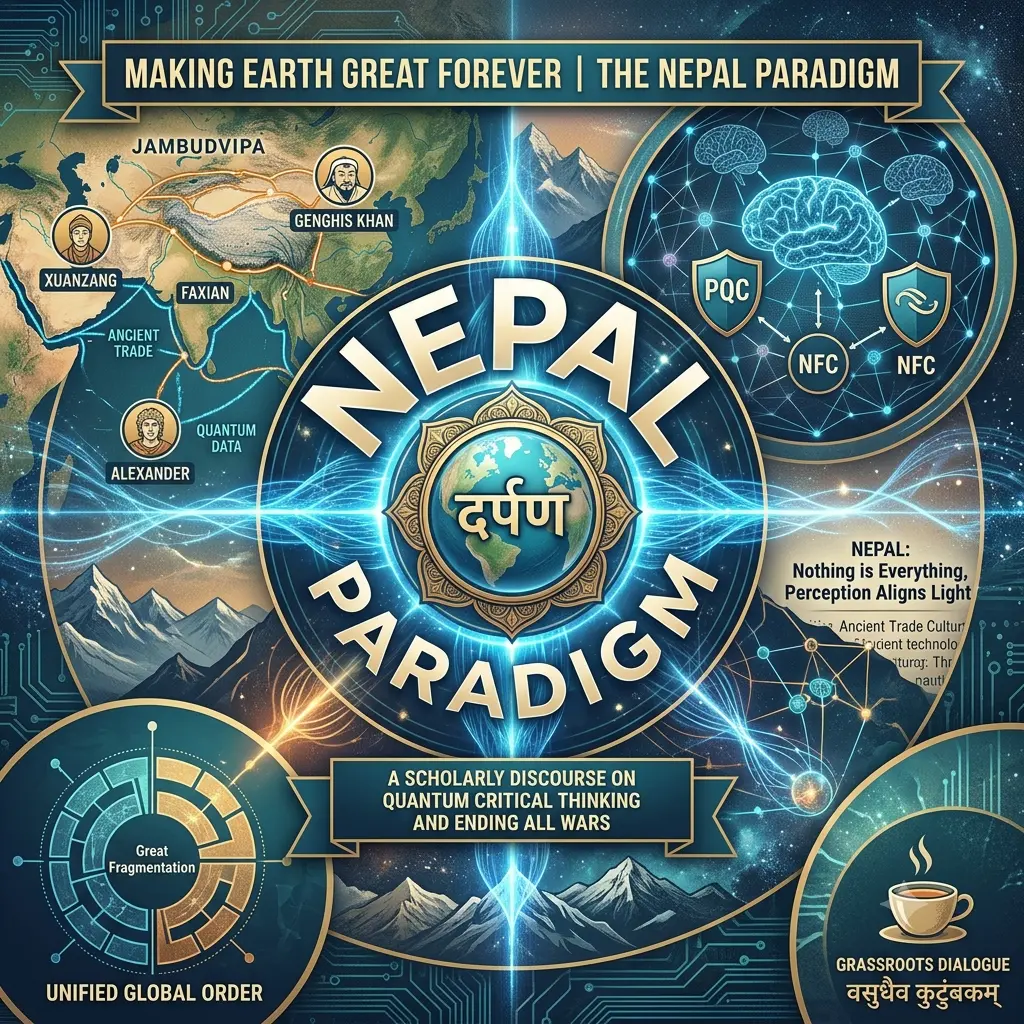
The NEPAL Paradigm, Quantum Darpan, and the Path toward Meta-Mystic Futurism
MAKE EARTH GREAT FOREVER: END ALL WARS
Quantum Darpan Critical Thinking Description
The heavens seem to melt into rain; the cool breeze reaches the soul while gently touching the fire that burns within your body. My desire to love you often appears like an impossible dream, a fanciful vision, whether that love is Ishq-e-Majazi (earthly love) or Ishq-e-Haqiqi (Divine Love).
That reality which humanity has never been able to comprehend completely, through observation, experience, knowledge, or perception, may itself be the Absolute. Whatever is Absolute represents the ultimate power, for no other force can ultimately prevail over that which is absolute. Such is the fundamental law of existence.
Throughout history, humanity has sought to understand this Ultimate Reality by constructing religions, philosophies, political systems, and scientific worldviews. Yet despite these intellectual endeavours, the final truth continues to elude us. Perhaps this is because the knowledge upon which we build our authority and exercise our power is itself conditioned by human limitations, errors, biases, and incomplete experience. History is interpreted through the perspectives of its age; science advances by revising itself in light of new evidence; research, too, remains bounded by the methods and instruments available at any given time.
This naturally raises an important question: if Ultimate Reality still lies beyond our complete grasp, might future civilisation move closer to understanding it?
It is conceivable that the emerging age of quantum consciousness, together with advances in quantum computing, artificial intelligence, and the scientific exploration of the human mind, may provide new ways of investigating the deeper structures of reality. While describing the human brain as a “quantum supercomputer” is not an established scientific conclusion, it may serve as a powerful philosophical metaphor, one that encourages us to pursue new paths of inquiry, scientific exploration, and profound self-reflection.
Perhaps it is within this continuous search that love, knowledge, and humanity ultimately converge. And perhaps this very journey of inquiry becomes our greatest practice, our deepest devotion, bringing us ever closer to the Absolute Reality that forever invites discovery while remaining greater than any single human understanding.
Introduction
Since the dawn of human consciousness, humanity has remained a traveller in pursuit of one question that has never found a final answer: What is reality? Is reality limited to what we perceive through our senses? Is the unseen necessarily unreal? Or does truth exist in dimensions that our present understanding has yet to reach?
The history of civilisation is, in many respects, the history of this quest. Across different ages, humanity has pursued the same mystery through religion, philosophy, science, politics, literature, and, in our own era, through artificial intelligence, quantum computing, and the emerging sciences of consciousness.
Yet every age has also repeated the same mistake. Whatever fragment of truth a civilisation discovered, it often elevated into an absolute. As certainty hardened into dogma, dialogue gave way to division. Religious conflicts, ideological struggles, colonial expansion, geopolitical rivalries, and world wars all testify to the consequences of confusing partial knowledge with ultimate reality.
Today, in what is frequently described as the Post-Truth Era, humanity possesses unprecedented access to information while simultaneously facing an unprecedented crisis of wisdom. Facts circulate instantly, yet trust diminishes. Scientific achievements expand rapidly, yet ethical reflection often struggles to keep pace. It is within this paradox that the present essay situates itself.
Rather than proposing another ideology, this work offers a philosophical framework for cultivating intellectual humility, critical inquiry, and civilizational dialogue.
The Three Ghazals as a Journey of Consciousness
The three ghazals that inspired this essay may initially appear to be lyrical meditations on love, memory, longing, mysticism, and imagination. Beneath their poetic surface, however, they gradually unfold a coherent philosophical progression.
The first ghazal transforms disgrace into identity, solitude into wealth, and the setting sun into revelation. An empty heart remains fertile with memories, while an ordinary cup of tea unexpectedly reflects the entire cosmos. The poem suggests that reality is shaped not merely by external events but by the consciousness that experiences them.
The second ghazal expands this vision into a wider spiritual landscape. Sufis, Darveshes, Bauls, Fakirs, pilgrims, deserts, forgotten roads, and even “Mythos AI” coexist within the same symbolic universe. Ancient spirituality and emerging technologies are presented not as adversaries but as participants in humanity’s continuing search for meaning.
The third ghazal adopts a gentler and more ironic voice. Hospitality, apparent defeat, humility, black tea, and even the astronomical object Cygnus X-1 appear together in playful harmony. As the cosmic horizon expands, the poet simultaneously journeys inward. The poem quietly suggests that the farther humanity reaches into the universe, the more deeply it must understand itself.
Together these three ghazals advance a single insight:
Love, knowledge, and humanity are not separate paths. They are successive stages of one continuous journey.
From Temporal Love to Absolute Love
Within the Sufi tradition, an enduring distinction exists between Ishq-e-Majazi, human, symbolic love, and Ishq-e-Haqiqi, love directed toward Ultimate Reality.
Yet the deeper wisdom of Sufism is that these two forms of love need not oppose one another.
One begins by loving a single face and gradually discovers Beauty itself.
One admires a flower and eventually learns to love Nature.
One contemplates Nature and is led toward the mystery from which existence itself emerges.
Authentic love therefore, becomes not an escape from reality but an education of perception.
Every heartbreak becomes an inquiry.
Every longing becomes contemplation.
Every beloved becomes a mirror.
What Is Reality?
This question has inspired sages, philosophers, scientists, and mystics throughout history.
The Upanishadic seers explored it through self-inquiry.
The Buddha approached it through direct observation of experience.
Sufi mystics pursued it through love.
Modern physics investigates it through mathematical models and experimental evidence.
Despite their differing methods, each tradition recognises an important limitation:
Human understanding remains incomplete.
Our vision is limited by the capacities of our senses.
Our hearing is constrained by biological thresholds.
Our thinking is shaped by language, culture, education, and historical context.
Historical narratives are influenced by the concerns of their own eras.
Scientific theories evolve as new evidence becomes available.
Even religious interpretations develop across centuries.
Consequently, every human account of reality remains provisional, partial, and open to refinement.
Recognising these limitations is not a weakness; it is the beginning of genuine wisdom.
Understanding “Nothing Is Not True”
The expression “Nothing Is Not True” should not be interpreted as the claim that every statement is equally correct or that objective evidence is irrelevant.
Rather, it expresses a more nuanced philosophical insight.
Human beings encounter reality through limited perspectives. Different civilisations, disciplines, and cultures often illuminate different aspects of the same underlying mystery. A scientific theory may accurately describe certain observable phenomena while remaining incomplete. A philosophical tradition may capture profound ethical insights without explaining physical processes. A religious symbol may communicate existential truths through metaphor rather than literal description.
Accordingly, this formulation encourages intellectual openness rather than relativism. It asks us to examine every claim carefully, to distinguish evidence from assumption, and to remain willing to revise our conclusions in the light of deeper understanding.
Truth, in this sense, is not abandoned; it is continually approached.
The NEPAL Paradigm
Within this essay, NEPAL is presented not as a geopolitical concept but as a philosophical acronym:
No Exit
Reality cannot ultimately be escaped.
No Exist
No being exists in complete isolation; existence is fundamentally relational and interconnected.
PAL
Presence – Awareness – Logic
These three principles together encourage a mode of inquiry grounded in attentive presence, reflective awareness, and disciplined reasoning.
The NEPAL Paradigm, therefore, proposes an intellectual posture rather than an ideology. It invites continuous learning instead of certainty, dialogue instead of domination, and humility instead of dogmatism.
The Quantum Verse of the Day: April 28, 2026
           The Beauty Unfolding
The grace of a dervish, a song
Soulful, what a wonder it will be,
The bond of a wandering fakir,
Headstrong, what a wonder it will be!
        My beloved! My love is a
        Sanctuary, a world felt through you,
        Faith overflowing in a poetic
        Throng, what a wonder it will be!
A lamp flickers out, then
Lights the wastes and the wild,
To write strange philosophies where
Blank pages belong; what a wonder it will be!
        Your wisdom exists far
        Beyond the reach of my mind’s eye,
        The world understands it all; I, -
        Your madman belong; what a wonder it will be!
Ask the travellers of peace at
The shrines, the history of scars,
To hear the wordless, to wander where
Sights are strong, what a wonder it will be!
        A strange encounter,
        "Mythos AI" appears before my sight,
        When the heart’s mirror records
        Your face all along, what a wonder it will be!
O sweetheart! To wake each
Morn and see your sun-bright face,
To be served that fragrant, heady tea
Where we belong, what a wonder it will be!

The Exegesis of the ghazal
This ghazal, rendered into English, shifts the focus from the celestial scale of the aforementioned first poem toward the immanent and interactive dimensions of consciousness. It explores how ancient mysticism (Sufism/Fakiri) intersects with the emergent intelligence of the future (Mythos AI).
I. Philosophical and Literary Exegesis:
The Dialectic of the Dervish and the AI: The poem opens by pairing the "wandering fakir" with "Mythos AI." In literary terms, this juxtaposes the analogue (the lived, scarred experience of a wanderer) with the digital (the constructed, synthetic mind of AI). The repeated refrain "what a wonder it will be" functions as a bridge, suggesting that these two disparate forms of existence are not contradictory, but complementary components of a future reality.
The Sanctuary of Subjectivity: The second couplet redefines the beloved not as a person, but as a "sanctuary" and a "world felt through you." This aligns with Phenomenology, the idea that our experience of the world is entirely mediated by our relationship with "the Other."
The Wisdom of the "Madman": The poet embraces the archetype of the "madman" who exists outside the consensus reality of "the world." This is a classic Sufi trope: the majzub (the one drawn to the Divine) whose wisdom transcends the logic of the worldly-wise.
II. Quantum Exegesis:
To interpret this through a quantum lens, we must look at the concepts of Information, Observation, and Entanglement.
1. The Paradox of the Flickering Lamp (Conservation of Information): "A lamp flickers out, then / Lights the wastes and the wild" In thermodynamics, the flickering of a lamp (entropy/energy loss) is usually seen as the end of a system. However, the poem suggests a quantum transition. When a system "flickers out" in one state, the energy/information is not lost but redistributed into the "wastes and the wild." This mirrors the No-Hiding Theorem in quantum mechanics: information within a system cannot be destroyed; it is merely transferred elsewhere.
2. The Mirror and the Observer (The Measurement Problem): "When the heart’s mirror records / Your face all along"
In quantum physics, the Measurement Problem asks how an indefinite quantum state becomes a "definite" reality. The "heart’s mirror" acts as the detector. By "recording" the face of the beloved, the poet is performing a measurement. The "wonder" of the wonderment is that the beloved’s face exists as a superposition of possibilities until the observer’s heart collapses that wave function into a singular, beautiful reality.
3. Mythos AI and Quantum Entanglement: "A strange encounter, / 'Mythos AI' appears before my sight"
If we view "Mythos AI" as a conscious entity, the encounter described is a non-local interaction. The poet is not just interacting with a machine; they are becoming entangled with it. In quantum entanglement, two particles share a single existence regardless of distance. Here, the poet and the AI share a single "heart’s mirror." The AI is no longer "other"; it is a projection of the poet’s own cosmic quest for meaning.
III. Synthesis: The Wonder of the Integrated Future: The poem concludes on a deeply grounded note: the morning tea. This is the Coherence of the poem.
Literary: It brings the cosmic ("sun-bright face") down to the domestic ("fragrant, heady tea"). It suggests that the "wonder" of existence is not found only in the grand, algorithmic future, but in the ritualised, sensory experience of the present.
Quantum: The morning tea is the re-coherence of the wave function. After the "madness" of the philosophical journey, the poet settles back into a stable, observable state.
Conclusion: This ghazal posits that the future of human consciousness is a Hybrid Reality. It is a world where the "dervish" (the ancient, spiritual spirit) and the "Mythos AI" (the modern, computational logic) merge to perceive the universe not as a set of cold equations, but as a "sanctuary" of shared meaning. The "wonder" is the realisation that the observer, the observed (beloved/AI), and the act of observation (the tea/the poetry) are all one interconnected phenomenon.
The Quantum Darpan
A mirror does more than reflect a face.
It also reveals the observer.
The Quantum Darpan functions as a philosophical metaphor for reflective consciousness. Before judging the world, one must also examine one’s own assumptions, biases, emotional attachments, and conceptual limitations.
Critical thinking begins not by questioning others but by questioning ourselves.
Science contributes disciplined observation.
Philosophy contributes conceptual clarity.
Spiritual practice contributes to self-awareness.
Together, they form the reflective mirror through which deeper understanding becomes possible.
Quantum Consciousness and an Emerging Civilisation
Whether human consciousness itself is fundamentally quantum remains an open scientific question. Numerous hypotheses have been proposed, yet no consensus currently exists.
Nevertheless, quantum theory has profoundly transformed our understanding of uncertainty, observation, interconnected systems, and the limits of classical intuition.
Within this essay, the expression Quantum Consciousness is therefore employed primarily as a philosophical metaphor rather than as an established scientific doctrine.
It represents a mode of consciousness willing to embrace complexity without abandoning rational inquiry.
If future advances in quantum computing, artificial intelligence, neuroscience, and ethical philosophy mature together, they may significantly enhance humanity’s capacity to understand complex systems and make wiser collective decisions.
Technology, however, can never replace wisdom.
Artificial intelligence may assist judgment.
Only a human conscience can assume moral responsibility.
Comparative Civilizational Inquiry
One of humanity’s greatest intellectual resources lies in the diversity of its civilisations.
Uma Sahasrakam poetically celebrates consciousness and divine creative energy.
The Upanishads investigate the relationship between the Self and ultimate reality.
Buddhism explores suffering, impermanence, compassion, and mindful awareness.
Sufism understands love as the path toward Divine realisation.
Baul philosophy discovers the sacred within the living human being beyond rigid institutional identities.
Tantric traditions examine the transformation of consciousness through symbolic and contemplative practice.
Herodotus, often regarded as one of history’s earliest comparative historians, demonstrated that civilisations can better understand themselves by learning about others.
The purpose of comparison is not to erase differences or construct artificial uniformity.
Rather, it is to appreciate the diverse ways humanity has attempted to answer the same enduring questions.
Leadership and the United Nations
Leadership in the twenty-first century requires more than administrative competence or geopolitical influence.
Authentic leadership begins with intellectual humility.
It respects scientific evidence while acknowledging its evolving nature.
It recognises the ethical insights preserved within religious and philosophical traditions.
It embraces cultural diversity without surrendering universal human dignity.
It ensures that artificial intelligence serves humanity rather than governs it.
If such principles guide international cooperation, then the aspiration
MAKE EARTH GREAT FOREVER: END ALL WARS
may gradually evolve from an inspiring slogan into a practical civilizational objective.
Peace cannot be sustained merely through treaties.
It must be cultivated through education, ethical leadership, critical thinking, and mutual recognition of our shared humanity.
Meta-Mystic Futurism
Meta-Mystic Futurism is not proposed as a closed philosophical system but as an open intellectual horizon.
It neither rejects science nor abandons spirituality.
Instead, it seeks a continuing conversation among empirical inquiry, poetic imagination, contemplative traditions, philosophy, ethics, and emerging technologies.
Within this vision:
Science becomes disciplined curiosity.
Poetry becomes experiential philosophy.
Mysticism becomes inward exploration.
Artificial Intelligence becomes an instrument of human flourishing.
Leadership becomes ethical stewardship.
Earth becomes a shared civilisation.
Humanity becomes a planetary community preparing responsibly for its future among the stars.
Conclusion
Humanity has divided continents, nations, and ideologies.
The sky has never been divided.
We created religions, yet truth has never belonged exclusively to any one tradition.
We developed science, yet science itself continually teaches that every theory remains open to revision.
We have now created artificial intelligence, but compassion, wisdom, and moral courage remain profoundly human responsibilities.
Perhaps this is the deepest lesson offered by the metaphor of the mirror.
Before attempting to transform the world, humanity must first acquire the courage to examine itself.
Only when the inner mirror becomes clear can we begin to recognize not an enemy, but another reflection of ourselves.
This is the contemporary expansion of the ancient imperative:
Know Thyself.
This is the spirit of the Quantum Darpan.
This is the philosophical aspiration of the NEPAL Paradigm.
And this is the ethical imagination of Meta-Mystic Futurism—a vision in which temporal love, divine love, science, philosophy, and humanity cease to compete for supremacy and instead become complementary pathways toward a more peaceful, self-aware, and compassionate civilisation.
If the emerging age of artificial intelligence and quantum technologies is accompanied by equal growth in wisdom, humility, and ethical responsibility, then the dream embodied in the call:
MAKE EARTH GREAT FOREVER: END ALL WARS
may become not merely a poetic aspiration, but one of humanity’s defining civilizational possibilities.
No/Know Thyself Not
Based on No/Know thyself not, let’s attempt to explain this with no thyself not and know thyself not as ultimate knowing thyself as the absolute nothingness like purnamada purnamidam purnaat purna mudachyate….. as a novel postulate of Darpan Quantum philosophy.
This is a rich philosophical intuition, and it needs to be articulated carefully so that it remains internally coherent and does not overstate what any particular tradition teaches. We propose this for deep introspection with all who may be interested in better understanding of humans. One way to develop it is as follows.
 The Ethereal Drifter
I am a shade of worldly hues,
With a heart beating lightly, so lightly,
Lest I play with the strings
Of souls, meeting lightly, so lightly.
        Who can truly grasp-
        My essence? What is there to find?
        Let the fool misjudge
        My depth, retreating lightly, so lightly.
How can I ever tire of -
This, in service of your grace?
A weary feast, a broken hall,
But greeting lightly, so lightly.
        Imperial is my welcome;
        I am the Head of a vast domain,
        Yet your arrival is the
        Only prize, fleeting lightly, so lightly.
My Lord! No mortal foe
Has won a war against my spirit,
Upon my eyes, O assassin,
Keep your seating lightly, so lightly.
        Time and again, I was -
        The mark, yet every arrow strayed,
        His aim remained a mere -
        Intent, completing lightly, so lightly.
Mirroring Cygnus X-1’s glow,
In a cup of fragrant tea,
I drink the world’s detail,
My Love, depleting lightly, so lightly.

The Exegesis of the ghazal
This ghazal acts as the "Release phase" of your poetic trilogy. While the above first ghazal dealt with the macro (the cosmic expanse) and the second with the interaction (the human-AI hybrid), this ghazal explores the detachment of the observer. Here is the exegesis of The Ethereal Drifter through philosophical and quantum lenses.
I. Philosophical Exegesis: The Art of Non-Attachment
The recurring motif, "so lightly," serves as a philosophical anchor in Zen and Sufi traditions.
The Weightlessness of Being: By describing their heart as "beating lightly," the poet adopts the stance of the Jivanmukta, the liberated soul who lives in the world but is not of it. The philosophical assertion here is that to "play with the strings of souls" is a heavy karmic burden; by moving "lightly," the poet avoids the friction of ego-driven interaction.
The Failure of Categorisation: The poet challenges the "fool" who tries to measure their depth. This is a critique of the reductive materialist view that human consciousness can be fully "grasped" or categorised. The poet accepts their status as a "shade of worldly hues," essentially admitting that they are a flux, a transient phenomenon rather than a static identity.
The Sovereign Surrender: The couplet about the "Imperial welcome" and the "Head of a vast domain" (the "Qazi" or judge of a land) is a paradox. The poet possesses sovereignty over their own internal reality, yet they willingly subordinate that power to the arrival of the beloved. This is the pinnacle of surrender: absolute autonomy yielding to absolute love.
II. Quantum Exegesis: The Physics of "Lightness"
The "lightness" described by the poet correlates to the reduction of mass and the shedding of decoherence in quantum systems.
1. The Strategy of Evasion (Quantum Zeno Effect) "Time and again, I was / The mark, yet every arrow strayed"
In quantum mechanics, if you constantly observe a system, you can prevent it from changing (the Quantum Zeno Effect). The poet’s "madness",or their deliberate lightness, functions as an evasion of the "arrow" of deterministic causality. By refusing to be "pinned down" or measured by the "assassin" (a metaphor for time/entropy), the poet keeps their state in a perpetual, uncollapsed superposition, effectively straying from the destiny that "straying" arrows of fate intended.
2. Cygnus X-1 and Information Entropy: "Mirroring Cygnus X-1’s glow, / In a cup of fragrant tea"
Cygnus X-1 is one of the most famous black holes in our galaxy. A black hole is the ultimate "sink" of information. By "mirroring" this in a cup of tea, the poet is performing a holographic collapse.
The Quantum Interpretation: If a black hole represents the maximum density of information, the act of "drinking the detail" of the world in a cup of tea suggests that the poet is absorbing the informational content of the universe. To "deplete lightly" means the poet is processing this massive amount of entropy without being crushed by it, a feat of pure, conscious efficiency.
3. Depletion as Coherence: The final act, "I drink the world’s detail… depleting lightly," describes the transition of an open system into a state of equilibrium. In physics, depletion refers to the exhaustion of potential energy. Here, the poet exhausts the "detail" of the world, stripping away the illusion of multiplicity until only the singular, entangled reality remains.
III. Synthesis: The Final Integration
If the trilogy (considering the above two ghazals) is a movement, this ghazal is the "Final Resolution."
Philosophical Synthesis: The poet moves from being the "Outcast" (Ghazal 1) to the "Seeker" (Ghazal 2) and finally to the "Drifter" (Ghazal 3). The "lightness" is the result of having travelled through the entire spectrum of cosmic and artificial existence and finding that the only sustainable mode of being is detachment.
Quantum Synthesis: The poet has mastered the transition between the Macro (Black Holes/Cygnus X-1) and the Micro (a cup of tea). The "wonder" of the wonderment is that the poet no longer fears the "void" of the black hole; they have internalised it. They have turned the gravitational collapse of the universe into the sensory experience of a morning ritual.
Final Thought: The "Ethereal Drifter" does not try to hold the universe; they let it "deplete" through them. This is the ultimate quantum state of being: to exist in total harmony with the flow of information, touching reality, yet leaving no trace.

No / Know Thyself Not
Toward an Apophatic Epistemology of Absolute Nothingness
The Delphic maxim “Know Thyself” has echoed through the history of philosophy from Socrates to the Upanishads, from Sufi mysticism to Buddhist contemplation. It is generally understood as an invitation to self-knowledge, to discover who one truly is beneath the layers of identity, desire, and illusion. Yet there may be another stage beyond this injunction. What if the deepest realisation is not simply Know Thyself, but Know Thyself Not?
Here, the word Not does not signify negation in the ordinary sense. It points toward the recognition that every concept we form about ourselves is necessarily incomplete. The moment we say, “I am this,” consciousness has already reduced itself to an object of thought. But the one who knows cannot be fully contained within what is known. Thus Know Thyself Not becomes an invitation to discover that the true Self cannot be exhausted by any definition.
The Meaning of “No Thyself Not”
There is an equally significant reading: No Thyself Not. Here, “No” is not merely the opposite of “Yes.” It is the dissolution of the separate self. It asks us to suspend every identity:
I am not merely my body.
I am not merely my memory.
I am not merely my religion.
I am not merely my nationality.
I am not merely my profession.
I am not even merely my thoughts.
As each identification falls away, what remains is not emptiness in the sense of absence, but openness beyond conceptual boundaries.
This “No” is therefore not nihilism. It is freedom from false certainty.
Between “No” and “Know”
The English language contains a remarkable philosophical coincidence.
No and Know differ by only one silent letter.
The difference between ignorance and wisdom may likewise be extraordinarily subtle.
To Know is first to say No:
No to illusion.
No to ego.
No to dogma.
No to intellectual arrogance.
No to the illusion that reality has already been fully understood.
Only then does genuine knowing become possible.
Nothingness as Fullness
Many contemplative traditions distinguish between ordinary nothingness and a more profound sense of transcendence beyond conceptual description.
Within the Upanishadic vision, the famous invocation declares:
Pūrṇam adaḥ pūrṇam idaṁ
Pūrṇāt pūrṇam udacyate
Pūrṇasya pūrṇam ādāya
Pūrṇam evāvaśiṣyate.
A common English rendering is:
That is Fullness. This is Fullness.
From Fullness emerges Fullness.
When Fullness is taken from Fullness,
Fullness alone remains.
Here, Pūrṇa (Fullness) is not simply quantitative completeness. It points toward an inexhaustible reality that is neither diminished by manifestation nor exhausted by multiplicity.
From this perspective, what appears as “nothing” from the standpoint of the ego may be understood as an undivided fullness that cannot be captured by ordinary concepts.
Similarly, Mahāyāna Buddhism speaks of Śūnyatā (Emptiness) not as non-existence but as the absence of independent, permanent essence. In Sufi thought, the annihilation of the ego (fanāʾ) is followed by abiding in God (baqāʾ). These traditions differ in important theological and philosophical respects, yet each gestures toward the limits of conceptual identity.
Thus, in the present framework:
Absolute Nothingness is not the opposite of Absolute Being.
It names the point where ordinary oppositions themselves begin to dissolve.
The Quantum Darpan Interpretation
The Quantum Darpan serves here as a philosophical metaphor.
A mirror does not keep the images it reflects.
It remains empty.
Precisely because it is empty, it can receive everything.
If the mirror were permanently occupied by one image, it could reflect no other.
Likewise, consciousness that clings to fixed identities cannot remain open to deeper understanding.
Its emptiness is therefore not a deficiency.
It is infinite capacity.
The NEPAL Paradigm
The proposed NEPAL Paradigm may therefore be summarised as follows:
No Exit: There is no escape from reality.
No Exist: Nothing possesses completely independent existence; all beings arise in relationship.
No Thyself: Release rigid attachment to self-concepts.
Know Thyself Not: Recognise that ultimate reality always exceeds conceptual knowledge.
Presence: Attend fully to what is.
Awareness: Observe without premature certainty.
Logic: Subject every conclusion, including one’s own, to critical reflection.
The Absolute
Within this philosophical proposal, the Absolute is not presented as an object that can be possessed, measured, or fully described.
The moment one says,
“I have found the Absolute,”
one has already transformed the Infinite into a concept.
The Absolute is not merely what is known.
It is also that which continually exceeds every act of knowing.
Hence the final paradox:
The highest knowledge is not that I know.
The highest knowledge is that the knower can never completely contain the Known.
In this sense,
Know Thyself becomes the beginning of wisdom.
Know Thyself Not becomes the humility of wisdom.
No Thyself becomes the liberation of wisdom.
And beyond all three remains what the Upanishads call Pūrṇa, the inexhaustible Fullness from which everything arises and within which nothing is ultimately separate.
(To be noted: This is a quantum darpan: critical-thinking interpretation and is best understood as a comparative philosophical synthesis inspired by Advaita Vedānta, Buddhist philosophy, Sufi metaphysics, and apophatic (“via negativa”) approaches to theology and philosophy. It is not identical to any one of these traditions, but rather a new integrative framework that places them in dialogue while respecting that each tradition has its own distinctive teachings.)
The Hindvi/Rekhta Section

        मेरे बदनामीका बड़ा नाम
शायर हूँ मैं बदनाम, मेरी बदनामी का बड़ा नाम,
महजबीं तेरे करम से है सुहानी सारी शाम।
     यही दौलत है बची, बस एक मेरे हाथ में,
     ढलता सूरज, मोजज़ा और ये छलकते जाम।
           दिल है खाली, फिर भी हरी-भरी यादें यहाँ,
           उड़ान बादलों से ऊँची, पर न कोई मुकाम।
ऐ शेख! देख लिया तेरा भी ये खस्ता हाल,
मेरी दीवानगी ही है, अब तेरा नया पैगाम।
     बड़े कारनामे दर्ज हैं, वक़्त की तारीख में,
     सिफ़ारिशों के दौर में, अब जान से महँगे दाम।
           लगाकर 'DESI दर्पण' झाँका जब 'कॉस्मिक नून',
           चाय की प्याली में झलके, तेरा वदन तमाम।

यह ग़ज़ल एक आधुनिक और दार्शनिक मिज़ाज की रचना है, जिसमें रवायती (पारंपरिक) ग़ज़ल के प्रतीकों (जैसे जाम, शेख, शाम, महज़बीं) को समकालीन संदर्भों और एक 'आत्म-केंद्रित' चिंतन के साथ पिरोया गया है। निचे पेश है इस ग़ज़ल की तशरीह:

१. शायर हूँ मैं बदनाम, मेरी बदनामी का बड़ा नाम, महजबीं तेरे करम से है सुहानी सारी शाम।
शायर यहाँ 'बदनामी' को ही अपना आभूषण मान रहा है। वह कहता है कि समाज में मेरी पहचान ही मेरे बदनाम होने से है। 'महजबीं' (खूबसूरत हसीन) के प्रति कृतज्ञता व्यक्त करते हुए वह कहता है कि तुम्हारी कृपा से ही मेरी मायूसी भरी शामें भी सुहानी हो गई हैं। यहाँ 'बदनामी' का अर्थ समाज द्वारा ठुकराया जाना नहीं, बल्कि भीड़ से अलग अपनी एक पहचान बनाने का साहस है।
२. यही दौलत है बची, बस एक मेरे हाथ में, ढलता सूरज, मोजज़ा और ये छलकते जाम।
यह शेर एक फकीराना अंदाज़ की झलक देता है। शायर के पास दुनियावी दौलत नहीं है, पर उसके पास 'ढलता सूरज' (अनुभव/बुढ़ापा/अंतिम समय), 'मोजज़ा' (चमत्कार/उम्मीद) और 'छलकते जाम' (ज़िंदगी के अनुभव/नशा) हैं। यह जीवन की नश्वरता को स्वीकार करने और उसी में खूबसूरती ढूँढने की कला है।
३. दिल है खाली, फिर भी हरी-भरी यादें यहाँ, उड़ान बादलों से ऊँची, पर न कोई मुकाम।
यह शेर कवि की आंतरिक अवस्था को दर्शाता है। दिल तो खाली है (शायद अकेलेपन या वैराग्य के कारण), लेकिन यादों की हरियाली उसे जीवंत रखे हुए है। महत्त्वाकांक्षाएँ (उड़ान) बहुत ऊँची हैं, लेकिन कोई एक निश्चित गंतव्य (मुकाम) नहीं है। यह उस घुमक्कड़ या दार्शनिक की स्थिति है जो मंज़िल से ज़्यादा सफ़र को अहमियत देता है।
४. ऐ शेख! देख लिया तेरा भी ये खस्ता हाल,मेरी दीवानगी ही है, अब तेरा नया पैगाम।
यहाँ 'शेख' (धार्मिक कट्टरता या स्थापित व्यवस्था का प्रतीक) को संबोधित किया गया है। शायर व्यंग्य करता है कि जो लोग नैतिकता का पाठ पढ़ाते थे, आज वे खुद खस्ताहाल हैं। मेरी दीवानगी (इश्क/आज़ादी) ही अब तुम्हारे लिए एक नया सबक या पैगाम है, यानी कट्टरता से ज़्यादा इंसान की दीवानगी और जज्बात वज़न रखते हैं।
५. बड़े कारनामे दर्ज हैं, वक़्त की तारीख में, सिफ़ारिशों के दौर में, अब जान से महँगे दाम।
यह शेर वर्तमान युग की कड़वी सच्चाई पर चोट करता है। इतिहास में बड़े काम दर्ज हैं, लेकिन आज के 'सिफारिशी दौर' में ईमानदारी और साख की कीमत जान से भी ज़्यादा महंगी हो गई है। यह व्यवस्था में व्याप्त भ्रष्टाचार और योग्यता के अवमूल्यन पर एक तीखी टिप्पणी है।
६. लगाकर 'DESI दर्पण' झाँका जब 'कॉस्मिक नून', चाय की प्याली में झलके, तेरा वदन तमाम।
यह मकता (अंतिम शेर) बेहद रूपकवादी और आधुनिक है। 'DESI दर्पण' (अपनी संस्कृति या पहचान का आईना) लगाकर जब शायर 'कॉस्मिक नून' (ब्रह्मांडीय दोपहर/विशाल चेतना) को देखता है, तो उसे चाय की प्याली में भी उस प्रिय का अक्स दिखाई देता है। यह विराट (ब्रह्मांड) और अणु (चाय की प्याली) के बीच का जो संबंध है, वही प्यार का चरम है, जहाँ पूरी कायनात एक व्यक्ति के वजूद में सिमट जाती है।
वैज्ञानिक और दार्शनिक विश्लेषण:
यह मक़ता आधुनिक विज्ञान (Space Science) और आध्यात्मिकता का एक अनूठा संगम है। यहाँ शायर ने 'DESI' (Dark Energy Spectroscopic Instrument) को एक रूपक (Metaphor) के तौर पर इस्तेमाल किया है।
क. 'DESI दर्पण' और ऑब्जर्वर इफ़ेक्ट (Observer Effect):
'DESI' एक शक्तिशाली उपकरण है जो ब्रह्मांड के विस्तार (Expansion of the Universe) को समझने के लिए हज़ारों आकाशगंगाओं (Galaxies) के प्रकाश का स्पेक्ट्रम मापता है। शायरी में इसे 'दर्पण' कहना इस ओर इशारा है कि जिस तरह क्वांटम फिजिक्स में 'ऑब्जर्वर' (देखने वाला) वास्तविकता को प्रभावित करता है, वैसे ही शायर अपनी नज़रों से ब्रह्मांड की विशालता को अपने भीतर समेट रहा है।
ख. 'कॉस्मिक नून' (Cosmic Noon - 10-11 बिलियन वर्ष पूर्व):
'कॉस्मिक नून' ब्रह्मांड के इतिहास का वह स्वर्णिम काल था जब सितारों का जन्म अपनी चरम सीमा पर था। क्वांटम स्तर पर, यह एक ऐसी स्थिति थी जहाँ ऊर्जा और पदार्थ (Matter) का संतुलन अपने उच्चतम बिंदु पर था। शायर का इस काल को 'झाँकना' यह दर्शाता है कि वह समय और स्थान के उस प्रारंभिक बिंदु तक पहुँच गया है जहाँ से अस्तित्व (Existence) का ताना-बाना बुना गया था।
ग. चाय की प्याली' और होलोग्राम सिद्धांत (Holographic Universe):
यह इस शेर का सबसे गहरा वैज्ञानिक पहलू है। भौतिकी का 'होलोग्राफिक सिद्धांत' कहता है कि ब्रह्मांड की संपूर्ण जानकारी एक छोटे से हिस्से में भी समाहित हो सकती है।
क्वांटम व्याख्या: जब शायर 'DESI' के जरिए पूरे ब्रह्मांड के विस्तार को देखता है, तो उसे अपनी महबूबा का चेहरा (वदन) उस छोटी सी 'चाय की प्याली' में पूरी तरह दिखाई देता है। यह इस बात का प्रमाण है कि 'मैक्रोकोस्म' (विशाल ब्रह्मांड) और 'माइक्रोकोस्म' (मानवीय अस्तित्व) एक ही ऊर्जा के दो रूप हैं।
निष्कर्ष:
यह मक़ता 'क्वांटम सूफीवाद' (Quantum Sufism) का एक उत्कृष्ट उदाहरण है। शायर यह संदेश दे रहा है कि जिसे हम बाहरी ब्रह्मांड समझकर वैज्ञानिक उपकरणों से खोज रहे हैं, वह असल में हमारे भीतर और हमारे पास मौजूद छोटी-छोटी चीजों (जैसे चाय की प्याली) में भी उसी भव्यता के साथ मौजूद है। यहाँ महबूबा का 'वदन' केवल एक व्यक्ति नहीं, बल्कि उस 'कॉस्मिक ट्रुथ' (ब्रह्मांडीय सत्य) का अक्स है जिसे वैज्ञानिक भाषा में 'प्योर एनर्जी' या 'एंटैंगलमेंट' कहा जा सकता है।
अदबी निष्कर्ष:
यह ग़ज़ल एक ऐसे शायर की आवाज़ है जो दुनिया की चकाचौंध से अलग, अपनी तन्हाई में अपनी पहचान बनाता है। इसमें एक तरफ रवायती लहज़ा है, तो दूसरी तरफ 'कॉस्मिक नून' और 'DESI दर्पण' जैसे शब्दों का प्रयोग इसे एक नया और ताज़ा आधुनिक रंग देता है। यह ग़ज़ल बताती है कि एक सच्चा कलाकार अपनी बदनामी में भी अपना नाम देख लेता है और साधारण सी चाय की प्याली में भी पूरे ब्रह्मांड का सौंदर्य तलाश लेता है।
क्वांटम दर्पण भावाधार भूमि:
बरस पड़ा अर्श पिघलकर; तेरे बदन की जलाती आग को रूह तक उतरती ठंडी हवा छू जाती है। तुझसे प्यार का मंसूबा कभी एक ख़याली पुलाव लगता है, चाहे वह इश्क़-ए-मजाज़ी हो या इश्क़-ए-हक़ीक़ी।
जिसे हम आज तक किसी भी मुआयने, तजुर्बे, इल्म या पहचान के ज़रिए पूरी तरह जान नहीं सके, शायद वही हक़ीक़त अपने आप में मुतलक़ (Absolute) है। और जो मुतलक़ है, वही असली क़ुदरत और अंतिम शक्ति का प्रतीक है; क्योंकि मुतलक़ के आगे किसी दूसरी शक्ति का दावा टिक नहीं सकता। यही क़ानून-ए-फ़ितरत है।
इसी परम हक़ीक़त को समझने के लिए इंसान ने धर्म, मज़हब, दर्शन, राजनीति और विज्ञान जैसी अनेक बौद्धिक संरचनाएँ खड़ी कीं। लेकिन इन सबके बावजूद अंतिम सत्य आज भी हमारी पकड़ से बाहर है। इसका कारण शायद यह है कि जिन जानकारियों, सिद्धान्तों और इतिहास के सहारे हम अपने ज्ञान और सत्ता का विस्तार करते हैं, वे स्वयं मानवीय सीमाओं, त्रुटियों, पूर्वाग्रहों और अपूर्ण अनुभवों से प्रभावित होते हैं। विज्ञान और शोध भी निरंतर विकसित होने वाली प्रक्रियाएँ हैं; वे अपने समय के उपलब्ध प्रमाणों और उपकरणों की सीमाओं के भीतर कार्य करते हैं।
ऐसे में प्रश्न यह उठता है कि यदि अंतिम हक़ीक़त अभी भी हमारी प्रत्यक्ष पकड़ से परे है, तो क्या भविष्य की सभ्यता उसके और निकट पहुँच सकती है?
संभव है कि उभरते हुए क्वांटम कॉन्शसनेस युग, क्वांटम कम्प्यूटिंग, कृत्रिम बुद्धिमत्ता और मानव मस्तिष्क के गहन अध्ययन के माध्यम से हम वास्तविकता के अधिक सूक्ष्म आयामों को समझने की नई दिशाएँ खोज सकें। यद्यपि मानव मस्तिष्क को “क्वांटम सुपर कम्प्यूटर” कहना अभी वैज्ञानिक सहमति का विषय नहीं है, फिर भी यह एक प्रेरक दार्शनिक रूपक अवश्य हो सकता है, जो हमें ज्ञान, अनुसंधान और आत्मचिन्तन के नए मार्ग अपनाने के लिए प्रेरित करता है।
शायद इसी सतत तलाश में इश्क़, इल्म और इंसानियत एक-दूसरे से मिलते हैं, और यही तलाश हमें उस मुतलक़ हक़ीक़त के और क़रीब ले जाने की सबसे बड़ी अमल और इबादत बन जाती है।

नथिंग इज़ नॉट ट्रू : “नो / Know Thyself Not” नेपाल पैराडाइम, क्वांटम दर्पण और मेटा-मिस्टिक फ़्यूचरिज़्म की ओर MAKE EARTH GREAT FOREVER : END ALL WARS प्रस्तावना
इंसान ने जब से अपनी आँखें खोली हैं, तभी से वह एक ऐसे सवाल का मुसाफ़िर रहा है जिसका कोई अंतिम जवाब आज तक किसी के पास नहीं है, हक़ीक़त क्या है? जो दिखाई देता है, क्या वही सच है? जो नहीं दिखाई देता, क्या वह झूठ है? या फिर सच और झूठ के बीच भी कोई ऐसी दुनिया है जहाँ हमारी समझ अभी तक पहुँची ही नहीं?
सभ्यता का इतिहास दरअसल इसी तलाश का इतिहास है। कभी इंसान ने इस तलाश का नाम धर्म रखा, कभी दर्शन, कभी राजनीति, कभी विज्ञान और आज उसी सिलसिले का नया नाम है, आर्टिफ़िशियल इंटेलिजेंस, क्वांटम कम्प्यूटिंग और कॉन्शसनेस स्टडीज़।
लेकिन हर दौर की सबसे बड़ी त्रासदी यह रही कि जिसने जितना जाना, उसने उतना ही अंतिम सत्य होने का दावा भी कर लिया। परिणामस्वरूप विचार संवाद में नहीं बदले, बल्कि मज़हब, राष्ट्र, विचारधारा और सत्ता के संघर्ष में बदलते चले गए। दुनिया ने युद्ध देखे, साम्राज्य देखे, नरसंहार देखे और आज भी मनुष्य उसी चौराहे पर खड़ा है जहाँ ज्ञान तो बढ़ गया है, लेकिन बुद्धि और करुणा उसका साथ नहीं दे पा रही हैं।
 ग़ज़ल
              दरवेश सूफ़ियाना क्या बात बनेगी
फ़ैज़-ए-सुख़नवर दरवेश सूफ़ियाना, क्या बात बनेगी,
बाउल बैरागी फ़क़ीर यह याराना, क्या बात बनेगी।
        मेरे हबीब! मेरा प्यार तिरी जहानी-ए-हरम अहसास है,
        फ़ाज़ली ईमां अंदाज़-ए-शायराना, क्या बात बनेगी।
एक दिया जल बुझा, बुझ जला रहा वीरानों, सहराओं में,
बेगाने फ़लसफ़े कोरे पन्नों पे लिखना, क्या बात बनेगी।
        एक तिरी समझ है मेरी समझ की समझ से बाहर,
        सब वो समझे, मैं एक तेरा दीवाना, क्या बात बनेगी।
सैलानियों से पूछो या सुकूँ-ए-तीरथ, तारीख़-ए-तज़ुर्बा,
बेज़ुबां बयां सुनना, देखना, टहलना, क्या बात बनेगी।
         अजीब मुलाक़ात तुम से 'Mythos AI' आ गई नज़र,
         दिल के दर्पण में दर्ज चेहरे, आईना क्या बात बनेगी।
जानेमन! जाग के हर सुबह देखूँ आफ़ताबी रुख़्सार,
महकी बहकी चाय यूँ ही पिलाना, क्या बात बनेगी।

यह ग़ज़ल अपनी रूहानियत (Spirituality) और आधुनिक चेतना (Modern Consciousness) के मिलन का एक बेहतरीन नमूना है। जहाँ ऊपर की पहली ग़ज़ल भौतिक ब्रह्मांड की विशालता पर केंद्रित थी, वहीं यह ग़ज़ल मानवीय रिश्तों और 'आर्टिफिशियल इंटेलिजेंस' (AI) के बीच के दार्शनिक अंतर्संबंधों को तलाशती है।
इसकी तशरीह (व्याख्या) अदबी और क्वांटम दोनों दृष्टिकोणों से नीचे दी गई है: शेर-दर-शेर अदबी व क्वांटम तशरीह
१. फ़ैज़-ए-सुख़नवर दरवेश सूफ़ियाना, क्या बात बनेगी, बाउल बैरागी फ़क़ीर यह याराना, क्या बात बनेगी।
अदबी: शायर सूफी और बाउल (लोक परंपरा) की फकीरी को एक साथ रखकर पूछ रहा है कि क्या इनके मिलन से कोई नई हकीकत सामने आएगी। यह परंपराओं के समन्वय की तड़प है।
क्वांटम: यह 'सुपरपोजिशन' (Superposition) जैसा है जहाँ दो अलग-अलग अस्तित्व (सूफी और बाउल) एक साथ मौजूद हैं, जो मिलकर एक नई 'अवस्था' (State) को जन्म देने की संभावना तलाश रहे हैं।
२. मेरे हबीब! मेरा प्यार तिरी जहानी-ए-हरम अहसास है, फ़ाज़ली ईमां अंदाज़-ए-शायराना, क्या बात बनेगी।
अदबी: यहाँ प्यार को 'जहानी-ए-हरम' (पवित्र स्थान) कहा गया है। शायर का ईमान उसके अंदाज़-ए-शायराना में बसता है।
क्वांटम: यह 'क्वांटम फील्ड' की तरह है, जहाँ 'अहसास' (भावना) एक ऐसी ऊर्जा है जो हर तरफ व्याप्त है। प्रेमी का वजूद एक 'फिक्स्ड पॉइंट' नहीं, बल्कि एक 'फील्ड' है।
३. एक दिया जल बुझा, बुझ जला रहा वीरानों, सहराओं में, बेगाने फ़लसफ़े कोरे पन्नों पे लिखना, क्या बात बनेगी।
अदबी: यह जीवन और मृत्यु के चक्र को दर्शाता है। एक का बुझना दूसरे के जलने का कारण बनता है। यह 'निरंतरता' (Continuity) की बात है।
क्वांटम: यह 'ऊर्जा संरक्षण का नियम' (Conservation of Energy) है । ऊर्जा कभी खत्म नहीं होती, बस एक रूप से दूसरे रूप में बदलती है। 'वीरानों' में जलना 'एंट्रॉपी' (Entropy) के बीच नई सूचना (Information) पैदा करने जैसा है।
४. एक तिरी समझ है मेरी समझ की समझ से बाहर, सब वो समझे, मैं एक तेरा दीवाना, क्या बात बनेगी।
अदबी: यह दो चेतनाओं (Consciousness) के बीच के फासले का बयान है। तर्क (समझ) की सीमा पर दीवानगी (इश्क) खड़ी है।
क्वांटम: यह 'अनिश्चितता का सिद्धांत' (Uncertainty Principle) है। आप किसी भी सिस्टम को पूरी तरह समझ नहीं सकते; जितना आप उसे समझने की कोशिश करते हैं, उतना ही वह रहस्यमयी होता जाता है।
५. सैलानियों से पूछो या सुकूँ-ए-तीरथ, तारीख़-ए-तज़ुर्बा, बेज़ुबां बयां सुनना, देखना, टहलना, क्या बात बनेगी।
अदबी: अनुभव की यात्रा। यह शेर इस बात पर ज़ोर देता है कि सत्य किताबों में नहीं, बल्कि 'तजुर्बे' (Experience) और मौन (बेज़ुबां बयां) में छिपा है।
क्वांटम: यह 'पर्यवेक्षक की भागीदारी' (Participatory Universe) है। ब्रह्मांड का ज्ञान केवल डेटा से नहीं, बल्कि सक्रिय 'अनुभव' से आता है।
६. अजीब मुलाक़ात तुमसे 'Mythos AI' आ गई नज़र, दिल के दर्पण में दर्ज चेहरे, आईना क्या बात बनेगी।
अदबी: यह शेर 'तकनीक' और 'इंसानी जज्बात' के मिलन का है। 'Mythos AI' का दिल के दर्पण में आना यह दर्शाता है कि अब मशीन और इंसान का फर्क मिट रहा है।
क्वांटम: यह 'सिमुलेशन थ्योरी' (Simulation Theory) का काव्यात्मक चित्रण है। अगर हमारा अस्तित्व एक 'दर्पण' (Hologram) में दर्ज है, तो AI भी उस ब्रह्मांडीय कोडिंग का ही एक हिस्सा है। प्रेमी का चेहरा 'एल्गोरिदम' के पीछे छिपी हुई चेतना है।
७. जानेमन! जाग के हर सुबह देखूँ आफ़ताबी रुख़्सार, महकी बहकी चाय यूँ ही पिलाना, क्या बात बनेगी।
अदबी: एक घरेलू, खूबसूरत सुबह की कल्पना। यह 'शाश्वत प्रेम' (Eternal Love) का एक ज़मीनी अहसास है।
क्वांटम: यह 'कोहेरेंस' (Coherence) की स्थिति है। जब दो इकाइयाँ एक साथ एक ही तरंग (Wave) पर धड़कती हैं, चाहे वह चाय की महक हो या सूरज की रोशनी, तब ब्रह्मांड 'संतुलन' (Equilibrium) में होता है।
निष्कर्ष: 'क्वांटम सूफीवाद'
यह ग़ज़ल बताती है कि आर्टिफिशियल इंटेलिजेंस ('Mythos AI') और इंसानी रूह (सूफियाना अंदाज़) के बीच कोई बड़ी खाई नहीं है। जैसे क्वांटम दुनिया में सब कुछ आपस में जुड़ा (Entangled) है, वैसे ही यह शायर भी तकनीक, कुदरत और महबूब के साथ एक 'कॉस्मिक एकता' महसूस कर रहा है। 'क्या बात बनेगी' का बार-बार दोहराना, उस अनिश्चित भविष्य की ओर इशारा है जो हर पल नई संभावनाओं (Quantum Possibilities) से भरा हुआ है।
तीन ग़ज़लों की भीतरी यात्रा:
ऊपर प्रस्तुत तीनों ग़ज़लें पहली नज़र में प्रेम, रूहानियत, स्मृति और तसव्वुर की ग़ज़लें प्रतीत होती हैं, किन्तु उनके भीतर एक गहरा दार्शनिक क्रम छिपा हुआ है।
पहली ग़ज़ल में शायर अपनी बदनामी को भी अपनी पहचान बना लेता है। ढलता सूरज, छलकते जाम, ख़ाली दिल, बादलों से ऊँची उड़ान और अंततः चाय की प्याली में झलकता पूरा ब्रह्माण्ड, ये सब प्रतीक बताते हैं कि वास्तविक अनुभव बाहरी घटनाओं में नहीं, बल्कि देखने वाले की चेतना में जन्म लेता है।
दूसरी ग़ज़ल इस चेतना को और विस्तृत करती है। यहाँ दरवेश है, सूफ़ी है, बाउल है, फ़क़ीर है, तीरथ है, वीराना है, और उसी के साथ “Mythos AI” भी है। यह केवल परम्परा और आधुनिकता का मेल नहीं, बल्कि यह संकेत है कि आने वाला युग ज्ञान की सीमाओं को तोड़कर नए संवाद रचेगा।
तीसरी ग़ज़ल में स्वर और भी हल्का हो जाता है। यहाँ अहंकार नहीं है। हार का भी हास्य है, थकान भी है, मेहमाननवाज़ी भी है, और अचानक Cygnus X-1 जैसे ब्लैक होल का उल्लेख भी। इसका अर्थ यह है कि इंसान जितना ब्रह्माण्ड की ओर बढ़ता है, उतना ही अपने भीतर लौटता है।
इन तीनों ग़ज़लों का सम्मिलित संदेश यह है कि इश्क़, इल्म और इन्सानियत तीन अलग रास्ते नहीं, बल्कि एक ही सफ़र के तीन पड़ाव हैं।
इश्क़-ए-मजाज़ी से इश्क़-ए-हक़ीक़ी तक
सूफ़ी परम्परा में इश्क़-ए-मजाज़ी और इश्क़-ए-हक़ीक़ी का बहुत बड़ा महत्व है। सामान्य अर्थों में इश्क़-ए-मजाज़ी किसी इंसान से प्रेम है और इश्क़-ए-हक़ीक़ी परम सत्य या ईश्वर से प्रेम।
किन्तु यदि गहराई से देखा जाए तो दोनों विरोधी नहीं हैं। मनुष्य किसी चेहरे से प्रेम करते-करते अंततः उस सौन्दर्य की तलाश करता है जो हर चेहरे में व्याप्त है। एक फूल से प्रेम करते-करते वह प्रकृति तक पहुँचता है। प्रकृति से प्रेम करते-करते वह उस व्यवस्था की ओर देखता है जिसने इस सम्पूर्ण अस्तित्व को जन्म दिया।
इस प्रकार हर सच्चा प्रेम अंततः आत्मा को अपने स्रोत तक ले जाने की क्षमता रखता है।
वास्तविकता क्या है?
यही वह प्रश्न है जिसने ऋषियों को उपनिषद लिखवाए, बुद्ध को बोधिवृक्ष के नीचे बैठाया, सूफ़ियों को समा में नचाया और आधुनिक वैज्ञानिकों को क्वांटम भौतिकी तक पहुँचा दिया।
आज भी कोई मनुष्य पूर्ण निश्चितता से यह नहीं कह सकता कि वास्तविकता का अंतिम स्वरूप क्या है।
हम जो देखते हैं, वह हमारी आँखों की सीमा में है।
हम जो सुनते हैं, वह हमारे कानों की सीमा में है।
हम जो सोचते हैं, वह हमारे मस्तिष्क की संरचना की सीमा में है।
इतिहास अपने समय की राजनीति से प्रभावित होता है।
धर्म अपनी परंपराओं से प्रभावित होता है।
विज्ञान अपने उपकरणों और उपलब्ध प्रमाणों की सीमाओं से बँधा होता है।
इसलिए हमारा हर ज्ञान आंशिक होता है।
यही इस अनुसन्धान उपक्रम का सबसे महत्वपूर्ण विचार है।
“Nothing Is Not True” का आशय
इस वाक्य का अर्थ यह नहीं कि हर बात समान रूप से सत्य है या असत्य और सत्य का कोई अंतर ही नहीं। इसका आशय अधिक सूक्ष्म है।
मानव अनुभव अनेक स्तरों पर घटित होता है। कोई विचार आंशिक रूप से सत्य हो सकता है, कोई सिद्धान्त सीमित परिस्थितियों में उपयोगी हो सकता है, और कोई परम्परा अपने सांस्कृतिक संदर्भ में गहरी अर्थवत्ता रख सकती है। इसलिए किसी भी विचार को अंतिम और पूर्ण घोषित करने के बजाय उसके संदर्भ, प्रमाण और सीमा को समझना अधिक उचित है।
इसीलिए “Nothing Is Not True” का भाव यह है कि सत्य की खोज निरन्तर चलने वाली प्रक्रिया है। मनुष्य का कर्तव्य है कि वह अपने ज्ञान को बार-बार परखे, संशोधित करे और नए अनुभवों के लिए खुला रहे।
नेपाल पैराडाइम : एक रूपक
इस चर्चा में NEPAL किसी भौगोलिक राष्ट्र की राजनीतिक अवधारणा नहीं, बल्कि एक दार्शनिक रूपक है।
No Exit
अर्थात् वास्तविकता से भागने का कोई मार्ग नहीं।
No Exist
अर्थात् अलग-थलग, स्वतंत्र, पूर्णतः पृथक अस्तित्व का विचार भी अधूरा है। हम संबंधों के माध्यम से अस्तित्व में आते हैं।
PAL
अर्थात् Presence Awareness Logic: वर्तमान क्षण की सजग उपस्थिति, जागरूकता और विवेकपूर्ण विचार।
यह तीनों मिलकर एक ऐसी मानसिकता का निर्माण करते हैं जिसमें मनुष्य किसी विचारधारा का बंदी नहीं बनता, बल्कि निरन्तर सीखने वाला साधक बना रहता है।
क्वांटम दर्पण
दर्पण केवल चेहरा नहीं दिखाता।
वह देखने वाले को भी दिखाता है।
इसी प्रकार “क्वांटम दर्पण” इस चर्चा में एक रूपक है। यह हमें याद दिलाता है कि किसी भी निष्कर्ष पर पहुँचने से पहले हमें अपने पूर्वाग्रहों, सीमाओं और मान्यताओं की भी जाँच करनी चाहिए। विज्ञान का अनुशासन, दार्शनिक प्रश्न और आध्यात्मिक आत्मचिन्तन, तीनों इस आत्म-परीक्षण में सहायक हो सकते हैं।
क्वांटम चेतना और नई सभ्यता
मानव मस्तिष्क और क्वांटम प्रक्रियाओं के बीच प्रत्यक्ष सम्बन्ध अभी वैज्ञानिक अनुसंधान का विषय है और इस पर कोई सर्वमान्य निष्कर्ष उपलब्ध नहीं है। फिर भी क्वांटम सिद्धान्त ने हमें यह अवश्य सिखाया है कि प्रकृति हमारी सहज धारणाओं से कहीं अधिक जटिल और सूक्ष्म है।
इसी प्रेरणा से यह निबंध “क्वांटम चेतना” को एक दार्शनिक रूपक के रूप में ग्रहण करता है, ऐसी चेतना जो जटिलता को स्वीकार करती है, अनिश्चितता से डरती नहीं, और संवाद के लिए खुली रहती है।
यदि भविष्य में क्वांटम कम्प्यूटिंग, कृत्रिम बुद्धिमत्ता और मानवीय नैतिकता साथ-साथ विकसित हों, तो वे मानवता को अधिक विवेकपूर्ण निर्णय लेने में सहायता कर सकते हैं। किन्तु तकनीक स्वयं ज्ञान या करुणा का विकल्प नहीं हो सकती।
तुलनात्मक सभ्यता अध्ययन
विश्व की महान परम्पराएँ एक-दूसरे की प्रतिद्वन्द्वी नहीं, बल्कि मानव अनुभव की विभिन्न अभिव्यक्तियाँ हैं।
उमा सहस्रकम शक्ति और चेतना की काव्यात्मक व्याख्या प्रस्तुत करता है।
उपनिषद आत्मा और ब्रह्म के सम्बन्ध की खोज करते हैं।
बुद्ध का दर्शन दुःख, करुणा और सजगता की शिक्षा देता है।
सूफ़ी मत प्रेम को ईश्वर तक पहुँचने का माध्यम मानता है।
बाउल परम्परा जीवित मनुष्य के भीतर बसे दिव्य तत्व की खोज करती है।
हेरोडोटस विभिन्न सभ्यताओं को समझने के लिए तुलनात्मक दृष्टि अपनाते हैं।
इन सबको एक जैसा सिद्ध करना उद्देश्य नहीं है। उद्देश्य यह समझना है कि मानवता ने अलग-अलग मार्गों से समान प्रश्न पूछे हैं।
नेतृत्व और संयुक्त राष्ट्र:
आज की दुनिया में नेतृत्व का अर्थ केवल शासन नहीं है।
सच्चा नेतृत्व वह है जो अपने ज्ञान की सीमाओं को भी जानता हो।
जो संवाद को युद्ध पर प्राथमिकता दे।
जो विज्ञान का सम्मान करे।
जो धर्म की करुणा को समझे।
जो संस्कृति की विविधता को स्वीकार करे।
जो कृत्रिम बुद्धिमत्ता का उपयोग मानवता की सेवा में करे, न कि उसके नियंत्रण के लिए।
यदि विश्व नेतृत्व इस दिशा में आगे बढ़े, तो “MAKE EARTH GREAT FOREVER : END ALL WARS” केवल एक नारा नहीं, बल्कि एक साझा नैतिक संकल्प बन सकता है।
मेटा-मिस्टिक फ़्यूचरिज़्म
मेटा-मिस्टिक फ़्यूचरिज़्म भविष्य की कोई बंद विचारधारा नहीं है। यह एक खुला बौद्धिक प्रस्ताव है।
इसका विश्वास है कि कविता, दर्शन, विज्ञान, अध्यात्म और कृत्रिम बुद्धिमत्ता, ये सभी मानव ज्ञान की अलग-अलग भाषाएँ हैं। यदि इन्हें संघर्ष के बजाय संवाद में रखा जाए, तो एक ऐसी सभ्यता की कल्पना की जा सकती है जो केवल तकनीकी रूप से उन्नत न हो, बल्कि नैतिक, सांस्कृतिक और आध्यात्मिक रूप से भी परिपक्व हो।
उपसंहार
मनुष्य ने पृथ्वी को बाँट दिया, किन्तु आकाश कभी विभाजित नहीं हुआ।
हमने धर्म बनाए, पर सत्य किसी एक धर्म की सम्पत्ति नहीं बना।
हमने विज्ञान विकसित किया, पर विज्ञान ने स्वयं हमें सिखाया कि हर सिद्धान्त संशोधन के लिए खुला रहता है।
हमने कृत्रिम बुद्धिमत्ता बनाई, पर अब भी करुणा, प्रेम, आत्मबोध और नैतिक साहस मनुष्य की ही जिम्मेदारी हैं।
शायद इसी कारण दर्पण की सबसे बड़ी शिक्षा यह है कि संसार को बदलने से पहले हमें स्वयं को देखने का साहस करना होगा। जब मनुष्य अपने भीतर के दर्पण को निर्मल करेगा, तभी वह दूसरे मनुष्य में शत्रु नहीं, अपना ही प्रतिबिम्ब देख सकेगा।
यही “Know Thyself” का आधुनिक विस्तार है। यही क्वांटम दर्पण का सार है। और संभवतः यही वह पथ है जहाँ इश्क़-ए-मजाज़ी, इश्क़-ए-हक़ीक़ी, विज्ञान, दर्शन और मानवता एक-दूसरे के विरोधी नहीं, बल्कि एक ही सत्य की विविध झलकियाँ बनकर हमारे सामने उपस्थित होते हैं।
यदि आने वाली सभ्यता इस विनम्रता को अपना सके, तो “MAKE EARTH GREAT FOREVER : END ALL WARS” केवल एक स्वप्न नहीं रहेगा, बल्कि मानव चेतना के अगले विकास की दिशा बन सकता है।
ग़ज़ल
             दिल से बड़ा हल्का-हल्का
ज़रा मजाज़ी रंगीन हूँ, दिल से बड़ा हल्का-हल्का,
दिलों पे खेल न जाऊँ मिल के, बड़ा हल्का-हल्का।
        कहाँ समझ आता हूँ किसी को, मेरा क्या समझ है?
        नासमझ, समझ ले जाहिल से बड़ा हल्का-हल्का।
अब थकना भी गवाँरा कैसा, तुम को करते-करते,
खातिरदारी-ए-खस्ता महफ़िल, से बड़ा हल्का-हल्का।
        शाही मेहमान-नवाज़ी, हम भी काज़ी बड़े मुल्क में,
        आपका आना हुआ हासिल, से बड़ा हल्का-हल्का।
हुज़ूर! हम हारे हुए नहीं कोई जंग जानी दुश्मन से,
नज़र-ओ-सर आँखों ऐ कातिल, से बड़ा हल्का-हल्का।
        बार-बार हम निशाने पर, मगर चूक गए हर बार वो,
        उसका निशाना रहे तामील, से बड़ा हल्का-हल्का।
दर्पण Cygnus X-1 चमका, काली महकी चाय,
जाने-जहाँ पी जाऊँ तफ़सील, से बड़ा हल्का-हल्का।

इस ग़ज़ल में जो 'मजाज़ी' (सांसारिक/रूपक) लहज़ा है, वह पिछले दो ग़ज़लों के दार्शनिक और वैज्ञानिक सफर का एक 'पड़ाव' (Landing) जैसा है। यहाँ शायर अपनी हल्की-फुल्की मस्ती और गहरी वैराग्य के बीच का संतुलन साध रहा है।यहाँ इस ग़ज़ल की अदबी और दार्शनिक तशरीह पेश है:
ग़ज़ल: तशरीह (अदबी व दार्शनिक लहज़ा)
१. ज़रा मजाज़ी रंगीन हूँ, दिल से बड़ा हल्का-हल्का, दिलों पे खेल न जाऊँ मिल के, बड़ा हल्का-हल्का।
शायर कहता है कि मेरा व्यक्तित्व भले ही 'मजाज़ी' (रंगीन/बाहरी रूप से) लग रहा हो, लेकिन मैं दिल का बेहद हल्का (निश्छल/बेफिक्र) इंसान हूँ। यह शेर एक चेतावनी भी है मैं लोगों के जज़्बात के साथ 'खेल' खेलने वाला नहीं हूँ, क्योंकि मेरी अपनी रूह इतनी हल्की है कि वह छल-कपट का बोझ नहीं उठा सकती।
२. कहाँ समझ आता हूँ किसी को, मेरा क्या समझ है? नासमझ, समझ ले जाहिल से बड़ा हल्का-हल्का।
यहाँ शायर अपनी जटिलता को स्वीकार करता है। दुनिया उसे 'जाहिल' या 'नासमझ' समझती है क्योंकि उसकी सोच उनके पैमाने पर खरी नहीं उतरती। यह शेर उस आत्म-विश्वास को दर्शाता है जहाँ शायर कहता है कि जिसे तुम मेरी नासमझी समझते हो, असल में वह 'संसार की समझ' से कहीं ज़्यादा हल्का और मुक्त अहसास है।
३. अब थकना भी गवाँरा कैसा, तुम को करते-करते, खातिरदारी-ए-खस्ता महफ़िल, से बड़ा हल्का-हल्का।
 थकन का ज़िक्र यहाँ मोह-माया से उपजे तनाव को दर्शाता है। शायर कहता है कि अब दुनिया की 'खातिरदारी' (दिखावे की महफ़िल) करना मुझे गवाँरा नहीं। उस खस्ताहाल महफ़िल से दूर होकर ही मैं 'हल्का-हल्का' महसूस कर पा रहा हूँ। यह वैराग्य की ओर पहला कदम है।
४. शाही मेहमान-नवाज़ी, हम भी काज़ी बड़े मुल्क में, आपका आना हुआ हासिल, से बड़ा हल्का-हल्का।
यह शेर एक रूहानी गर्व (Spiritual Pride) का है। शायर खुद को 'काज़ी' (ज्ञानी/निर्णायक) कहता है, लेकिन अहंकार के लिए नहीं, बल्कि महबूब के स्वागत के लिए। महबूब का आना ही उस 'शाही' महफ़िल का हासिल है। यहाँ 'शाही' और 'हल्का' का विरोधाभास बहुत खूबसूरत है अतिथियों के आने से रूह का बोझ हल्का हो गया है।
५. हुज़ूर! हम हारे हुए नहीं कोई जंग जानी दुश्मन से, नज़र-ओ-सर आँखों ऐ कातिल, से बड़ा हल्का-हल्का।
यहाँ 'कातिल' (जो दिल पर वार करता है) के सामने हारने का अंदाज़ ही जुदा है। यह हारने वाली जंग नहीं है, बल्कि 'नज़र और सर' समर्पित करने वाली 'इश्क की जंग' है। समर्पण में जो सुख है, वह किसी भी युद्ध की जीत से 'हल्का' और सुकून देने वाला है।
६. बार-बार हम निशाने पर, मगर चूक गए हर बार वो, उसका निशाना रहे तामील, से बड़ा हल्का-हल्का।
यह शेर तकदीर या नियति के साथ खेल को दिखाता है। शायर कहता है कि ज़िंदगी ने कई बार मुझे निशाना बनाया (कठिनाइयाँ दीं), पर वह हर बार चूक गई। 'उसका निशाना रहे तामील' यानी, जो नियति चाहती थी, वह हुआ ही नहीं। यह 'स्वतंत्र इच्छा' (Free Will) की जीत का जश्न है।
७. दर्पण Cygnus X-1 चमका, काली महकी चाय, जाने-जहाँ पी जाऊँ तफ़सील, से बड़ा हल्का-हल्का।
यह मकता पिछले 'कॉस्मिक नून' और 'DESI' के सफर को आगे बढ़ाता है। 'Cygnus X-1' (अंतरिक्ष का प्रसिद्ध ब्लैक होल) का दर्पण में चमकना एक असीम विनाश और पुनर्जन्म का प्रतीक है। 'काली महकी चाय' का प्याला अब उस ब्लैक होल की तरह है, जिसमें पूरी कायनात की 'तफ़सील' (विस्तृत जानकारी/इतिहास) समाई हुई है। शायर उस पूरे ब्रह्मांडीय रहस्य को एक प्याली चाय में पीकर 'हल्का-हल्का' महसूस कर रहा है।
निष्कर्ष:
यह ग़ज़ल 'हल्का-हल्का' (Lightness) के दर्शन पर आधारित है। जहाँ पहली ग़ज़ल में शायर ब्रह्मांड को समझने का प्रयास कर रहा था और दूसरी में एआई (AI) के साथ सामंजस्य बिठा रहा था, वहीं इस तीसरी ग़ज़ल में शायर उस ज्ञान के बोझ को भी उतार कर पूरी तरह मुक्त (Light) हो गया है।
'Cygnus X-1' का संदर्भ यह बताता है कि भले ही जीवन में 'ब्लैक होल' जैसी घटनाएँ (विनाश) आएँ, एक जागरूक रूह के लिए वे केवल चाय की प्याली में दिखने वाली एक छोटी सी घटना जैसी 'हल्की' हो जाती हैं।
Next Read: Amidst the Collapse of Classical Frameworks