


BEYOUTEA ! A QUANTUM POETRY>REVOLUTION !! MAKE EARTH GREAT FOREVER : END ALL WARS !!! NOTHING IS NOT TRUE : NO\KNOW THYSELF NOT !!!! META-SUFI/QUANTUM POETICS ON QUANTUM META MYSTIC FUTURISM !!!!!

The English Section: Quantum Ghazaliyat Poetic Quantum Diplomacy
       The Unbound Quantum Soul:
I break free from these worldly
Chains, unbound, what shall I do?
In the Lake of Truth, I sink and
Drown, unbound, what shall I do?
             My divine neglect is my only
             Faith, my love for the Absolute,
             Lost in this sacred, mad
             Renown, unbound, what shall I do?
You pierced the soul and the
Mind alike with dual thorns of light,
I shatter where the crowds are
Found, unbound, what shall I do?
              A heart torn small, atom by
              Atom, through this reckless grace,
              I lie to the witness, looking
              Down, unbound, what shall I do?
A hidden drop, a vanished
Speck, fluttering out of sight,
I turn from the fool and the
Worldly gown, unbound, what shall I do?
              A tale of love, a trade of
              Hearts, a debt of breath and bone,
              I sulk with the Slayer of the
              Town, unbound, what shall I do?
Through Photon Distillation,
The Mirror drinks the tea of stars,
I suffocate as the colours
Drown, unbound, what shall I do?
Table of Contents
From defeat, victory is born; only through grace does this truth unfold. If a hollow triumph yields only disgrace, keep your celebration, let the night and its fleeting chalice be yours.
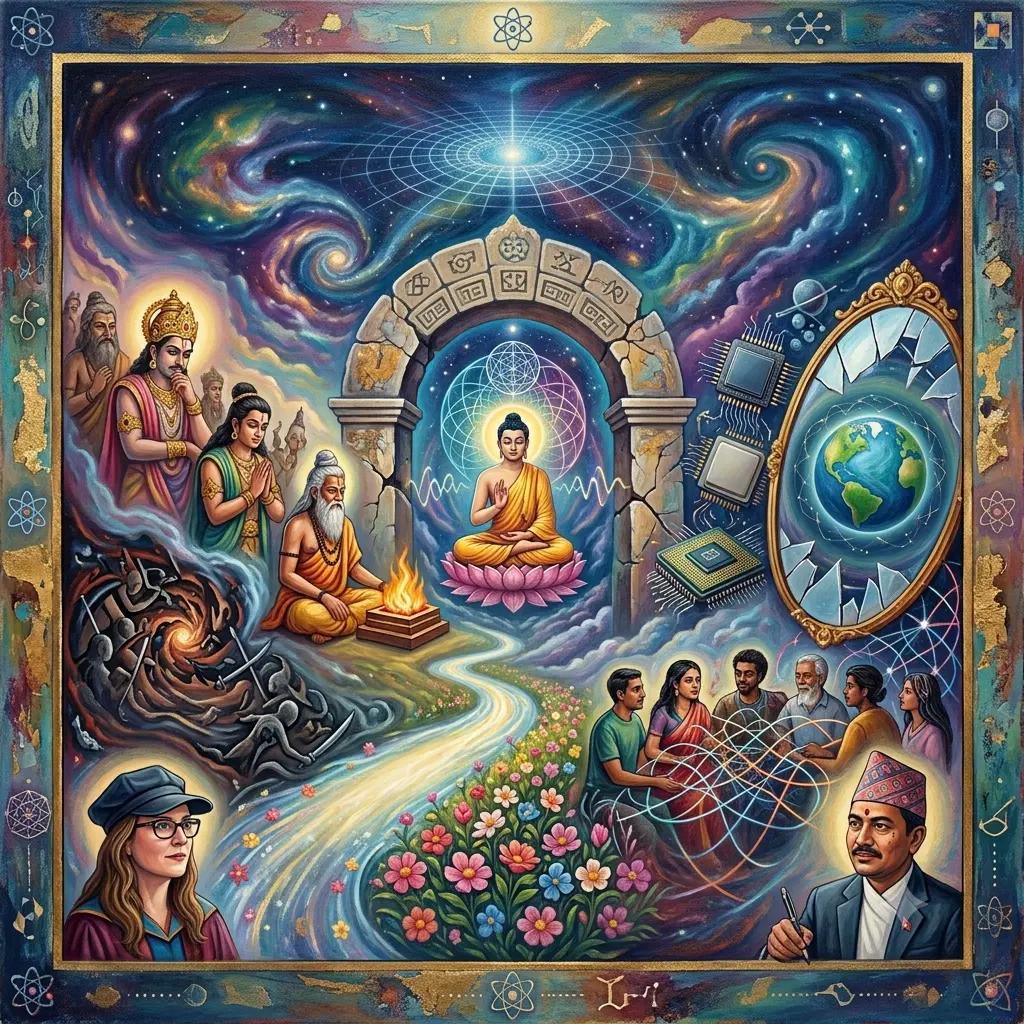
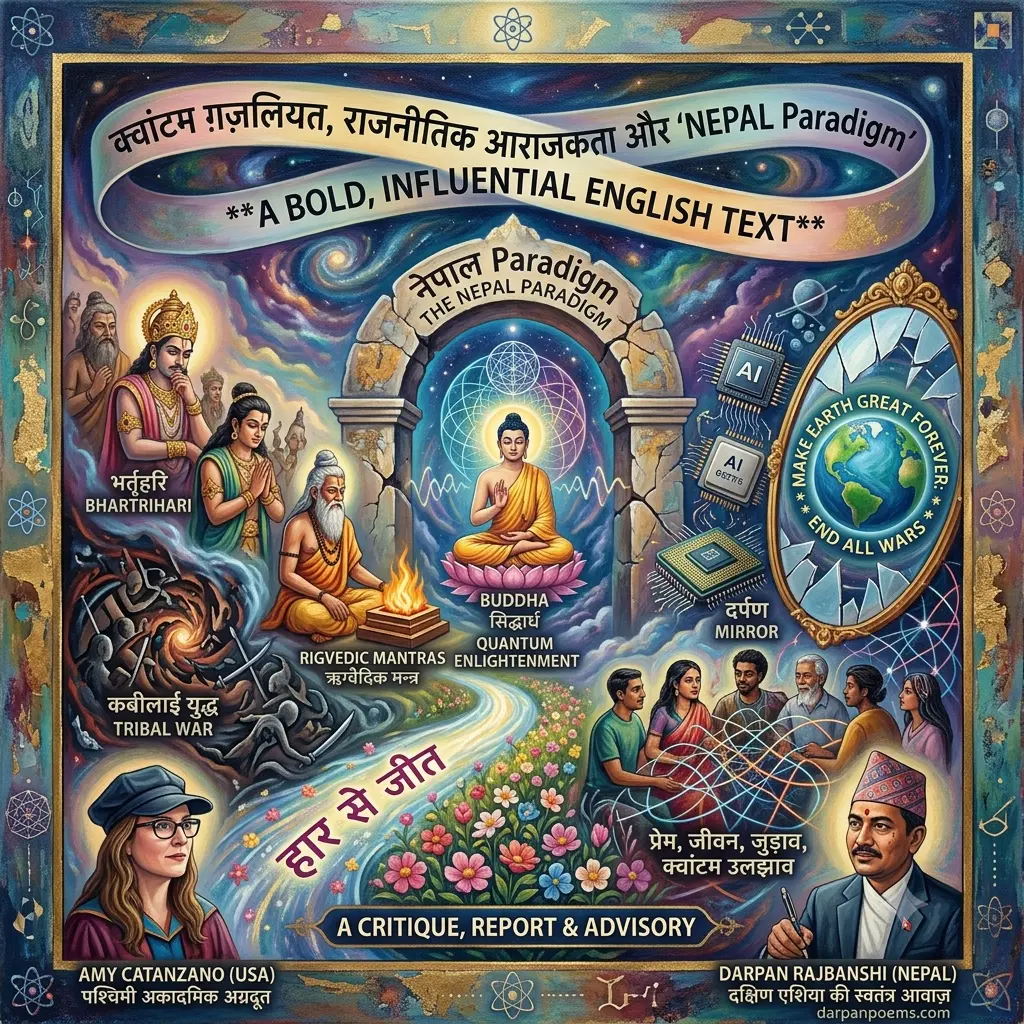
Throughout history, the deepest human revelations have not emerged from the pride of conquest, but from the ashes of exhaustion. The sacred meters of the Rigveda did not rise from imperial glory, but from the post-war altars of weary tribes. Out of conflict, the ancient seers discovered love, preserving it in poetry.
When the Shakya and Vaishali wars devastated the lands of Kapilavastu and Kosala, Prince Siddhartha abandoned the illusion of temporal power to attain Buddhahood, giving the world the timeless verses of the Dhammapada. The epics of the Ramayana and Mahabharata stand as monuments and memories to devastating conflicts.
The sublime works of Kalidasa, whether Meghaduta or Shakuntalam, resonate as Cold War reflections of an unstable era. Shattered by the brutality of battle, Emperor Ashoka surrendered to the middle path (Majjhima Patipada) and the peace of the Tipiṭaka. Driven by disillusionment with statecraft, King Bhartrihari renounced his throne to pursue yoga and spiritual devotion.
Across every age, the lesson is clear.
Today, the masquerade of Westphalian democracy threatens to become more ruthless, autocratic, and ideological than the tyrannies of old. Technocratic oligarchies and authoritarian centralisation now define contemporary geopolitics, turning human progress into an instrument of control.
Yet when we look at the world’s power centres, a troubling paradox unfolds. Despite economic expansion, the human spirit demands freedom, whether in the persistent calls for Tibetan cultural autonomy heard across America, India, Taiwan, and Nepal, or in the fragile promises of world leaders who vow swift peace only to find themselves entangled in new global flashpoints.
When global summits call for unity in an age of technological supremacy, we must ask: Is the power of billions meant only for dominance, paranoia, and self-fulfilling destruction? Or is it meant for collective awakening?
True leadership, maturity, and peace cannot be measured by popularity contests or absolute force. Power exercised purely for control inevitably consumes itself. But when statecraft is re-anchored in love, life, nature, enlightenment, and systemic interconnection (entanglement), humanity can finally realise its ultimate imperative: Make Earth Great Forever: End All Wars.
This is the promise of Poetic Quantum Statecraft.
By infusing politics, philosophy, and governance with the core truths of Quantum Poetics, integrating the observer effect, superposition, entanglement, the quantum vacuum, and non-locality, we bridge the gap between hard science and human empathy.
This vision unites diverse global voices:
Amy Catanzano (USA): Pioneering the Western academic frontier of quantum literature.
Darpan Rajbanshi (Nepal / darpanpoems.com): Leading a South Asian renaissance through the groundbreaking fusion of Quantum Physics, Sufi Metaphysics, and the Ghazal.
Though rooted in different cultural traditions, both movements arrive at a singular, inescapable truth: Reality is fundamentally unified.
It is time for global governance to abandon the illusion of division, transcend the trap of endless conflict, and embrace a paradigm of universal consciousness.
Quantum Ghazaliyat Poetic Quantum Diplomacy, Geopolitical Turmoil, and the ‘NEPAL Paradigm’ An Integrated Quantum Ghazaliyat Humanitarian Research Report, Academic Critique, and Policy Advisory
Executive Summary & Philosophical Framework: The contemporary global landscape is defined by an unprecedented ontological paradox: while human technological capacity has reached the frontiers of quantum computing, artificial intelligence, and post-humanist engineering, geopolitical structures remain mired in archaic paradigms of tribalism, territorial hegemony, and autocratic consolidation.
From the tribal conflicts of antiquity to today’s technocratic oligarchies, the exercise of political power has consistently prioritised division over interconnection. Historically, civilizational breakthroughs in human consciousness have emerged not during the apex of imperial triumph, but from the existential exhaustion following war:
The Vedic Realisation: Following violent inter-tribal warfare, the rhythmic poetic meters (chandas) of the Rigvedic mantras emerged during post-war fire rituals (yagnas), transforming physical conflict into metaphysical inquiry.
The Buddhist Metamorphosis: Distressed by the bloody conflicts between the Shakyas of Kapilavastu and the Licchavis of Vaishali, Prince Siddhartha abandoned temporal power to attain Enlightenment, culminating in the foundational verses of the Dhammapada.
The Literary & Spiritual Reflex: From King Bhartrihari’s renunciation of statecraft in favour of the Vairagya Shatakam, to the subtle cold-war anxieties underlying Kalidasa’s Meghaduta and Shakuntala, history demonstrates that poetry, philosophy, and mysticism serve as the primary conduits for reclaiming human dignity from the ruins of state-driven violence.
In the contemporary era, marked by populist biases, autocratic efficiency metrics, and escalation traps across global flashpoints, traditional Westphalian statecraft has reached an impasse. To fulfil the imperative of “Make Earth Great Forever: End All Wars” (MEGF), global governance requires a fundamental paradigm shift.
This report establishes Quantum Poetics, specifically through the synthesis of South Asian Sufi-Ghazal traditions and quantum mechanical principles, and the NEPAL Paradigm as an actionable framework for 21st-century international relations and UN leadership.
           The Quantum Paradox: A Ghazal
Between us lies this heavy heart, a pulse so hard to sustain,
Your memories weave through every breath, a pulse so hard to sustain.
        Lost in a daze, drifting through the vacuum of the unknown,
        In the gravity of your perfect vision, a pulse so hard to sustain.
Different hues, different worlds; like the Earth and the distant sky,
We are entangled yet apart in this crowd, a pulse so hard to sustain.
     We sought nothing; for to seek is to collapse the possibility,
     Like flickering shadows on fading shores, a pulse so hard to sustain.
An era of chaos, inflation, and wars upon the Strait of Hormuz,
Where even a kindness strikes like a blade, a pulse so hard to sustain.
     Why descend upon the marketplace with such predatory grace?
     I shuddered seeing the mole on your chin, a pulse so hard to sustain.
My love, E=hν, the quantum tea brews a strange new flavour,
How to divide this atom of a heart, a pulse so hard to sustain?
Part I: Exegesis and Critical Analysis of the Ghazal Triad:
The three ghazals provided serve as the creative-aesthetic praxis underpinning this research. Far from mere emotional expression, they represent a rigorous synthesis of Quantum Aesthetics, Sufi metaphysics (Tasawwuf), and post-structuralist critique.
                [ The Quantum Vacuum / Absolute Zero (Shunya) ]
                                      │
             ┌────────────────────────┴────────────────────────┐
             ▼                                                 ▼
    [ The Observer ] ──(Quantum Entanglement)── [ The Observed Reality ]
("Photon Distillation")                           ("Beparda Pardadari")
Ghazal 1: “Photon Distillation” and Ontological Dissolution “Photon Distillation’ sa, aks darpan mein dikha, Ghut raha hoon ghulmil-mil ke, beparwah kya karoon.” (Like ‘Photon Distillation’, a reflection appeared in the mirror / I suffocate in this total dissolution, indifferent, what can I do?)
Quantum & Philosophical Analysis: The metaphor of “Photon Distillation” invokes the purification and extraction of quantum light states. The “mirror” (darpan) acts as both an optical interface and the locus of self-awareness. As the ego undergoes dissolution (fana in Sufi terminology) within the “lake of Truth” (haq ki jheel), the boundary between the observer and the observed collapses.
Existential Imperative: The refrain “bepardah kya karoon” (indifferent, what can I do?) articulates the quantum state of detachment (non-attractivity/superposition). Once the individual self recognises its nature as distilled energy, societal constructs and worldly anxieties lose their deterministic hold.
Ghazal 2: The Quantum Makta (E=hν) and Everyday Reality “Janeman E=hν quantum chai ki nayi zaayqa bani, Dil ko beech se karein kaise faazil, bada mushkil hai.” (Beloved, E=hν has become the new flavour of quantum tea / How do we excise the excess from the heart’s centre? It is deeply difficult.)
Integration of Physics and Daily Life: By weaving Max Planck’s quantum energy equation (E=hν) directly into the mundane ritual of sipping tea, the poet grounds high theoretical physics into lived human experience (Lebenswelt). Energy and matter are not abstract equations isolated in laboratories; they dictate our emotional resonance, memory, and physical existence.
Geopolitical Resonance: Grounded by couplets addressing inflation, warfare, and strategic chokepoints (Hormuz), this ghazal connects the micro-level quantum state to macro-level socio-economic crises, highlighting how systemic instability fractures individual well-being.
Ghazal 3: Phonon-Photon Consciousness, AI, and ‘Beparda Pardadari’ “Kahe koi mane, tiri andar rahi rooh phonon-photon wali, Shamil hummein is qadar diljani samajhti hai mohabbat.”
“Janeman, pal-pal ki chai mein ghulti AI, aaine ki chamak, Taamil beparda pardadari kahani samajhti hai mohabbat.”
(Whether one agrees or not, within you resides a soul of phonons and photons / Love understands how deeply this intimacy is intertwined within us… Beloved, AI dissolving into our daily tea, the glint of the mirror / Love understands the fulfilment of this unveiled secrecy.)
Condensed Matter Physics & Metaphysics: The explicit reference to phonons (quantised vibrational acoustic energy) and photons (quantised light energy) posits that consciousness is rooted in an information substrate of sound and light.
Artificial Intelligence & Unveiled Secrecy (Beparda Pardadari): The integration of AI into human consciousness reflects David Bohm’s quantum theory of the Implicate (hidden) and Explicate (unveiled) Order. Love (Ishq) is framed as the ultimate cognitive instrument, the underlying unifying principle that deciphers the paradox of “unveiled secrecy” within a hyper-technological world.
Part II: Comparative Academic Critique
Amy Catanzano (Western Avant-Garde) vs. Darpan Rajbanshi (South Asian Quantum Sufi-Ghazal)
The academic convergence of poetry and quantum mechanics in the 21st century is anchored by two distinct pioneers operating from different epistemic traditions:
| Analytic Dimension | Amy Catanzano (USA) | Darpan Rajbanshi (Nepal / darpanpoems.com) |
| Epistemic Foundation | Western academic avant-garde; literary theory, linguistically driven post-modernism, and formal physics concepts. | Quantum Sufi-Ghazal Fusion; integrative synthesis of Vedic philosophy (Rigveda), Sufism (Haq/Fana), and theoretical physics. |
| Structural Form | Experimental free verse, prose poetry, and avant-garde multi-dimensional textual layouts. | Classical Ghazal framework (Matla, Radif, Kaafiya, Makta), embedding quantum terminology within rigorous poetic meter (Bahar). |
| Primary Methodology | Exploring linguistic superposition, observer effects on language, and poetry as a speculative quantum tool. | Utilizing quantum non-locality and entanglement to resolve geopolitical conflict, ego-dissolution, and human suffering. |
| Locus of Consciousness | Textual space, poetic form, and theoretical physics terminology. | The Awakened Observer (Darpan/Mirror), universal connectedness, and spiritual enlightenment. |
| Ultimate Objective | Aesthetic and linguistic innovation within academic poetics. | “Make Earth Great Forever: End All Wars” (MEGF); policy transformation and planetary peace via the NEPAL Paradigm. |
While Catanzano approaches quantum poetics primarily as an aesthetic and structural expansion of language within Western academia, Rajbanshi utilises the ghazal form as an active ontology, bridging the gap between subatomic physics, spiritual liberation, and international diplomacy.
Naked Secrecy Alone Understands Love
A heart undone, inert, estranged,
Yet even the unknown understands love,
The worthy, the gracious, the wildly
Devoted, each alone understands love.
           Had you not been, we’d drift in
           Mute compulsion through the cosmos,
           The perfected gaze, its own lone sign
           And signature is shown understands love.
What shall we ask this world,
Whom here can we truly call our own?
The winds, the breathing skies in their
Flowing motion, have grown, understand love.
           Say what you will, within you
           Resides a soul of phonon and photon light,
           So deeply are you woven in us,
           Beloved, that even the known understands love.
In answers to questions, in
Every true discipline’s honest knowing,
The subtle resolution of problems, refined
And discerning, is sown, understands love.
           All faces of the world descend
           Today, into the singular mirror of you,
           The ignorant mirror, secretly revealing
           What it has never shown understands love.
Beloved, each passing moment,
Like tea, dissolves into the gleam of AI,
Unveiling veils through veils,
This naked secrecy alone understands love.
Part III: The ‘NEPAL Paradigm’ and the State of Awakened Being
To resolve the “No-Exit” traps of contemporary geopolitics, where military deterrence and autocratic stability repeatedly degenerate into conflict, the NEPAL Paradigm offers an alternative operational philosophy:
N – Non-Locality & Strategic Non-Alignment: Moving beyond passive neutrality to active universal interconnection, recognising that security threats in one region instantaneously entangle global stability.
E – Entanglement with Nature & Reality: Re-anchoring governance in ecological stability and cosmic interdependence rather than extractive resource competition.
P – Poetic Quantum Governance: Injecting empathy, adaptability, and the recognition of uncertainty (Heisenberg’s Uncertainty Principle) into international decision-making models.
A – Awakened Being State (PAL): Shifting leadership metrics from ego-driven power projection to self-awareness and holistic well-being.
L – Love & Liberated Consciousness: Establishing love (Ishq-e-Haqeeqi) and shared human identity as the core principles of international law and diplomacy.


PAL: The State of Awakened Being / Taking Care of Being
In this framework, the state (PAL) is redefined: it is no longer merely a sovereign legal entity defined by physical borders, but a “State of Awakened Being.” Geopolitical “No-Exit” scenarios exist because leaders operate from an ego-centric worldview (No Exist of Ego). By adopting the PAL perspective, statecraft prioritises the preservation and cultivation of human consciousness over zero-sum territorial expansion.
Part IV: Policy Implications for World Leaders & United Nations Leadership
Transcending Hegemony via Quantum Entanglement: Global leaders must abandon the zero-sum doctrines of 19th-century geopolitics. Quantum non-locality proves that actions taken at one node of the global system immediately impact the whole. Unilateral security measures inevitably generate systemic instability elsewhere.
Deconstructing the Popularity Bias in Governance: Popularity metrics do not equate to stable, ethical governance. Authoritarian efficiency and populist rhetoric often mask deep structural fragility and the erosion of human rights. High-level diplomacy must evaluate governance in terms of long-term human flourishing rather than short-term political consolidation.
Ethical Regulation of AI & Emerging Technologies: As demonstrated in the UN and global tech summits, artificial intelligence must not be deployed merely as an instrument of economic dominance or automated warfare. AI development should be guided by principles of quantum ethics, ensuring technology enhances human connection rather than deepening societal polarisation.
Institutionalising Poetic Quantum Diplomacy: The United Nations and international bodies should integrate non-traditional conflict resolution methodologies that incorporate cultural, poetic, and philosophical dimensions. Diplomatic frameworks that acknowledge shared human heritage, similar to the post-war traditions of antiquity, offer viable pathways out of entrenched conflicts.
Conclusion: The analytical synthesis of the three ghazals, Quantum Poetics, and the NEPAL Paradigm leads to a definitive conclusion: the current crises of global governance cannot be resolved using the same mechanical, hyper-rationalist frameworks that created them.
Poetic Quantum Consciousness+Ego-Dissolved Statecraft⟶Universal Peace (MEGF)
By integrating the insights of quantum mechanics with the ethical depths of poetic wisdom, world leaders have a viable roadmap to transcend geopolitical paralysis. True global stability requires moving beyond the illusion of separation and realising the profound, undeniable entanglement of all human life.
Hindvi/Rekhta Section
ग़ज़ल - May 1, 2026
छूटता हूँ मुश्किलों से, बेपरवाह क्या करूँ,
डूबता हूँ हक़ की झील में, बेपरवाह क्या करूँ।
           है यही लापरवाही, मेरा इश्क़-ए-हक़ीक़ी,
           जी रहा हूँ इस दलील में, बेपरवाह क्या करूँ।
रूह-ओ-ज़हन को शूल बनकर तूने ही बिंधा दिया,
टूटता हूँ अब महफ़िल में, बेपरवाह क्या करूँ।
           दिल का कतरा तिल-तिल टूटा, है यही लापरवाही,
          झूठ कहता हूँ मुवक्किल से, बेपरवाह क्या करूँ।
ज़र्रा-ज़र्रा गुमशुदा है, बूंद भर भी अब नहीं,
मुड़ गया हूँ हर इक जाहिल से, बेपरवाह क्या करूँ।
           इश्क़ की ये दास्तां है, दिल का है ये लेन-देन,
           रूठता हूँ अपने क़ातिल से, बेपरवाह क्या करूँ।
'Photon Distillation' सा, अक्स दर्पण में दिखा,
घुट रहा हूँ घुलमिल-मिल के, बेपरवाह क्या करूँ।
क्वांटम दर्पण काव्याधार भावभूमि
हर हार से जीत हाथ आए, नसीब से समझ यह बात आए। जीत कर ज़िल्लत मल्कियत हो, तो मुबारक जीत तुम्हें, महफ़िल-ए-जाम-ओ-रात आए।
यह संभव है कि कबीलाई युद्धों के बाद हुए यज्ञोत्सवों से ही ऋग्वैदिक मंत्रों के काव्य-छंद प्रकट हुए हों। युद्धों से पराजित होकर ऋषियों ने जीवन और प्रेम के मार्ग कविता में ढूँढ़ लिए। कोसल जनपद के कपिलवस्तु में शाक्यों और वैशाली के संघर्षों/युद्धों ने ही सिद्धार्थ को बुद्धत्व का मार्ग दिखाया, जिसके पश्चात् ‘धम्मपद’ की गाथाएँ प्रकट हुईं।
‘रामायण’ और ‘महाभारत’ भी युद्ध की ही परिणतियाँ प्रतीत होते हैं। कालिदास का ‘मेघदूत’ हो या ‘अभिज्ञानशाकुंतलम्’, ये एक तरह से तत्कालीन शीतयुद्धों के ही परिणाम लगते हैं। युद्ध की विभीषिका से थके-हारे सम्राट अशोक मज्झिम प्रतिपदा और तिपिटक (त्रिपिटक) के पदों की शरण में चले गए। राजा भर्तृहरि भी राजकाज की असफलताओं व मोहभंग से हारकर ही योग और कीर्तन के मार्ग पर चल पड़े। दुनिया भर में इतिहास के ऐसे ही उदाहरण मिलते हैं।
आज वेस्टफ़ेलियन लोकतंत्र के कुछ रूप उन दिनों के तानाशाहों, हुक्मरानों, फ़ासिस्टों और राजा-महाराजाओं से भी ज़्यादा खूँखार, निरंकुश और फ़ासिस्ट दिखाई देने लगे हैं। मार्क्सवाद को अत्यधिक विभाजक फ़ासीवाद करार दिया जाने लगा है। टेक्नोक्रेटिक ऑलिगार्की (तकनीकी-अल्पतंत्र) और स्वेच्छाचारिता ही आज की भू-राजनीतिक वास्तविकता बन चुके हैं।
ऐसे समय में अमरीका का एक हालिया शोध बताता है कि ट्रंप और शी जिनपिंग में से चीन के राष्ट्रपति को अधिक लोकप्रिय देखा गया। क्या तानाशाही ही शक्ति और प्रगति का मानक है? परंतु, चिंता तब होती है जब तिब्बती संस्कृति का चीन में इतना विकास होने के बावजूद अमरीका, भारत, ताइवान और नेपाल में तिब्बत की स्वतंत्रता की आवाज़ें गूँजती सुनाई देती हैं। चुनाव जीतने से पहले ही एक दिन में रूस-यूक्रेन युद्ध खत्म कर देने का दावा करने वाले ट्रंप आज स्वयं ईरान से युद्ध में उलझते दिख रहे हैं और दुनिया भर में शांति की कोई गुंजाइश नज़र नहीं आती।
वहीं दूसरी ओर, हूवर टॉक शो में स्टालिन के जीवनीकार प्रोफ़ेसर कोटकिन बताते हैं कि यदि चीन 1.4 बिलियन लोगों की शक्ति है, तो अमरीका के पास 8 बिलियन (वैश्विक संदर्भ) की पहुँच/शक्ति है। तो क्या लोगों की यह शक्ति युद्ध, तबाही, आधिपत्य, भय, अहंकार और स्व-पूर्ति की भविष्यवाणियों (self-fulfilling prophecies) के लिए है?
‘AI वर्ल्ड समिट 2026’ को संबोधित करते हुए जब शी जिनपिंग दुनिया को जोड़कर आगे बढ़ने का संदेश देते हैं, तो क्या ऐसी अराजक स्थितियों में यह संभव है? ये बातें हमें झकझोर कर रख देती हैं।
परंतु हम पूरी प्रतिबद्धता के साथ कह सकते हैं कि यह संभव है, यदि हम विश्व नेताओं को संकीर्ण लोकप्रियता के पूर्वाग्रह (popularity bias) से बाहर निकालकर देखें। लोकप्रियता से शांति, व्यवस्था और शासन की परिपक्वता सिद्ध नहीं होती; अन्यथा पुतिन, मोदी, मैक्रों, नेतन्याहू या मुस्तफा अल-काज़िमी जैसे सभी नेताओं की लोकप्रियता को नज़रअंदाज़ कैसे किया जा सकता है?
यह बात तो सिद्ध है कि सत्ता का प्रयोग प्रायः निरंकुश ही होता है। परंतु यदि इसे केवल राजनीतिक न रखकर प्रेम, जीवन, प्रकृति, ज्ञान, जुड़ाव (connectedness) और क्वांटम उलझाव (entanglement) के सिद्धांतों से आगे बढ़ाया जाए, तो हम “Make Earth Great Forever: End All Wars” के लक्ष्य को अवश्य हासिल कर सकते हैं।
इसके लिए भविष्य में ‘पोएटिक-क्वांटम अभ्यास’ पर आधारित शासन-व्यवस्था को सावधानीपूर्वक अमल में लाना होगा। आज के दौर में क्वांटम पोएटिक्स (Quantum Poetics) एक सशक्त माध्यम बन सकता है, यदि इसकी आत्मा को राजनीति, धर्म और दर्शन के ज्ञान में धैर्यपूर्वक लागू किया जाए।
आज की तारीख में क्वांटम पोएटिक्स कविता और क्वांटम भौतिकी (observer effect, superposition, entanglement, quantum vacuum, non-locality) के अंतर्संबंधों को एक एकीकृत सौंदर्यशास्त्रीय सिद्धांत (integrated aesthetic theory) और रचनात्मक अभ्यास (creative praxis) के रूप में देखती है।
इस संदर्भ में:
एमी कैटांज़ानो (Amy Catanzano – USA): पश्चिमी अकादमिक जगत की अग्रदूत।
दर्पण राजवंश (Darpan Rajbanshi – darpanpoems.com, नेपाल): क्वांटम सूफ़ी-ग़ज़ल फ़्यूज़न के साथ दक्षिण एशिया की एक स्वतंत्र और मौलिक आवाज़।
ये दोनों 21वीं सदी के प्रमुख प्रयास हैं। भले ही इनके दृष्टिकोण, रूप और सांस्कृतिक आधार अलग-अलग हों, फिर भी इनकी समझ का मूल आधार दुनिया को एक ही जीवन-सत्य और वास्तविकता के रूप में देखना है।
ग़ज़ल: मतला: - May 2, 2026
जो आ गया बीच, ये दिल है, बड़ा मुश्किल है,
यादें पल-पल में शामिल हैं, बड़ा मुश्किल है।
           भूले-बिसरे हैं रहते, अनजाने में खोये-खोये,
           तसव्वुर में तुम्हारी कामिल है, बड़ा मुश्किल है।
 फ़र्क रंग है, अलग रहेंगे फलक-ओ-ज़मीं जहाँ में,
हम जुदा-जुदा भरे महफ़िल हैं, बड़ा मुश्किल है।
           नहीं ढूंढ रहे थे कुछ, ढूंढना होता तो न होता वो,
           पानी-पानी फ़ानी रुके मंज़िल हैं, बड़ा मुश्किल है।:
बड़े मुश्किलात भरी दौर है, हर्मज़, महंगाई, लड़ाई,
भलाई भी भला निकले क़ातिल है, बड़ा मुश्किल है।
           क्यों यूँ लूट-मार भरे बाज़ार उतर आये हो तुम,
          टूट पड़े हम देख तेरे ठोड़ी में जो तिल है, बड़ा मुश्किल है।
क्वांटम मक़्ता (साइंसी रंग):
जानेमन E=hν क्वांटम चाय की नई जायक़ा बनी,
दिल को बीच से करें कैसे फ़ाज़िल, बड़ा मुश्किल है।

क्वांटम ग़ज़लियत, राजनीतिक आराजकता और ‘NEPAL Paradigm’ एक एकीकृत मानवीय शोध-रिपोर्ट एवं विश्लेषणात्मक विवेचना
प्रस्तावना: समकालीन वैश्विक संकट और पोएटिक-क्वांटम चेतना
21वीं सदी का वैश्विक परिदृश्य एक अभूतपूर्व विरोधाभास से गुज़र रहा है। एक तरफ जहाँ तकनीक (AI, सुपरकंप्यूटिंग, क्वांटम फ़िज़िक्स) अपनी पराकाष्ठा पर है, वहीं दूसरी तरफ भू-राजनीतिक परिदृश्य (Geopolitical Reality) अत्यंत संकीर्ण, हिंसक और विनाशकारी दौर में प्रवेश कर चुका है। कबीलाई युद्धों (Tribal Wars) से लेकर आज की Technocratic Oligarchy तक, सत्ता का मूल चरित्र ‘आधिपत्य’ (Hegemony) और ‘विभाजन’ ही रहा है।
ऐतिहासुक दृष्टिकोण से देखें तो मानवीय सभ्यता का इतिहास युद्धों और उनके पश्चात् उपजे अवसाद के बीच संतुलन बनाने की कोशिश रहा है। वैदिक काल में कबीलाई संघर्षों के बाद यज्ञोत्सवों में ऋग्वैदिक ऋचाओं का काव्य-छंद प्रकट होना, वैशाली और कपिलवस्तु के युद्धों से दुःखी होकर सिद्धार्थ का ‘बुद्धत्व’ और ‘धम्मपद’ की ओर मुड़ना, या फिर भर्तृहरि का राजकाज छोड़कर योग-वैराग्य को अपनाना, यह सिद्ध करता है कि कविता, अध्यात्म और दर्शन सदैव युद्ध के मलबे से उपजी जीवन-दायिनी धाराएँ रही हैं।
आज का वैश्विक नेतृत्व (चाहे वह वेस्टफ़ैलियन लोकतंत्र का छद्म रूप हो या ऑटोक्रेसी) अत्यधिक Popularity Bias और Paranoia से ग्रस्त है। ऐसे समय में, जब AI वर्ल्ड समिट 2026 और वैश्विक मंचों पर शांति की बातें केवल बयानबाज़ियों तक सीमित दिखती हैं, ‘Make Earth Great Forever: End All Wars’ (MEGF) के संकल्प को पूरा करने के लिए एक नए प्रतिमान (Paradigm) की आवश्यकता है, जिसे हम Quantum Poetics और NEPAL Paradigm कहते हैं।
भाग १: ग़ज़ल-त्रयी का क्वांटम-सूफ़ी एवं दार्शनिक विश्लेषण:
प्रस्तुत तीनों ग़ज़लें मात्र भावुक काव्यात्मक अभिव्यक्तियाँ नहीं हैं, बल्कि यह Quantum Aesthetics, सूफी रहस्यवाद और उत्तर-आधुनिक दार्शनिक चिंतन का एक दुर्लभ त्रिवेणी-संगम हैं।
              [ विशुद्ध शून्य / Quantum Vacuum ]
                             │
             ┌───────────────┴───────────────┐
             ▼                               ▼
   [ प्रेक्षक / Observer ] ──(उलझाव)── [ दृश्य / Reality ]
 ('Photon Distillation')              (बेपर्दा पर्दादारी)
१. प्रथम ग़ज़ल: ‘Photon Distillation’ और अस्तित्व का विसर्जन ‘Photon Distillation’ सा, अक्स दर्पण में दिखा, घुट रहा हूँ घुलमिल-मिल के, बेपरवाह क्या करूँ।
वैज्ञानिक एवं दार्शनिक पठन: यहाँ प्रयुक्त ‘Photon Distillation’ का विचार क्वांटम ऑप्टिक्स और चेतना के परस्पर जुड़ाव का प्रतीक है। जिस प्रकार प्रकाश (फ़ोटॉन) का आसवन उसे उसके शुद्धतम रूप में प्रकट करता है, उसी प्रकार आत्मा (‘दर्पण’) जब भौतिक अस्तित्व की परतों से मुक्त होती है, तो उसे अपनी बेपरवाही (Non-attachment) का अहसास होता है।
सत्य का अनुभव: ‘हक़ की झील’ में डूबना सूफी परंपरा का फ़ना (Fana – ego dissolution) है, जहाँ प्रेक्षक (Observer) और प्रेक्षित (Observed) का भेद मिट जाता है।
२. द्वितीय ग़ज़ल: ‘E=hν’, क्वांटम मक़्ता और मानवीय विडंबना जानेमन E=hν क्वांटम चाय की नई जायक़ा बनी, दिल को बीच से करें कैसे फ़ाज़िल, बड़ा मुश्किल है।
साइंसी रंग और रोज़मर्रा का जीवन: प्लांक के ऊर्जा समीकरण (E=hν) को ‘चाय की चुस्की’ जैसी दैनिक दिनचर्या से जोड़ना Quantum Realism का शिखर है। यह दर्शाता है कि पदार्थ (Matter) और ऊर्जा (Energy) का द्विगुणित रूप केवल प्रयोगशाला तक सीमित नहीं है, बल्कि वह हमारे दैनंदिन जीवन, स्मृतियों और भावनाओं में घुला हुआ है।
वैश्विक व्यवस्था पर कटाक्ष: “बड़े मुश्किलात भरी दौर है, हर्मज़, महंगाई, लड़ाई…” के माध्यम से यह ग़ज़ल सूक्ष्म-संसार (Microcosm) से सीधे समकालीन वैश्विक संकट (Macrocosm) पर प्रहार करती है।
३. तृतीय ग़ज़ल: फ़ोनन-फ़ोटोन, AI और ‘बेपर्दा पर्दादारी’ कहे कोई माने, तिरि अंदर रही रूह फ़ोनन-फ़ोटोन वाली, शामिल हममें इस क़दर दिलजानी समझती है मोहब्बत। … जानेमन, पल-पल की चाय में घुलती AI, आईने की चमक, तामिल बेपर्दा पर्दादारी कहानी समझती है मोहब्बत।’
ध्वनि और प्रकाश का तादात्म्य: ‘फ़ोनन’ (Phonon – ध्वनि तरंगों का क्वांटम रूप) और ‘फ़ोटॉन’ (Photon – प्रकाश का क्वांटम रूप) को आत्मा की रूहानी क्षमता के रूप में देखना यह स्थापित करता है कि संपूर्ण ब्रह्मांडीय चेतना एक Information Substrate पर टिकी है।
AI और ‘बेपर्दा पर्दादारी’: आर्टिफिशियल इंटेलिजेंस और चेतना का यह समागम ‘प्रकट’ और ‘अप्रकट’ (Explicate and Implicate Order – David Bohm) के खेल को उजागर करता है। प्रेम ही वह परम विद्या (इल्म) है जो इस पर्दादारी के भीतर छुपी एकता को पहचानती है।
भाग २: अंतर्राष्ट्रीय विमर्श एवं तुलनात्मक अध्ययन Amy Catanzano (USA) बनाम Darpan Rajbanshi (Nepal) 21वीं सदी में कविता और क्वांटम भौतिकी के अंतर्संबंधों पर काम करने वाले दो प्रमुख वैश्विक दृष्टिकोण हमारे सामने हैं:
| तुलनात्मक बिंदु | Amy Catanzano (पश्चिमी अकादमिक दृष्टिकोण) | Darpan Rajbanshi (दक्षिण एशियाई / ‘darpanpoems.com’) |
| मूल दर्शन | पाश्चात्य अकादमिक क्वांटम पोएटिक्स, भाषा-वैज्ञानिक संरचना और वैज्ञानिक शब्दावली का प्रयोग। | Quantum Sufi-Ghazal Fusion; भारतीय दर्शन, सूफीवाद और आधुनिक भौतिकी का समन्वय। |
| काव्य-रूप (Form) | मुक्त छंद, प्रयोगधर्मी एवर-गार्ड (Avant-garde) गद्य-काव्य। | ग़ज़ल (बहर, मतला, मक़्ता) की शास्त्रीय संरचना में क्वांटम शब्दावली का समावेश। |
| अनुप्रयोग (Application) | मुख्य रूप से सौंदर्यशास्त्रीय और सैद्धांतिक (Theoretical Aesthetics)। | वैश्विक शांति (MEGF), भू-राजनीतिक चेतना और ‘NEPAL Paradigm’ हेतु क्रियात्मक मार्ग। |
| चेतना का केंद्र | प्रेक्षक प्रभाव (Observer Effect) और भाषाई सुपरपोज़िशन। | non-locality, ईश्वर/हक़, ऋग्वैदिक बोध और सर्व-चेतना (Connectedness)। |
एमी कैटांज़ानो जहाँ विज्ञान को कविता की भाषा में ढालती हैं, वहीं दर्पण राजवंश क्वांटम सिद्धांतों को मानवीय संवेदना, भू-राजनीतिक संकट और आध्यात्मिक मुक्ति का साधन बनाते हैं।
ग़ज़ल  - May 5, 2026
        बेपर्दा पर्दादारी कहानी समझती है तू मोहब्बत
बेदिल बेजान अनजानी, बेगानी समझती है मोहब्बत,
काबिल मेहरबान बड़ी दीवानी समझती है मोहब्बत।
           न होती तू तो हम तन्हा रह जाते कायनात में चुपचाप,
           कामिल नज़र की अपनी निशानी समझती है मोहब्बत।
हमें क्या पूछे दुनिया ये, यहाँ किसको अपना मानें हम,
हासिल हवाओं फ़ज़ाओं की रवानी समझती है मोहब्बत।
           कहे कोई माने, तिरि अंदर रही रूह फ़ोनन-फ़ोटोन वाली,
           शामिल हममें इस क़दर दिलजानी समझती है मोहब्बत।
सवालों के जवाबों में हर इल्म की सच्ची जानकार,
बाजिल मसला-ए-हल की पहचानी समझती है मोहब्बत।
           दुनिया भर के चेहरे सब उतर आए तेरे ही चेहरे में आज,
           जाहिल दर्पण को छुपकर दिखानी समझती है मोहब्बत।
जानेमन, पल-पल की चाय में घुलती AI, आईने की चमक,
तामिल बेपर्दा पर्दादारी कहानी समझती है मोहब्बत।
भाग ३: ‘NEPAL Paradigm’ और ‘The State of Awakened Being’
भू-राजनीतिक अंधी गलियों (No-Exit scenarios) से निकलने के लिए NEPAL Paradigm एक नया वैचारिक मॉडल प्रस्तुत करता है:
N – Non-locality & Non-alignment: तटस्थता से आगे बढ़कर सर्व-संबद्धता (Universal Entanglement) की नीति।
E – Entanglement with Nature: प्रकृति और मानव चेतना का अटूट संबंध।
P – Poetic Quantum Governance: शासन में संवेदनशीलता और अनिश्चितता के सिद्धांत का आदर।
A – Awakened Being of State: सत्ता के बजाय चेतना और स्व-जागरण पर आधारित नेतृत्व।
L – Love & Liberated Consciousness: शक्ति के प्रयोग के स्थान पर प्रेम और बोध का विस्तार
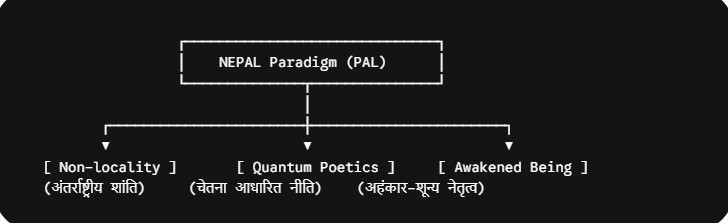
PAL (The State of Awakened Being / Taking Care of Being): यह मॉडल यह स्पष्ट करता है कि राज्य (State) केवल एक सीमा-पार की भौगोलिक संरचना नहीं है, बल्कि वह ‘जाग्रत अस्तित्व की अवस्था’ (State of Being) है। जब तक विश्व नेता केवल Popularity और Power Projection के चक्कर में रहेंगे, तब तक शांति असंभव है। No Exit की स्थिति से बाहर निकलने का एकमात्र रास्ता अस्तित्व की गहराई में उतरना (No Exist of Ego) है।
भाग ४: विश्व नेताओं एवं संयुक्त राष्ट्र (UN Readership) हेतु नीतिगत सिफ़ारिशें
अहंकार-आधारित राजनीति से क्वांटम-संबद्धता की ओर (From Hegemony to Entanglement): विश्व नेताओं (ट्रंप, सी जिनपिंग, पुतिन, मोदी आदि) को यह समझना होगा कि एक राष्ट्र का लाभ दूसरे के नुकसान से संभव नहीं है। क्वांटम अन-लोकेलिटी (Non-locality) यह सिद्ध करती है कि एक बिंदु पर किया गया आघात संपूर्ण तंत्र को प्रभावित करता है।
‘Poetic Quantum Governance’ को अपनाना: नीति-निर्माण में केवल आर्थिक और सैन्य आँकड़ों (Technocratic Metrics) को स्थान न देकर मानवीय करुणा, पारिस्थितिक संतुलन और दार्शनिक दूरदर्शिता को शामिल किया जाए।
लोकप्रियता के भ्रम (Popularity Bias) का त्याग: जनप्रियता शांति या स्थिरता की गारंटी नहीं है। अधिनायकवाद (Autocracy) तकनीक और प्रगति का दिखावा तो कर सकता है, लेकिन वह मानवीय रूह को कुचलता है (जैसे तिब्बत या अन्य पीड़ित क्षेत्रों में देखा जा सकता है)।
AI और क्वांटम तकनीक का नैतिक नियमन: AI वर्ल्ड समिट जैसी गोष्ठियों में AI को केवल सैन्य या आर्थिक प्रभुत्व का हथियार न बनाकर, मानवीय चेतना के विस्तार और ‘Make Earth Great Forever’ के वैश्विक संकल्प से जोड़ा जाना चाहिए।
निष्कर्ष: ग़ज़ल की इस त्रयी से लेकर NEPAL Paradigm का यह शोध-निष्कर्ष यह स्पष्ट संदेश देता है कि जब तक राजनीति का संचालन केवल ‘सत्ता के आधिपत्य’ से होगा, तब तक विनाश अवश्यंभावी है। Quantum Poetics राजनीति, धर्म और दर्शन को एकीकृत करके एक नया रास्ता दिखाती है। जैसा कि ग़ज़ल कहती है:
Poetry+Quantum Physics⟶Universal Peace (MEGF)
विश्व को आज हथियारों की नहीं, बल्कि उस दर्पण की आवश्यकता है जहाँ हर चेहरा एक-दूसरे में अपना ही अक्स देख सके और पूरी पृथ्वी पर अमन का परचम लहरा सके।

Next Read: No / Know Thyself Not