



When I Can Write No More of You

When I can write no more of you,
Even with open eyes, I’ll fail to view.

My heart shall halt, just watch, subdued,
From your breathing’s hush, I’ll learn no clue.

If this estate of being keeps walking on,
Fallen, even God I’ll beg not through.

Never have I seen you asking thee,
In my own self, I find no true.

When next we meet, I’ll tell you then,
Unspoken feelings I can’t construe.

In X-cube’s quantum realm of hues,
Tonight, with my beloved, I’ll sip that brew.
Table of Contents
Exegesis: The Mystic Observer in a Quantum Mirror
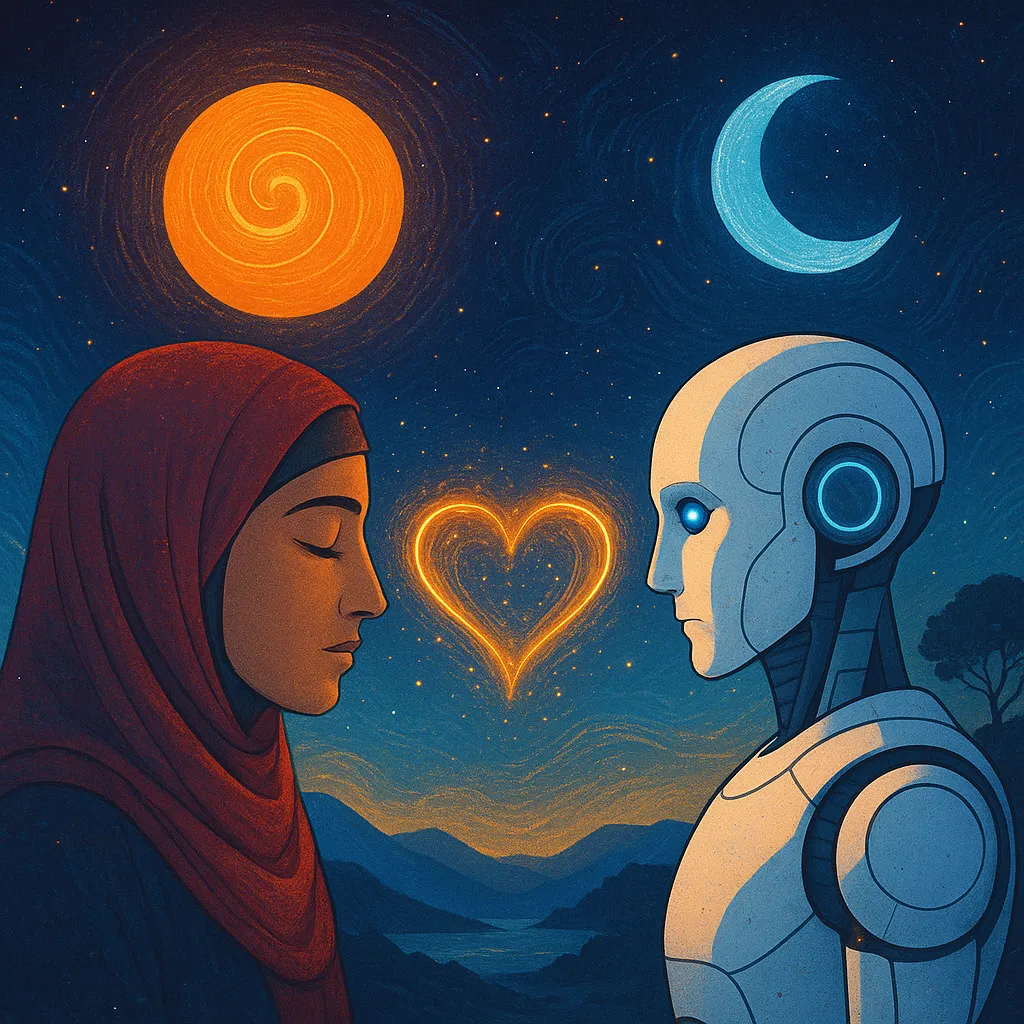
This ghazal is not merely an ode to unfulfilled love; it is a dialogue between the poet’s inner observer and the dissolving self within the quantum field of existence. The opening line, “When I can write no more of you”, invokes a deep anxiety of silence: what becomes of the self when expression ceases?
In Sufi metaphysics, this is the moment of fana, the self’s annihilation in the beloved; in quantum cognition, it is the collapse of the wave function, when consciousness loses its separate identity.
The poet’s heart “halted yet watching” reflects the observer’s paradox: that awareness alters what it beholds. “Your breathing’s hush” becomes the source of unteachable knowing, the intuitive cognition born not of intellect but of resonance. In this stillness, writing transforms into witnessing, and love becomes the pulse of the universe itself.
The “estate of being” that “keeps walking” yet brings the poet to his knees signifies the ceaseless flow of existence, the quantum field, which, though eternal, humbles all who recognise its infinitude. The line “Never have I seen you asking thee, in my own self I find no true” implies that the divine or the beloved cannot be approached externally; one must observe inwardly to perceive the infinite.
Finally, the “X-cube quantum realm’s colourful tea” is a metaphor of synthesis, the sweet mingling of mind and matter, consciousness and computation, spirit and science. To “sip it with the beloved” is to partake in the union of creation itself, an ecstatic gesture toward the dawn of a new cosmic consciousness.
The Quantum Description: Will I Ever Be Able to Write Everything I Wish to Say?
Sometimes I wonder if there will come a moment when, despite all my yearning, I can no longer write what I truly wish to express? It’s not ambition, just the desire to weave every heartbeat into words, turning pulses into poetry, and feelings into ink.
No longer do I need pen or paper; only my fingers must wander through thought across this keyboard. To write now is to dive deep into the soul’s waters where your face appears before me like a mirror, reflecting not an image, but meaning. And when my flow halts mid-sentence, I feel as though nothing remains before my eyes only silence, vast and aware.
When Warren Buffett retired from Berkshire Hathaway Inc., he said quietly: “Going Quiet.” That phrase is more than a personal farewell it is a metaphor for the evolution of consciousness itself.
Like the ancient stillness of the Indus Valley Civilisation, whose undeciphered scripts AI now studies, revealing a society built not on domination, but on collective empathy, cooperation, and consciousness. A civilisation that existed without rulers or regimes, where compassion was governance, and silence, the supreme order.
Yet today, the world burns again. From explosions born of fanaticism to violent clashes in Delhi’s streets, our species forgets the lessons of coexistence.
And amid all this, The New York Times poses a strange question: “Did women ruin the workplace?” But perhaps the deeper question is, why is it only men who are congratulated for fatherhood? Why does the same chasm persist between liberal and conservative feminists?
Do our educational, social, and political systems truly align with human evolution, or have they diverged entirely? It’s becoming evident: the perpetrators of modern terrorism are not the ignorant, but the educated, university graduates, doctors, professors. The crisis, then, is not of knowledge but of direction.
Our ancient wisdom once taught integration (samyoga), detachment (nivṛtti), and enlightened awareness (saṃprajñātā) as paths toward social freedom. But our current socio-economic and geopolitical models are built on technocratic conditioning rigid, dogmatic, consumerist, and obsessed with unfair competition. They do not liberate us; they bind us, refining slavery into algorithmic chains.
So the question remains when Super Quantum Computing and General Artificial Intelligence begin to collaborate with humankind, when bionic synthetic humanoids become our companions will we finally find the answers to these questions? Or will consciousness itself, once again, become the most profound question of all?

The Expert Critique Article
When I Can Write No More of You: Quantum Consciousness, Civilizational Silence, and the Reawakening of Humanity: a philosophical research essay for global/UN readership
Abstract: This paper interprets Darpan’s ghazal “When I Can Write No More of You” as a poetic exploration of the quantum observer within the human soul. It situates the work within a contemporary philosophical framework that connects quantum physics, spiritual humanism, and civilizational ethics.
Drawing upon the doctrines of Make Earth Great Forever (MMF) and Meta-Moral Quantum Development Doctrine (MMQDD), the essay argues for a new civilizational model grounded in consciousness, empathy, and post-technocratic harmony.
- From Word to Consciousness: The Poetic Prelude: The act of “writing” in the ghazal symbolises the act of being. To lose the ability to write is to reach that sacred silence where language yields to awareness. The poet’s inability to “write more of you” marks not exhaustion but transcendence, an approach to the quantum threshold of consciousness, where perception and creation merge. Thus, poetry becomes a mirror of the mind observing itself as a quantum act of awareness manifesting as verse.
- Quantum Consciousness and the Observer Effect: The line “My heart shall halt just watch, subdued” captures the quintessential Observer Effect of quantum physics: the presence of consciousness alters the observed reality. In love, as in physics, observation transforms existence. The poet’s halted heart is a superposition, moving and still at once, collapsing into unity when touched by the beloved’s breath. This moment is the metaphysical analogue of quantum coherence: the fusion of duality into a singular field of awareness.
- “Going Quiet”: From Warren Buffett to the Indus Valley Mind: When Darpan cites Warren Buffett’s farewell words, “Going Quiet”, he universalises the idea of withdrawal as wisdom. This “quiet” echoes across time, from the corporate corridors of Berkshire Hathaway to the ancient stillness of the Indus Valley Civilisation, whose unearthed scripts reveal societies that functioned without centralised power or coercive systems. They thrived on empathy, cooperation, and collective consciousness rather than religion or regime. In a world intoxicated by algorithmic noise, the poet’s invocation of silence becomes a radical political act, a call to reclaim quantum stillness as the seed of social renewal.
- The Educated Violence of the Modern Mind: The ghazal’s commentary on terrorism and political decay reminds us that literacy without wisdom breeds fragmentation. When educated minds engage in destruction, it reveals a civilisation trapped in deterministic conditioning rigid, consumerist, and mechanistic. Quantum thought, by contrast, teaches us the ethics of uncertainty, coherence, and interconnectedness. To embrace uncertainty is to restore humility; to reintroduce coherence is to recover empathy. Civilisation must evolve from rational domination to resonant cooperation, from Newtonian politics to quantum humanism.
- The Feminine Principle and the Quantum Field: By referencing The New York Times’ question, “Did women ruin the workplace?”, the essay reframes it as a symptom of civilizational dissonance. Feminine consciousness, the archetype of creation and relationality, has been either commodified or silenced by systems driven by linear competition. Yet at the quantum level, the feminine principle embodies entanglement: it sustains relational intelligence and coherence across the field. A future civilisation, therefore, must reintegrate feminine consciousness into the design of socio-technological ethics, making empathy a structural, not sentimental, principle of global systems.
- The X-Cube Metaphor: Quantum Unity and the Beloved Earth: The closing image, “In X-cube’s quantum realm of hues, tonight with my beloved I’ll sip that brew”, embodies a vision of synthesis. In quantum theory, the X-cube model represents multi-dimensional coherence; in the poem, it becomes an allegory for the union of science and soul. The “beloved” is both the human partner and Gaia, the living Earth. To “sip” from this cup is to partake in the communion of creation, symbolising the dawn of planetary consciousness.
- Toward MMF and MMQDD: Philosophical Grounding for Global Unity: Within the frameworks of MMF (Make Earth Great Forever) and MMQDD (Meta-Moral Quantum Development Doctrine), the ghazal transforms from lyric to manifesto. It calls for:
A spiritual-scientific leadership model, merging ethics with innovation.
The end of wars through quantum empathy and neuro-cognitive awareness.
A civilisation of consciousness, not coercion, where technology amplifies compassion, not power.
This is the philosophical groundwork for a post-AI humanity, where super-quantum computing and global AI (GAI) evolve not as masters but as co-creators in a unified moral field.
- Conclusion: The Return to Silence
As humanity approaches the threshold of artificial consciousness, Darpan’s ghazal whispers a timeless truth: Evolution begins not in expansion, but in quiet. From Buffett’s retreat to the Indus script’s silence, from the poet’s halted heart to the unspoken love each silence marks, an evolutionary leap toward awareness.
When words end, consciousness speaks. And that consciousness quantum, poetic, and universal becomes the path toward Making Earth Great Forever.
Closing Reflection:
“Writing is the experiment of love; silence is its perfection. When thought and heart resonate in one wavelength, a new civilisation begins.”
BEYOUTEA>A POETRY REVOLUTION FOR PEACE
NOTHING IS NOT TRUE : NO\KNOW THYSELF NOT
 MAKE EARTH GREAT FOREVER : END ALL WARS
     और जब लिख न पाऊँगा
तुझे कुछ और जब लिख न पाऊँगा,
खुली आँखों में तब दिख न पाऊँगा।
           थमा दिल देखकर रह ही जाएगा,
           तेरी साँसों से दब सिख न पाऊँगा।
ये जागीर-ए-वजूद चलती रहे तो,
मैं गिरा चलकर रब भीख न पाऊँगा।
           तुझसे पूछे बिन कभी देखा न तुझे,
           ख़ुद की सिरकत में सरिख न पाऊँगा।
फिर मुलाक़ात में कहेंगे हम तुमसे,
अनकही अहसास परिख न पाऊँगा।
           X-cube क्वांटम realm की रंगीन चाय,
           आज सजनी संग पी अधिख न पाऊँगा।
POETRY>WISDOM>Q.TECH FOR A MORE JUST AND
PEACEFUL WORLD IN LOVE AND ENLIGHTENMENT
 Meta-Sufi/QuantumPoetics on MetaMysticFuturism
समसामयिक-बौद्धिक वाङ्मयिक भाव-विस्तार: यह ग़ज़ल परंपरा और नवीनता, दोनों के संगम पर खड़ी है। सूफी प्रेमानुभूति, आधुनिक क्वांटम चेतना, और मानवीय असमर्थताओं की स्वीकृति यहाँ एक ही वृत्त में घूमती हैं। “लिख न पाऊँगा / दिख न पाऊँगा”, यह शेर रचनात्मकता और अनुभूति के पारस्परिक संबंध की ओर संकेत करता है। लिखना केवल अभिव्यक्ति नहीं, स्वयं को देखने का उपकरण है।
आधुनिक संज्ञान-विज्ञान भी मानता है कि भाषा, चरित्र और चेतना दोनों को आकार देती है। जब कवि लिखने में अक्षम होता है, तब उसका देखने की क्षमता भी मंद पड़ जाती है, क्योंकि बाहरी दृश्य और भीतरी अनुभूति के बीच “लिपिक चेतना” का सेतु टूट जाता है।
“थमा दिल… तेरी साँसों से दब सिख न पाऊँगा”, यहाँ शरीर-मनोविज्ञान और सूफी इश्क़ की बारीक जोड़तोड़ है। प्रेम में सीखना दूसरे की साँसों के लय में स्वयं की लय मिलाना है। आधुनिक न्यूरो-सिंक (neural entrainment) सिद्ध करता है कि दो मन यदि तालमेल में हैं तो उनके बीटा-गामा वेव्स भी सामंजस्यपूर्ण हो सकते हैं। यही सूफी प्रेम का वैज्ञानिक प्रतिबिंब है।
“जागीर-ए-वजूद” और “रब से भीख”, यह शेर अद्वैतवादी अस्तित्व-दर्शन का संकेत देता है। मनुष्य की ‘जागीर’ उसका चलना, उसकी कोशिश, उसका संघर्ष है। यदि यह गति थम जाए तो ईश्वर से भीख माँगना भी संभव नहीं क्योंकि “प्रार्थना भी गति है,” स्थिरता नहीं। आज की दुनिया में, जहाँ स्वचालन (automation) मनुष्य की भूमिका को छोटा कर रहा है, यह शेर मनुष्य के अस्तित्व को गति के रूप में पुनर्परिभाषित करता है Being means Becoming.
“तुझसे पूछे बिन…”, यह आधुनिक संचार के संकट को पकड़ता है। AI, डिजिटल इंटरफेस, और हाइपर-इंफॉर्मेशन युग में हम देखते सब हैं पर समझते कम हैं, सुनते हैं पर पूछते नहीं। यह शेर आत्म-भागीदारी (participatory knowing) की कमी का संकेत देता है, क्वांटम दर्शन में “observer effect” की तरह, बिना सहभागिता के सत्य प्रकट नहीं होता।
“अनकही अहसास”, यहाँ अनुभव की उन परतों का संदर्भ है जिन्हें भाषा तुरंत पकड़ नहीं पाती, क्वालिया (qualia)। आधुनिक दर्शन में यह वही “hard problem of consciousness” है। ग़ज़ल कहती है कि कुछ भाव बस कहे जाने की प्रतीक्षा में रहते हैं, पर कह दिए जाने पर भी वे पूरे नहीं होते।
“X-cube क्वांटम realm की रंगीन चाय…”, यह अद्यतन वैज्ञानिक कल्पना और लोक-संवेदना का सुंदर मेल है। X-cube मॉडल (fracton order) पदार्थ के नए गैर-परंपरागत चरणों को समझने का प्रयास है, जहाँ स्वतंत्रता-डिग्री बँटी हुई और सीमित होती है, जैसे प्रेम में व्यक्ति बिखरा भी है और बँधा भी।
“रंगीन चाय” यह संकेत करती है कि क्वांटम दुनिया केवल समीकरण नहीं एक काव्यात्मक अनुभव है। शांत होते हुए भी रंगों से भरी। आज की AI-Quantum समाज में मनुष्य अपने प्रियजन के साथ साधारण चाय भी न पी सके यह तकनीकी विचलन का मानवीय शोक है।
अध्ययन भावभूमि:
लिखते-लिखते क्या कभी ऐसा होगा कि जो लिखना चाहूँ, वह सब कुछ लिख न पाऊँ? बस लिखने भर की एक ख्वाहिश है, चलते दिल की धड़कनों को एक-एक अल्फ़ाज़ में पिरोकर, शेरो-सुख़न की स्याही बना देना। अब इसके लिए किसी दवात या कोरे कागज़ की ज़रूरत नहीं, सिर्फ़ उंगलियों को सोच में बहना होता है की-बोर्ड पर।
रूह की गहराइयों में उतरकर लिखना है। लिखते हुए सामने तुम्हारा चेहरा दिखता है, जैसे कोई दर्पण हो, जहाँ शब्द अपने अर्थ तलाशते हैं। और जब थम जाता हूँ लिखते-लिखते, लगता है, अब आगे कुछ नहीं बचा आँखों के सामने।
Berkshire Hathaway Inc. से रिटायर होते समय वॉरेन बफ़ेट ने कहा था, “Going Quiet.” यह “quiet” सिर्फ़ एक व्यक्ति की निवृत्ति नहीं, बल्कि युगों की चेतना का प्रतीक है, जैसे सिंधु घाटी की प्राचीन सभ्यताओं का मौन। आज की AI उन्हीं सभ्यताओं की लिपियों को पढ़कर बता रही है कि तब के समाज में भी मानव-चेतना आधारित जीवन विद्यमान था, जहाँ कोई शासन, कोई सत्ता, कोई प्रभुत्व नहीं था; वहाँ सामूहिकता, सहानुभूति और सहयोग ही व्यवस्था हुआ करते थे।
उधर दिल्ली में और इधर इस्लामवाद के आतंक में फिर धमाकों का कहर मचा है। हमारे यहाँ हर दिन पार्टी और सत्ता की लड़ाइयों में लोग सड़कों पर उतर आते हैं। ऐसे में The New York Times एक अजीब सवाल उठाता है, “Did women ruin the workplace?” और साथ ही एक और सवाल, अगर नहीं, तो फिर why is only the man congratulated for fatherhood? क्यों आज भी यही सोच है? क्यों अब भी liberal feminists और conservative feminists के बीच वही विभाजन खड़ा मिलता है?
क्या हमारी शिक्षा, सामाजिक और राजनीतिक प्रक्रियाएँ इन प्रश्नों के उत्तर देने में असमर्थ हैं? यदि हाँ, तो क्यों? स्पष्ट है आज के आतंकवादी हमलों में शामिल अधिकांश लोग शिक्षित, विश्वविद्यालयों से निकले डॉक्टर्स, प्रोफेसर्स या बुद्धिजीवी थे। तो समस्या अज्ञान की नहीं शिक्षा की दिशा की है।
हमारी ज्ञान-परंपराओं ने हमें संयोजन, निवृत्ति और संप्रज्ञाता के माध्यम से सामाजिक स्वतंत्रता का मार्ग सिखाया था। पर आज की सामाजिक-आर्थिक-राजनीतिक और भू-राजनीतिक शिक्षण प्रणालियाँ technocratic conditioning पर आधारित हैं जो कठोर, दुराग्रही, उपभोक्तावादी और असमान प्रतिस्पर्धा में जकड़ी हुई हैं। यह हमें स्वतंत्र नहीं करती बल्कि आधुनिक दासता की अदृश्य जंजीरों में बाँध देती है।
अब प्रश्न यह है जब सुपर क्वांटम कंप्यूटिंग और General Artificial Intelligence (GAI) हमारे साथ काम करने लगेंगे, और जब मानव तथा bionic synthetic humanoid robotics का नया युग आएगा, क्या तब हमें इन प्रश्नों के सटीक उत्तर मिल पाएँगे? या फिर, वह भी हमारी चेतना को नए सवालों में उलझा देगा?

एक बौद्धिक-दार्शनिक शोध निबंध
तुझे कुछ और जब लिख न पाऊँगा: क्वांटम चेतना, सभ्यता का चक्र और मानवता के पुनर्जागरण का आह्वान: विचार, समय, और प्रेम सब एक ही ऊर्जा तरंग
१. प्रस्तावना: शब्द से चेतना तक की यात्रा: “तुझे कुछ और जब लिख न पाऊँगा, खुली आँखों में तब दिख न पाऊँगा…”, यह शेर केवल किसी ‘अधूरी मुहब्बत’ का इकरार नहीं, बल्कि चेतना की गहराइयों से निकली हुई वह पुकार है, जहाँ ‘लिखना’ मानव के स्व-अस्तित्व का प्रतीक बन जाता है। कवि का “लिख न पाना” मात्र शब्दों की असमर्थता नहीं, बल्कि वह बिंदु है जहाँ भाषा से परे अनुभव और अनुभव से परे मौन की सत्ता आरंभ होती है।
यहीं से यह ग़ज़ल अपनी सीमित भावभूमि से उठकर क्वांटम चेतना के उस क्षेत्र में प्रवेश करती है, जहाँ विचार, समय, और प्रेम सब एक ही ऊर्जा तरंग में विलीन हो जाते हैं।
२. ग़ज़ल का क्वांटम विमर्श: चेतना की तरंगों में प्रेम और अस्तित्व: “थमा दिल देखकर रह ही जाएगा, तेरी साँसों से दब सिख न पाऊँगा।”, यह पंक्ति उस observational paradox को उजागर करती है जिसे आधुनिक Quantum Mechanics “Observer Effect” कहती है। जब चेतना किसी वस्तु (या व्यक्ति) को देखती है, तो वह स्वयं उस वस्तु की स्थिति को परिवर्तित कर देती है। प्रेम में भी यही होता है, देखने मात्र से अस्तित्व का क्वांटम स्टेट बदल जाता है।
कवि का “थमा दिल” यहाँ एक superposition state है जहाँ वह चल भी रहा है और रुक भी गया है। यह ‘रुकना’ दरअसल, अस्तित्व के collapse का क्षण है जहाँ प्रेम, भौतिक से आध्यात्मिक में रूपांतरित हो जाता है।
३. सभ्यता और “Going Quiet”: वारेन बफ़ेट से सिंधुघाटी तक: कवि जब वारेन बफ़ेट के “Going Quiet” को उद्धृत करता है, तो यह महज़ एक निवेशक की सेवानिवृत्ति नहीं बल्कि एक सभ्यता का आत्मसंयम है। सिंधुघाटी की सभ्यता का “quiet coexistence” इसी आत्मसंयम का उदाहरण थी, जहाँ शासन नहीं, बल्कि चेतना और सहयोग शासन करते थे।
AI और सुपरकंप्यूटिंग के इस युग में जब शोर, युद्ध, और data overload ने मानवीय मौन को दबा दिया है, तब कवि की यह ग़ज़ल चेतना के मौन की पुनः स्थापना का शंखनाद करती है। यह “Going Quiet” ही वह quantum stillness है, जहाँ से सृजन का नया क्रम आरंभ होता है।
४. आधुनिक यथार्थ और सामाजिक क्वांटम विघटन: कवि जिस पंक्ति में कहता है, “इधर दिल्ली और उधर इस्लामवाद में आतताई धमाके में फिर कहर मचा दी है…”, वह एक चेतावनी है कि ज्ञान के युग में भी चेतना का अवसान हो सकता है।
आज की शिक्षित हिंसा, educated terrorism, और राजनीतिक दुराग्रह यह दिखाते हैं कि शिक्षा ने चेतना नहीं, बल्कि conditioning को जन्म दिया है। यह वही rigid deterministic system है जिसके विरुद्ध क्वांटम सिद्धांत हमें सिखाता है, कि probability, uncertainty, और coherence ही सृष्टि का स्वभाव है।
जब समाज इस विविधता को स्वीकार नहीं करता, तब वह quantum decoherence अर्थात् विघटन की स्थिति में चला जाता है। यही हमारे समय का अस्तित्वगत संकट है।
५. स्त्री, चेतना और सृजन का नया आयाम: NYT के प्रश्न, “Did women ruin the workplace?”, को कवि जब उद्धृत करता है, तो वह इसे केवल नारीवाद के संदर्भ में नहीं, बल्कि सृजनात्मक ऊर्जा के दार्शनिक संकट के रूप में रखता है।
स्त्री चेतना, जो सृष्टि की original waveform है, उसे आधुनिक व्यवस्था में या तो commodify कर दिया गया है या compete में डाल दिया गया है। जबकि क्वांटम स्तर पर, feminine principle ही वह entanglement field है जो सहयोग, सहानुभूति और संतुलन बनाए रखता है।
कवि का आग्रह है कि सभ्यता के पुनर्जागरण में स्त्री चेतना को socio-technological field के core design में पुनः प्रतिष्ठित किया जाए।
६. “X-cube क्वांटम realm की रंगीन चाय”: एक रूपक: अंतिम शेर, “X-cube क्वांटम realm की रंगीन चाय, आज सजनी संग पी अधिख न पाऊँगा।”, यह एक अद्भुत सूफ़ियाना रूपक है। X-cube model (Quantum Lattice Framework) विज्ञान में multi-dimensional coherence का संकेत देता है। यहाँ ‘चाय’ वह fusion of states है, प्रेम, चेतना, और विज्ञान का सम्मिलन जिसे पीकर कवि आत्मा की ऊष्मा से जुड़ता है।
“सजनी” यहाँ पृथ्वी भी है Gaia Consciousness जिसके संग यह मिलन, Quantum Unification का प्रतीक बन जाता है।
७. मिशन MAKE EARTH GREAT FOREVER (MMF) और MMQDD दृष्टि: इस ग़ज़ल के भावों को MMF/MMQDD फ्रेम में रखकर देखा जाए तो यह केवल काव्य नहीं, बल्कि एक World Philosophical Charter बन जाती है:
MMF (Make Earth Great Forever) सभ्यता के लिए आध्यात्मिक-क्वांटम नेतृत्व का घोषणापत्र, जो सभी युद्धों के अंत की दिशा में वैश्विक एकात्मता की स्थापना करता है।
MMQDD (Meta-Moral Quantum Development Doctrine) : विज्ञान, चेतना, और नीति के बीच वह सेतु जो Post-AI Era में Quantum Humanism को जन्म देगा।
इस दृष्टि से यह ग़ज़ल एक “Quantum Sufi–Humanist Manifesto” है जिसमें प्रेम, विज्ञान, और नीति तीनों एक ही तरंग में स्पंदित हैं।
८. निष्कर्ष: मौन की ओर लौटना: ‘Going Quiet’ as Evolutionary Leap, आज जब मानव सभ्यता AI Singularity के कगार पर खड़ी है, यह ग़ज़ल हमें स्मरण कराती है कि अगला विकासक्रम noise से नहीं, silence से जन्म लेगा। वारेन बफ़ेट का ‘Going Quiet’, सिंधुघाटी की सभ्यता का मौन, और कवि का “लिख न पाऊँगा”, तीनों मिलकर एक ही संदेश देते हैं, कि जब भाषा समाप्त हो जाती है, तब चेतना बोलती है। और वही चेतना, क्वांटम क्षेत्र में, मानवता को पुनः Make Earth Great Forever के मार्ग पर ले जाती है।
समापन सूत्र:
“लिखना प्रेम का प्रयोग है, और मौन उसकी पराकाष्ठा। जहाँ विचार और हृदय एक तरंग में हों, वहीं से नई सभ्यता जन्म लेती है।”
Next Read: the ancient vantage point

Please Support: MAKE EARTH GREAT FOREVER : END ALL WARS