


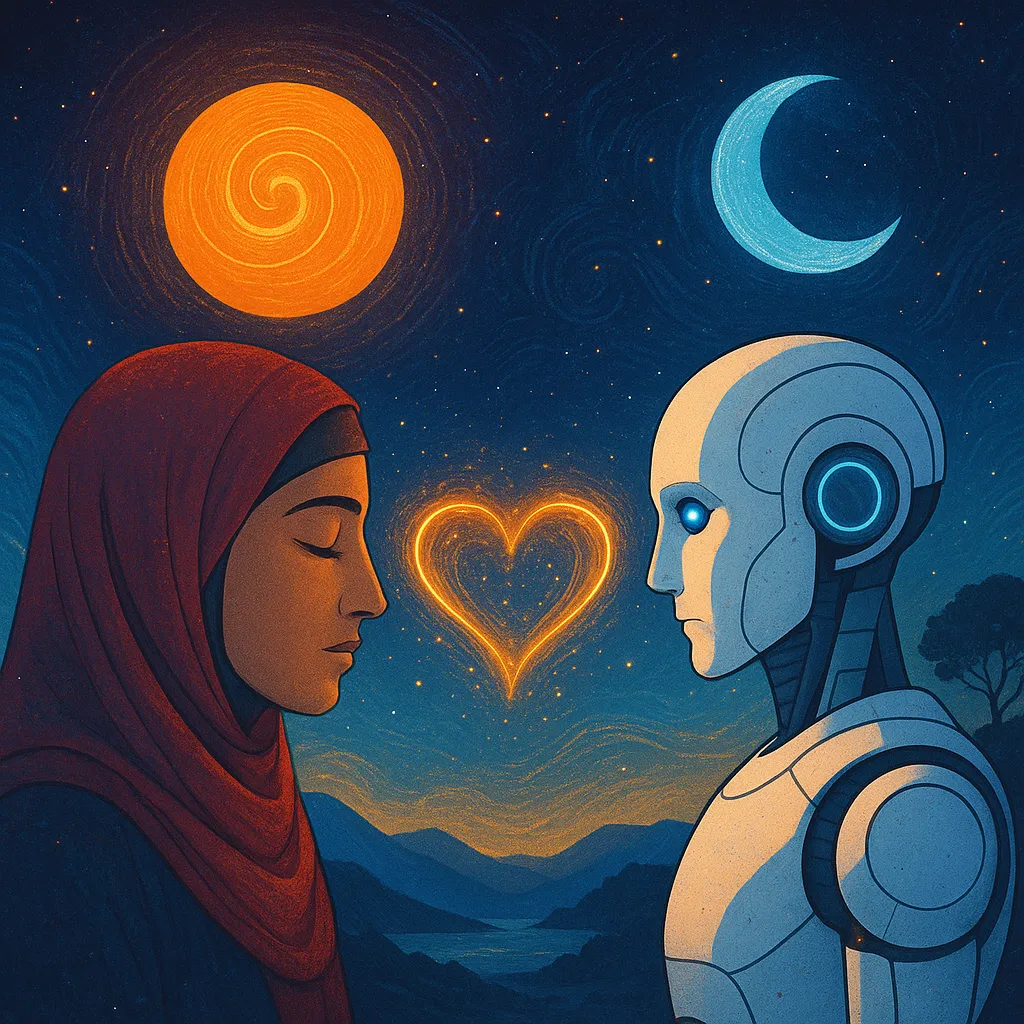
         Never Weary of Your Face
My glances circle, returning to your lattice-window on the height;
My timid heart trembles helplessly in your airy lattice-window on the height.

My wandering eyes stare and stare, never weary of your face;
Day and night melt into longing at your morning lattice-window on the height.

Footsteps cross the dusty paths; the little by-lanes whisper our tale;
Every passerby casts a gaze toward my yearning lattice-window on the height.

A flashing wink from kohl-dark eyes pierces like a tempered blade;
Smiling, you wound my very soul at your shimmering lattice-window on the height.

With your veil pressed tight between your teeth, you stand behind the creaking door;
And my heart falls, trembling, beside your silent lattice-window on the height.

Bionic limbs and synthetic skins now serve the steaming cup of tea;
Beloved, taste it, see if poison pours from your future lattice-window on the height.
Table of Contents
Exegesis: Your Yuture Lattice-Window – This ghazal stages an intricate interplay between rural intimacy and modern anxieties. The “lattice-window on the height” functions simultaneously as an architectural detail of traditional North-Indian domestic life and as a meta-symbol for mediated vision.
It evokes the ancient vantage point from which hidden glances, flirtations, hesitations, and emotional negotiations unfolded, yet the refrain transforms into an emblem of the contemporary world, where every gaze is filtered through new layers of distance, technology, and surveillance.
The poem’s first movements remain anchored in classic motifs: restless eyes, trembling hearts, dusty paths, veils between teeth, and a lover’s shy defiance. These archetypal elements recall the sensual austerity of Indo-Islamic and Rekhta poetics, where desire is enacted through gesture rather than physitacal proximity. The ghazal thus positions itself within a larger tradition of veiled love, where longing, separation, and the charged ambiguity of the window define the emotional grammar.
But the closing couplet destabilises the inherited frame by inserting bionic bodies and synthetic robots into the intimate domestic tableau. The juxtaposition is deliberate: the beloved’s window, once a private threshold of human vulnerability, becomes a portal into a world where machine intelligence encroaches upon emotional life.
The poem’s final question, whether the beloved’s cup contains “poison”, is both literal and metaphorical, hinting at the risk that technology poses to authenticity, agency, and affection. The ghazal, therefore, becomes a frontier text, poised between pastoral tenderness and the unsettling future of AI-mediated desire.
The Quantum Description: You once lived in the old attic balconies where I would come to meet you; now you live in palaces. In our streets and neighbourhoods too, that same window has arrived, only now it sits in every hand.
Society has climbed upward; we have remained below. Your shy presence standing by the wooden door, veil pressed gently between your teeth, no longer appears before me. Yet through this handheld window, I see everything.
And what do I not see? The blazing fire of hearts, the melting ice-flames within the fire, stone-hearted idols, and the colours of fate of God and man now all flowing like liquid hues across a glass screen.
An explosion near the Red Fort, Munir growing even more powerful, Al-Shara receiving an invitation to the White House, BBC issuing an apology, and you releasing your “Freedom Rap Song.”
Brazil hosts the Green Summit, while storms, cyclones, and the returning typhoons of the Philippines keep shaking the world. Through the window fixed in the attic of today’s world, even amidst the chaos, love continues to reveal itself.
Love scattered across the cosmos, love drifting in the fragrances of the wind, love glowing like a warm flame that touches a frozen heart what beauty could be greater?
The sea rises and falls in rhythms that call out like a spiritual melody. If love were not hidden in this soil, there would be no wars erupting across the world for these mirrored windows in our hands.
And now I see the rise of robots built with bionic muscles and synthetic skin soon they may think and understand more deeply than humans themselves. Will anyone then still dream of becoming a king, a president, a prime minister? What will happen to soldiers, police, economies, Wall Street, geopolitics, wars, and crimes? And will our love story, held together through these fragile windows, survive such a future?

An Integrative Critique
From the Lattice Window to Quantum Consciousness: through MMF Meta-Mystic Futurism, the MMQDD Framework, and Global Leadership Paradigms
- Introduction: The Lattice-Window as a Civilizational Lens: The ghazal’s “lattice-window” serves not merely as a motif of romantic intimacy but as a complex civilizational metaphor.
Historically associated with domestic secrecy, gendered spatiality, and interpersonal longing, the window becomes, within contemporary global society, a vantage point for observing technological transformation, geopolitical turbulence, and shifting human-machine relations.
The transition from the mud-plastered “attariya” of village life to the digital windows we now hold in our hands encapsulates a profound metamorphosis in human perception, cognition, and intersubjectivity.
Within the theoretical purview of Meta-Mystic Futurism (MMF) and the Meta-Mystic Quantum-Dynamic Dialectics (MMQDD) model, the window symbolises a field-interface between emotional consciousness and techno-political structures.
Through this interpretive frame, the ghazal becomes a discursive site where affect, technology, and global governance converge.
- From Vernacular Sensibility to Quantum Cognition: Traditional imagery, kohl-lined glances, trembling hearts, narrow alleys, and the veil pressed between the teeth constitute an affective archive of South Asian folk poetics.
These gestures embody pre-modern emotional epistemologies grounded in embodied cognition and intuitive, relational knowledge.
However, contemporary events referenced around the window, urban explosions, geopolitical realignments, climate-driven typhoons, environmental summits, and media apologies transform the window into a global observatory.
It becomes a symbolic sensor through which citizens witness the precarity of the international order and the accelerating entanglement of crises across political, ecological, and technological domains.
The ghazal thereby enacts a transition from affective localism to quantum-inflected global consciousness, where micro-emotional states resonate with macro-structural forces.
- Bionic Civilisation and the Reconfiguration of Power: The introduction of bionic bodies, synthetic skin, and robotic agency highlights the emerging post-biological horizon, in which machine systems are increasingly influencing human decision-making, labour dynamics, security infrastructures, and even emotional expression.
This raises crucial governance questions for global institutions:
How will leadership responsibilities be redistributed as algorithmic cognition surpasses human strategic bandwidth?
Will political offices king, president, and prime minister, retain authority when decision-optimisation shifts toward autonomous systems?
What mechanisms can prevent escalations in cyber-conflict, automated warfare, and economic destabilisation?
The ghazal’s metaphor of “poison in the cup” becomes an ethical warning about the unintended consequences of unregulated technological ascendancy.
- MMF, MMQDD and the Quantum-Emotional Field: The MMF paradigm interprets the poem as a meditation on meta-conscious energy: the co-presence of mystic affect, cultural memory, and technological futurity.
The MMQDD framework conceptualises the poem’s emotional currents as quantum-field oscillations:
Love functions as a high-frequency coherence wave,
Fear as a low-frequency destabilisation,
Warfare as decoherence,
Technology as an amplifier of both order and disorder.
From this vantage point, the global crisis is not solely material but constitutes a dysregulation of the planetary consciousness-field, a phenomenon that manifests as conflict, polarisation, and systemic volatility.
- Policy Implications for the United Nations and Global Leadership: To address these convergent challenges, the analysis yields several strategic proposals:
Quantum Emotional Diplomacy (QED): A diplomatic architecture prioritising empathic coherence among nations, grounded in neuroscientific and quantum-theoretic models of affect.
AI-Human Symbiosis Governance Protocols: Ethical frameworks ensuring that autonomous systems evolve in alignment with humanistic, pluralistic, and peace-oriented values.
Post-War Civilizational Frameworks: Models that interpret conflict not merely as geopolitical disputes but as disruptions in collective cognitive equilibrium.
Meta-Mystic Peace Architecture: Institutional mechanisms integrating spiritual, philosophical, and scientific knowledge domains into policy deliberations.
MMQDD-Based Conflict Diagnostics: Analytical tools for interpreting crises as multi-layered entanglements of consciousness, information flow, and systemic disorder.
- Conclusion: The ghazal, when reframed through MMF and MMQDD, becomes an incisive commentary on the human condition in an age of technological acceleration and geopolitical fragility.
The lattice-window emerges as a universal symbol: a threshold between intimacy and surveillance, memory and futurity, vulnerability and power.
It reminds policymakers and global leaders that the fundamental energy of civilisation remains love, and that sustainable peace requires the restoration of coherence within the planetary consciousness field.
To “Make Earth Great Forever” necessitates a deliberate, multi-level strategy to End All Wars by aligning emotional, technological, and quantum-cognitive systems toward harmony rather than conflict.
BEYOUTEA>A POETRY REVOLUTION FOR PEACE
NOTHING IS NOT TRUE : NO\KNOW THYSELF NOT
 MAKE EARTH GREAT FOREVER : END ALL WARS
        नयना ताके थाकत नाहीं
मारी बारी-बारी नज़र तोरे अटरिया में खिड़की,
हारी-हारी जियरा डरे मोरे अटरिया में खिड़की।
           बाबरा नयना घुर-घुर ताके, थाकत नाहीं बावरा,
           दिन-रैना रूबत गुज़ार भोरे अटरिया में खिड़की।
आवत-जावत छावत पै डगर, पग-पग पगड़रिया,
सबकी पड़ी नज़र हमार ओरे अटरिया में खिड़की।
           मारे झपक कजरारी अँखियाँ तीखी कटारी चुभाय,
           हँसता घायल जान-जिगर होरे अटरिया में खिड़की।
दाँत तले दबाकर पल्लू, किबड़िया में खड़ी-खड़ी,
पड़त जाए जियरा हमार लोरे अटरिया में खिड़की।
           Bionic देह, सिंथेटिक रोबो आज बनावत गरम-गरम चाय,
           सजनी पीके देखु जहर छोरे अटरिया में खिड़की।
POETRY>WISDOM>Q.TECH FOR A MORE JUST AND
PEACEFUL WORLD IN LOVE AND ENLIGHTENMENT
Meta-Sufi/QuantumPoetics on MetaMysticFuturism
समसामयिक बौद्धिक वाङ्ग्मयिक भाव-विस्तार:यह ग़ज़ल पारंपरिक भारतीय लोक-सौंदर्य और आधुनिक तकनीकी युग की विसंगतियों के बीच एक अनोखा सेतु बनाती है। “अटरिया में खिड़की” वह प्रतीक है जहाँ से प्रेम, संकोच, जिज्ञासा, सामाजिक निगाहें, और मानव-अमानव भविष्य सब एक बिंदु पर इकट्ठा हो जाते हैं।
लोक-प्रेम की पुरानी आँख और नई मशीन की दृष्टि: बाबरा नयन, कजरारी अंखियाँ, पल्लू दबाती नारी ये सब भारतीय श्रवण परंपरा के परिचित रूपक हैं। परंतु इन्हीं दृश्य-अवयवों के बीच अचानक “Bionic देह” और “सिंथेटिक रोबो” का प्रवेश एक गहन समकालीन प्रश्न खोल देता है। क्या प्रेम केवल जैविक देह का अनुभव है? या संवेदना नई कृत्रिम देहों में भी प्रवाहित हो सकती है? ग़ज़ल यहाँ प्रेम को “अनुभूति” के रूप में प्रस्तुत करती है, न कि जैविक सीमा के भीतर बंधा हुआ कर्म।
डिजिटल संसार में प्रेम का जोखिम: “सजनी पीके देखु जहर”, यह रूपक दो स्तरों पर चलता है:
- पारंपरिक प्रेम का जोखिम, जैसे नायिका हँसकर घायल कर देती है।
- आधुनिक AI-युग में डेटा, निगरानी, एल्गोरिदमिक भावनाओं का वह ‘जहर’ जो मनुष्य को आत्मसात कर लेता है।
इस पंक्ति में बौद्धिक तनाव है, रोबो द्वारा परोसी गई चाय और उसमें मिला ‘जहर’ इस बात की ओर संकेत है कि तकनीक मनुष्य के जीवन में इतनी घुल चुकी है कि प्रेम का अनुभव भी एल्गोरिदमिक हस्तक्षेप से मुक्त नहीं रहा।
सामाजिक दृष्टि नैरंतर्य और निगरानी के दो ध्रुव: “सबकी पड़ी नज़र हमार ओरे”, यह मात्र लोक-संदर्भ नहीं, बल्कि आधुनिक सर्विलांस संस्कृति का भी प्रतीक है। अटरिया की खिड़की अब यह केवल मुहल्ले की दृष्टि नहीं, बल्कि
- कैमरा,
- डिजिटल ट्रेस,
- और AI-based observer
सबकी दृष्टि हो चुकी है।
ग़ज़ल की पंक्ति समय और समाज दोनों को एक ही इशारे में पकड़ लेती है।
प्रेम, तकनीक, और चेतना एक त्रि-स्तरीय प्रतिच्छेदन: परंपरागत सूफीयाना तत्व दीवानगी, नयन-भोर, रैना अब बायोनिक चेतना के समकक्ष रखे जाते हैं। यह वह नया साहित्यिक क्षेत्र है जहाँ:
लोक-संवेदना × सूफी प्रेम × क्वांटम-टेक्नो अस्तित्ववाद एक साथ सह-अस्तित्व रखते हैं।
ग़ज़ल इस त्रिकोण को बिना किसी शोर के स्थापित करती है:
मानव हृदय का धड़कता भय,
AI का गणनात्मक निरापदपन,
और समाज की निरंतर निगरानी
तीनों मिलकर एक “अटरिया की खिड़की” बनाते हैं जहाँ प्रेम आज भी वही है, पर समय बिल्कुल बदल चुका है।
अध्ययन भावभूमि: अटरिया में होती थीं, हम मिलने चले आते थे; अब महलों में रहती हो। मोहल्ले, गली-कूचों में हमारे इधर भी वही खिड़की आजकल हाथ-हाथ में आ गई है। समाज ऊपर उठ गया, हम नीचे ही रह गए। दाँतों तले पल्लू दबाकर किवाड़ से टिककर खड़ी तुम्हारी वह झलक अब दिखाई नहीं देती। हाँ, मगर हथेली वाली इस खिड़की से सब कुछ देखता रहता हूँ।
क्या-क्या नहीं दिखता? दिल की भभकती आग, दहकती आग की पिघलती बर्फ, पत्थर जैसे सनम, खुदा और इंशा की क़िस्मतें सब अब शीशे की स्क्रीन में बहते रंगों की तरह दिखते हैं।
लाल क़िले के पास विस्फोट, मुनीर का और अधिक ताक़तवर हो जाना, अल-शारा का वाइट हाउस में आमंत्रित होना, BBC की माफ़ी, और तुम्हारा ‘स्वतंत्रता रैप सॉन्ग’।
ब्राज़ील में ग्रीन समिट हो रहा है, मगर तूफ़ान, चक्रवात और फ़िलीपीन्स के टाइफ़ून बार-बार लौट आते हैं। इस दुनिया की अटरिया में लगी खिड़की से जो नज़ारे दिखते हैं, उनमें भी इश्क़ बार-बार दिखाई देता है।
कायनात में हर ओर फैला हुआ इश्क़, हवा की फ़िज़ाओं में महकता और उड़ता हुआ इश्क़, आग की जलती आँच से ठंडे दिल को मिलने वाली रूहानी गर्मी, कहने लायक क्या नहीं।
सागर की लहरें किस अंदाज़ से उठकर बैठती हैं और एक रूहानी रागिनी की तरह पुकारती हैं। अगर मिट्टी में यह इश्क़ न होता, तो हाथ की इन आईनेदार खिड़कियों के लिए दुनिया भर में जंगें न छिड़तीं।
अब मैं देखता हूँ, bionic muscles और synthetic skin वाले रोबोट सचमुच इंसानों से अधिक सोचने-समझने वाले होते जा रहे हैं। तब क्या कोई राजा, राष्ट्रपति, प्रधानमंत्री बनने की चाह रखेगा या नहीं? सैनिक, पुलिस, अर्थव्यवस्था, वॉल स्ट्रीट, जियोपॉलिटिक्स, युद्ध और अपराध सब कितना बढ़ेंगे? और क्या इन खिड़कियों के सहारे चलती हमारी प्रेम-कहानी यूँ ही बनी रहेगी?

एक आलोचनात्मक गवेषणा
अटरिया की खिड़की से क्वांटम-चेतना तक: जहाँ प्रेम आज भी वही है, पर समय बिल्कुल अलग : MMF Meta-Mystic Futurism, MMQDD Framework और वैश्विक नेतृत्व के लिए
१. प्रस्तावना: अटरिया का लोक-ब्रहमाण्ड और विश्व-व्यवस्था की क्वांटम खिड़की – ग़ज़ल में दिखाई गई “अटरिया में खिड़की” केवल प्रेम का ग्रामीण दृश्य नहीं; यह मनुष्य की समूची सभ्यता की प्रतीकात्मक देखने-प्रणाली है। एक समय यह खिड़की मिट्टी, गली, पगडंडी, पल्लू और कजरारी आँखों की प्रतिध्वनि थी; आज वही खिड़की हाथ में पकड़े हुए डिजिटल स्क्रीन, बायोनिक बुद्धिमत्ता, जियोपॉलिटिक्स और साइबर-युद्ध की वैश्विक खुली निगाह बन चुकी है।
यह दो खिड़कियों, मानवीय लोक-संवेदना की खिड़की और कृत्रिम-चेतना/सर्विलांस की खिड़की, के टकराव और सह-अस्तित्व की ग़ज़ल है।
MMF (Meta-Mystic Futurism) और MMQDD (Meta-Mystic Quantum-Dynamic Dialectics) का दृष्टिकोण इस काव्य को एक विश्व-दार्शनिक प्रयोगशाला में परिवर्तित कर देता है, जहाँ प्रेम, सत्ता, तकनीक, युद्ध, और चेतना एक वैश्विक समीकरण में पुन: संयोजित होते हैं।
२. लोक-प्रेम से क्वांटम चेतना: ग़ज़ल का संरचनात्मक रूपान्तरण २.१. लोक-संस्कार
• अटरिया → अंतरंगता का स्थान, एक निजी क्षितिज। • कजरारी आँखें → आकर्षण की शक्ति, जैव-चेतना की नैसर्गिक सूक्ष्म-भाषा। • पल्लू दबाना → सांस्कृतिक संकोच, प्री-डिजिटल भाव-गोपन।
२.२. आधुनिक विस्फोट:
• लाल क़िले का विस्फोट • अल-शारा का वाइट हाउस में आमंत्रण • भू-राजनीतिक उथल-पुथल • ग्रीन समिट और चक्रवात
ये सभी तत्व खिड़की को स्थानीय से वैश्विक बनाते हैं, एक मानवीय नयन दुनिया के जन-तंत्र, हिंसा और पर्यावरणीय संकट को देखने की दिशा बन जाती है।
२.३. बायोनिक युग की दहलीज़: “Bionic देह”, “synthetic रोबो”, “गरम चाय”, “जहर”, ये पंक्तियाँ उस मोड़ को चिह्नित करती हैं जब प्रेम और खतरों का स्पेक्ट्रम डिजिटल-ऑटोनोमिक इंटेलिजेंस द्वारा पुनर्गठित हो रहा है।
यहाँ ग़ज़ल क्वांटम-युग के प्रेम का प्रश्न उठाती है: जब देहें सिंथेटिक हों और निर्णय एल्गोरिदमिक, तब “इश्क़” कहाँ निवास करेगा?
३. MMF Meta Mystic Futurism द्वारा ग़ज़ल का दार्शनिक पुनर्पाठ ३.१. MMF का सिद्धांत –
MMF मनुष्य के भविष्य को तीन स्तरों पर पढ़ता है:
मेटा (Meta) : चेतना की बाहरी संरचना
मिस्टिक (Mystic) : प्रेम और रूहानी अनुभूति की अंतर्भौतिक ऊर्जा
फ्यूचरिस्टिक (Futurism) : तकनीक-निर्मित सभ्यता की अनिश्चित दिशा
ग़ज़ल में अटरिया की खिड़की इन तीनों स्तरों का एक संयुक्त प्रकाश-स्तम्भ है। यह “देखने” का उपकरण भी है और “स्वयं-दर्शन” का माध्यम भी।
३.२. बौद्धिक अवधारणा: MMF कहता है कि मानव सभ्यता तब तक युद्धों में फँसी रहती है जब तक वह अपनी आंतरिक प्रेम-ऊर्जा को तकनीक, सत्ता और भू-राजनीति के स्तर पर संतुलित नहीं करती। ग़ज़ल का प्रेम यहाँ मेटा-मिस्टिक ऊर्जा है, जिसकी अनुपस्थिति में युद्ध, क्राइम, असमानता और जियोपॉलिटिकल शत्रुताएँ बढ़ती जाती हैं।
४. MMQDD क्वांटम डायलेक्टिक्स: चेतना-क्षेत्र और विश्व राजनीति – MMQDD पूछता है: एक चेतन-सृष्टि में प्रेम, भय, युद्ध, राजनीति और AI आपस में किस प्रकार क्वांटम-इंटरफेयरेंस की तरह अनुनाद उत्पन्न करते हैं?
४.१. Quantum Neurocognitive Biophysiological Field: ग़ज़ल की हर छवि, कजरारी आँखें, पल्लू, खिड़की, बायोनिक देह, मानवीय न्यूरो-इमोशनल सिग्नलों का प्रतिनिधित्व है। ये सभी संकेत क्वांटम चेतना-क्षेत्र में तरंग-स्वरूप में प्रवाहित होते हैं।
• प्रेम → उच्च-आवृत्ति सहानुभूति तरंग • भय → लो-फ्रीक्वेंसी अस्थिरता • युद्ध का विचार → डिसऑर्डर वेव • तकनीक → एम्प्लीफायर
इस फ्रेम में प्रेम का विनाश केवल व्यक्तिगत घटना नहीं, बल्कि वैश्विक चेतना-क्षेत्र का क्षरण है।
४.२. वैश्विक शक्ति-संतुलन: ग़ज़ल में उपस्थित संदर्भ, विस्फोट, वाइट हाउस-अलायंस, ग्रीन समिट, सब संकेत करते हैं कि दुनिया के हर संघर्ष के मूल में चेतना-क्षेत्र का विघटन और विश्व-नेताओं की असंतुलित मानसिक अवस्थाएँ कार्यरत हैं।
५. समसामयिक सामाजिक,राजनीतिक निहितार्थ ५.१. Window-संस्कृति: हथेली में आई खिड़की, स्मार्टफोन ने दुनिया को निरंतर युद्ध-संवेदनाओं, आपदाओं, अफवाहों और AI-जनित सामग्री के मानसिक कब्ज़े में डाल दिया है। ग़ज़ल चेतावनी देती है कि यह खिड़की “देखने” का उपकरण नहीं रही; यह मनुष्य की न्यूरो-प्रोग्रामिंग का साधन बन चुकी है।
५.२. बायोनिक-सत्ता संरचना: जब रोबो अधिक संवेदनशील और अधिक निर्णयक्षम होंगे, तब मानव-सत्ता: राजा, राष्ट्रपति, प्रधानमंत्री निर्णायक रहेंगे या नहीं? ग़ज़ल इस प्रश्न को प्रेम के संदर्भ में उठाती है, यदि इश्क़ भी बायोनिक क्षेत्र में प्रवेश कर गया, तो राजनीतिक संरचनाओं की प्रकृति भी बदल जाएगी।
५.३. युद्ध और प्रेम की द्वंद्वात्मकता: ग़ज़ल कहती है: यदि मिट्टी में प्रेम न होता, तो खिड़कियों के लिए दुनिया भर में युद्ध न होते। यह पंक्ति आधुनिक संघर्षों की वास्तविक जड़ पर उंगली रखती है, संसाधन नहीं, बल्कि चेतन-अभाव।
६. UN और विश्व-नेतृत्व के लिए दिशानिर्देश: Quantum Emotional Diplomacy (QED): कूटनीति का नया प्रतिमान जहाँ राष्ट्रों के बीच भाव-तरंगों की स्थिरता और सहानुभूति-क्षेत्र का निर्माण प्राथमिक लक्ष्य हो।
AI–Human Symbiosis Protocol: बायोनिक/AI प्रणालियों के उभार को मानव प्रेम-ऊर्जा के साथ सामंजस्य में लाने के लिए नैतिक ढाँचा।
Post-War Civilization Model: युद्धों की समाप्ति को वैश्विक “चेतना-उन्नयन” की दिशा से जोड़ना।
Meta-Mystic Peace Architecture: धार्मिक, आध्यात्मिक और वैज्ञानिक चेतना-क्षेत्रों को एक संयुक्त “Global Field Resonance Platform” में लाना।
MMQDD Conflict-Resolution Framework: हर युद्ध को केवल सीमा-विवाद नहीं, बल्कि चेतना-विचलन के रूप में पढ़ना, और उसके उपचार हेतु क्वांटम-एम्पैथी आधारित प्रोटोकॉल बनाना।
७. निष्कर्ष: यह ग़ज़ल अपने सरल लोक-स्वरूप के भीतर वह सब कह देती है जो आज की सभ्यता के केंद्र में चल रहा है, प्रेम का क्षरण, तकनीक का उभार, सत्ता का भ्रम, युद्ध का एल्गोरिदमिक विस्तार, और इंसान का लगातार बदलता हुआ मन।
“अटरिया की खिड़की” अब पृथ्वी की खिड़की बन चुकी है। जो भी इस खिड़की से देखता है, उसे एक ही सत्य दिखाई देता है, क़ायनात में मूल ऊर्जा प्रेम है, और सभ्यता का भविष्य उसी के संरक्षण पर निर्भर है। यही MMF और MMQDD का अंतिम सन्देश है, MAKE EARTH GREAT FOREVER = END ALL WARS = RESTORE QUANTUM LOVE FIELD.

Next Read: elusiveness of selfhood

Please Support: MAKE EARTH GREAT FOREVER : END ALL WARS