


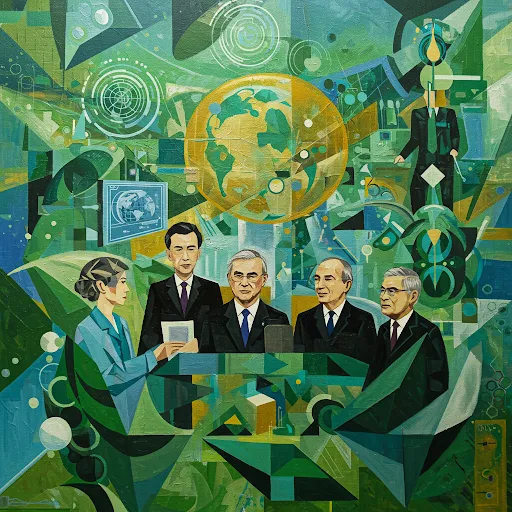
Reimagining Global Diplomacy and Progress in the Era of AI: A Tapestry of Wisdom, Equity, and Technological Promise
The dawn of the 21st century has ushered in an era of unprecedented interconnectedness. The digital revolution, powered by the internet, advanced computing, and the burgeoning capabilities of artificial intelligence, has irrevocably altered the landscape of human existence.
Geographical boundaries have become increasingly porous, economies intertwined, and societal structures challenged. This hyper-connected world presents a paradox: while offering immense potential for collective advancement, it simultaneously amplifies existing inequalities and exposes the fragility of our global systems.
The chasm between the haves and have-nots continues to widen, cooperation often succumbs to division, and the pursuit of progress is frequently overshadowed by the relentless drive for individual gain. In this post, we put forward a topic Reimagining Global Diplomacy and Progress in the Era of AI: A Tapestry of Wisdom, Equity, and Technological Promise for international attention.
To navigate this complex terrain and realize a more equitable and sustainable future, we must draw upon a diverse range of wisdom, from ancient philosophical insights to the transformative potential of modern technology.
Table of Contents
The Fractured Foundation: Maslow’s Hierarchy and Modern Disparity
Abraham Maslow’s renowned hierarchy of needs posits a fundamental framework for understanding human motivation, suggesting that individuals are driven by a sequential progression of needs, starting with physiological survival and culminating in self-actualization.
While intended as a guide towards human flourishing, the application of this model in contemporary society reveals a stark and troubling reality. The relentless pursuit of material wealth and power, often prioritized above communal well-being and ecological sustainability, has led to a distorted interpretation of success.
Our current economic paradigms often celebrate the accumulation of vast fortunes by a select few, while a significant portion of the global population struggles to meet even the most basic needs.
Stock markets, initially conceived as mechanisms for shared economic growth, have in many instances become instruments of speculation and the further concentration of wealth, exacerbating the cycle of disparity rather than fostering widespread prosperity.
The path towards a more balanced and fulfilling society necessitates a fundamental re-evaluation of our definition of success. Instead of solely focusing on material accumulation, we must prioritize education, equity, and enlightened governance as the cornerstones of progress.
In this context, the wisdom of ancient thinkers like Chanakya offers invaluable guidance. His insights into statecraft, diplomacy, and the human condition remain remarkably relevant in our technologically advanced world.
Beyond his political acumen, Chanakya’s appreciation for the natural world and the power of human connection provides profound lessons. Consider these lines, imbued with a gentle yet powerful understanding of human nature:
“The fragrance of flowers spreads only in the direction of the wind. But the goodness of a person spreads in all directions.”
This simple yet profound observation underscores the enduring impact of ethical conduct and the intrinsic value of contributing positively to the collective.
It reminds us that true success lies not merely in personal achievement but in the positive influence we exert on the world around us.
The Nordic Compass: Charting a Course Towards Equity
The Nordic nations stand as compelling examples of societies that have consciously strived to bridge the gap between aspiration and reality, prioritizing the well-being of all citizens through robust social welfare systems, a strong emphasis on education, and a deep-seated commitment to social justice.
Their model of governance offers a powerful counter-narrative to the prevailing economic ideologies that often prioritize individual gain over collective prosperity.
While historical economic theories like diminishing returns, Ricardian production, and Marxian capital analytics have offered valuable insights, their uncritical application has sometimes led to unintended consequences, including increased inequality and social stratification.
Imagine a world where the principles underpinning the Nordic model – inclusivity, equality, and a focus on human capital – were adopted on a global scale, not as an idealistic aspiration but as a practical framework for progress.
In such a world, the transformative power of AI and supercomputing could be harnessed to redistribute resources more equitably, create fairer economic systems, and empower marginalized communities.
Rather than reinforcing existing power structures, technology could become a catalyst for dismantling them, paving the way for a more just and equitable global society where opportunities are not limited by birth or circumstance.
Chanakya’s Enduring Wisdom: Diplomacy for a Connected World
Chanakya’s treatise on statecraft, the Arthashastra, offers timeless principles of diplomacy rooted in Dharma, or righteousness. He understood that lasting peace is not merely the absence of conflict but a state achieved through a delicate balance of power and wisdom.
This insight remains profoundly relevant in our interconnected world, where the actions of one nation can have far-reaching consequences for the entire global community. As Chanakya eloquently stated:
“A single wheel does not move. Similarly, only one virtuous person cannot achieve success.”
This emphasizes the critical importance of collaboration and collective action in achieving shared goals, particularly in the realm of international relations. While alliances like the European Union, BRICS, BIMSTEC, and QUAD have faced scrutiny and are sometimes perceived as instruments of strategic power plays, they also hold the potential to evolve into genuine platforms for multilateral cooperation.
A revitalized and reimagined United Nations, empowered by the analytical capabilities of AI and guided by collective human wisdom, could serve as a central coordinating body for global peace initiatives, fostering dialogue, resolving conflicts, and promoting shared values.
AI as an Equalizer: Forging a New Economic Paradigm
The true revolutionary potential of artificial intelligence lies not in its capacity to generate immense wealth for a select few but in its ability to democratize access to resources, knowledge, and opportunities.
Imagine a future where AI-powered tools are integrated into every facet of life, from optimizing agricultural practices and streamlining manufacturing processes to providing personalized education and healthcare for all.
In such a scenario, the benefits of technological progress would not be confined to the elite but would be shared across all segments of society, fundamentally altering the way we live and work.
Realizing this vision requires a conscious departure from the speculative excesses of financial markets and the unchecked growth of corporate power. Instead, we must strive to build an economy grounded in the ancient Indian concept of Purusharthas: Dharma (righteousness), Artha (prosperity), Kama (fulfillment), and Moksha (liberation).
By aligning economic policies with these timeless values, we can create a civilization that prioritizes human well-being, ethical conduct, and the pursuit of a meaningful life over the singular pursuit of profit.
A Shared Cosmic Destiny: Uniting Humanity Beyond Earth
As humanity embarks on ambitious endeavours in space exploration, this collective pursuit can serve as a powerful symbol of our shared aspirations and our capacity for unity.
The vast expanse of the cosmos beckons us not as individual nations competing for dominance but as a single species venturing into the unknown.
By harnessing the transformative power of AI, the principles of enlightened diplomacy, and the enduring wisdom of our philosophical heritage, we can chart a course towards a future defined by cooperation, interconnectedness, and lasting peace.
In this reimagined world, inspired by the holistic vision of thinkers like Chanakya, leaders would act not as self-serving despots or avaricious billionaires but as responsible custodians of humanity’s collective destiny.
They would be guided by the principles of love, respect for nature, and a willingness to sacrifice individual gain for the greater good. As expressed in countless poems celebrating the beauty and interconnectedness of life, such as William Blake’s poignant lines:
"To see a World in a Grain of Sand

And a Heaven in a Wild Flower,

Hold Infinity in the palm of your hand

And Eternity in an hour." (Blake, 1863)
These verses remind us of the profound interconnectedness of all things and the inherent value present in even the smallest aspects of the natural world. This perspective is crucial for fostering a sense of global stewardship and recognizing our shared responsibility for the well-being of our planet and all its inhabitants.
Ultimately, the synthesis of ancient wisdom, ethical governance, and the transformative potential of AI offers a pathway towards a brighter future, one where the pursuit of progress is inextricably linked to the pursuit of justice, equity, and the flourishing of all humanity.
References
Blake, W. (1863). Auguries of Innocence. In W. M. Rossetti (Ed.), Poetical Works of William Blake (pp. 118-123). Bell and Daldy.
Kauṭilya. (n.d.). Arthashastra (R. Shamasastry, Trans.). Mysore: Mysore Printing and Publishing House. (Original work likely composed between the 4th and 3rd centuries BCE)
Rangarajan, L. N. (1992). Kautilya: The Arthashastra. Penguin Books India.
Maslow, A. H. (1943). A theory of human motivation. Psychological Review, 50(4), 370–396.
Telia, A., Dahl Fitjar, R., & Kuhnle, S. (Eds.). (2018). The Nordic Welfare State: A Model for Others?. Palgrave Macmillan.
United Nations. (n.d.). About the UN. Retrieved from [Insert actual UN website address]

Next Read: Transforming @1Leadership