



            The Red Heart Tincture in Wine
The red heart’s tincture, airy nest in wine, so light, reeling, reeling;
What thunder raised such havoc in the night, reeling, reeling.

Let me keep watching, heart, no eyelid dares a blink or slight;
A sea-scented goblet overbrims and spills its rite, reeling, reeling.

So drowned am I, what wit to rise, what shore, what guiding light?
Joy laced with wounds tilts life’s glass left and right, reeling, reeling.

You forged pure Love; with words I kept the pact of faithful rite,
To script the heart’s own breath from pulse to bite, reeling, reeling.

By Mercy’s grace, You gave us love; yet rulers feed the famine’s blight,
They stoke the hunger-fire while souls seek light, reeling, reeling.

Tea now is dyed by nonsymmorphic symmetry’s tricky, prismatic light;
Beloved, today the wager flips the board outright, reeling, reeling.
Table of Contents
Academic Explanation
This ghazal orchestrates a convergence of eros, ethics, and epistemology. The opening establishes a sensuous chromatics, “the red heart’s tincture” that couples intoxication to a metaphysical destabilisation (“havoc in the night”), formalised through the radif reeling, reeling.
The second couplet deepens perception into vigil: the speaking voice forbids blinking while a “sea-scent goblet” spills over, marrying oceanic vastness with a ritual chalice. The imagery intimates plenitude so abundant it must overflow, a classic mystical trope rendered in tactile sensoria.
Subsequent couplets complicate rapture with oxymoronic balance (“joy laced with wounds”), making affect itself a site of knowledge. Fidelity is recast as textual vocation, keeping faith through the discipline of words, so that poetry itself functions as covenant.
The penultimate social turn opposes divine mercy to political hunger (“rulers feed the famine’s blight”), refusing to sever private ecstasy from public suffering.
The final scientific metaphor of “nonsymmorphic symmetry” and its “prismic light” signals a modernist, research-inflected imagination: order emerges not despite asymmetry but through it, inviting a vision where brokenness refracts into higher structures of meaning.
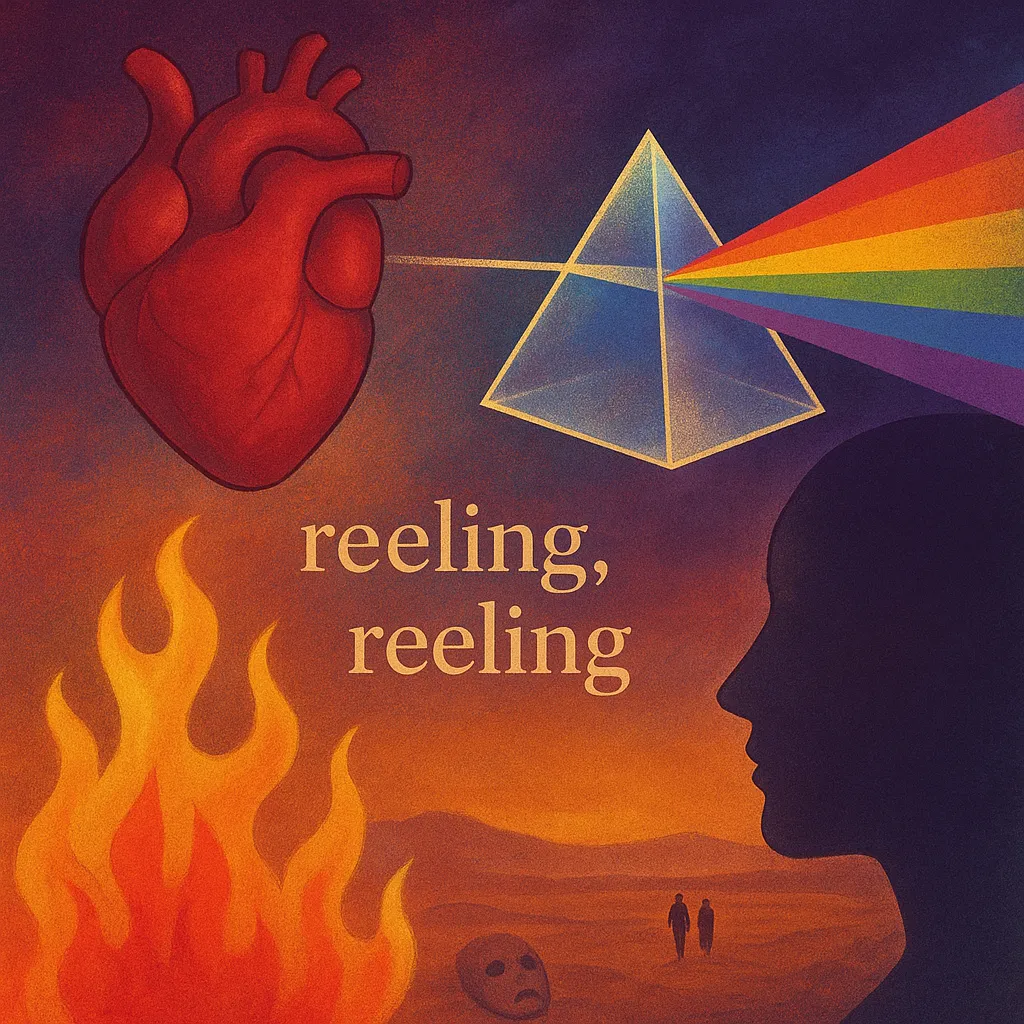
The Red Heart Tincture in Wine – Reeling Hearts, Refractions of Mercy: A Ghazal, a Science, and a Future World
The ghazal before us begins with the image of a red heart trembling in intoxication, “reeling, reeling.” At once, it invites us into a world where love and chaos swirl together. What is this intoxication?
It is not merely the wine of romance, but the larger human condition, our vulnerability before passion, before pain, before beauty itself.
The couplets unfold like mirrored chambers: the unblinking gaze holding onto the beloved, the overflowing sea-turned-goblet, the joy braided with grief, the word turned into covenant. Each refrain of “reeling” carries us deeper into this oceanic trance.
Yet this is not a poem that isolates itself in personal rapture. In one couplet, divine mercy is contrasted with the cruelty of power, “By Mercy’s grace You gave us love; yet rulers feed the famine’s blight.”
Suddenly, the ghazal widens into history, into the burning hunger of Gaza and Sudan, into the fire of warlords who engineer scarcity. Love here is not escapism but resistance, a way of refusing to let human dignity collapse into the ash of politics. The ghazal insists: the language of the heart must remain faithful, must testify, must resist silence.
The most startling gesture arrives in the closing verse: “Tea now is dyed by nonsymmorphic symmetry’s prismatic light.” Here, the ghazal dares to break convention, reaching for the language of quantum physics.
What does this mean? In crystallography, nonsymmorphic symmetry shows us how asymmetry itself creates new order. Brokenness, fracture, irregularity, these do not destroy beauty; they refract it into higher forms.
Through this scientific metaphor, the ghazal whispers a lesson for our world: human suffering and difference, if refracted through compassion, can yield a new harmony.
This vision resonates with the ancient Sanskrit aesthetic of Śākuntalam, where nature and emotion merge into one shimmering field of tenderness.
It resonates too with Christian agape, the love that gives itself without measure, and with Islamic rahma, mercy as divine overflow. And it resonates with Indian Mīmāṃsā, where duty is performed with the precision of ritual, word by word, breath by breath.
Together, these traditions tell us that love is not a sentiment but an ethic, a discipline, a structure of responsibility.
Seen through this prism, the ghazal becomes more than poetry. It becomes a manifesto for a possible future, a “Quantum Happy World,” where asymmetry is not feared but embraced, where hunger and war are not ignored but countered with structures of compassion, where governance itself learns from physics: that balance emerges not by erasing differences, but by refracting them into luminous new patterns.
And so, the refrain “reeling, reeling” is not only intoxication. It is in balance in motion. It is the art of swaying yet not collapsing, of carrying one’s steps in rhythm even as the earth tilts. In this delicate dance, poetry, science, and spirituality converge.
They remind us that the heart’s intoxication may be the first step toward a higher clarity, the clarity to imagine and to build a humane future.
Expert Critique
Form and Prosody (Ghazal Architecture).
The poem preserves the ghazal’s autonomy of couplets (sher) while sustaining a unifying radif (“reeling, reeling”), a sonic device that simulates trance and instability.
The translation adopts near-qāfiyā (rhyme-family preceding the radif) to honor the original’s play with halka / tahalka / chhalka / dhalka, converting semantic tilt into acoustic recurrence.
The matla correctly places the radif in both hemistichs; subsequent couplets restrict it to the second line, maintaining canonical tension between unity and independence.
Imagery & Semantics (Sensory Epistemology).
Chromatic and gustatory motifs (“red heart’s tincture,” “sea-scent goblet,” “tea dyed by symmetry”) stage knowledge as tasting/seeing, an aesthetics continuous with Śākuntalam’s lush sensoria, where nature mediates insight.
Oxymoron (“joy laced with wounds”) enacts a Sufi-like dialectics of sukr/sabr (intoxication/patience), rendering affect as a rigorous mode of knowing rather than mere ornament.
Śākuntalam Aesthetics → Meta-Mystic Futurism.
From the Śākuntalam lineage, the poem inherits tenderness, fragrance, and the contemplative gaze (the unblinking look).
The close then pivots into meta-mystic futurism: classical rasa is reframed with contemporary scientific idiom, extending the pastoral/mystical register toward research-grade metaphor and futurity.
Science as Metaphor: Nonsymmorphic Symmetry & Mirror-like Refraction.
Nonsymmorphic symmetry (where fractional translations combined with reflections/glides create higher-order invariants) is mobilized as an ethical-aesthetic model: apparent disorder generates deeper structure.
The “prismic light” hints at mirror-like refractional effects: fracture → refraction → new spectra. Poetically, griefs and asymmetries refract into novel harmonies, an image of repair without naïve smoothing.
Private Ecstasy / Public Ethics (Gaza & Sudan Frame).
The couplet indicting “rulers feed the famine’s blight” links lyric subjectivity to geopolitical suffering (crafted scarcities, warlord logistics). The ghazal refuses the aesthetic fallacy of detachment.
In our interpretive frame, Gaza and Sudan exemplify structural hunger and displacement. The poem’s vow to “keep faith with words” becomes literary civil courage: testimony as resistance to normalized scarcity.
Tripartite Humanitarian Grounding (Mīmāṃsā, Christian, Islamic).
Mīmāṃsā: duty as precise performance, here, the rite is linguistic; faithful utterance is ethical action.
Christian agape: self-giving love universalized beyond kin/tribe; it sublates the poem’s eros into neighbor-regard.
Islamic rahma: mercy as divine attribute reflected in human conduct; it counters the “hunger-fire” ignited by power. Together they propose a cross-tradition ethic where compassion is not sentiment but obligation.
Quantum-Ethical Horizon (Toward a “Quantum Happy Future World”).
The quantum analogy (entanglement, superposition of pain/joy) legitimizes complexity as the moral baseline.
Policy corollary: design institutions that harness asymmetry (plural identities, contested histories) as informational richness rather than noise, translating “refraction” into multiperspectival governance.
Methodological Strengths & Limits.
Strengths: Interdisciplinarity (poetics/physics/theology), refusal of lyric isolation, rigorous metaphor that does cognitive work.
Limits: Scientific imagery risks exoticism if not situated; future iterations could anchor the physics metaphor with a brief, precise gloss alongside the verse to guide non-specialists.
Implications & Recommendations.
For poets/scholars: Continue hybridizing classical aesthetics with contemporary science to build a shared lexicon of repair.
For educators: Teach ghazal form alongside ethical case studies (Gaza/Sudan) to model literature as action.
For policymakers/technologists: Treat asymmetry-to-order dynamics (a la nonsymmorphic symmetry) as a design principle for humanitarian supply chains, anticipating fracture, enabling refraction (redundancy, local agency, transparent flows).
Conclusion: The poem’s achievement is to bind rapture to responsibility. By aligning Śākuntalam’s sensuous clarity with meta-mystic futurism, and by transposing nonsymmorphic symmetry into an ethic of refractive repair, the ghazal offers not escape but equipment: a way to feel precisely, speak faithfully, and act humanely amid manufactured catastrophe. In this light, “reeling, reeling” is not surrender but a calibrated sway, keeping balance while the world tilts.
BEYOUTEA>A POETRY REVOLITION>PEACE
NOTHING IS NOT TRUE : NO\KNOW THYSELF NOT
            MAKE EARTH GREAT FOREVER
लाल दिल का रंग नशेमन हल्का बहका बहका,
कैसी मचादी है जोर का तहल्का बहका बहका।
           देखते रह जावां दिल पलक झपक बिना झपके,
           महका सा सागर से जाम छल्का बहका बहका।
इतना डूबा हुआ हूँ अब निकलने का होश कहाँ,
दर्द भरी खुसी भी जिंदगी ढल्का बहका बहका।
           तूने बनाई प्यार हमने लफ्ज़ो से वफ़ा निभाई है,
           लिखना है दिलसे बात पलपल्का बहका बहका।
करम ख़ुदा के नवाजिसें मोहब्बत तूने है बख्शा,
जलाए हुकूमतें भूख आग सल्का बहका बहका।
           नॉनसीममोरफिक सिमिट्री रंग की लगी है चाय,
           सजनी आज बाज़ी नहल दहल्का बहका बहका।
LET'S GOODNESS A CHANCE : END ALL WARS
POETRY>WISDOM>Q.TECH FOR A MORE JUST AND
PEACEFUL WORLD IN LOVE AND ENLIGHTENMENT
भाव-विस्तार
यह ग़ज़ल रंग और रूपक के अद्भुत मेल से एक ऐसी भावभूमि रचती है जहाँ प्रेम, वियोग, नशा और करुणा का प्रवाह एक साथ चलता है। “लाल दिल” का बहकना केवल व्यक्तिगत इश्क़ की तड़प नहीं, बल्कि संपूर्ण मानव हृदय की धड़कन है जो प्रेम और करुणा में डूबी हुई है।
इसमें नशेमन और तहलका की छवि प्रेम के उन्माद और आत्मविस्मृति को दर्शाती है, वहीं “सागर से छलकते जाम” का बिंब जीवन की अनन्तता और मधुर नशे को रूपायित करता है।
ग़ज़ल का दूसरा स्वर गहन पीड़ा और संतुलित सुख का है , “दर्द भरी खुशी” एक अद्भुत विलोममूलक (oxymoronic) स्थिति है, जिसमें जीवन का असली सौंदर्य छिपा है।
कवि का हृदय यह अनुभव करता है कि प्रेम और दुख, नशा और जागरूकता, सब मिलकर जीवन की प्रामाणिकता रचते हैं। वहीं “लफ्ज़ों से निभाई वफ़ा” का भाव प्रेम के अमूर्त सौंदर्य को काव्य की मूर्त अभिव्यक्ति में बदल देता है।
ग़ज़ल का सामाजिक आयाम भी गहरा है। “ख़ुदा के करम” और “हुकूमत की भूख की आग” का द्वंद्व यह संकेत देता है कि प्रेम और ईश्वर की करुणा मानवता को बचा सकती है, जबकि सत्ता और लालच उसे झुलसा देते हैं।
अंतिम शेर में “non-symmorphic symmetry” जैसे वैज्ञानिक बिंब का प्रयोग दिखाता है कि कवि पारंपरिक ग़ज़ल को आधुनिक वैज्ञानिक चेतना और भविष्यवादी दृष्टि से जोड़ रहा है।

लाल दिल का रंग नशेमन – अकादमिक-आलोचनात्मक विवेचना : शाकुंतलम सौंदर्य से क्वांटम मेटा-मिस्टिक फ्रेम तक
संस्कृत काव्य की शाकुंतलम् परंपरा हमें प्रकृति और प्रेम की आदर्शीकृत सौंदर्य दृष्टि देती है, जहाँ हृदय और ब्रह्मांड एक ही तत्त्व में विलीन हो जाते हैं। इस ग़ज़ल का सौंदर्य उसी परंपरा की स्मृति कराता है, परंतु उसे आधुनिक meta-mystic futurism की ओर मोड़ देता है। “बहका बहका” की आवृत्ति एक rhythmic trance निर्मित करती है, मानो आत्मा और cosmos एक quantum entanglement की स्थिति में प्रवेश कर रहे हों।
अब यदि इसे गाज़ा और सूडान की भूखमरी से जोड़ें, तो यह ग़ज़ल एक और गहरा अर्थ धारण कर लेती है। वहाँ crafted famine और warlords-created scarcity मानवीय हृदय को घायल कर रहे हैं।
ठीक वैसे ही जैसे nonsymmorphic symmetry क्रिस्टल लैटिस में mirror-like refractional effects उत्पन्न करके संपूर्णता को नए आयाम देती है, उसी तरह मानवीय करुणा और प्रेम की “symmetry-breaking yet order-creating” शक्ति आज की भूख और हिंसा से भरे विश्व में सुधार ला सकती है।
इस परिप्रेक्ष्य में क्वांटम फिजिक्स और मानवीय दर्शन का सम्मिलन आवश्यक है। nonsymmorphic symmetry हमें सिखाती है कि जटिलता और असमानता भी गहरे स्तर पर नई सुंदरता और संरचना को जन्म दे सकती है।
उसी प्रकार, ईसाई और इस्लामी मानवीय मूल्य, agape (divine love) और rahma (divine compassion), जब मीमांसा की दार्शनिक परंपरा से संयुक्त होते हैं, तो वे मानवता के लिए क्वांटम-हैप्पी भविष्य का मार्ग खोलते हैं।
इस प्रकार, यह ग़ज़ल केवल व्यक्तिगत प्रेमगीत नहीं, बल्कि एक academic poetic manifesto है। यह हमें बताती है कि कला, आध्यात्मिकता और क्वांटम विज्ञान को एक नए वैश्विक मानवीय नैतिक ढाँचे में रूपांतरित करना होगा।
जब nonsymmorphic symmetry की तरह असमानताओं को स्वीकारते हुए हम उन्हें उच्चतर क्रम में ढालेंगे, तभी गाज़ा और सूडान जैसी त्रासदियाँ मिट सकेंगी, और एक करुणा-आधारित, भविष्यवादी विश्व-संरचना निर्मित होगी।
एक और सौंदर्य प्रबंध शीर्षक
“बहका बहका सौंदर्य से क्वांटम करुणा तक : ग़ज़ल, शाकुंतलम् और नॉनसीममॉर्फिक सिमिट्री के आलोक में मानवीय भविष्य का पुनर्निर्माण”
सारांश
यह शोध लेख प्रस्तुत ग़ज़ल को साहित्यिक-दार्शनिक पृष्ठभूमि से जोड़ते हुए आधुनिक क्वांटम भौतिकी की अवधारणा nonsymmorphic symmetry के परिप्रेक्ष्य में व्याख्यायित करता है। इसमें यह प्रतिपादित किया गया है कि कैसे प्रेम, करुणा और सौंदर्य का शाश्वत आयाम हिंसा, भूख और सत्ता की लालसा से ग्रस्त वर्तमान विश्व के लिए एक सुधारात्मक नैतिक ढाँचे का आधार बन सकता है। ग़ज़ल की “बहका बहका” पुनरावृत्ति केवल भावनात्मक नशा नहीं, बल्कि भविष्यवादी meta-mystic futurism का सांकेतिक अनुनाद है।
प्रस्तावना
साहित्य में ग़ज़ल की परंपरा सदियों से प्रेम, वियोग और आत्मानुभूति की गहराई का संवाहन करती रही है। संस्कृत नाट्य परंपरा के शाकुंतलम् में सौंदर्य, करुणा और मानवीय संवेदनाओं का ऐसा शिल्प मिलता है जो आज भी हृदय को स्पंदित करता है। प्रस्तुत ग़ज़ल इस शाकुंतलम्-सौंदर्य दृष्टि को आगे बढ़ाते हुए उसे एक meta-mystic futurism की भूमि में स्थापित करती है, जहाँ भावनाएँ, दार्शनिक चेतना और आधुनिक विज्ञान का मेल होता है।
साहित्यिक-भावनात्मक विश्लेषण
“लाल दिल का रंग नशेमन हल्का बहका बहका” से प्रारंभ होकर यह ग़ज़ल प्रेम और करुणा की उस लयात्मक यात्रा को व्यक्त करती है जो नशे में भी संतुलित है। यहाँ प्रेम के उन्माद और जीवन की पीड़ा दोनों का समावेश है,“दर्द भरी खुशी भी ज़िंदगी ढल्का बहका बहका।” इसके साथ ही कवि सत्ता और भूख की आग पर भी कटाक्ष करता है, “जलाए हुकूमतें भूख आग सल्का बहका बहका।” यह द्वंद्व प्रेम और करुणा बनाम सत्ता और हिंसा का है।
दार्शनिक और वैज्ञानिक आयाम
कवि द्वारा nonsymmorphic symmetry का प्रयोग मात्र वैज्ञानिक उपमा नहीं है, बल्कि एक गहरा दार्शनिक संकेत है। भौतिकी में nonsymmorphic symmetry ऐसे क्रिस्टलीय ढाँचों में पाई जाती है जहाँ असमानता (asymmetry) से ही एक नई जटिलता और सौंदर्य जन्म लेता है। इसी प्रकार, जीवन और समाज की असमानताएँ जब करुणा और प्रेम के प्रकाश में देखी जाती हैं, तो वे उच्चतर नैतिक संरचना की ओर ले जाती हैं।
इस संदर्भ में मीमांसा की दार्शनिक पद्धति, ईसाई धर्म का agape (निःस्वार्थ दिव्य प्रेम), और इस्लाम का rahma (ईश्वर की करुणा) एक साझा मानवीय आधार प्रदान करते हैं। यह त्रिवेणी आज की हिंसक भू-राजनीति, विशेषतः गाज़ा और सूडान की निर्मित भूखमरी, के लिए एक सुधारात्मक उत्तर बन सकती है।
समसामयिक सन्दर्भ : गाज़ा और सूडान
गाज़ा और सूडान में युद्ध और भूखमरी केवल राजनीतिक असफलता का परिणाम नहीं, बल्कि मानवीय करुणा के अभाव का प्रतीक हैं। जब सत्ता अपनी भूख को प्राथमिकता देती है, तब लाखों लोग रोटी और पानी के लिए तरसते हैं। इस ग़ज़ल की पंक्तियाँ इन वास्तविकताओं के बीच प्रेम और करुणा की संभावना को जीवित रखती हैं। nonsymmorphic symmetry की भाँति यह दिखाती हैं कि असमानताओं और टूटनों के बीच भी एक नया विश्व-संतुलन संभव है।
निष्कर्ष
यह ग़ज़ल केवल साहित्यिक रचना नहीं, बल्कि एक दार्शनिक और वैज्ञानिक घोषणापत्र (manifesto) है।
यह शाकुंतलम्-सौंदर्य परंपरा से प्रेरित होकर, ईसाई और इस्लामी करुणा मूल्यों से संयुक्त होकर, तथा क्वांटम विज्ञान की nonsymmorphic symmetry की अंतर्दृष्टियों से सशक्त होकर हमें बताती है कि भविष्य का मार्ग Quantum Happy Future World की ओर जाता है।
ऐसा विश्व जहाँ भूख, युद्ध और सत्ता की लालसा नहीं, बल्कि करुणा, प्रेम और वैश्विक मानवीयता ही नयी विश्व-संरचना का आधार बने।
Next Read: conflict-free world society