


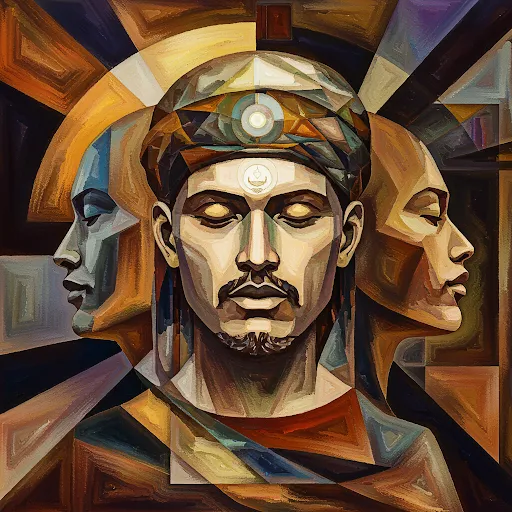
Weaving a Tapestry of Universal Humanity: Lessons from Leaders, Poets, and Consciousness Studies
In our current world, shadowed by conflict, divided by borders, and burdened by inequality, the dream of a truly unified human family can feel distant. Yet, within the wisdom of leaders, the verses of poets, and the profound insights into consciousness, lie the seeds of a more peaceful and interconnected future.
At Darpan Poems, we believe in the power of words and understanding to illuminate this path. Let us explore how the lessons gleaned from diverse sources can guide us towards a civilization rooted in genuine human values – a universal humanity where peace, pride, and prosperity flourish for all. In this post try to take on Weaving a Tapestry of Universal Humanity: Lessons from Leaders, Poets, and Consciousness Studies with a bird’s eye view.
Table of Contents
Echoes of Unity: Lessons from Global Leaders
While their approaches may differ, examining the actions and reported beliefs of global leaders like Barack Obama, Donald Trump, and King Charles III can offer unexpected insights into fostering unity.
Barack Obama’s presidency was often marked by a call for bridging divides. His well-documented appreciation for figures like Lord Hanuman, a symbol of selfless service and unwavering devotion in Hindu tradition, speaks to a broader understanding of interfaith harmony.
Obama’s efforts in promoting multiculturalism and diplomatic engagement serve as a reminder for leaders to prioritize cooperation and mutual respect across religious and cultural lines. Imagine a world where diplomatic efforts are infused with the spirit of understanding and service, fostering bridges instead of building walls.
Interestingly, even figures perceived as divisive can offer unexpected perspectives. Donald Trump’s engagement with Hindu communities and the performance of Hindu prayers (pujas) in his name during elections highlight the growing intersection of spirituality and global politics.
This signifies a shift in geopolitical consciousness, urging leaders to acknowledge and respect diverse cultural and spiritual traditions in their diplomatic strategies. It suggests that fostering alliances can be rooted in cultural understanding rather than purely transactional interests.
King Charles III has consistently championed causes that bridge the gap between Western and Eastern thought. His deep interest in Ayurveda, yoga, and holistic wellness reflects an appreciation for ancient wisdom traditions, particularly Hindu philosophy.
This encourages leaders to consider governance models that prioritize well-being holistically, encompassing not just economic indicators but also the spiritual and physical health of their citizens.
Imagine policies that integrate the principles of holistic well-being, moving beyond mere consumerism towards a more balanced and sustainable way of life.
The Poet’s Voice: Singing of Interconnectedness
Poets, with their sensitivity to human emotion and the natural world, have long articulated the interconnectedness that transcends artificial boundaries. The verses of Scandinavian and South American poets like Tomas Tranströmer, Edith Södergran, Pablo Neruda, and Gabriela Mistral resonate with themes of unity that are profoundly relevant today.
Tomas Tranströmer, the Swedish master of imagery, often used the natural world as a unifying force. His poems reveal how the shared experience of nature – the rustling leaves, and the vast sky – connects us on a fundamental level, irrespective of political identities. Reading his work reminds us that our shared planet is a common ground, a source of wonder that binds us together.
Edith Södergran, a Finnish-Swedish modernist poet, explored themes of identity and belonging with a yearning for a universal self. Her verses often transcend nationalistic confines, hinting at a deeper, shared human experience.
Her poetic quest for a universal identity mirrors the longing for a world where our shared humanity takes precedence over divisive labels.
Pablo Neruda, the passionate voice of Chile, celebrated love and human connection as forces more powerful than conflict. His poems sing of shared joys, sorrows, and the fundamental bonds that tie us together.
Neruda’s work reminds leaders and citizens alike that empathy and love are the cornerstones of peaceful coexistence.
Gabriela Mistral, another luminary from Chile, dedicated her poetry to themes of humanity, justice, and the nurturing power of nature.
Her profound connection to the human spirit echoes the Hindu ideal of Vasudhaiva Kutumbakam – “The world is one family.” Mistral’s verses inspire us to see beyond our differences and recognize the inherent unity of humankind.
These poets offer a powerful lens through which we can envision global unity – not as a political construct, but as an emotional, artistic, and existential reality deeply ingrained in the human experience.

The Fabric of Reality: Consciousness Bridging Science and Spirituality
Delving into the nature of consciousness offers another profound pathway towards understanding our interconnectedness. Hindu philosophy posits that consciousness is the fundamental reality, omnipresent and eternal.
The Upanishads speak of Brahman, the universal consciousness that underlies all existence. This ancient wisdom finds intriguing parallels in modern science.
Quantum physicists like Sir Roger Penrose have explored the possibility that consciousness arises from quantum processes within the microtubules of our neurons. While still a subject of ongoing research, this suggests that consciousness may be more deeply embedded in the fabric of reality than previously understood.
The growing interest in panpsychism, the philosophical view that consciousness or mind-like properties are fundamental and pervasive throughout the universe, also resonates with Hindu philosophical ideas of a universal consciousness.
The scientific search for a “consciousness field” echoes the Hindu concept of Chaitanya – pure awareness as the ground of being.
Imagine leaders and policymakers embracing this deeper understanding of consciousness. It could foster a profound shift in perspective, moving away from narrow, self-serving interests towards a recognition of our inherent interconnectedness and interdependence.
Such a shift could naturally lead to policies that prioritize global well-being, cooperation, and peace.
A Future Forged in Unity: Universal Humanity as Our Guiding Star
By integrating the lessons from global leaders who have shown inclinations towards unity and interfaith understanding, the profound insights of poets who celebrate our shared humanity, and the converging perspectives on consciousness from ancient wisdom and modern science, we can chart a course towards a brighter future.
This path towards universal humanity envisions:
- A world without wars: Fostered by a deep sense of global inert-existential respect and the recognition of our shared consciousness, rendering conflict obsolete.
- A world without artificial borders: Achieved through policies that promote universal brotherhood and recognize our shared human identity above nationalistic divisions.
- A world with minimal armament: As the focus shifts from conflict to holistic well-being and global cooperation, the need for extensive military build-up diminishes.
- A world without deprivation: Driven by economic models inspired by interconnected well-being, ensuring that the needs of all members of the global family are met.
- A world with elevated human consciousness: Embracing both ancient wisdom and modern science to cultivate a deeper understanding of ourselves and our place in the universe.
The 21st century presents us with a critical choice. We can continue down paths of division and destruction, or we can embrace the timeless wisdom of our interconnected existence.
Let the lessons from Obama’s spirit of unity, the potential for a new geopolitical consciousness highlighted by Trump’s engagement, King Charles III’s appreciation for holistic wisdom, the unifying verses of poets, and the evolving understanding of consciousness guide us.
Let us, together, shape a future where peace, pride in our shared humanity, and prosperity flourish for all on this precious planet.

This is the vision Darpan Poems holds dear – a vision of universal humanity realized.