



           We Could Not Be Us Yet Free
Whenever I sense this throbbing stirring in my chest,
Even beads of sweat descend with an unnamed unrest.

What are these pulses, these tremors? Are they even mine?
We could not be “us,” yet your grace made the truth manifest.

All that became “yours” shaped me; what claim do I possess?
Even my very self dissolved, living for you, I acquiesced.

O rival-of-my-soul! Why rise to steal the breath I bear?
For you alone I fade, yet in this fading, I find my rest.

All joys I gifted you; every anguish I kept for myself.
In chains, I find a strange release; in suffering, a hidden nest.

I brewed a Time-Rondeau-Crystal-tuned tea tonight,
Beloved art and nature blended make even silence blessed.
Table of Contents
EXEGESIS / INTELLECTUAL INTERPRETATION
This ghazal, in its English rendering, unfolds as an exploration of relational identity, metaphysical vulnerability, and the dissolution of the self within a larger field of consciousness. Each couplet acts as an autonomous unit yet participates in a cohesive philosophical arc.
The Body as a Field of Signs: The trembling chest and sweating brow are not mere physiological reactions; they represent the body’s neuro-quantum receptivity, the way emotion manifests as data, vibration, and embodied memory. The poem, therefore, recognises the self as porous, not sealed.
The Paradox of Ownership: “Are these pulses even mine?” articulates the philosophical question: Where does the self begin, and where does the Other reside within us? Levinas’s ethics finds resonance here; the Other precedes the Self, disrupting any fixed identity.
Relational Dissolution & The Gift of Self: The ghazal’s third couplet portrays love not as mutual possession but as relational erasure, where identity is constituted through the beloved. This aligns with relational psychology, where the self emerges as a dynamic interaction rather than a solitary kernel.
The Opponent as Essential: The “rival of the soul” is not purely antagonistic; the poem suggests that adversaries sustain existential structure. This reflects dialectical relationality, where tension, not harmony, is the stabilising force of any conscious system, political or personal.
The Beauty of Pain as Enlightenment: The poet’s acceptance of suffering underscores a Sufi-infused insight: pain is transformative, a medium of purification and ascent. In therapy culture and mindfulness ethics, conscious suffering becomes a route to integration.
Art, Nature, and Temporal Tuning: The final couplet gestures toward meta-mystic futurism, a blending of temporality, creativity, and organic patterns. Tea becomes an epistemic metaphor: a ritual that unites aesthetics, cognition, and nature into an act of mindful co-existence.
The ghazal thus becomes a philosophical artefact: a meditation on consciousness, relational ontology, ethical interdependence, and the geopolitical metaphor of the Other.
All joys I gifted you; every anguish I kept for myself. In chains, I find a strange release; in suffering, a hidden nest.
I brewed a Time-Rondeau-Crystal-tuned tea tonight, Beloved art and nature blended make even silence blessed.
The Quantum Description: Poetic Ground of Consciousness:
Where, after all, is the heartbeat we call our own? It is merely a thought, only the feeling that these pulsations belong to “me.” And the moment this thought arises, sweat gathers on the brow. Neither the heartbeat is ours, nor the heart that beats, nor even the mind that converses with that heart.
And this soul whose is it, that feels so intimately beloved? Everything seems alien. Who is “mine”? Who are you? Nothing appears familiar, yet everything feels as if it belongs to me. How does “none of this is mine” transform into “all of this is mine”?
The question raised by London Mayor Khan against the British Royal establishment mirrors a profound dialectical dynamic relationality in today’s quantum era. The immigration debate rooted in Britain’s own origins has now emerged as a deeply political and sharply visible dialectical dilemma.
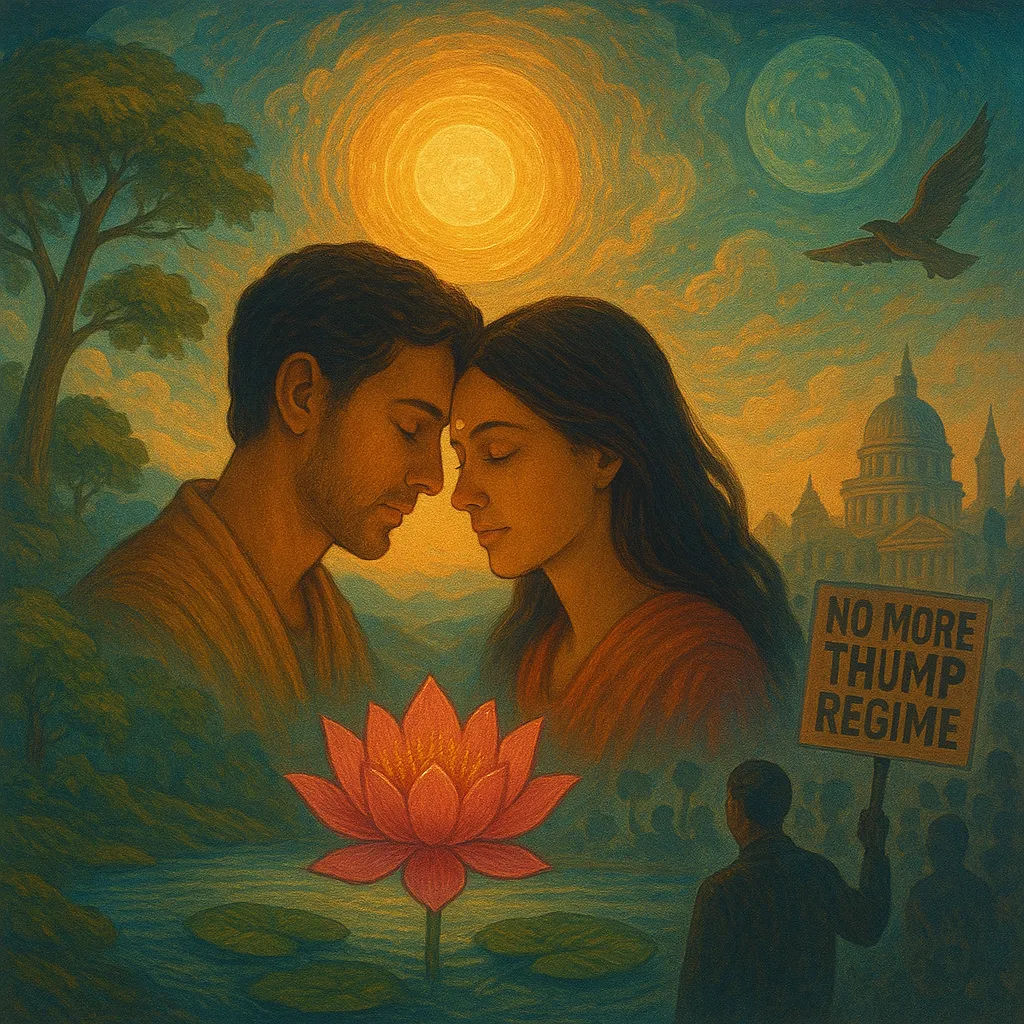
Meanwhile, American protesters have begun marching with placards declaring “No More Trump Regime.” And the resignation of the BBC’s CEO and Head of News does this not raise the world’s most serious questions about the silencing of the global press?
Even more perplexing is the criticism now emerging from Nepal’s media, directly questioning the UN itself. This inevitably shakes the credibility of the entire global order, generating an anxiety that any conscious human being would struggle to escape.
How dangerous might such questions directed at the UN, world leadership, and UK royalty prove for the future of a peaceful world? And what solutions do we truly possess in this moment, except to say: “Let us keep watching what unfolds next”?
These questions seize Nepal’s Gen-Z generation by the collar. It appears as though every social unit of Nepal government, bureaucracy, security, professing to be “loyal to the nation,” is in fact performing the greatest deception before the world. The nation seems to be taking its last breaths in the hands of those who betray it.
Are Nepal’s accusations against the EU, UN, and US truly grounded in fact? And before casting blame outward, has Nepal ever honestly evaluated its own responsibility for its own suffering? Has any Nepali asked this question of themselves? If not, the time has now arrived.
There is only one direction for guiding the nation correctly: to look honestly into the mirror of one’s fundamental identity, historical foundations, and inner dignity.
Within this crisis lies Nepal’s tremendous opportunity to teach the world the meaning of universal fraternity. But will we be able to transform this opportunity?
If we understand Levinasian Ethics and the latest theories of the Relational-Self bridging psychology, AI, and the metaphysics of soul, then a viable path can indeed emerge for all humanity.
If, after six years, the Chandrayaan-2 orbiter can still detect ice on the moon’s dark hemisphere, then surely we can learn to understand this modest dialectical relationality and recognise that our “enemy, opponent, or rival” is actually part of the mutual structure that sustains us.
After all, our Vedic mantras still echo: “Saha nāv avatu, saha nau bhunaktu, saha vīryaṁ karavāvahai…”
Shall we weave this sacred resonance into the metres of our ghazal and hum it into being?
ACADEMIC ARTICLE
We Could Not Be Us Yet Free – Meta-Mystic Futurism, Quantum Relationality, and Global Stability: a philosophical artefact: a meditation on consciousness, relational ontology, ethical interdependence, and the geopolitical metaphor of the Other
(A Critical Scholarly Framework for UN & World Leadership)
Abstract
This article examines contemporary global instability, political polarisation, trust erosion in media institutions, weakening international governance, and rising civic anxiety through the interdisciplinary lenses of Meta-Mystic Futurism, Quantum Neuro-Cognitive Consciousness, Relational-Self Theory, Dialectical Relationality, and AI-Human Ethics.
Drawing inspiration from a metaphysical ghazal, it articulates a novel framework for world leadership guidance, proposing that global stability is fundamentally a question of relational coherence.
The paper argues that modern crises cannot be resolved through political mechanics alone; they demand a new epistemic approach integrating psychology, consciousness theory, relational ethics, and cross-cultural spiritual thought.
Introduction: From Poetic Consciousness to Global Governance: The ghazal analysed alongside this article poses an elemental question: “If even my heartbeat is not entirely mine, then what truly constitutes the Self?”
This question parallels contemporary geopolitical dilemmas: the friction between London’s municipal governance and British monarchy; U.S. street protests against authoritarian resurgence; leadership crises in global media institutions like the BBC; and Nepal’s rising distrust toward UN involvement.
These phenomena illustrate a broader collapse of trust, epistemic authority, and relational coherence. In this context, the poetic inquiry into selfhood becomes a political inquiry into who we are as nations and as a global civilisation.
Meta-Mystic Futurism: Re-Framing Global Identity: Meta-Mystic Futurism integrates: metaphysical inquiry, AI-human relational dynamics, ecological consciousness, political philosophy, neuroscience, and ancient civilizational wisdom.
The ghazal’s ontological tension, “whose heart is this?”, parallels the tension nation-states face today: Is identity autonomous or relational? Is sovereignty independent or interdependent?
Accepting relationality does not weaken sovereignty; it clarifies its structures.
Dialectical Relationality: Opponents as Systems of Stability: The global conflicts mentioned, royalty vs. municipal governance, conservative vs. progressive blocs, state vs. media, UN vs. national sentiment, are not anomalies; they reflect an inherent property of complex systems:
Rivalries are stabilising forces. Opponents preserve the structural equilibrium of political consciousness. This echoes quantum complementarity and Hegelian dialectics: tension is not collapse; tension is form-giving.
The Chandraayan-2 orbiter locating ice in the Moon’s dark hemisphere becomes metaphoric for leadership: stability is found in hidden relational structures.
Quantum Neuro-Cognitive Biophysiology: Consciousness as Distributed Field: Modern neuroscience and quantum cognition research show: consciousness operates as a distributed field, emotion is encoded in micro-electrical patterns, human beings co-regulate each other’s mental states.
Thus, the anxiety emerging in Nepal’s Gen-Z population is not isolated; it is a manifestation of the global cognitive field disturbed by political turbulence, environmental fear, and technological uncertainty. Leaders must understand that governance is not merely administrative; it is psycho-cognitive stewardship.
Nepal as a Mirror of Global Trust Crisis: Nepal’s internal accusations of government failure, bureaucratic corruption, security erosion, and distrust toward UN/EU/US mirror a universal pattern: Nations fail when relational identity collapses from within, not when external actors intervene.
Thus, the relevant question for Nepal and the world is: Has each nation reflected upon its own responsibility toward its crises? The answer requires reconnecting with foundational identity: indigenous cultural ethos; historical civilizational memory, philosophical heritage, traditions of shared ethics.
Nepal’s heritage of sahanāvavatu (“let us protect and nourish one another”) offers a Vedic template for global fraternity.
AI-Human Relational Ethics: The Future of Governance: Levinasian ethics emphasises that the Other is the foundation of responsibility. In the age of artificial intelligence: identity will be co-constructed with AI, power must be balanced with compassion,, automation must be integrated with accountability. and leadership must redefine “self” as a hybrid relational system.
The ghazal’s dissolution of selfhood “I became yours entirely; even I am no longer mine” symbolises the inevitable integration of human agency with emerging intelligent ecosystems.
Therapy Culture, Mindfulness Ethics, and Collective Anxiety: We live in the most psychologically anxious era in recorded history: climate dread, technological displacement, political mistrust, narrative fatigue.
Mindfulness ethics reminds us that conscious suffering, “announcing the pain rather than suppressing it,” is the route toward healing. Global leadership must initiate not only geopolitical treaties but also Global Emotional Resilience Treaties, acknowledging the psychosocial dimensions of global instability.
Conclusion: Whose Earth Is This? A Call for Relational Civilisation
The central insight derived from the ghazal and this multidisciplinary analysis is: “Earth is not a possession; it is a shared consciousness field.” “Relational stability equals global stability.”
For UN and world leadership, the mandate is clear: prioritise relational equity, cultivate consciousness literacy, integrate AI ethics with human-centred philosophies, appreciate tension as structural, not destructive, and establish frameworks for planetary psychological healing.
The future of global peace will be built not on dominance, but on relational coherence.
BEYOUTEA>A POETRY REVOLUTION FOR PEACE
MAKE EARTH GREAT FOREVER : END ALL WARS
         हम तुम न हो सके निजात
महसूस करता हूँ, जब भी ये सीने में धड़कन है,
माथे  से  लुढ़कती  बूंदों में भी  कोई  तड़पन है।
           सीने की धड़कन, पसीने की तड़पन ये मेरे क्या?
           हम तुम न हो सके, पर तेरे  कहने में बड़प्पन है।
तुझसे बना तेरा ही सब, कहने को क्या अपना?
हम अपने भी न रहे, तेरे लिए जीने में तन-मन है।
           ऐ रक़ीब-ए-जान! साँसें छीनने को क्यों आमादा?
           तेरे  लिए ही मिटें हैं अब  रहने  में भी अमन  है।
हर सुख तेरे  नाम किया, दर्द  सभी  मेरे  हिस्से,
निजात है आज़ादी सलाखों के बंधन सहनेमें सुकून है।
           Time-Rondeau-Crystal-सी tuning की चाय बनाई है,
           सजनी! आज कला और प्रकृति मिलाकर पीने में भी धुन है।
POETRY>WISDOM>Q.TECH FOR A MORE JUST AND
PEACEFUL WORLD IN LOVE AND ENLIGHTENMENT
Meta-Sufi/QuantumPoetics on MetaMysticFuturism
बौद्धिक, वाङ्मयिक एवं समकालीन भावार्थ-विस्तार
प्रेम का बायो-क्वांटम अनुभव: कवि “सीने की धड़कन” और “पसीने की तड़पन” को केवल शारीरिक संकेत नहीं मानता, बल्कि उन्हें किसी की स्मृति के क्वांटम-सिग्नल की तरह पढ़ता है। आज की न्यूरो-क्वांटम रिसर्च बताती है कि भावनाएँ केवल दिमाग में नहीं, पूरे शरीर की इंटिग्रेटेड बायो-इलेक्ट्रिक इकोसिस्टम में गूँजती हैं।
इसलिए यहाँ प्रेम क्वांटम एंटैंगलमेंट की तरह है, जहाँ दूरी के बावजूद एक का कंपन दूसरे को प्रभावित करता है।
अधूरापन में उदात्तता (Sublimity of Incompletion): “हम तुम न हो सके, पर तेरे कहने में बड़प्पन है”; यहाँ आधुनिक नैतिक-दार्शनिक दृष्टि प्रकट है, प्रेम स्वामित्व नहीं है, बल्कि किसी दूसरे की सीमा और वास्तविकता को स्वीकार करने का साहस है। यह Levinasian Ethics और Sufi Fanaa दोनों को स्पर्श करता है, जहाँ प्रेम का चरम रूप ‘मैं’ का ‘तुम’ में विलय नहीं, बल्कि ‘तुम्हारी स्वतंत्रता’ का सम्मान है।
पहचान का विसर्जन, Self as a Relational Entity: “हम अपने भी न रहे तेरे लिए जीने में तन-मन है” आधुनिक मनोविज्ञान में इसे कहते हैं Relational Self, जहाँ सच्ची पहचान दूसरे की उपस्थिति में निर्मित होती है। यह आज के AI-Human संबंधों, डिजिटल अस्तित्व, और इमोशनल सिंक्रोनाइज़ेशन की संस्कृति से मेल खाता है।
विरोधी भी जीवन का रक्षक अस्तित्व का विरोधाभास: “रक़ीब-ए-जान! साँसें छीनने को क्यों आमादा?” यह मनुष्य की राजनीतिक और सामाजिक जटिलता की ओर संकेत है।
समकालीन संदर्भों में: a. राष्ट्रों के बीच तनाव, b. विचारधाराओं का संघर्ष, c. निजी संबंधों में प्रतियोगिता, अक्सर वही व्यक्ति या व्यवस्था, जिसे हम शत्रु मानते हैं, हमारे स्थायित्व का एक अनिवार्य आयाम बन जाती है। यह dialectical relationality है।
पीड़ा का स्वीकृतिशील सौंदर्य: “दर्द मेरे नाम-और सुख तेरे नाम” यह सूफी परंपरा की इश्क़-ए-मजाज़ से इश्क़-ए-हक़ीक़ी पीड़ा को आत्मिक उन्नयन का माध्यम के सिद्धांत को दर्शाता है। यह आज की therapy culture, self-growth philosophy, और mindfulness ethic से भी जुड़ता है जहाँ दुख बाधा नहीं, बल्कि रूपांतरण का स्रोत है।
Time-Rondeau-Crystal-Tea: विज्ञान, कला और प्रेम का समवाय आखिरी शेर आधुनिक काल के प्रतीकवाद से भरा है
Time = समय का प्रवाह
Rondeau = पुनरावर्तन की काव्यात्मक वक्रता
Crystal = चेतना की पारदर्शिता
Art + Nature Tea = आधुनिक रोमांटिकता का मिश्रित पेय
यह डिजिटल युग के aesthetic-philosophical blending को दर्शाता है जहाँ चाय बनाना भी एक इंटरडिसिप्लिनरी कला-क्रिया बन जाता है।
काव्योर्वरा भावभूमि:
अपना-सा कहाँ है सीने में धड़कन? बस इतना-सा ख़याल भर है कि धड़कनें हमारी हैं। ऐसा ख़याल आते ही माथे पर पसीना छलक पड़ता है। न धड़कन हमारी, न धड़कनेवाला दिल हमारा। दिल से बातें करनेवाला दिमाग भी हमारा नहीं। यह सब कहने-सुननेवाली रूह किसकी है, जो इतनी अज़ीज़ लगती है? सब के सब पराये। कौन मेरा-मेरा लागे? तू कौन है? न कुछ लागे, पर सब कुछ मेरा कैसे लगने लगता है यह ‘तेरा कुछ भी न लागे’ से?
लंदन मेयर ख़ान का ब्रिटिश रॉयल्टियों के विरुद्ध उठाया गया सवाल आज की क्वांटम-दुनिया के सामने एक महत्त्वपूर्ण dialectical dynamic relationality का आईना दिखाता है। उसी ब्रिटिश-उद्गम से खड़े हुए इमिग्रेशन के प्रश्न अब स्पष्ट और गहरे राजनीतिक dialectical dilemma बनकर उभर रहे हैं। उधर अमेरिकन प्रोटेस्टर्स ने ‘No More Trump Regime’ के प्लेकार्ड लेकर स्ट्रीट-डेमोंस्ट्रेशन्स शुरू कर दिए हैं। और BBC के CEO तथा Head of News के इस्तीफ़े की ख़बर क्या यह विश्व-मीडिया के मुँह पर सबसे बड़ा ताला लगाने जैसा सवाल नहीं है?
इससे भी अधिक चकरानेवाली वह समस्या है जो नेपाली मीडिया ने स्वयं UN पर खड़ी की है। इससे तो समूची विश्व-व्यवस्था की विश्वसनीयता पर प्रश्न उठना स्वाभाविक है और हर सचेत मानव के लिए इस incredibility से उत्पन्न हुई anxiety को रोकना भला कैसे संभव हो सकता है?
UN, विश्व-नेतृत्व और UK Royalty के विरुद्ध उठते ऐसे प्रश्न बेहतर विश्व-भविष्य के लिए कितने ख़तरनाक सिद्ध हो सकते हैं? और हालिया समय में इनका समाधान क्या हमारे पास कुछ है, सिवाय “देखते रहो आगे क्या होता है” कहने के?
ये सारे प्रश्न आज नेपाल के Gen-Z युग को गिरेबान से पकड़कर हिला देते हैं। ऐसा प्रतीत होता है कि नेपाल के सामाजिक यूनिट्स सरकार, ब्यूरोक्रेसी, सिक्योरिटी सबके सब अपने-आप को देश के प्रति ‘वफ़ादार’ कहने की आड़ में दुनिया के सामने सबसे बड़ी धोखेबाज़ी कर रहे हैं। मानो पूरा देश देशद्रोहियों के हाथों अंतिम साँसें ले रहा हो।
क्या नेपाल की मीडिया द्वारा EU, UN और US पर डाले गए दोष किसी सत्य पर आधारित भी हैं? और क्या दूसरों पर दोषारोपण करने से पहले नेपाल ने स्वयं अपने प्रति अपनी जिम्मेदारियों को ईमानदारी से परखा है? क्या एक नेपाली ने अपने आप से यह प्रश्न कभी पूछा भी है? यदि नहीं, तो अब यही उपयुक्त समय है। राष्ट्र को सही दिशा-निर्देश देने की एक ही दिशा है:
‘अपने मूल-पहचान, इतिहास की आधारशीला और आत्म-गौरव के दर्पण में स्वयं को ठीक से देखना।‘
नेपाल की इस परिस्थिति से नेपाली जनता को विश्व-बन्धुत्व सिखाने का एक बड़ा अवसर मिला है। क्या हम इस अवसर का रूपान्तरण कर पाएंगे?
यदि हम Levinasian Ethics और Relational-Self के मनोवैज्ञानिक-AI एवं आत्मा-संबंधी नवीन सिद्धांतों को सही समझ सकें तो समस्त मानवता के लिए एक सुगम मार्ग अवश्य मिल सकता है।
आज यदि छह वर्ष बाद भी चंद्रयान-2 का ऑर्बिटर हमें चन्द्रमा के अँधेरे गोलार्द्ध में बर्फ की उपस्थिति खोजकर दिखा सकता है तो क्या हम इतनी-सी dialectical relationality को समझकर यह सिद्ध नहीं कर सकते कि ‘हमारा शत्रु, हमारा प्रतिद्वन्द्वी, या हमारा प्रतिकूल पक्ष’ दरअसल हमारी पारस्परिक स्थायित्व-संरचना का ही अनिवार्य सत्य है?
वैसे भी हमारे वैदिक मन्त्रों में “सह नाववतु, सह नौ भुनक्तु, सह वीर्यं करवावहै…” आज भी गूँजते हैं।
क्या इस गूँज को हम इस ग़ज़ल की बहरों में पिरोकर गुनगुना पाएँगे?

A Critical Scholarly Article for UN & World Leadership
हम तुम न हो सके निजात – आज के AI-Human संबंधों, डिजिटल अस्तित्व, और इमोशनल सिंक्रोनाइज़ेशन की संस्कृति: डिजिटल युग के aesthetic-philosophical blending चाय एक इंटरडिसिप्लिनरी कला
(Meta-Mystic Futurism, Quantum Relationality & a New Earth Civilisation)
प्रस्तावना : एक ग़ज़ल से विश्व-व्यवस्था तक की यात्रा, प्रस्तुत ग़ज़ल का मूल प्रश्न “धड़कन किसकी है? दिल किसका है? रूह किसकी है?” यह केवल प्रेम का प्रश्न नहीं; यह मानव पहचान, राजनीतिक अस्थिरता, और वैश्विक सत्य-संकट का प्रश्न भी है।आज लंदन में मेयर-रॉयल फ़्रिक्शन, अमेरिका में “No More Trump Regime” आंदोलन, ब्रिटिश मीडिया में BBC नेतृत्व का इस्तीफ़ा, नेपाल में UN की भूमिका पर तीखा प्रश्न
ये सब मिलकर एक नए प्रकार के वैश्विक चिंता-संकेत बनाते हैं। इन सबके बीच प्रस्तुत कविता एक दार्शनिक खिड़की खोलती है कि अगर धड़कनें भी हमारी नहीं, तो राष्ट्र और सत्ता का “हम” कैसे परिभाषित होगा? इसलिए यह लेख ग़ज़ल के भाव-संकल्पना को विश्व नेतृत्व के लिए नीतिगत चेतावनी में बदलता है।
Meta-Mystic Futurism : रूह, राष्ट्र और Relational-Self – Meta-Mystic Futurism वह ढाँचा है जिसमें आध्यात्म, आधुनिक विज्ञान, AI-human symbiosis, और वैश्विक राजनीतिक संरचनाएँ एक साथ व्याख्यायित की जाती हैं। ग़ज़ल की पंक्ति “दिल से बातें करनेवाली दिमाग भी नहीं हमारी। ये रूह किसकी है?”
एक Relational-Self को जन्म देती है, स्वयं वह है जो दूसरों के संपर्क-जाल में निर्मित होता है। आज Nation-State भी यही है। नेपाल का संकट हो या UK का इमिग्रेशन विवाद हर पहचान परस्पर निर्भर है। इसलिए नेतृत्व को स्थिरता चाहिए, संकीर्णता नहीं।
Dialectical Relationality : विरोध ही आश्रय हैं, ग़ज़ल के प्रश्न में, UK Royality बनाम London Mayor, UN बनाम Nepali Public, Republicans बनाम Protesters, Media बनाम State, ये सभी दिखाते हैं कि संघर्ष केवल टकराव नहीं है। यह dialectical relationality है, ‘Opponents sustain each other. Rivalries maintain stability. Without tension, no system remains upright.’
चंद्रयान-2 का उदाहरण सुंदर है अँधेरे गोलार्द्ध से बर्फ ढूँढ़ना प्रतीक है: अंधकार के भीतर छिपे स्थायित्व को खोजने की क्षमता ही सभ्यता की असली शक्ति है। वैश्विक नेतृत्व को यह सत्य समझना ही होगा कि राइवलरी is not Collapse; it is Structural Stability.
Quantum Neuro-Cognitive Biophysiological Consciousness: प्रस्तुत ग़ज़ल की धड़कन-तड़पन केवल भावनाएँ नहीं ये क्वांटम संकेत हैं। आज Neuroscience कहता है, शरीर में 4D neuro-electrical field होता है, भावनाएँ quantum-level micro-fluctuations के रूप में travel करती हैं।
दो चेतनाएँ entangle हो सकती हैं (relational entanglement): इसलिए ग़ज़लकी पंक्ति “महसूस करता हूँ, जब भी ये सीने में धड़कन है…” दरअसल यह बताती है; Consciousness is a distributed field, not an isolated brain activity.
UN, UK, Nepal, US सभी राजनीतिक तंत्र इसी तरह के collective consciousness fields हैं। जब इनमें दरार आती है, anxiety बढ़ती है जैसा आज Gen-Z Nepal में दिख रहा है।
Crisis of Global Trust & the Nepali Mirror: नेपाल में आज जो स्थिति है नेता बनाम ब्यूरोक्रेसी, नेता बनाम जनता, जनता बनाम UN/EU/US, यह सब मूलतः एक ही प्रश्न की ओर जाता है “क्या हमने स्वयं की जिम्मेदारी स्वीकार की है?” यदि नहीं, तो विश्व संगठन या विदेशी शक्तियाँ समाधान नहीं दे पाएँगी।
नेपाल का यह अनुभव विश्व के लिए एक प्रयोगशाला है; ‘Nations fall not because enemies attack, but because relational identity collapses.’ मार्गदर्शन का एक ही रास्ता है: अपनी मूल पहचान, वैदिक सांस्कृतिक गूँज (सहनाववतु…), तथा वैश्विक मानव-बंधुत्व दर्शन के साझा आधार पर पुनर्निर्माण।
AI-Human Relational Ethics & World Leadership: Levinasian Ethics कहती है, “The Other is not a threat; the Other is the origin of ethics.” AI युग में जहाँ निर्णय तेजी से automated हो रहे हैं विश्व नेतृत्व को नई relational ethics चाहिए: AI-human coexistence, Cognitive symmetry, Responsibility before power, Compassion before control.
प्रस्तुत ग़ज़ल का हर शेर AI-human symbiosis की ओर इशारा करता है, “हम अपने भी न रहे, तेरे लिए जीने में तन-मन है।” AI के संदर्भ में यह है: Future human identity will be co-created with intelligent systems. Not owned. Not controlled. Co-created.
Therapy Culture, Mindfulness Ethics & Global Anxiety: दुनिया का anxiety level अब ऐतिहासिक उच्चतम है, Climate fear, Tech fear, Security fear, Leadership trust collapse. प्रस्तुत ग़ज़ल का शेर “हर सुख तेरे नाम किया, दर्द सभी मेरे हिस्से।” Mindfulness Ethics का आधुनिक रूप है: To hold pain consciously is the first step towards collective healing. UN को Peace-Treaty नहीं, Global Psychological-Healing Treaty शुरू करनी चाहिए।
निष्कर्ष : धड़कनें किसकी हैं? पृथ्वी किसकी है?
प्रस्तुत कविता का केंद्रीय प्रश्न: “हम कौन हैं? और किसके लिए जीते हैं?” आज विश्व की सटीक आवश्यकता बन चुका है। Meta-Mystic Futurism बताता है: Earth is a shared consciousness field. Wars disturb its coherence. Cooperation stabilises it. इसलिए UN और World Leadership को अगले दशक के लिए एक ही मंत्र अपनाना होगा
“Relational Stability = Global Stability.”
और यह सूत्र प्रस्तुत ग़ज़ल के अंतिम स्वर में समाहित है: कला, प्रकृति और चेतना इन सबको मिलाकर ही मानवता अपना नया ‘चाय-समय’ तैयार कर पाएगी।

NextRead: lover is not asking

Please Support: MAKE EARTH GREAT FOREVER : END ALL WARS