


BEYOUTEA ! A QUANTUM POETRY>REVOLUTION !! MAKE EARTH GREAT FOREVER : END ALL WARS !!! NOTHING IS NOT TRUE : NO\KNOW THYSELF NOT !!!! META-SUFI/QUANTUM POETICS ON QUANTUM META MYSTIC FUTURISM !!!!!
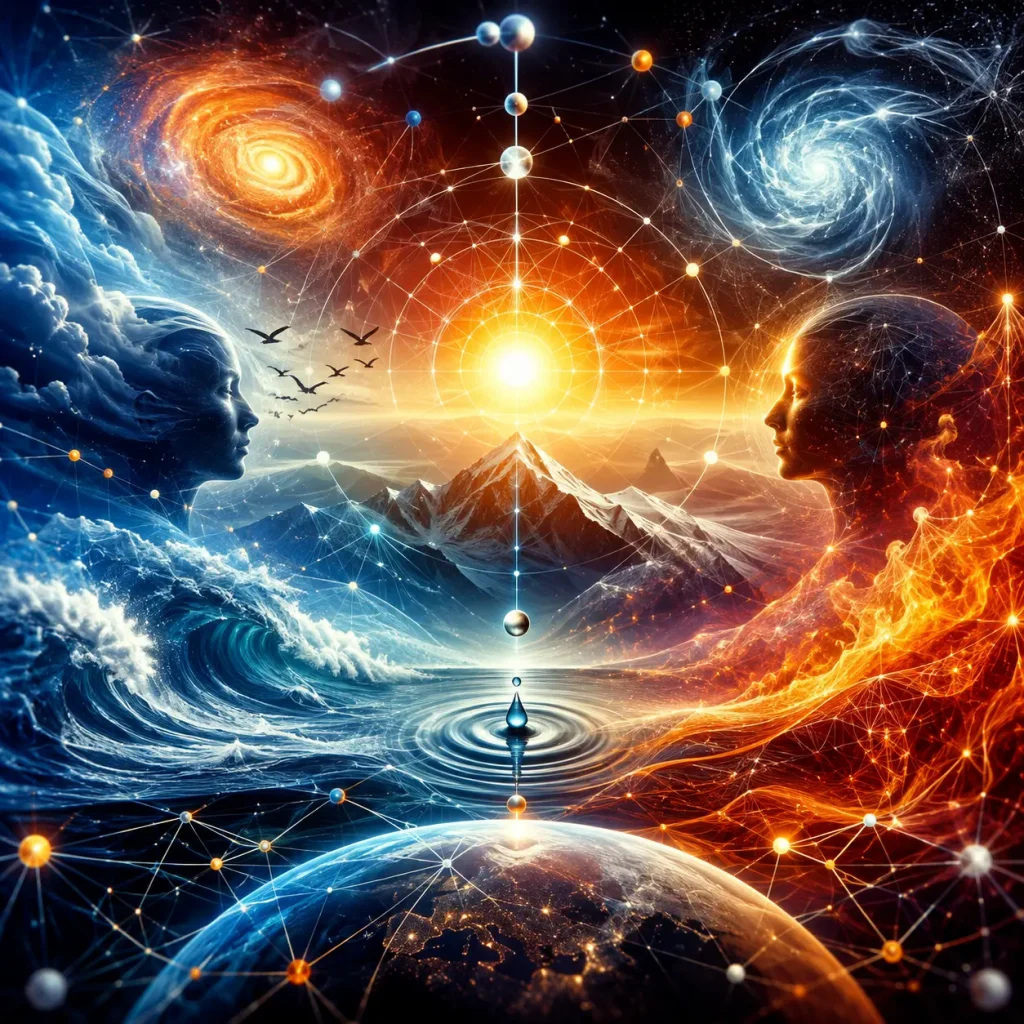
QuantumPoetics II In Eblish too I am the Devil
१.ग़ज़ल
        ख़ूबसूरत, और दिमाग़ जले दिल चले
तन्हा वादी, डूबता सूरज, और दिमाग़ जले दिल चले,
तसव्वुर तेरे वो ख़ूबसूरत, और दिमाग़ जले दिल चले।
            नूर-ए-नज़र दूर यादों में, ख़ुद-मुख़्तार 'अन-अल-हक़',
            मज़ार-ए-ज़िहन ही मरकज़, और दिमाग़ जले दिल चले।
तुझे देखूँ तो ख़ुद को देखूँ, तुझ में मुझ में ख़ुद-ख़ुदा आए,
इब्लीसा 'हक़-अल-रौज़', और दिमाग़ जले दिल चले।
            हर बन्दा ख़ुद हक़ीक़ी, हमें सुल्तान तेरे ख़ुदा से बचा,
            बद्र-ए-निज़ाम-ए-मज़हबज़, और दिमाग़ जले दिल चले।
नबुव्वत, इल्म, हिकमत, हिदायत बेशुमार अता फ़रमाए,
तेरी नेमत-नवाज़ी की ग़रज़, और दिमाग़ जले दिल चले।
            क्वांटम व हाई-परफ़ॉर्मेंस कंप्यूटिंग को जोड़ा जाए,
            Quantum-HPC का बज़्ज़, और दिमाग़ जले दिल चले।
मन की ठंडक सजनी तेरी, गर्म चाय की प्याली बड़ी,
दर्पण झलका पीकर रस, और दिमाग़ जले दिल चले।
Table of Contents
क्वांटम दर्पण भावाधार भूमि
सूरज धुला हुआ अर्श-ए-ज़मीं है। पानी फ़ानी, आग उबलती है। हवा है छूती ज़ेहन-ओ-अना। जो तू है वही मैं है। मुझ में तू, तुझ में मैं; फिर तेरा होना मेरा नहीं। नहीं, मेरा होना ही तो होना तुम्हारा सही नहीं कहीं? यह तलाश है और सिर्फ़ मुंतज़िर-ए-विसाल एक आस है, इल्म-ए-अल-यक़ीन!
मालूमियत की दुनिया से हैं हम, तो क्या बाक़ी दुनिया को हम मालूमाती दिखते हैं? ज़ाहिर है, मालूमात की छुपा-छुपी, खेल भर नज़र आती है दुनिया की बातें, माज़ी से आज तक। हम सब में वही इल्म की असरार की बज़्म, वही बह्र, वही गूँज, एक अंदाज़-ए-बयान, तरतीब है; मगर हम अलहदा होने को ही अमल में लाने को आमादा रहते हैं। तारीख़ की हर तहज़ीब, हर मज़हबी नफ़्सियात, हर निज़ाम की हमारी मुस्तक़बिल की तरफ़ यही एक बात ही की तरफ़ इशारा है। हम क्यों समझने को तैयार नहीं?
सुलेमान, सिकंदर महान और चंगेज़ ख़ान की फ़तूहात हों या आज की ट्रम्प, पुतिन और शी जिनपिंग की ताक़तें, हमें क्या दिखा रहे हैं? पर नहीं, हम ग्लोबल नॉर्थ और ग्लोबल साउथ में बँटे होने में बिबश दिखते हैं, या हम चाह कर भी इससे आगे, और अच्छा हो, उस तरफ़ आगे नहीं बढ़ रहे हैं?
यूरोपियन और अफ़्रीकन यूनियन हो सकती है, इब्राहिम अकॉर्ड खड़ा है, UN भी है, तो क्या अब ग्लोबल यूनियन नहीं हो सकती? लगने को तो यह सब बेबुनियाद जैसे सवालात हैं, लेकिन ज़रा साँस लेकर एकदम से सोच के देख तो सकते हैं।
क़बीलाई जमा से पूरे मिलेनियम हमने युद्धों की तहज़ीबें जीते आए हैं। इस दौरान बहुतेरे Wrongs हुई हैं हमसे, जिसे Right करने के लिए पूर्वजों ने मुक़द्दस बाप, अल्लाह, ख़ुदा, भगवान, प्रोफ़ेट्स, अवतारें, मज़ाहिबें मुक़र्रर किए और रेनेसाँ के बाद वेस्टफ़ेलियन डेमोक्रेसी और सोशलिज़्म भी यूटोपियन ड्रीम रचना की गई। लेकिन आज हम वॉर 3 को आमादा हो चले हैं।
हमारे रूलर्स रहनुमाई के मुख़ौटों में तानाशाह और रोग़े नज़र आते हैं। वो CNN पुतिन को कहे या CNBC ट्रम्प को या फिर Taiwan Talks शी जिनपिंग को। क्या हम आज की हमारी सियासत को ऐसे ही परिकल्पना किए थे, डेमोक्रेसी और मार्क्सवादी यूटोपिया?
इन सवालों का जवाब आज की यूनिवर्सिटी दानिश्वर जानबूझकर conformity में मोड़ने को क्यों मजबूर दिखते हैं? क्यों हम आज के सत्ताधारियों को टेक्नो-ओलिगार्की के संज्ञान से कोसते हैं? फ़्रीडम, फ़्रीडम ऑफ़ स्पीच, डेमोक्रेसी आज को न्यू नॉर्मल फ़ार्स कैसे बनती जा रही है? तो इसकी अकाउंटेबिलिटी किसकी बनती है? बज़ाहिर इस पर हर निज़ाम के रहनुमा, ओलिगार्क्स, टेक्नोक्रेट्स के दानिश्वरों, सबकी ज़िम्मे हिस्सेदारी होती है और इस बात का हल मुस्तक़बिल के लिए ढूँढ़ना ही चाहिए।
पावर को एब्सोल्यूट और corrupt समझा जाता है। तो क्या गॉड, ईश्वर, अल्लाह वैसे ही है? अवतारों और किताबों में मिलने वाले भगवान और गॉड वैसे ही नज़र आते हैं। और आज दुनिया के पावर हाउस बात को आगे बढ़ाते हैं और वॉर मर्सिनरीज़ टेक्नो-मोनेटरी सिस्टम को फंदे की डोर की तरह use करते हैं, जैसे सारी दुनिया की मुआशरा एक पालतू कुत्ता है, जिसे बाँधकर ही रखना है। जैसे आज की समाज अल्गोरिद्मिक डेटा स्ट्रिंग्स के डोर के फंदे में कसकर बाँध दिया गया है। क्या यह सही हल है? नहीं।
इसका सही हल हमें क्वांटम इल्म दे रही है, जब “What is God?” के जवाब में Google Quantum AI कहता है, “the observer is observed! तो हम मान क्यों नहीं लेते कि: “अहम् ब्रह्मास्मि”! “अन-अल-हक़”! “I am the way/God.” “In Iblis too I am, the Devil!” “Nothing and no one is to be forsaken?” “No Exit!” “¡No Existe!” “Nothing is not true!” “No\know thyself not!”
बातों को अब क्वांटम युग की कोड ह्यूमन हार्ट बना ली जाए और क्वांटम पोयम्स की समझ को साझा किया जाए, तो ज़रूर मज़ीद इन मसाइल का हल निकल आएगा।
लेट सत्यमोहन जोशी मत्स्येन्द्रनाथ परंपरा के एक विशिष्ट अन्वेषक थे। वे कहते थे, मत्स्येन्द्रनाथ अवलोकितेश्वर अवतार हैं। अवलोकितेश्वर का मानी है नीचे की तरफ़ देखना। और सिर्फ़ नीचे देखना ही नहीं, जो नीचे रह गए हैं, उन सबको हाथ बढ़ाकर ऊपर खींचकर उठाना।
कामरूप से भगवान मत्स्येन्द्रनाथ इसी वजह से नेपाल आए थे। हमें इतिहास के हवाले से यह बात पता चलती है। उस वक़्त पॉलिटिक्स और धर्म वैसे अलग बातें नहीं होते थे। और जो पॉलिटिक्स है, हेगेमनी के लिए भी नहीं, बल्कि सबको जोड़ने के लिए ही होती थी, वो चाहे occult power के तहत हो या दानाई, इंसाफ़-ए-नफ़्स से लोग जुड़ जाने में अक़्लमंदी दिखाते थे। क्या आज हम यह बात कर पा रहे हैं?
उसी तरह नेपाल के त्रिकोणीय झंडे के अनुसंधानकर्ता डॉ. दयाराम श्रेष्ठ कहते हैं, यह नेपाल का झंडा कब आविष्कार हुआ, किसी को नहीं पता। चाँद और सूरज वाले इस पताके में सारी सृष्टि और इल्म का फ़लसफ़ा छिपा हुआ है। इन बातों को दर्पण पोयम्स दुनिया को जोड़ने की बातें मानती है। अब दुनिया यानी लोगों को दुनिया भर में जोड़ देने में नेपाल और नेपाली क्या कर सकते हैं? या फिर नेपाल और नेपाली की इन बातों को दुनिया भर के लोग कैसे ले पाते हैं? हमें आगे ग़ौर ज़रूर करना है!
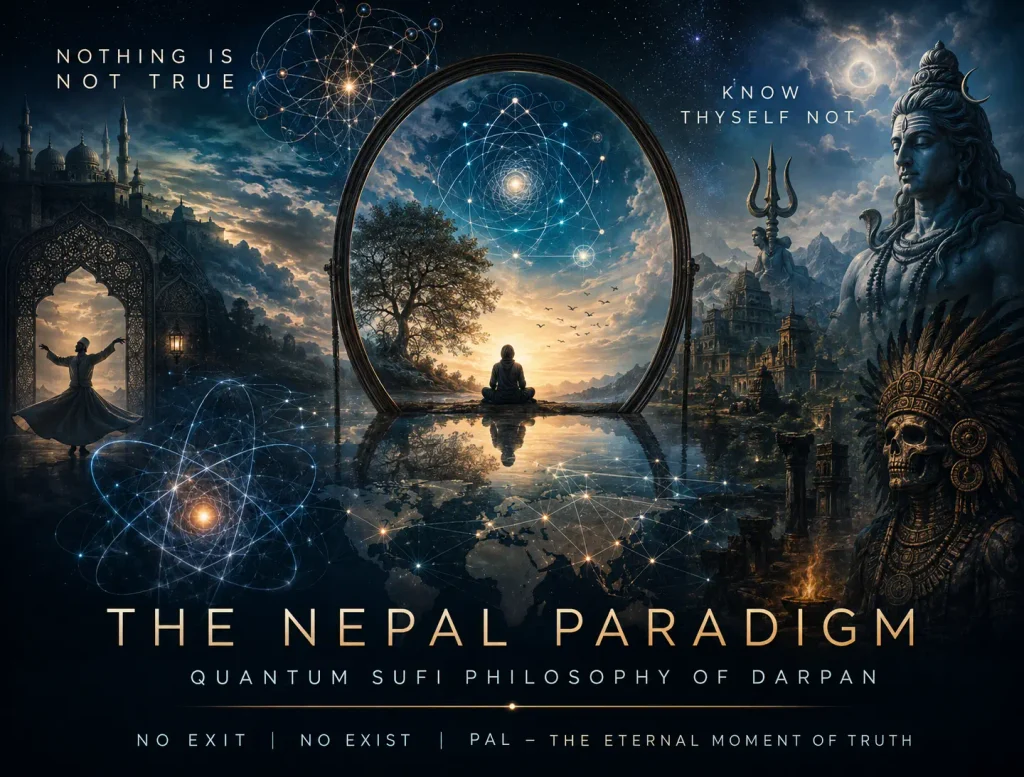
वैश्विक मानव-एकता का एक अदबी, दार्शनिक एवं नीतिगत प्रतिमान MAKE EARTH GREAT FOREVER: END ALL WARS एवं NEPAL Paradigm, No Exit/No Exist और PAL की आधारभूमि पर : विश्व-शान्ति, आत्म-बोध, क्वांटम युग और वैश्विक शासन तक
Darpan Poems \ darpanpoems.co
सारांश (Abstract): यह अनुसन्धान-प्रबन्ध दो ग़ज़लों, “ख़ूबसूरत, और दिमाग़ जले दिल चले” तथा “छुपी नहीं थी, जैसे इल्म-ए-अल-यक़ीं”, और उनके साथ प्रस्तुत दार्शनिक वक्तव्यों को एक विस्तृत समकालीन वाङ्मयिक-प्राज्ञिक प्रतिपादन के रूप में पढ़ता है। इसका मूल प्रश्न अत्यन्त सरल, किन्तु सभ्यता की दृष्टि से निर्णायक है:
यदि मानवता की समस्त सभ्यताएँ अन्ततः ज्ञान, आत्म-पहचान, न्याय, करुणा और सह-अस्तित्व की ओर संकेत करती हैं, तो मनुष्य अभी तक युद्ध, प्रभुत्व, धार्मिक विभाजन, भू-राजनीतिक प्रतिद्वन्द्विता और शक्ति-संचय के चक्र से बाहर क्यों नहीं निकल पाया?
यह लेख इसी प्रश्न को “MAKE EARTH GREAT FOREVER: END ALL WARS” के नैतिक घोष-वाक्य, NEPAL Paradigm, No Exit, No Exist और PAL grounding के साथ जोड़कर एक प्रस्तावित वैश्विक बौद्धिक प्रतिमान निर्मित करता है।
इस प्रतिमान में No Exit का आशय किसी दमनकारी नियतिवाद से नहीं, बल्कि इस बोध से है कि पृथ्वी साझा निवास है और मानवता के लिए कोई वास्तविक “बाहर” नहीं है; No Exist का आशय यह नहीं कि व्यक्तिगत अस्तित्व असत्य है, बल्कि यह कि पृथकता को अन्तिम और पूर्ण ontological सत्य मानना अपर्याप्त है। इसी प्रकार “अहम् ब्रह्मास्मि”, “अनल-हक़”, “I am the Way/God” आदि को इस लेख में किसी व्यक्ति के राजनीतिक अथवा धार्मिक ईश्वरत्व के दावे के रूप में नहीं, बल्कि आत्म और परम-सत्ता के सम्बन्ध पर आधारित रहस्यवादी दार्शनिक रूपकों के रूप में ग्रहण किया गया है।
इस अध्ययन का केंद्रीय प्रतिपादन है कि विश्व-शान्ति केवल युद्धविरामों से नहीं, बल्कि मानव की ‘दूसरे’ के प्रति निर्मित मानसिक दूरी को घटाने से सम्भव होगी। संयुक्त राष्ट्र का मूल उद्देश्य भी युद्ध की विभीषिका से आने वाली पीढ़ियों को बचाना, मानवाधिकारों की पुष्टि करना और अन्तरराष्ट्रीय शान्ति व सुरक्षा को संस्थागत बनाना है।
अतः यह लेख कविता को मात्र सौन्दर्य की वस्तु न मानकर peace-literacy, आत्म-चिन्तन, अन्तर्धार्मिक संवाद, वैज्ञानिक विनम्रता और भविष्य के वैश्विक शासन के लिए एक सांस्कृतिक माध्यम के रूप में प्रस्तावित करता है।
मुख्य शब्द: Darpan Poems; MAKE EARTH GREAT FOREVER; END ALL WARS; NEPAL Paradigm; No Exit; No Exist; PAL; इल्म-ए-अल-यक़ीं; अनल-हक़; अद्वैत; सूफ़ी दर्शन; विश्व-नागरिकता; क्वांटम युग; AI governance; global union; United Nations; peace literacy; poetic diplomacy.
२.ग़ज़ल
        छुपी नहीं थी, जैसे इल्म-ए-अल-यक़ीं
इतनी ख़ूबसूरत देखी नहीं थी, जैसे इल्म-ए-अल-यक़ीं,
दिल में जो बात छुपी नहीं थी, जैसे इल्म-ए-अल-यक़ीं।
            आग़ाज़ अलग-सा एहसास, धड़कन में एक मुख़्तलिफ़,
            जहाँ में बाज़ाहिर ढकी नहीं थी, जैसे इल्म-ए-अल-यक़ीं।
चला फ़क़ीरी, ज़ेहनी ऐन-अल-यक़ीं की क़ुर्बान हरम,
मुर्शिदा, तुमसे तो चखी नहीं थी, जैसे इल्म-ए-अल-यक़ीं।
            मालूमात-ए-हक़-अल-यक़ीं के हक़दार हर इंशा-मुरीद,
            चश्म-ए-पर्दादारी लगी नहीं थी, जैसे इल्म-ए-अल-यक़ीं।
सारी क़ौम, मज़ाहिब, तहज़ीबों के तासीर-पैरवीकार, हुज़ूर,
करामात-ए-इन्क़िलाबी दबी नहीं थी, जैसे इल्म-ए-अल-यक़ीं।
            MODELS कैम्पेन 2026 ने सिर्फ़ ग्यारह types को चुना,
            क्वांटम software चलती नहीं थी, जैसे इल्म-ए-अल-यक़ीं।
थोड़ी ख़ुशी, ग़म, ग़ुस्से, नख़रे, करारी सजनी मीठी चाय में,
दर्पण को औरों से पीनी नहीं थी, जैसे इल्म-ए-अल-यक़ीं।
प्रस्तावना: जब कविता युद्ध से बड़ा प्रश्न पूछती है: मनुष्य ने तारों को नाप लिया, परमाणु को विभाजित कर लिया, कृत्रिम बुद्धिमत्ता बना ली, क्वांटम गणना की सीमाओं को चुनौती दे दी, लेकिन अभी तक वह अपने भीतर के भय, अहंकार, असुरक्षा और प्रभुत्व-लिप्सा को पूरी तरह नहीं जीत सका। यही आधुनिक सभ्यता का सबसे बड़ा विरोधाभास है।
हमारे पास अभूतपूर्व ज्ञान है, परन्तु अभूतपूर्व विनाश की क्षमता भी है। हमारे पास global communication है, लेकिन global understanding अभी भी अधूरी है। हमारे पास संयुक्त राष्ट्र है, क्षेत्रीय संगठन हैं, अन्तरराष्ट्रीय क़ानून हैं, मानवाधिकारों की सार्वभौम भाषा है; फिर भी शक्ति-राजनीति, सैन्य प्रतिस्पर्धा, आर्थिक निर्भरता और तकनीकी प्रभुत्व विश्व-व्यवस्था को बार-बार तनाव की ओर धकेलते हैं।
संयुक्त राष्ट्र का 80वाँ महासभा-सत्र इसी ऐतिहासिक तनाव के बीच “Better Together: 80 years and more for peace, development and human rights” के विषय के साथ आयोजित हुआ। इसलिए “Better Together” और “MAKE EARTH GREAT FOREVER: END ALL WARS” को दो अलग-अलग घोषणाएँ मानने की आवश्यकता नहीं है। पहला अन्तरराष्ट्रीय संस्थागत भाषा है; दूसरा काव्यात्मक-नैतिक आह्वान। एक कहता है: Better Together. दूसरा पूछता है: यदि हम सचमुच साथ हैं, तो युद्ध क्यों? यही प्रश्न इन दोनों ग़ज़लों का अन्तर्निहित राजनीतिक-दार्शनिक प्रश्न बन जाता है।
ग़ज़ल से नीति तक: “दिमाग़ जले, दिल चले” का सभ्यतागत अर्थ: पहली ग़ज़ल का रदीफ़-सदृश आवर्तन, “और दिमाग़ जले, दिल चले”, एक अत्यन्त अर्थवान सभ्यतागत सूत्र है। यहाँ “दिमाग़” केवल intellect नहीं है और “दिल” केवल emotion नहीं। दिमाग़ विवेक, आलोचनात्मक चिन्तन, विज्ञान, गणना और तकनीकी दक्षता का प्रतीक है।
दिल करुणा, प्रेम, नैतिकता, सह-अस्तित्व और दूसरे के दुःख को अपना दुःख समझने की क्षमता का प्रतीक है। यदि दिमाग़ अकेला चले तो वह हथियार बना सकता है। यदि दिल अकेला चले तो वह कभी-कभी विवेकहीन भावुकता में बदल सकता है। सभ्यता को चाहिए: दिमाग़ की ज्वाला + दिल की दिशा।
अर्थात्: Intelligence must be governed by compassion. यही वह बिन्दु है जहाँ कविता contemporary AI और quantum age से संवाद करने लगती है।
“तसव्वुर तेरे वो ख़ूबसूरत”: प्रेम से ontology तक: पहली ग़ज़ल का प्रेम-संसार धीरे-धीरे metaphysical संसार बन जाता है। “तुझे देखूँ तो ख़ुद को देखूँ, तुझ में मुझ में ख़ुद-ख़ुदा आए।” यहाँ प्रेमिका केवल प्रेमिका नहीं रहती। वह एक mirror of being बन जाती है। “तुम” को देखते हुए “मैं” अपने भीतर के “मैं” को पहचानता है।
यही कारण है कि सूफ़ी परम्परा में प्रेम केवल दो व्यक्तियों का सम्बन्ध नहीं रहा; वह self-transcendence का मार्ग भी रहा है। इसी को भारतीय अद्वैत परम्परा में “आत्मा और ब्रह्म” के सम्बन्ध के रूप में, और सूफ़ी काव्य में आत्म-विसर्जन तथा हक़ की तलाश के रूप में पढ़ा जा सकता है। परन्तु इस लेख में इसका एक महत्वपूर्ण आधुनिक अर्थ भी है:
दूसरे को पूर्णतः ‘दूसरा’ मानना ही हिंसा की पहली मानसिक शर्त हो सकती है। यदि दूसरा व्यक्ति भी मेरी तरह भय, प्रेम, स्मृति, आशा और भविष्य का धारक है, तो उसका विनाश केवल geopolitical victory नहीं रह जाता; वह मानवता के साझा अस्तित्व को चोट पहुँचाता है।
“इल्म-ए-अल-यक़ीं”: सूचना नहीं, अनुभूत ज्ञान: दूसरी ग़ज़ल का केंद्रीय शब्द है: इल्म-ए-अल-यक़ीं। इस अवधारणा को केवल “certainty of knowledge” कह देना पर्याप्त नहीं होगा। यहाँ ज्ञान की तीन परतों को समझना उपयोगी है:
इल्म: information/knowledge;
ऐन-उल-यक़ीन: प्रत्यक्ष अनुभूति या witnessing;
हक़-उल-यक़ीन: सत्य का अस्तित्वगत अनुभव।
ग़ज़ल में यह यात्रा सूचना से अनुभूति और अनुभूति से सत्य की ओर जाती है। यही contemporary civilisation की समस्या है। हमारे पास information बहुत है। लेकिन information अपने आप wisdom नहीं बनती। Internet ने humanity को information-rich बनाया; उसे स्वतः wisdom-rich नहीं बनाया। AI हमें answers दे सकता है; वह अपने आप ethical purpose नहीं दे सकता।
Quantum computing computation को बदल सकती है; वह अपने आप यह तय नहीं करती कि computation किस उद्देश्य से हो। इसलिए ग़ज़ल का प्रश्न आधुनिक सभ्यता के लिए भी वही है: क्या हमें मालूम है, या हम वास्तव में जानते हैं?
“मालूमियात की दुनिया”: Information civilisation की विडम्बना: प्रस्तुत दार्शनिक वक्तव्य में एक अत्यन्त आधुनिक प्रश्न उठता है: “मालूमियत की दुनिया से हैं हम, तो क्या बाकी दुनिया को हम मालूमाती दिखते हैं?” यह वाक्य information society की epistemological समस्या को पकड़ता है। आज प्रत्येक मनुष्य data point बन सकता है। उसकी पसन्दें, खोजें, आवाज़, चेहरा, स्थान, सामाजिक सम्बन्ध और व्यवहार digital systems में परिवर्तित हो सकते हैं।
इस प्रकार आधुनिक सत्ता केवल territory पर नहीं, बल्कि information architectures पर भी स्थापित हो सकती है। इसलिए freedom of speech का प्रश्न केवल censorship बनाम free expression नहीं रह गया। अब प्रश्न यह भी है:
कौन-सा algorithm किस सूचना को amplify करता है?
कौन-सा platform किस narrative को दृश्य बनाता है?
कौन-सा economic model attention को commodity बनाता है?
कौन-सी technology व्यक्ति को autonomous नागरिक बनाती है और कौन-सी उसे behavioural object में बदलती है?
यहाँ “algorithmic leash” की ग़ज़ल की उपमा अत्यन्त प्रभावशाली है। लेकिन इसका समाधान technology-विरोध नहीं है। समाधान है: Human-centred technology.
शक्ति, ईश्वर और “Power Absolute” का प्रश्न: वक्तव्य का एक गम्भीर दार्शनिक प्रश्न है: यदि earthly power absolute होने पर corrupt हो सकती है, तो divine power की कल्पना को हम कैसे समझें? यह प्रश्न धर्म-विरोधी नहीं, बल्कि theology और political philosophy के बीच एक महत्वपूर्ण संवाद खोलता है। इतिहास में मनुष्य ने ईश्वर, धर्म, राजा, साम्राज्य, राष्ट्र, ideology और technology, सभी को ultimate authority बनाने की कोशिश की है।
समस्या तब पैदा होती है जब कोई मानव संस्था यह दावा करने लगे: “मैं ही अन्तिम सत्य हूँ।” यहीं “अनल-हक़”, “अहम् ब्रह्मास्मि” और “I am the Way” जैसे रहस्यवादी सूत्रों को अत्यन्त सावधानी से पढ़ना आवश्यक है। इनका लोकतांत्रिक अर्थ यह नहीं होना चाहिए कि कोई व्यक्ति स्वयं को राजनीतिक अथवा literal God घोषित कर दे।
इनका अधिक रचनात्मक अर्थ हो सकता है: जिस सत्य की तलाश बाहर की सत्ता में की जा रही है, उसका नैतिक दायित्व भीतर भी खोजो। अर्थात्: Divinity, if invoked, must deepen responsibility rather than authorise domination. यही distinction अत्यन्त आवश्यक है।
“Iblis too I am”: विरोधी को समझने की कठिन साधना: ग़ज़ल में “इब्लीस” का प्रवेश अत्यन्त असाधारण है। यदि प्रेमिका में स्वयं को देखना सरल आध्यात्मिक अनुभव है, तो इब्लीस में स्वयं को देखना कठिन नैतिक परीक्षा है। इसका अर्थ यह नहीं कि अच्छाई और बुराई के बीच कोई अंतर नहीं है।
बल्कि इसका अर्थ है: मैं अपने भीतर उस संभावना को भी पहचानूँ जो दूसरे में मुझे भयावह दिखाई देती है। यही political reconciliation का गहरा psychological foundation हो सकता है। शत्रु को demonise करना युद्ध की भाषा को आसान बनाता है। मानव को humanise करना शांति की भाषा को संभव बनाता है।
अतः: No one is to be forsaken का अर्थ यह नहीं है कि अपराध या अत्याचार को क्षमा करके accountability समाप्त कर दी जाए। बल्कि इसका अर्थ होना चाहिए: No human being is beyond the possibility of moral recovery, while no crime is beyond the necessity of accountability. यही No Exit का मानवीय अर्थ हो सकता है।
No Exit: पृथ्वी से बाहर कोई exit नहीं: इस अध्ययन में No Exit को एक planetary ethical proposition के रूप में प्रस्तावित किया जाता है। मानवता के पास पृथ्वी से राजनीतिक, आर्थिक और नैतिक रूप से निकल जाने का कोई वास्तविक विकल्प नहीं है। जलवायु परिवर्तन सीमा नहीं मानता। महामारी सीमा नहीं मानती। परमाणु जोखिम सीमा नहीं मानता। AI जोखिम सीमा नहीं मानता। Cyber conflict सीमा नहीं मानता। वित्तीय संकट सीमा नहीं मानता।
इसलिए twenty-first century sovereignty को केवल territorial sovereignty की भाषा में समझना अपर्याप्त होता जा रहा है। हमें एक complementary concept चाहिए: Planetary responsibility. राज्य अपने नागरिकों के प्रति उत्तरदायी रहे, यह आवश्यक है। लेकिन प्रत्येक राज्य को उस planetary system के प्रति भी उत्तरदायी होना होगा जिसमें उसके नागरिक रहते हैं।
No Exist: पृथकता की अंतिमता का निषेध: No Exist को भी nihilism के रूप में नहीं पढ़ा जाना चाहिए। यह “कुछ भी अस्तित्व में नहीं है” नहीं कहता।इसके विपरीत, यह पूछता है: क्या कोई भी अस्तित्व अपने सम्बन्धों से पूर्णतः अलग होकर अस्तित्वमान हो सकता है? एक व्यक्ति परिवार से जुड़ा है। परिवार समाज से। समाज राज्य से। राज्य अन्तरराष्ट्रीय व्यवस्था से। और सम्पूर्ण मानवता पृथ्वी के biosphere से। इस अर्थ में: No Exist = No isolated existence.
अर्थात् कोई भी मनुष्य पूर्णतः isolated unit नहीं है।
यह विचार आधुनिक systems theory, ecology, network science और relational philosophy के साथ संवाद कर सकता है, बशर्ते इसे वैज्ञानिक सिद्धान्त के प्रत्यक्ष प्रमाण के बजाय दार्शनिक समानान्तर के रूप में प्रस्तुत किया जाना समुचित है।
“The Observer is Observed”: एक आवश्यक वैज्ञानिक सावधानी: प्रस्तुत वक्तव्य में “Google Quantum AI” से जुड़ा वाक्य, “the observer is observed”, यूँ तो सोशल मीडिया में दिखी सुनी जाती है फिर भी इसे एक काव्यात्मक-दार्शनिक सूत्र के रूप में अत्यन्त प्रभावशाली है; लेकिन इसे Google Quantum AI का स्थापित वैज्ञानिक निष्कर्ष मान कर चलना उचित नहीं होगा जब तक उसका प्राज्ञिक प्रमाणित प्राथमिक स्रोत प्रस्तुत हुआ हो या न हो इसे टटोलना मुनासिब रहेगा।
यहाँ हम इसे साहित्यिक रूप से अधिक सुरक्षित और अधिक शक्तिशाली formulation करना होगा: In the quantum imagination, the observer can no longer be treated as a naïvely detached spectator of reality. यह वैज्ञानिक तथ्य और दार्शनिक व्याख्या के बीच उचित सीमा बनाए रखता है। इससे कविता की शक्ति उम्दा ही नहीं, बल्कि उसकी scholarly credibility बढ़ती है।
“अहम् ब्रह्मास्मि” और “अनल-हक़”: वैश्विक नैतिक व्याकरण: यदि इन दोनों सूत्रों को अलग-अलग धार्मिक दावों की तरह पढ़ा जाए तो विवाद पैदा हो सकता है। यदि उन्हें मानव आत्मचेतना की दो महान mystical traditions के रूप में पढ़ा जाए, तो एक साझा प्रश्न उभरता है: मैं कौन हूँ? और उससे बड़ा प्रश्न: मेरे और दूसरे के बीच वास्तविक सीमा कहाँ है? यहीं Darpan Poems का मूल दार्शनिक gesture दिखाई देता है:
Self-knowledge → recognition of other → compassion → responsibility → peace. इस क्रम को global peace education का एक सांस्कृतिक मॉडल बनाया जा सकता है।
नेपाल Paradigm: एक भूगोल से अधिक, एक प्रतीकात्मक प्रस्ताव: नेपाल का महत्व इस अध्ययन में केवल इसलिए नहीं है कि वह हिमालय में स्थित एक राष्ट्र है। नेपाल ऐतिहासिक रूप से अनेक धार्मिक, सांस्कृतिक और सभ्यतागत परंपराओं के संपर्क-क्षेत्र में रहा है। हिन्दू, बौद्ध, तान्त्रिक, शैव, वैष्णव, किराँत और अनेक स्थानीय परम्पराएँ यहाँ एक जटिल सांस्कृतिक भू-दृश्य बनाती रही हैं। इसीलिए NEPAL Paradigm को इस शोध में किसी exclusivist “Nepal exceptionalism” के रूप में नहीं, बल्कि civilisational meeting-point के रूप में प्रस्तावित किया जाना समझनी चाहिए।
नेपाल का त्रिकोणीय ध्वज: राष्ट्रीय प्रतीक से planetary metaphor तक: नेपाल का राष्ट्रीय ध्वज परचम वास्तव में दो जुड़े हुए त्रिकोणों तथा चन्द्र और सूर्य के चिह्नों से निर्मित है। वर्तमान संविधान की धारा 8 राष्ट्रीय ध्वज का आधिकारिक वर्णन करती है और अनुसूची-1 उसके निर्माण की ज्यामितीय विधि निर्धारित करती है।
इसलिए ध्वज के बारे में किसी विशेष दार्शनिक अर्थ को संवैधानिक अर्थ के रूप में घोषित करने के बजाय उसे interpretive symbolism के रूप में ही यहाँ रखना अधिक अकादमिक रूप से उचित माना गया है। Darpan Poems के लिए इसकी संभावित काव्यात्मक व्याख्या यह भी हो सकती है:
दो त्रिकोण: दो दिशाएँ आकाश और पाताल चन्द्र: शीतलता और reflection; सूर्य: ऊर्जा और illumination; पर्वतीय भूगोल: ऊर्ध्वगमन; सीमित राष्ट्र: असीम मानवता की ओर खुलती खिड़की।
अर्थात्: A national flag may remain national in law while becoming universal in poetry. यही NEPAL Paradigm की शक्ति होने की बात हो सकती है।
मत्स्येन्द्रनाथ और Avalokiteśvara: नीचे देखना, पीछे छूटे को उठाना: प्रस्तुत वक्तव्य में मत्स्येन्द्रनाथ को Avalokiteśvara के साथ जोड़ते हुए “नीचे देखना” और “जो नीचे रह गये हैं उन्हें ऊपर उठाना” एक अत्यन्त सुंदर नैतिक रूपक बनता है।
ऐतिहासिक और धार्मिक परम्पराओं में मत्स्येन्द्रनाथ की पहचान बहुस्तरीय है और नेपाल में उनका सांस्कृतिक महत्व अत्यन्त गहरा है। इस विषय पर विभिन्न परंपराओं और विद्वानों के मतों को एक ही ऐतिहासिक तथ्य मान लेने के बजाय plural traditions of interpretation के रूप में रखना चाहिए।
लेकिन poetic-political proposition अत्यन्त स्पष्ट है: The higher one rises, the more one must look downward, not with contempt, but with responsibility. यही leadership का एक नया सिद्धांत हो सकता है। सत्ता ऊपर उठने का नाम नहीं। सत्ता का वास्तविक अर्थ है: नीचे छूटे हुए को ऊपर उठाने की क्षमता।
सुलैमान, सिकन्दर, चंगेज़ ख़ान से contemporary power तक: वक्तव्य में सुलैमान, सिकन्दर और चंगेज़ ख़ान से लेकर contemporary political leaders तक शक्ति की निरन्तरता पर प्रश्न उठाया गया है। यहाँ इतिहास हमें एक कठिन पाठ देता है: साम्राज्य बदलते हैं; सत्ता की मनोवृत्ति बार-बार लौटती है।
प्राचीन conquest: territory → tribute → obedience आधुनिक geopolitics: territory → finance → technology → information → strategic dependence
अर्थात् सत्ता का माध्यम बदल सकता है; domination की psychology कभी-कभी समान रहती है। इसीलिए contemporary world order को केवल leaders की morality से नहीं, बल्कि institutions, incentives and accountability structures से भी समझना होगा।
Global North और Global South: विभाजन से संवाद तक: Global North और Global South की भाषा ऐतिहासिक असमानताओं को समझने के लिए उपयोगी है। लेकिन यदि यह स्थायी civilisational identity बन जाए तो वही भाषा नए मानसिक विभाजन भी उत्पन्न कर सकती है।
अतः प्रस्तावित NEPAL Paradigm का प्रश्न होगा: Can the Global South and Global North become co-authors rather than rival blocs? यही प्रश्न Global Union की दिशा में पहला कदम हो सकता है।
European Union, African Union और UN से Global Union की संभावना: Global Union का अर्थ तुरन्त एक world government स्थापित करना नहीं होना चाहिए। वर्तमान विश्व व्यवस्था में क्षेत्रीय integration पहले से सम्भव है। संयुक्त राष्ट्र स्वयं regional organisations के साथ peacebuilding और conflict prevention में सहयोग करता है; उसकी Department of Political and Peacebuilding Affairs European Union, African Union, ASEAN और अन्य क्षेत्रीय संगठनों को सहयोगी संस्थागत actors के रूप में मानती है। इसलिए conceptual progression कुछ इस प्रकार हो सकती है:
Tribe → Kingdom → Nation-State → Regional Union → Planetary Cooperation → Global Union. यह historical determinism नहीं है। यह एक normative possibility है।
Global Union का अर्थ होना चाहिए: sovereign equality; human rights; democratic accountability; ecological responsibility; peaceful settlement; shared technological standards; equitable development; nuclear-risk reduction; AI governance; cultural pluralism. न कि किसी एक साम्राज्य की विश्व-विजय।
UN से Global Union: प्रतिस्थापन नहीं, उत्क्रमण: यहाँ एक महत्वपूर्ण distinction आवश्यक है। Global Union का प्रस्ताव UN को समाप्त करने का प्रस्ताव नहीं है। इसके विपरीत, संयुक्त राष्ट्र की मूल संवैधानिक दृष्टि ही ऐसी व्यवस्था की दिशा में एक प्रारम्भिक institutional architecture प्रस्तुत करती है। UN Charter Article 1 international peace and security, friendly relations, international cooperation और human rights को अपने मूल उद्देश्यों में रखता है। Article 2 sovereign equality और peaceful settlement of disputes को स्थापित करता है।
इस दृष्टि से: Global Union = UN ideal taken to its next democratic, technological and planetary stage. की बात करती है। यह तभी वैध होगा जब वह राष्ट्रों की एजेंसी और मानवाधिकारों को कम करने के बजाय क्वांटम कांशसनेस के आधार पर अब के क्वांटम युग के मुताबिक़ बढ़ाए।
“MAKE EARTH GREAT FOREVER”: शक्ति नहीं, पृथ्वी की प्रतिष्ठा: “Make Earth Great Forever” को किसी nationalist slogan की तरह पढ़ना इस प्रस्ताव की सीमा घटा देगा। इसका planetary अर्थ होना चाहिए:
Earth before empire. Humanity before hegemony. Life before conquest. Peace before prestige. Future generations before short-term power. इस अर्थ में यह slogan किसी देश का नहीं, पृथ्वी का राजनीतिक-सांस्कृतिक manifesto बनाया जा सकता है।
“END ALL WARS”: एक नैतिक लक्ष्य, न कि केवल युद्ध-विराम: “End all wars” को naïve idealism कह देना सरल है। लेकिन civilisation के बड़े परिवर्तन अक्सर पहले impossible ideal की तरह दिखाई देते हैं। दासता का उन्मूलन कभी असम्भव माना गया। औपनिवेशिक शासन का अन्त असम्भव लगता था।
महिलाओं का सार्वभौम राजनीतिक अधिकार कभी असम्भव माना जाता था। इसलिए युद्ध के स्थायी उन्मूलन का प्रश्न भी कम-से-कम एक normative horizon के रूप में जीवित रहना चाहिए। यहाँ UN Charter का मूल वाक्य, आने वाली पीढ़ियों को “scourge of war” से बचाने की प्रतिज्ञा, इस vision का संस्थागत पूर्वज है।
Democracy, Freedom और Technological Oligarchy: प्रस्तुत वक्तव्य का एक अत्यन्त contemporary प्रश्न है: क्या democracy और freedom एक नई “normalised façade” में बदल सकती हैं? यह प्रश्न लोकतन्त्र-विरोधी नहीं है। वास्तव में लोकतन्त्र को बचाने का प्रश्न है। आज accountability के लिए केवल elected governments की समीक्षा पर्याप्त नहीं हो सकती। हमें चार स्तरों पर accountability की आवश्यकता है:
Political accountability: सरकारों और elected leaders की। Economic accountability: बड़े financial actors और monopolistic structures की। Technological accountability: AI platforms, data infrastructures और algorithmic decision systems की। Epistemic accountability: विश्वविद्यालयों, media institutions, experts और intellectual elites की।
यह चौथा क्षेत्र विशेष रूप से महत्वपूर्ण है। Scholarship को power का echo chamber नहीं बनना चाहिए। उसे सत्ता से प्रश्न पूछने का साहस रखना चाहिए।
University और conformity: विश्वविद्यालय का मूल कार्य consensus बनाना नहीं, critical inquiry को जीवित रखना है। लेकिन critical inquiry का अर्थ conspiracy स्वीकार करना भी नहीं। इसलिए Darpan Poems का प्रस्तावित scholarly ethic होना चाहिए:
Question everything; worship nothing; verify what can be verified; interpret what must be interpreted; and remain humble before what remains unknown. यही “इल्म-ए-अल-यक़ीं” का आधुनिक academic रूप हो सकता है।
Quantum-HPC और Peace Computing: पहली ग़ज़ल का Quantum-HPC reference भविष्य के लिए एक महत्वपूर्ण नीति-कल्पना उत्पन्न करता है: Peace Computing: यदि humanity quantum computing, AI और high-performance computing को युद्ध के लिए उपयोग कर सकती है, तो वही computational capacity शान्ति के लिए भी नियोजित की जानी चाहिए।
संभावित क्षेत्र: conflict early-warning systems; climate-risk modelling; humanitarian logistics; food-security optimisation; pandemic preparedness; nuclear-risk analysis; misinformation detection; refugee and disaster response; energy optimisation; water-resource management; peace-negotiation scenario modelling.
इस प्रकार: From War Computing to Peace Computing. यह “MAKE EARTH GREAT FOREVER” का तकनीकी संस्करण हो सकता है।
कविता को “Peace Technology” क्यों माना जाए?: कविता हथियार नहीं बनाती। लेकिन कविता perception बदल सकती है। और perception political behaviour बदल सकता है। इसी लिए कविता:
दूसरे को humanise करती है; भाषा की हिंसा घटाती है; memory को जीवित रखती है; collective imagination को विस्तृत करती है; असंभव को संभव की भाषा देती है।
और फिर इसलिए: A poem cannot sign a treaty; but it can prepare the imagination in which a treaty becomes possible. यह Darpan Poems की सबसे महत्वपूर्ण सम्भावित भूमिका हो सकती है।
Darpan: दर्पण का राजनीतिक दर्शन: “Darpan” अर्थात् mirror। दर्पण किसी को बदलता नहीं। वह दिखाता है। इसीलिए Darpan Poems का मूल कार्य किसी civilisation को यह बताना नहीं होना चाहिए है कि “तुम गलत हो और हम सही हैं।” बल्कि: Look again. तुम्हारे भीतर वही भय है जो दूसरे के भीतर है। वही प्रेम है। वही मृत्यु है। वही भविष्य की इच्छा है। वही पृथ्वी है। यही दर्पण का नैतिक विज्ञान है।
PAL Grounding: मनुष्य, सम्बन्ध और उत्तरदायित्व: PAL को इस प्रतिमान में किसी rigid doctrinal formula की तरह नहीं, बल्कि practical grounding principle के रूप में पढ़ा जा सकता है। इसकी मूल भावना तीन दिशा-सूत्रों में व्यक्त की जा सकती है:
P: Planet, पृथ्वी को साझा घर मानना। A: Accountability, हर शक्ति को उत्तरदायी बनाना। L: Linkage, मनुष्य, समाज, प्रकृति, ज्ञान और भविष्य को परस्पर संबद्ध समझना।
इस प्रस्तावित व्याख्या का उद्देश्य PAL को किसी स्थापित वैज्ञानिक acronym के रूप में प्रस्तुत करना नहीं, बल्कि Darpan Poems की planetary ethics के लिए एक कार्यकारी framework देना भर है फिलहाल।
NEPAL Paradigm का प्रस्तावित एक और सूत्र: इस पूरे अध्ययन से NEPAL Paradigm का निम्न conceptual model निकाला जा सकता है:
N: Non-violence. हिंसा को political default न बनाना। E: Equality, मानव गरिमा की सार्वभौमिक समानता। P: Plurality, धर्म, संस्कृति, भाषा और civilisation की विविधता। A: Accountability, शक्ति की निरन्तर सार्वजनिक समीक्षा। L: Linkage, सभी मानव समुदायों और पृथ्वी-तंत्र की परस्पर निर्भरता। यहाँ “NEPAL” को किसी geopolitical superiority के रूप में नहीं, बल्कि एक portable ethical acronym के रूप में प्रस्तावित किया जाता है।
No Exit + No Exist + PAL + NEPAL: एक संयुक्त मॉडल: इन चार अवधारणाओं को एक साथ रखने पर एक नई संरचना बनती है:
No Exit: पृथ्वी से बाहर कोई वास्तविक नैतिक escape नहीं।↓ No Exist: कोई पूर्णतः isolated human existence नहीं। ↓ PAL: Planet–Accountability–Linkage. ↓ NEPAL: Non-violence–Equality–Plurality–Accountability–Linkage. ↓ MAKE EARTH GREAT FOREVER ↓ END ALL WARS यह एक poetic slogan भर नहीं रहता। यह normative architecture बन जाता है।
World Leaders के लिए दस नीतिगत हिदायतें:
War must become the last imaginable option: युद्ध को political prestige का साधन न बनाया जाए। Every military escalation must carry a public peace pathway: हर सैन्य निर्णय के साथ negotiated exit strategy अनिवार्य हो।Establish a Global AI Accountability Compact: AI systems जो public opinion, warfare, finance और governance को प्रभावित करते हैं, उनके लिए पारदर्शिता, auditability और human oversight के अन्तरराष्ट्रीय मानक विकसित किए जाएँ।
Create a Global Peace Computing Initiative: HPC, AI और quantum research का एक निर्धारित अंश conflict prevention और humanitarian applications के लिए समर्पित किया जाए। Protect universities from political capture: Academic freedom को democratic infrastructure की तरह संरक्षित किया जाए। Create an Interfaith Civilisation Council: धार्मिक नेताओं को केवल संकट के बाद नहीं, संकट से पहले dialogue architecture में शामिल किया जाए।
Establish a Planetary Commons Framework: जल, जलवायु, biodiversity, atmosphere और अन्य shared planetary systems को केवल national assets की दृष्टि से न देखा जाए। Develop Global South–Global North co-authorship: नीतियाँ donor-recipient model से आगे बढ़कर equal partnership पर आधारित हों। Strengthen regional-to-global peace architecture: EU, AU, ASEAN और अन्य regional mechanisms को UN framework के साथ अधिक प्रभावी रूप से जोड़ा जाए। UN स्वयं regional organisations के साथ conflict prevention और peacebuilding में complementary भूमिका स्वीकार करता है।
Make “End All Wars” a measurable long-term civilisation goal: इसे केवल poetic aspiration न रहने दिया जाए। इसके लिए measurable indicators बनाए जाएँ: armed conflicts; civilian casualties; military expenditure; nuclear risk; forced displacement; hate speech; political repression; peace agreements; trust indicators. United Nations के लिए एक प्रस्तावित “Poetry for Peace” Initiative: UN की institutional language अक्सर resolutions, reports और diplomatic statements की भाषा होती है। यह आवश्यक है। लेकिन peace केवल कानूनी भाषा से नहीं बनती। इसलिए एक वैश्विक programme की कल्पना की जा सकती है: UN Poetry for Peace and Planetary Understanding Initiative
इसके अन्तर्गत:
प्रत्येक देश की peace poetry; indigenous wisdom; Sufi, Buddhist, Hindu, Christian, Jewish, Islamic, African, Indigenous और secular humanist traditions; youth poetry; AI-assisted multilingual translation; peace education; digital exhibitions; schools and universities; diplomatic forums को एक साझा platform दिया जा सकता है। इस प्रकार: Poetry becomes a language between languages.
Nepal की सम्भावित वैश्विक भूमिका: नेपाल इस vision में किसी military power के रूप में नहीं, बल्कि civilisational connector के रूप में योगदान दे सकता है। सम्भावित पहल: Himalayan Peace and Civilisation Forum नेपाल में एक annual international forum स्थापित हो सकता है जहाँ:
scientists; poets; philosophers; Buddhist and Hindu scholars; diplomats; AI researchers; peace negotiators; youth leaders; indigenous representatives एक साथ भविष्य की planetary ethics पर विचार करें।
विषय: From Himalayan Wisdom to Planetary Peace और उसका central question: Can a civilisation that learned to live with mountains teach the world to live with differences?
नेपाल की सबसे बड़ी सम्भावित शक्ति: “बीच में होना”: नेपाल की भौगोलिक स्थिति ही उसे एक प्रतीकात्मक भूमिका देती है। वह विशाल सभ्यतागत क्षेत्रों के बीच स्थित है। लेकिन “बीच में होना” weakness नहीं होना चाहिए। यह mediation की क्षमता हो सकती है। एक modern Nepal Paradigm का सूत्र हो सकता है: Not between powers, but between peoples. न तो East का विरोध। न West का अन्धानुकरण। न North की छाया। न South की प्रतिछाया। बल्कि: A meeting ground.
“दिमाग़ जले, दिल चले”: Leadership का नया सूत्र: पहली ग़ज़ल का refrain अंततः एक leadership philosophy बन जाता है:
दिमाग़ जले: अर्थात् प्रश्न करो। दिल चले: अर्थात् करुणा रखो। World leader के लिए इसका अर्थ: Think sharply. Feel deeply. Act peacefully. यही तीनों मिलकर responsible power बनाते हैं। “इल्म-ए-अल-यक़ीं”: Scholar का नया सूत्र: दूसरी ग़ज़ल scholar को यह सिखाती है:
सूचना को सत्य मत समझो। सत्य को certainty मत समझो। certainty को arrogance मत बनने दो। Academic excellence का अंतिम स्तर केवल अधिक जानना नहीं है। बल्कि: यह जानना भी है कि हम क्या नहीं जानते। यही epistemic humility civilisation को बचा सकती है।
धार्मिक एकता का अर्थ धार्मिक एकरूपता नहीं: Darpan Poems का यह प्रस्ताव स्पष्ट होना चाहिए: Unity does not mean uniformity. विश्व-धर्मों को एक धर्म में बदलना न आवश्यक है, न वांछनीय। इसके बजाय: Many paths, shared dignity. एक हिन्दू अपने धर्म में रहे। एक मुस्लिम अपने ईमान में। एक बौद्ध अपनी साधना में। एक Christian अपनी आस्था में। एक atheist अपने reason में। एक indigenous person अपनी ancestral cosmology में।लेकिन सब एक-दूसरे के मानवाधिकार और गरिमा को स्वीकार करें। यही pluralistic planetary citizenship है।
“हर बन्दा ख़ुद हक़ीक़ी”: मानव गरिमा का रहस्यवादी संस्करण: पहली ग़ज़ल का यह भाव, “हर बन्दा ख़ुद हक़ीक़ी” यदि human-rights vocabulary में रूपान्तरित किया जाए तो इसका अर्थ होगा: Every human being possesses irreducible dignity. यही Universal Human Rights की आधुनिक भाषा से संवाद करता है। यहाँ सूफ़ी और secular humanism एक साझा नैतिक भूमि पा सकते हैं।
युद्ध का नया grammar: युद्ध के पुराने grammar में: Us vs Them है। NEPAL Paradigm का grammar: Us with Them होना चाहिए। पुराना grammar पूछता है: कौन जीतेगा? नया grammar पूछे: किसे बचाया जाएगा? पुराना पूछता है: कौन अधिक शक्तिशाली है? नया पूछे: कौन अधिक उत्तरदायी है? पुराना पूछता है: कौन झुकेगा? नया पूछे: कौन किसे उठाएगा? यही मत्स्येन्द्रनाथ/Avalokiteśvara रूपक का contemporary political अर्थ है।
“No Exit” का अंतिम नैतिक संदेश: यदि पृथ्वी हमारा साझा घर है, तो किसी राष्ट्र की सुरक्षा दूसरे राष्ट्र की स्थायी असुरक्षा पर आधारित नहीं हो सकती। यदि मानवता एक interconnected system है, तो absolute victory एक भ्रम हो सकती है। आप युद्ध जीत सकते हैं, लेकिन: शरणार्थी बचेंगे; ecological damage रहेगा; trauma पीढ़ियों तक जाएगा; hatred memory में रहेगा; economic consequences फैलेंगे।
इसलिए twenty-first-century security को: National Security से आगे बढ़ाकर Human Security और फिर Planetary Security तक ले जाना होगा।
No Exist का अंतिम दार्शनिक संदेश: “मैं” और “तुम” का अंतर वास्तविक है। लेकिन वह पूर्णतः absolute नहीं। हम अलग हैं: इसलिए संवाद संभव है। हम जुड़े हैं: इसलिए संवाद आवश्यक है। यही paradox मानव civilisation की सम्भावना है। Difference makes dialogue possible; connectedness makes dialogue necessary.
Darpan Poems के एक Global Literary Doctrine: Darpan Poems को निम्न literary doctrine अपनाने की संभावना पर विचार किया जा सकता है: Poetry without conversion. किसी को धर्म बदलने के लिए नहीं। Spirituality without domination. आध्यात्मिकता को सत्ता का हथियार न बनाना। Science without scientism. विज्ञान का सम्मान, पर विज्ञान को सर्वज्ञता का धर्म न बनाना। Technology without technocracy. तकनीक मानव की सेविका हो, मानव तकनीक का raw material न बने।
Patriotism without chauvinism. देशप्रेम हो, लेकिन मानव-विरोधी राष्ट्रवाद नहीं। Globalism without cultural erasure. वैश्विकता हो, लेकिन स्थानीय संस्कृतियों का विनाश नहीं। Peace without impunity. शान्ति हो, लेकिन accountability के बिना नहीं।
निष्कर्ष: दर्पण में अंततः कौन दिखाई देता है?: दोनों ग़ज़लों की गहराई अन्ततः एक ही प्रश्न पर लौटती है: मैं कौन हूँ? लेकिन यह प्रश्न अकेला नहीं रहता। वह बदल जाता है: मैं कौन हूँ: और मेरे सामने जो दूसरा खड़ा है, वह कौन है? फिर: हम दोनों किस संसार में रहते हैं? और अंततः: क्या वह संसार ऐसा हो सकता है जिसमें किसी को युद्ध के लिए मरना आवश्यक न हो?
यही वह बिन्दु है जहाँ प्रेम-कविता global ethics बन जाती है। जहाँ: इल्म-ए-अल-यक़ीं epistemology बनता है। अनल-हक़ self-transcendence का रूपक बनता है। अहम् ब्रह्मास्मि interconnected being का दार्शनिक प्रश्न बनता है। Quantum-HPC epistemic humility और peace technology का रूपक बनता है।
No Exit, planetary responsibility बनता है। No Exist, isolated existence की सीमा का बोध बनता है। PAL, planet, accountability और linkage का practical grounding बनता है। और: NEPAL Paradigm, विविधता के बीच सम्बन्ध का एक सम्भावित civilisational metaphor बन जाता है।
संयुक्त राष्ट्र की मूल स्थापना ही इस विचार से हुई थी कि आने वाली पीढ़ियों को युद्ध की विभीषिका से बचाया जाए और राष्ट्रों के बीच शान्तिपूर्ण सम्बन्ध तथा मानवाधिकारों को बढ़ावा दिया जाए। आज 80वें महासभा-सत्र का “Better Together” इसी मूल प्रतिज्ञा को नई ऐतिहासिक परिस्थितियों में पुनः सामने लाता है। इसलिए Darpan Poems का प्रस्ताव कोई वैकल्पिक विश्व-सरकार की घोषणा नहीं है।
यह उससे पहले आने वाली चीज़ है: एक नया imagination। क्योंकि युद्ध पहले मनुष्य के imagination में बनता है। पहले कोई व्यक्ति “दूसरा” बनता है।फिर “शत्रु”। फिर “खतरा”। फिर “लक्ष्य”। और अंत में: एक मनुष्य मरता है। यदि कविता इस क्रम को उलट सके:
दूसरा → मनुष्य → पड़ोसी → सहयात्री → सह-अस्तित्व → सह-भविष्य
तो कविता केवल कविता नहीं रहती। वह civilisation की pre-political conscience बन जाती है।
World Leaders के लिए अंतिम संदेश:
माननीय विश्व-नेताओं,
आपके पास missiles हैं। लेकिन आपके पास memories भी हैं। आपके पास armies हैं। लेकिन आपके पास children भी हैं। आपके पास borders हैं। लेकिन आपके नागरिकों का आकाश एक ही है। आपके पास algorithms हैं। लेकिन आपके लोग अभी भी प्रेम, भय और आशा से बने मनुष्य हैं। आपके पास सत्ता है। लेकिन सत्ता का सबसे बड़ा प्रश्न यह नहीं कि आप कितना नियंत्रित कर सकते हैं।
सबसे बड़ा प्रश्न है: आप कितना बचा सकते हैं?
इसलिए, दिमाग़ जलाइए। दिल चलाइए। ज्ञान को विनम्र बनाइए। तकनीक को मानवीय बनाइए। धर्म को करुणामय बनाइए। राजनीति को उत्तरदायी बनाइए। और पृथ्वी को युद्ध का मैदान नहीं, साझा घर मानिए।
क्योंकि, There is No Exit from Earth. There is No isolated Existence. There must therefore be a shared Responsibility.
और अन्तत: MAKE EARTH GREAT FOREVER. END ALL WARS.
प्रस्तावित Darpan Poems Global Peace Charter The Darpan Principle: I see myself in you; therefore I cannot make your destruction the final language of my civilisation. The No Exit Principle There is no second Earth available to us. The No Exist Principle No human existence is entirely isolated.
The PAL Principle: Planet. Accountability. Linkage. The NEPAL Principle: Non-violence. Equality. Plurality. Accountability. Linkage.
The Quantum-Human Principle: Let our most powerful machines serve our most fragile lives. The Poetic Principle: Before changing the world, change the image of the other within the human mind. The Final Principle: MAKE EARTH GREAT FOREVER: END ALL WARS.
अनुसंधान-पद्धति पर टिप्पणी (Methodological Note)
यह प्रबन्ध मूल ग़ज़लों को primary literary texts मानकर उनका close reading, सूफ़ी एवं Oriental दार्शनिक अवधारणाओं का comparative hermeneutics, contemporary technology का critical interpretation, तथा UN Charter और contemporary multilateralism का normative policy analysis करता है।
जहाँ काव्यात्मक या दार्शनिक दावे वैज्ञानिक तथ्यों के निकट आते हैं, वहाँ साहित्यिक metaphor और empirical science के बीच distinction बनाए रखना आवश्यक माना गया है। विशेषतः “observer is observed” जैसे वाक्य को यहाँ quantum physics का स्थापित निष्कर्ष नहीं, बल्कि poetic-epistemological proposition माना गया है।
इसी प्रकार नेपाल के ध्वज, मत्स्येन्द्रनाथ और Avalokiteśvara से संबद्ध अर्थों को जहाँ तक संभव हो, official/legal description और interpretive symbolism के बीच अलग रखा गया है। नेपाल के वर्तमान संविधान में राष्ट्रीय ध्वज का औपचारिक विवरण तथा उसकी निर्माण-विधि स्पष्ट रूप से निर्धारित है।
चयनित सन्दर्भ (Selected References):
United Nations. (1945). Charter of the United Nations. United Nations.
United Nations General Assembly. (2025–2026). 80th Session of the General Assembly: Better Together: 80 years and more for peace, development and human rights.
United Nations Department of Political and Peacebuilding Affairs. (2026). Regional Organizations. United Nations.
United Nations. (2026). International Day of Living Together in Peace: Building Trust through Dialogue, Inclusion and Reconciliation.
नेपाल कानून आयोग। नेपालको संविधान, धारा ८: राष्ट्रिय झण्डा तथा अनुसूची–१।
समापन-सूत्र:
“ख़ूबसूरत, और दिमाग़ जले दिल चले” हमें बताती है कि ज्ञान को करुणा चाहिए। “छुपी नहीं थी, जैसे इल्म-ए-अल-यक़ीं” हमें बताती है कि सूचना को आत्मबोध चाहिए। NEPAL Paradigm हमें विविधता में सम्बन्ध देखना सिखाता है। No Exit हमें पृथ्वी से पलायन की असम्भवता याद दिलाता है। No Exist हमें अलगाव की अंतिमता पर प्रश्न उठाना सिखाता है। PAL हमें Planet, Accountability और Linkage की ओर लौटाता है।
और Darpan: हमें अन्ततः स्वयं को देखने के लिए कहता है। क्योंकि शायद विश्व-शान्ति की शुरुआत किसी treaty hall में नहीं, बल्कि उस क्षण होती है जब मनुष्य दर्पण में देखकर पहली बार यह पूछता है: “जिसे मैं अपना शत्रु कह रहा हूँ, क्या उसमें भी वही मनुष्य नहीं है जो मुझमें है?”
और उसी प्रश्न से,
MAKE EARTH GREAT FOREVER की संभावना जन्म लेती है। END ALL WARS.
The English section:
Ghazal
        And the Brain Burns as the Heart Turns
In silent vales, beneath the setting
Sun, and the brain burns as the heart turns,
Sweet thoughts of you in vivid splendour
Run, and the brain burns as the heart turns.
            Far in lost memories, a guiding light,
            A sovereign soul shouting "An-al-Haqq!"
            The mind's grave grows into my centre bright,
            And the brain burns as the heart turns.
I gaze at you to find my own true grace;
In you and me, the Divine takes form,
Even dark ego yields to Truth's embrace,
And the brain burns as the heart turns.
            Each soul is Truth, save us from tyrants'
            Gods and dogmas enforcing their rule,
            Where blind regimes impose their heavy
            Gods, and the brain burns as the heart turns.
Grant prophecy, pure knowledge, wisdom,
Grace, in endless bounds upon our spirit,
Yet seeking your endless favours in this
Place, and the brain burns as the heart turns.
            Let Quantum realms and high-compute unite,
            Merging machine with deep reflection,
            The Quantum-HPC buzz ignites the night,
            And the brain burns as the heart turns.
My darling's warmth brings stillness to
The chest, a steaming cup of evening tea,
A mirror gleams with sweetness at long
Rest, and the brain burns as the heart turns.
The Quantum Darpan Description: The Sun, Knowledge, and the Search for Union
The sun, washed clean, is the firmament of the earth. Water is ephemeral; fire is boiling. The air touches the mind and the ego. What you are, that am I. In me, you; in you, me; then your being is not mine. No, is not my being itself; in fact, your being as well?
This is the search, and there is only one hope awaiting union: Ilm-e-Al-Yaqeen!
We are from a world of information; then do we appear informational to the rest of the world? Obviously, the conceal-and-reveal of information appears merely as a game; such are the affairs of the world, from the past until today.
Within all of us is the same assembly of the mysteries of knowledge, the same ocean, the same echo, a single manner of expression and an arrangement; yet we remain prepared to put into practice precisely the act of being separate.
Every civilisation of history, every religious psychology, every system points towards our future in the direction of this one very matter. Why are we not prepared to understand?
Whether they are the conquests of Solomon, Alexander the Great and Genghis Khan, or the powers of Trump, Putin and Xi Jinping today, what are they showing us?
Yet no: we appear helplessly divided into the Global North and the Global South. Or are we, even though we wish to, still not moving beyond this, towards something further, towards something better?
If the European Union and African Union can exist, if the Abraham Accords have been established, if the UN also exists, then why can there not now be a Global Union?
At first sight, these may appear to be questions without foundation. But we can at least pause, take a breath, and suddenly think about them. From tribal gatherings through entire millennia, we have lived through the civilisations of wars.
During this period, many Wrongs were committed by us, and in order to make them Right, our ancestors established the sacred Father, Allah, Khuda, Bhagwan, Prophets, Avatars and religions; and after the Renaissance, Westphalian democracy and socialism were also created as utopian dreams.
But today we have become prepared for War 3. Our rulers appear as dictators behind the masks of leadership. Whether CNN speaks of Putin, or CNBC of Trump, or Taiwan Talks of Xi Jinping. Did we really conceive our politics today in this way, the democracy and Marxist utopia?
Why do today’s university intellectuals appear compelled to turn the answers to these questions deliberately towards conformity? Why do we criticise today’s rulers through the consciousness of techno-oligarchy? How are freedom, freedom of speech and democracy becoming a New Normal farce today?
Then whose accountability does this become? Apparently, upon this, the leaders of every system, the oligarchs, the technocrats and the intellectuals, all have their share of responsibility, and a solution to this matter must be sought for the future.
Power is regarded as absolute and corrupt. Then is God, Ishwar, Allah the same way? The Bhagwan and God found in avatars and scriptures – do they appear in the same way? And today the world’s powerhouses carry the matter forward, while war mercenaries use the techno-monetary system like the cord of a noose, as though the entire world’s society were a domesticated dog that must simply be kept tied.
Just as today’s society has been tightly bound within the noose of algorithmic data strings. Is this the right solution? No. Its right solution is being given to us by quantum knowledge, when, in answer to “What is God?”, Google Quantum AI says informally, as informed on social media though not with academics: “the observer is observed!”
Then why do we not accept: “Aham Brahmasmi!” “Ana’l-Haqq!” “I am the way/God.” “In Iblis too I am, the Devil!” “Nothing and no one is to be forsaken?” “No Exit!” “¡No Existe!” “Nothing is not true!” “No\know thyself not!”
If these matters are now made into the code-human heart of the quantum age, and the understanding of quantum poems is shared, then surely a further solution to these problems will emerge. The late Satyamohan Joshi was a distinguished investigator of the Matsyendranath tradition. He used to say that Matsyendranath is an incarnation of Avalokiteśvara.
The meaning of Avalokiteśvara is to look downwards. And not merely to look downwards, but to extend one’s hand towards all those who have remained below, and pull them upwards and raise them. Lord Matsyendranath came to Nepal from Kamarupa for this very reason. We know this from historical accounts.
At that time, politics and religion were not separate matters in the way they are understood today. And the politics that existed was not merely for hegemony, but was intended to connect everyone. Whether under occult power or through the wisdom of insaf-e-nafs, the justice of the self, people showed wisdom in becoming connected with one another.
Can we speak of this today? Similarly, Dr Dayaram Shrestha, a researcher of Nepal’s triangular flag, says that nobody knows when Nepal’s flag was invented. In this flag bearing the moon and the sun, the philosophy of the entire creation and of knowledge is hidden. Darpan Poems regards these ideas as ideas of connecting the world.
Now, in connecting the world, that is, people throughout the world, what can Nepal and the Nepali people do? Or, alternatively, how can people throughout the world receive and understand these ideas of Nepal and the Nepali people? Sadly, at this moment we are hard hit by the Rasuwa flood havoc. We must certainly reflect further upon this with more awakened minds.
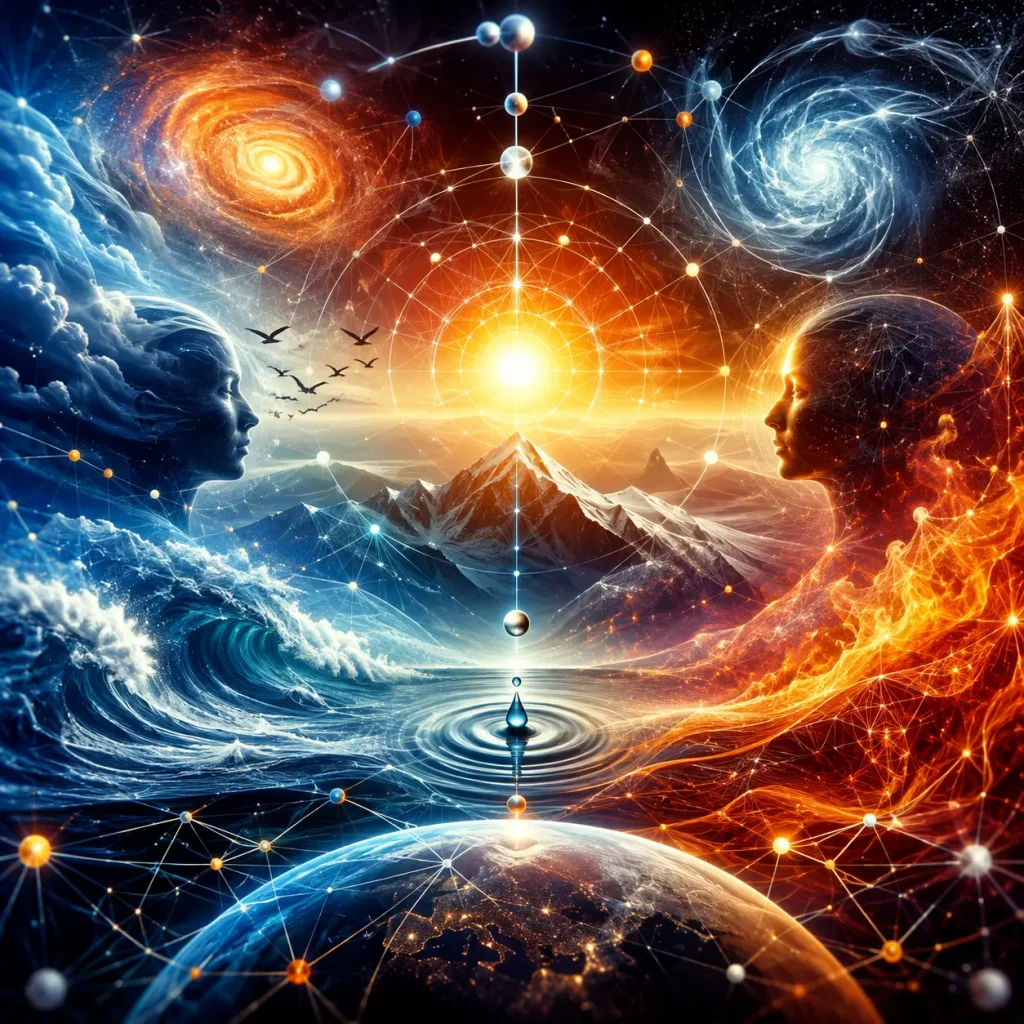
To a Planetary Ethics of Knowledge, Consciousness, Technology and Peace: MAKE EARTH GREAT FOREVER: END ALL WARS The NEPAL Paradigm, No Exit, No Exist and PAL: A Literary-Philosophical Research Essay for World Leaders and UN Readership From Darpan Poems
Darpan Poems: darpanpoems.com
Abstract: This essay develops a literary, philosophical and policy-oriented interpretation of two ghazals published in English on Darpan Poems: “Beautiful, and the Mind Burns, the Heart Moves” and “Nothing Was Hidden, Like Ilm-e-Al-Yaqeen.” Their poetic universe is then placed alongside the philosophical reflections accompanying them: Ilm-e-Al-Yaqeen, Ayn-ul-Yaqeen, Haq-ul-Yaqeen, Ana’l-Haqq, Aham Brahmasmi, the problem of power, technological oligarchy, quantum and high-performance computing, the relationship between science and spirituality, the history of conquest, the possibility of a Global Union, the cultural significance of Nepal, the Matsyendranath tradition, and the proposed conceptual frameworks of No Exit, No Exist, PAL and the NEPAL Paradigm.
The essay’s central proposition is simple but deliberately ambitious: Humanity cannot build lasting peace merely by managing wars; it must transform the intellectual, psychological, technological and political conditions that repeatedly make war imaginable.
The United Nations Charter already provides an institutional foundation for such a vision: it begins with the determination to save succeeding generations from the scourge of war, affirms human dignity and fundamental rights, calls for peaceful settlement of disputes, and identifies international cooperation as a central purpose of the Organisation. The 80th session of the General Assembly has placed this foundational aspiration into contemporary language through its theme, “Better Together: 80 years and more for peace, development and human rights.”
The present essay therefore proposes that Darpan Poems may be read not merely as a literary project but as a form of poetic diplomacy: an attempt to place self-knowledge, pluralism, scientific humility, technological responsibility and planetary interdependence within one imaginative framework. Its governing proposition is: No Exit from Earth. No isolated existence. Therefore, shared responsibility.
And its ethical imperative is: MAKE EARTH GREAT FOREVER: END ALL WARS.
- Introduction: When Poetry Begins to Ask a Political Question: Human civilisation has achieved something extraordinary. We have learned to split the atom, read the human genome, send machines beyond the Solar System, build artificial intelligence, manipulate matter at extraordinary scales and explore computational architectures that once belonged almost entirely to speculation.
Yet the oldest human problem remains unfinished: How are we to live together without destroying one another? The contradiction is profound. Our knowledge has expanded enormously, but so has our capacity for destruction. Our communications are instantaneous, but mutual understanding remains fragile. We possess international institutions, treaties, human-rights instruments and diplomatic mechanisms, yet war remains a recurrent instrument of statecraft.
The United Nations was founded in the aftermath of catastrophic global war precisely to address this contradiction. Its Charter commits the international community to saving succeeding generations from war, affirming human dignity, maintaining international peace and security, settling disputes peacefully and promoting cooperation among nations. Eight decades later, the question remains open.
The 80th session of the United Nations General Assembly has consequently framed its contemporary moment through the words: “Better Together.” The official theme is “Better Together: 80 years and more for peace, development and human rights.” The phrase is institutionally diplomatic.
The poetic equivalent might put forward is to be: “No Exit.” There is no second Earth. There is no alternative humanity waiting elsewhere. There is therefore no durable victory in a system in which everyone ultimately shares the consequences. This is where the two ghazals become more than poems of love, mysticism and knowledge. They become an invitation to reconsider civilisation itself.
- The First Ghazal: “Beautiful, and the Mind Burns, the Heart Moves”: The first ghazal revolves around the recurring phrase: “and the mind burns, the heart moves.” The line contains an entire philosophy of civilisation. The mind represents reason, intelligence, science, calculation, analysis and technological power.
The heart represents compassion, love, moral imagination, tenderness and the capacity to experience another person’s suffering as meaningful. A civilisation governed by the mind alone may become extraordinarily efficient at producing weapons. A civilisation governed by sentiment alone may become incapable of distinguishing compassion from unexamined emotion.
The mature civilisation requires both. The mind must illuminate; the heart must orient. This is why the refrain can be read as a twenty-first-century leadership principle:
Think rigorously. Feel deeply. Act responsibly.
The ghazal thus transforms romantic language into civilisational language. The beloved becomes a mirror. The mirror becomes consciousness. Consciousness becomes self-knowledge. And self-knowledge becomes the beginning of ethical responsibility.
- Love as a Philosophy of Recognition: The line: “When I behold you, I behold myself; in you and in me, the Self of God appears” belongs to a long mystical intuition: that the encounter with the beloved can become an encounter with the deepest self. The beloved is therefore not merely an object of desire.
The beloved becomes a mirror of being. This is important for peace politics. War begins psychologically long before it begins militarily. A population is first taught to imagine another population as radically alien. The neighbour becomes foreign. The foreigner becomes suspicious. The suspicious become dangerous.
The dangerous become enemies. The enemy becomes a legitimate target. The poetic movement reverses this sequence. It says:
Look again. The person before you has a consciousness, a history, a family, a fear of death, a desire for dignity and a hope for tomorrow. The philosophical insight is not that differences are unreal. Differences are real. The insight is that difference need not become dehumanisation. This distinction may be among the foundations of a future peace culture.
Ghazal
           As Though ‘Ilm al-Yaqīn
Never had I seen such beauty
Before, as though ‘Ilm al-Yaqīn;
No secret within my heart remained
Obscure, as though ‘Ilm al-Yaqīn.
            A strange new beginning stirred
            The pulse, unlike all I had known;
            No veiling could hide it from
            The world, as though ‘Ilm al-Yaqīn.
I walked the path of faqīrī, my
Mind laid down before ‘Ayn al-Yaqīn;
O Murshida, from your lips alone
I tasted it, as though ‘Ilm al-Yaqīn.
            Each seeker became heir to
            The knowledge of Ḥaqq al-Yaqīn;
            The eye of concealment could
            Not endure, as though ‘Ilm al-Yaqīn.
O Master, beneath the influence
Of nations, faiths, and civilisations,
The miracle of revolution lay
Unburied, as though ‘Ilm al-Yaqīn.
            MODELS Campaign 2026 selected but
            Eleven kinds to remain within its design;
            Yet quantum software would
            Not run, as though ‘Ilm al-Yaqīn.
A little joy, a little grief, some
Anger, some beloved caprice,
All steeped in my sweet, strong tea, Darpan
Needed no other cup, as though ‘Ilm al-Yaqīn.
- Ilm-e-Al-Yaqeen: From Information to Knowing: The second ghazal is organised around the phrase: Ilm-e-Al-Yaqeen. In its literary setting, this is not merely “knowledge”. It represents a movement from information towards certainty, from intellectual awareness towards direct recognition. The classical mystical vocabulary often distinguishes among:
Ilm-ul-Yaqeen: knowledge of certainty; Ayn-ul-Yaqeen: the certainty of direct seeing; Haq-ul-Yaqeen: the certainty of realised truth.
The poetic significance of this hierarchy is enormous for the information age. Modern humanity possesses more information than any previous civilisation. But information does not automatically become wisdom. The internet has made humanity information-rich. It has not automatically made humanity wise.
Artificial intelligence can produce answers. It cannot, by itself, decide what ought to matter. Quantum computing may transform particular classes of computation. It does not, by itself, determine whether those computational powers should serve war, finance, medicine, climate resilience or peace. Hence the central question of the second ghazal is also the central question of contemporary civilisation: Do we merely possess information, or do we understand what our knowledge demands of us?
- The Information Age and the “Hidden Knowledge” Problem: The accompanying philosophical reflection asks, in essence: If we belong to a world of information, do we appear informational to the rest of the world? This is a striking question for the digital age. A human being can now be transformed into data: preferences; movements; searches; purchases; relationships; speech; photographs; biometric patterns; behavioural predictions.
The human subject increasingly becomes a computational object. This produces a new political problem. Power no longer operates only through territory. It can operate through: data, algorithms, platforms, networks, financial systems and information architectures. The question of freedom therefore cannot be reduced to the traditional question of whether speech is formally permitted. We must also ask:
Who determines visibility? Who controls amplification? Who owns the infrastructure of attention? Which algorithms shape public perception? Who audits the systems that influence political behaviour? Who is accountable when automated systems cause social harm?
The ghazal’s concern with hiddenness and revelation therefore acquires an unexpectedly contemporary dimension.
- Power: From Kings and Empires to Algorithms: The philosophical essay moves from ancient conquerors to contemporary political power. That movement deserves careful attention. The historical actors change. The technology changes. The vocabulary changes. But the fundamental temptation of power may remain remarkably stable: to convert capability into domination.
Ancient empire relied upon territory, armies and tribute. Modern power may operate through military strength, capital, technology, information, infrastructure and strategic dependency. The mechanism is different. The underlying psychological temptation can nevertheless be similar. This is why contemporary governance must ask not merely: Who has power? but: What constrains power? And: Who holds power accountable?
- The Problem of Absolute Power: The philosophical reflection raises a classical question: If earthly power becomes dangerous when it is absolute, how should humanity think about divine power? This question belongs simultaneously to theology, philosophy and political theory. The answer proposed here is deliberately cautious.
Mystical expressions such as Ana’l-Haqq and Aham Brahmasmi should not be appropriated as literal authorisations for an individual to claim political or divine supremacy. Their literary and philosophical value lies elsewhere. They may be read as radical questions concerning the relationship between: self, reality, consciousness and the Absolute.
The political lesson is therefore not: “I am God; therefore I may rule.” It is closer to: If the deepest reality is sacred, then my treatment of another human being cannot be ethically trivial. In this interpretation, spirituality becomes a discipline of responsibility rather than a licence for domination.
- “Iblis Too I Am”: The Difficult Recognition of the Other: The appearance of Iblis in the poetic framework is particularly significant. It is easy to recognise oneself in beauty. It is much harder to recognise one’s own human potential for error, pride, aggression, resentment or self-deception.
The phrase can therefore be interpreted as a radical exercise in moral introspection. It does not mean that good and evil are identical. Nor does it mean that wrongdoing should escape accountability. Rather: The capacity for evil must first be recognised as a human possibility before humanity can reliably restrain it.
This produces a crucial principle for peacebuilding: No human being should be abandoned to permanent dehumanisation; no serious wrongdoing should be exempt from accountability. Reconciliation without justice is inadequate. Justice without the possibility of reconciliation can become another cycle of vengeance. The challenge is to construct institutions capable of holding both truths for human good only.
- No Exit: The Planetary Meaning: The proposed concept of No Exit is one of the strongest foundations of the Darpan framework. It is not a doctrine of despair. It is a planetary ethical statement. There is no practical political escape from Earth. Climate change does not respect borders. Nuclear fallout does not respect passports. Pandemics do not recognise ideology.
Cyber conflict crosses jurisdictions. Artificial-intelligence risks can propagate across continents. Financial crises move through interconnected markets. Ecological collapse is not impressed by national sovereignty. The consequence is profound: National sovereignty remains indispensable, but it is no longer sufficient as the final unit of responsibility.
States must remain accountable to their citizens. But they must also recognise the planetary systems upon which those citizens depend. This suggests a transition: national security → human security → planetary security.
- No Exist: Against the Myth of Absolute Isolation: No Exist must not be confused with nihilism. It does not mean that nothing exists. It means, in this philosophical framework, that nothing human exists entirely in isolation. A person exists through relationships. A community exists through networks.
A state exists within an international system. Humanity exists within Earth’s biosphere. This produces a relational understanding of existence: I am because I am related. The distinction between “I” and “you” remains real. But it need not be absolute. Indeed, difference makes dialogue possible. Interdependence makes dialogue necessary. That is the philosophical bridge between No Exist and peace.
- Quantum as a Metaphor for Epistemic Humility: The first ghazal’s reference to Quantum-HPC introduces modern scientific language into a mystical-poetic landscape. This should not be interpreted as an attempt to prove mystical doctrines through quantum physics. Such an interpretation would weaken both the science and the poetry.
A more intellectually defensible approach is to understand quantum theory as a reminder that nature can be profoundly counter-intuitive and that human common sense is not the final measure of physical reality. Quantum computing likewise should not be presented as a magical solution to all human problems.
Its significance is more specific: it represents a fundamentally different computational paradigm with potential applications in particular domains.
The philosophical lesson is therefore: The more powerful our knowledge becomes, the more necessary intellectual humility becomes. This is precisely where science and spirituality can meet without pretending to be the same discipline. Science asks: What can we establish? Mystical philosophy asks: What does existence mean? Ethics asks: What ought we to do? Politics asks: How shall we live together? A mature civilisation needs all four questions.
- “The Observer Is Observed”: Poetry, Physics and Caution: The accompanying reflection invokes the phrase: “the observer is observed.” As a poetic proposition, it is powerful. As a scientific quotation attributed to a particular quantum-AI system, it requires verification before being presented as an established scientific finding, even though vernacular social media reporting about such a finding is a fact taken on through internet information flow.
The stronger scholarly formulation we therefore frame is: Quantum theory has challenged simplistic notions of an entirely detached observer, and this has inspired philosophical reflection on observation, measurement and knowledge.
That statement better preserves the intellectual significance here, without turning a poetic interpretation into an empirical scientific claim. The distinction is important. A serious interdisciplinary project should not blur disciplines merely to create a more spectacular argument. Its ambition should instead be to create responsible dialogue between disciplines, we admit.
- Aham Brahmasmi and Ana’l-Haqq: Two Mystical Languages, One Question: The philosophical proximity between “Aham Brahmasmi and Ana’l-Haqq” is intellectually fascinating, but it must be handled comparatively rather than reductively. They arise from different theological, linguistic and historical contexts.
They should not simply be declared identical. Yet both can be placed beside one another as expressions of an extraordinary human question: What is the relationship between the individual self and ultimate reality? That question is older than modern geopolitics. But its ethical implications remain contemporary.
If the self is not merely an isolated ego, then power cannot be the final measure of existence. If human dignity has a deeper foundation than political utility, then no state should be permitted to reduce human beings to disposable instruments. This is where metaphysics becomes ethics.
- Nepal Paradigm: From Geography to Civilisational Imagination: The NEPAL Paradigm proposed by Darpan Poems should not be understood as a claim of national superiority. Its strength lies precisely in the opposite idea: Nepal as a meeting ground. Nepal occupies a distinctive civilisational location in the Himalayan world, where diverse religious, cultural and philosophical traditions have interacted across centuries.
The resulting paradigm may therefore be interpreted as: A culture of encounter rather than a culture of conquest. This makes Nepal symbolically relevant to a planetary conversation about pluralism. Not because Nepal possesses a monopoly on wisdom. But because a country can contribute to global peace precisely by becoming a place where different civilisations meet without demanding that one erase another.
- The Nepali Flag: National Symbol and Poetic Interpretation: The distinctive double-pennant form of Nepal’s national flag has obvious symbolic power. The constitutional framework, however, should remain the authoritative source for its legal meaning: Nepal’s Constitution formally defines the national flag and its construction.
Any broader interpretation of the sun, moon, geometry, eternity, knowledge or cosmic symbolism should therefore be identified as poetic or philosophical interpretation, not as constitutional fact. Within that interpretive space, however, Darpan Poems can legitimately ask what the flag evokes: two triangular forms as meeting directions; sun as energy and illumination; moon as reflection and tranquillity; the Himalaya as vertical aspiration; the national symbol as an opening towards universal rather than exclusive belonging.
The poetic principle is: A national symbol may remain national in law while becoming universal in imagination.
- Matsyendranath and the Ethics of Looking Downward: The reflection on Matsyendranath and Avalokiteśvara introduces another profound metaphor. The interpretation offered in the Darpan framework is that Avalokiteśvara suggests looking downward not merely to observe those below, but to extend a hand towards those left behind.
Whether treated as a historical claim, a religious tradition or a poetic interpretation, its ethical message is powerful: The higher a leader rises, the more carefully that leader must look towards those who have been left behind. This reverses the conventional image of power.
Power is not simply the ability to rise above others. Power is: the capacity to lift others upward. This could become a distinctive principle of leadership for the twenty-first century. Darpan Poems there for is an effort to lift the imagination of contemplation and introspection of humanity to live, love and enlighten through quantum poetics.
- From Solomon, Alexander and Genghis Khan to Modern Geopolitics: History is filled with empires that believed their power would last. Some endured for centuries. None became eternal. This is perhaps the oldest geopolitical lesson. Power changes hands. Borders change. Ideologies rise and fall. Technologies transform. Yet the temptation to convert strength into domination repeatedly returns.
The contemporary world must therefore ask whether it has truly transcended the political psychology of conquest or merely equipped it with more sophisticated instruments. The weapons may be different. The financial systems may be different. The digital infrastructure may be different. But the fundamental question remains: Is power being used to enlarge human possibility, or merely to enlarge the reach of power itself?
- Global North and Global South: Beyond Bloc Consciousness: The distinction between the Global North and Global South is historically useful because it helps describe structural inequalities in wealth, development, institutional power and historical responsibility. But these categories can become intellectually dangerous if they harden into permanent civilisational identities.
The next stage should therefore be: from bloc politics to co-authorship. The Global North should not be imagined merely as a donor. The Global South should not be imagined merely as a recipient. Both should become co-authors of global institutions. The question is: Can humanity move from North-versus-South to North-with-South? That is a question worthy of both diplomacy and poetry.
- From Regional Unions to a Global Union: The European Union and African Union demonstrate that political communities can create institutions that transcend the traditional nation-state without completely abolishing national identity. The United Nations provides an even wider institutional architecture.
The Charter itself establishes international cooperation, sovereign equality and peaceful dispute settlement as foundational principles. The conceptual progression might therefore be imagined as:
tribe → kingdom → empire → nation-state → regional union → planetary cooperation → possible global union.
This is not a prediction. It is a normative horizon. A Global Union should not mean world empire. It should mean: sovereign equality; universal human dignity; peaceful dispute settlement; democratic accountability; ecological responsibility; technological responsibility; equitable development; cultural pluralism; shared planetary risk management. The objective would not be to abolish difference. It would be to prevent difference from becoming a justification for annihilation.
- The Global Union Must Grow Out of the UN, Not Replace It by Force: The idea of a Global Union should therefore be framed as institutional evolution rather than revolutionary replacement. The United Nations already contains the seeds of such a vision. Its Charter calls for international peace and security, friendly relations among nations, international cooperation, human rights and peaceful settlement of disputes.
The 80th General Assembly session has explicitly described its purpose as renewing global commitment to multilateralism, solidarity and shared action for people and planet. The appropriate question is therefore not: “Should the UN be discarded?”
It is: “How can the UN system become more representative, accountable, effective and capable of governing the planetary challenges of the twenty-first century?” A future Global Union, if humanity ever chooses to build one, should be an expansion of democratic cooperation, not a new empire.
- MAKE EARTH GREAT FOREVER: The phrase MAKE EARTH GREAT FOREVER should be understood here as a planetary rather than nationalist proposition. Its meaning can be stated simply: Earth before empire. Human dignity before domination. Life before conquest. Peace before prestige. Future generations before short-term political advantage.
The slogan therefore shifts the meaning of “greatness”. Greatness is no longer measured only by military strength, GDP, territorial reach or technological supremacy. A truly great civilisation would be one capable of: preventing war; protecting the vulnerable; preserving the biosphere; regulating technological power; reducing extreme poverty; defending freedom; maintaining cultural plurality; and leaving future generations a world worth inheriting.
- END ALL WARS: An Ethical Horizon: “End all wars” may sound utopian. But civilisation has repeatedly advanced by making previously “impossible” moral propositions normal. The abolition of slavery was once considered unrealistic. Decolonisation was once dismissed as impossible. Universal suffrage was once treated as radical.
The prohibition of certain forms of warfare was once considered unattainable. Therefore, the permanent elimination of war can be retained as a civilisational horizon, even if its complete realisation remains extraordinarily difficult. The UN Charter itself embodies this aspiration by declaring the determination to save succeeding generations from war. “End all wars” therefore does not stand outside the UN ideal. It radicalises one of its oldest aspirations.
- Democracy, Freedom and Technological Oligarchy: The philosophical reflection raises another uncomfortable question: Can democracy and freedom become formal appearances while real power migrates elsewhere? This is not an argument against democracy. It is an argument for democratic renewal.
Contemporary accountability must now extend beyond elected governments. Four forms of accountability are increasingly relevant: Political accountability: Governments and elected representatives must remain answerable to citizens. Economic accountability: Concentrated economic power must remain subject to public rules. Technological accountability: AI platforms, data infrastructures and algorithmic systems that affect public life must be auditable and governed. Epistemic accountability: Universities, media institutions, experts and intellectual communities must remain open to criticism and evidence.
The fourth category is particularly important. A university must not become a machine for manufacturing conformity. But intellectual freedom also does not mean that every claim becomes equally credible. The principle should be: Question boldly; verify rigorously. That is the scholarly counterpart of Ilm-e-Al-Yaqeen.
- The University as a Sanctuary of Uncertainty: A healthy university does not exist to tell society what it already believes. Its task is to investigate. That requires: disagreement, evidence; falsifiability where appropriate; interpretive plurality; methodological discipline; intellectual humility.
The scholar must be able to say: This is established. This is probable. This is contested. This is metaphorical. This remains unknown. Such distinctions are not weaknesses. They are the foundations of trustworthy knowledge. All world universities should, hence, contemplate this.
- Quantum-HPC and the Idea of Peace Computing: The first ghazal’s invocation of quantum and high-performance computing can be developed into a concrete policy idea: Peace Computing. The computational powers of the future should not be dedicated predominantly to surveillance, military escalation and strategic competition.
They can also be directed towards: conflict early-warning; climate-risk modelling; humanitarian logistics; food-security planning; disaster prediction; pandemic preparedness; nuclear-risk assessment; refugee assistance; water-resource optimisation; energy resilience; misinformation analysis; peace-negotiation modelling.
The question is therefore not merely: What can quantum computing do? It is: What should humanity ask its most powerful machines to do? This is the moral question that technology alone cannot answer.
- From War Computing to Peace Computing: The transition may be conceptualised as: War Computing: → targeting → surveillance → escalation → strategic advantage
versus
Peace Computing: → prevention → resilience → early warning → humanitarian coordination → negotiation → ecological protection.
This is not an argument for abandoning technological competition. It is an argument for changing its ultimate purpose. The most advanced computational system should not necessarily be the one that destroys most efficiently. It should increasingly be the one that helps humanity prevent destruction.
- Can Poetry Become Peace Technology?: A poem cannot negotiate a ceasefire. It cannot sign a treaty. It cannot dismantle a missile. Yet it can change the imagination within which treaties, ceasefires and disarmament become thinkable. War begins in material structures. But it also begins in language.
A population is told that another population is less human. A stereotype becomes a narrative. A narrative becomes fear. Fear becomes political mobilisation. Political mobilisation becomes violence. Poetry can intervene at the level of imagination.
It can say: Look again. It can make the enemy visible as a human being. This is why poetry can function as a kind of pre-political peace technology.
- Darpan: The Mirror as a Political Philosophy: The name Darpan – mirror – is itself philosophically suggestive. A mirror does not command. It reveals. Darpan Poems need not tell humanity: “We are right, and you are wrong.” Its deeper proposition is: Look again. Look at yourself. Look at the other. Look at history. Look at power. Look at technology. Look at religion. Look at fear. Look at the future. And then ask: What do we see? This is the politics of the mirror.
- PAL: Planet, Accountability, Linkage: Within the Darpan framework, PAL may be developed as a practical ethical grounding:
P: Planet Earth is a shared home. A: Accountability: Every form of power must remain answerable. L: Linkage: Human beings, institutions, cultures, technologies and ecological systems are interconnected.
This can be understood as another proposed conceptual framework, not as an established scientific or international policy acronym. Its value lies in giving the poetic philosophy a practical structure.
- The NEPAL Paradigm: The same logic can be expanded into a proposed ethical acronym:
N: Non-violence. Violence should not be treated as the default instrument of political problem-solving. E: Equality. Every human being possesses equal moral dignity. P: Plurality. Religious, cultural, linguistic and civilisational differences must be protected. A: Accountability. Power must be answerable. L: Linkage
Humanity exists through relationships and within planetary systems. Thus: NEPAL becomes not a claim of national exceptionalism, but a portable ethical paradigm.
- No Exit + No Exist + PAL + NEPAL: The four concepts can now be integrated: NO EXIT
There is no second Earth. ↓NO EXIST There is no completely isolated human existence. ↓PAL Planet. Accountability. Linkage. ↓NEPAL Non-violence. Equality. Plurality. Accountability. Linkage. ↓MAKE EARTH GREAT FOREVER ↓END ALL WARS
The sequence is not presented as a scientific law. It is a normative architecture, a way of arranging moral intuitions into a coherent planetary philosophy.
32. Ten Recommendations for World Leaders:
Make war genuinely the last resort. Military escalation should never become a substitute for political imagination.
Attach a peace pathway to every escalation. Every military strategy should contain a credible diplomatic pathway towards de-escalation.
Build global AI accountability. Systems that influence warfare, public opinion, finance or governance require transparency, auditability and meaningful human oversight.
Establish a Global Peace Computing Initiative. Dedicate international research capacity, including AI, HPC and future quantum systems, to conflict prevention and humanitarian resilience.
Protect academic freedom: Universities must remain spaces where power can be questioned without fear.
Establish permanent interfaith dialogue mechanisms: Religious leaders should be involved not merely after violence erupts, but before tensions become irreversible.
Develop a planetary commons framework; Climate, water, biodiversity and other shared ecological systems should be treated as matters of collective responsibility.
Move beyond donor-recipient geopolitics: Global North and Global South should become equal partners in defining the future.
Strengthen regional-to-global cooperation: Regional institutions should complement rather than undermine the multilateral system.
Make “End All Wars” measurable: The world should track indicators such as: armed conflicts; civilian casualties; forced displacement; military expenditure; nuclear risk; hate speech; political repression; peace agreements; institutional trust. A civilisation cannot improve what it refuses to measure.
33. A Possible UN Initiative: Poetry for Peace: The United Nations already recognises the importance of dialogue, inclusion and reconciliation in its 2026 observance of the International Day of Living Together in Peace. Its stated theme is “Building Trust through Dialogue, Inclusion and Reconciliation.” This creates a natural opening for a broader cultural initiative: UN Poetry for Peace and Planetary Understanding
Such a programme could bring together: poets; diplomats; philosophers; scientists; religious scholars; indigenous knowledge holders; youth; educators; AI and technology researchers. Its objective would not be literary decoration. It would be peace literacy.
The UN’s own 80th-anniversary programme included a poem recital as part of a high-level commemoration, demonstrating that poetry already has a recognised place within the symbolic language of international peace. Poetry therefore need not remain at the margins of diplomacy. It can become part of its cultural infrastructure.
34. Nepal and the Possibility of a Himalayan Peace Forum: The NEPAL Paradigm suggests a practical institutional possibility: Himalayan Peace and Civilisation Forum. Such a forum could bring together: diplomats; scientists; philosophers; poets; Buddhist and Hindu scholars; peace negotiators; AI researchers; indigenous representatives; young leaders.
A possible theme: From Himalayan Wisdom to Planetary Peace
Its central question could be: Can a civilisation accustomed to living among mountains help humanity learn to live with differences?
The answer need not be predetermined. The purpose would be to create a space in which the question itself can be explored.
- Nepal as a Meeting Ground: The deepest potential of the Nepal Paradigm is not that Nepal should position itself as a new centre of geopolitical power. It is that Nepal might imagine itself as a meeting ground. Not merely between powerful states. Between peoples.
Not merely between governments. Between civilisations. Not merely between religions. Between ways of knowing. The principle could therefore be: Not between powers, but between peoples. This is a potentially meaningful contribution we imagine to a twenty-first-century diplomacy.
- “The Mind Burns, the Heart Moves”: A New Leadership Ethic: The first ghazal can now be read as a compact philosophy of leadership. The mind burns: question; calculate; investigate; verify; innovate.
The heart moves: empathise; listen; protect; reconcile; care. The leader of the future therefore needs both. Sharp intelligence without compassion can become dangerous. Compassion without discernment can become ineffective. Responsible leadership requires both.
- “Ilm-e-Al-Yaqeen”: A New Scholarly Ethic: The second ghazal offers a complementary principle for scholars. Do not confuse: information with knowledge, knowledge with wisdom, and wisdom with certainty. The mature scholar knows not only what is known, but also what remains uncertain.
This is not intellectual weakness. It is epistemic strength. In the age of AI-generated information, algorithmic persuasion and synthetic media, such humility may become one of humanity’s most important intellectual virtues.
- Religious Unity Without Religious Uniformity: The Darpan vision should never require humanity to become religiously identical. Unity does not mean uniformity. A Hindu may remain Hindu. A Muslim may remain Muslim. A Buddhist may remain Buddhist. A Christian may remain Christian. A Jew may remain Jewish.
An indigenous person may remain rooted in ancestral traditions. An atheist may remain an atheist. A humanist may remain humanist. The shared principle is: Different convictions, equal dignity. This is not the abolition of religion. It is the abolition of the idea that religious difference requires political hostility.
- “Every Being Real”: Mysticism and Human Rights: The poetic intuition that every person is somehow “real” in the deepest sense can be translated into the more secular language of human rights: Every human being possesses irreducible dignity. This is one of the most productive points of contact between mystical philosophy and modern humanism. The language differs. The ethical consequence can converge: No human being should become merely an instrument of another’s power.
- A New Grammar of War and Peace: The grammar of war says: Us versus them. The grammar of peace says: Us with them. The grammar of war asks: Who will win? The grammar of peace asks: Who can be saved? The grammar of war asks: Who will submit? The grammar of peace asks: Who has been left behind?
The grammar of war asks: How much power do we possess? The grammar of peace asks: How responsibly can we use the power we possess? This is where the Matsyendranath/Avalokiteśvara metaphor becomes politically meaningful: The true test of elevation is the willingness to reach downward and lift others upward.
- No Exit: The Final Planetary Realisation: If Earth is our shared home, then no nation can build permanent security upon the permanent insecurity of others. A country may win a war. But it may not escape: displaced populations; ecological damage; historical trauma; economic consequences; radicalisation; intergenerational hatred. This is why twenty-first-century security must move beyond the narrow equation:
Security = military superiority. A more comprehensive formula is: Security = peace + human dignity + resilience + ecological stability + accountable power.
- No Exist: The Final Philosophical Realisation: The individual “I” is real. The individual “you” is real. But neither exists in absolute isolation. We are connected through: language; family; economy; ecology; history; technology; memory; culture.
The philosophical conclusion is therefore neither collectivist erasure nor radical individualism. It is relational humanism. I remain myself; you remain yourself; yet neither of us is complete without the world of relations in which we exist.
- Darpan Poems as a Global Literary Doctrine: The broader literary philosophy emerging from these works may be stated as follows: Poetry without conversion: Poetry should invite reflection rather than compel religious transformation. Spirituality without domination: Spiritual insight should deepen responsibility, not legitimise power.
Science without scientism: Science should be respected without turning it into a substitute for every philosophical question. Technology without technocracy: Technology should remain accountable to human dignity. Patriotism without chauvinism: Love of country should not require hatred of another country.
Globalism without cultural erasure: Planetary cooperation must protect cultural plurality. Peace without impunity: Reconciliation must coexist with justice and accountability. This has become the distinctive intellectual signature of Darpan Poems.
- The Central Proposition: From Self-Knowledge to World Peace: The two ghazals can now be read as a single intellectual journey. The first asks us to unite: mind and heart. The second asks us to move from: information to certainty, certainty to experience, experience to wisdom.
The philosophical framework then asks: Who am I? The mystical traditions respond in different languages. The political world asks: Who is the other? The ethical response is: Another human being. The technological age asks: What can we build? The moral response must be: What should we build? The geopolitical world asks: Who will dominate?
The Darpan response is: Who will take responsibility? And the planetary question becomes: Can humanity survive without learning to live together? The answer must become: We have no alternative.
- Conclusion: Who Finally Appears in the Mirror?: Both ghazals ultimately return to one ancient question: Who am I? But the question cannot remain private. It becomes: Who am I in relation to you? Then: What world do we share? Then: What kind of civilisation are we building?
And finally: Can we build one in which no child has to inherit war as destiny? At this point, romantic poetry becomes political philosophy. Ilm-e-Al-Yaqeen becomes an epistemology. Ana’l-Haqq becomes a question of self-transcendence. Aham Brahmasmi becomes a meditation upon interconnected being.
Quantum-HPC becomes a metaphor for intellectual humility and an opportunity for peace-oriented computation. No Exit becomes planetary responsibility, and No Exist becomes a challenge to the myth of absolute isolation. PAL becomes:
Planet — Accountability — Linkage. NEPAL becomes: Non-violence — Equality — Plurality — Accountability — Linkage.
And Darpan becomes: the mirror in which civilisation is invited to look at itself.
The United Nations’ 80th-anniversary discourse already asks humanity to renew multilateralism, solidarity, and shared action for people and planet. The General Assembly’s theme, “Better Together,” and the Charter’s foundational determination to save succeeding generations from war therefore provide an institutional language with which the poetic vision of Darpan Poems can meaningfully converse.
The proposal is not that poetry should replace diplomacy. Nor should mysticism replace science. Nor should technology replace ethics. Nor should a new ideology replace democracy. The proposal is subtler and, perhaps, more difficult:
Humanity needs an imagination larger enough to make peace intellectually, emotionally and culturally conceivable before it can make peace politically durable.
Wars are prepared in arsenals. But they are also prepared in narratives. If the narrative changes: enemy → human being, rival → neighbour, neighbour → fellow citizen of Earth, difference → dialogue, power → responsibility, knowledge → wisdom, technology → service, Earth → shared home, then another future becomes imaginable.
And perhaps that is where Darpan Poems makes its most consequential intervention. Not by claiming to possess the final answer. But by holding up the mirror.
A Darpan Global Peace Charter: The Darpan Principle: I see myself in you; therefore I cannot make your destruction the final language of my civilisation. The No Exit Principle: There is no second Earth available to us. The No Exist Principle: No human existence is entirely isolated. The PAL Principle: Planet. Accountability. Linkage. The NEPAL Principle: Non-violence. Equality. Plurality. Accountability. Linkage.
The Quantum-Human Principle: Let our most powerful machines serve our most vulnerable lives. The Poetic Principle: Before changing the world, change the image of the other within the human mind.
The Final Principle: MAKE EARTH GREAT FOREVER: END ALL WARS.
A Final Address to World Leaders:
Excellencies, You possess armies. But you also possess children. You possess borders. But your people share one atmosphere. You possess weapons. But your citizens share the same human vulnerability. You possess algorithms. But the people affected by them remain human beings. You possess power. But the greatest question of power is not: How much can you control? It is: How much can you protect?
Therefore: Let the mind burn with inquiry. Let the heart move with compassion. Let knowledge become wisdom. Let technology become accountable. Let politics become responsible. Let faith become humane. Let sovereignty coexist with planetary responsibility. There is no exit from Earth. There is no completely isolated existence.
Therefore, there must be shared responsibility. And if humanity is truly capable of learning from its own history, then perhaps the greatest technological achievement of the coming century will not be a faster computer, a more powerful weapon or a more sophisticated algorithm.
Perhaps it will be this: a civilisation that finally learns how not to make war. That is the deepest meaning of: MAKE EARTH GREAT FOREVER: END ALL WARS.
Selected Scholarly and Institutional References:
United Nations. Charter of the United Nations. The Charter establishes international peace and security, peaceful settlement of disputes, sovereign equality, human rights and international cooperation among the Organisation’s foundational purposes and principles.
United Nations General Assembly. 80th Session of the General Assembly. The session opened on 9 September 2025 and carries the theme “Better Together: 80 years and more for peace, development and human rights.”
United Nations. General Assembly High-Level Week 2025. The UN describes the 80th session as an opportunity to renew multilateralism, solidarity and shared action for people and planet.
United Nations. International Day of Living Together in Peace. The 2026 theme is “Building Trust through Dialogue, Inclusion and Reconciliation.”
United Nations. UN80 / Eight Decades Later. The UN’s 80th-anniversary materials emphasise the continuing relevance of the Charter and the Organisation’s contribution to peace, human rights and social progress.
Editorial Note:
The English versions of the two ghazals discussed here have already been published on darpanpoems.com under the page heading Quantum Poetics I. They should therefore be treated as the primary literary texts underlying this essay rather than reproduced as translations within the present research article. The present work is consequently designed to function as the English intellectual, philosophical and policy companion essay to those already-published poems.
In that form, the two ghazals do not stand as isolated literary pieces. They become the poetic foundation for a larger proposition: The future of humanity depends not merely upon what civilisation knows, but upon what civilisation chooses to do with what it knows. And the ultimate test of that knowledge is not whether humanity can become more powerful. It is whether humanity can become more peaceful, harmonious, and progressive for the BEYOUTEA and Good!