


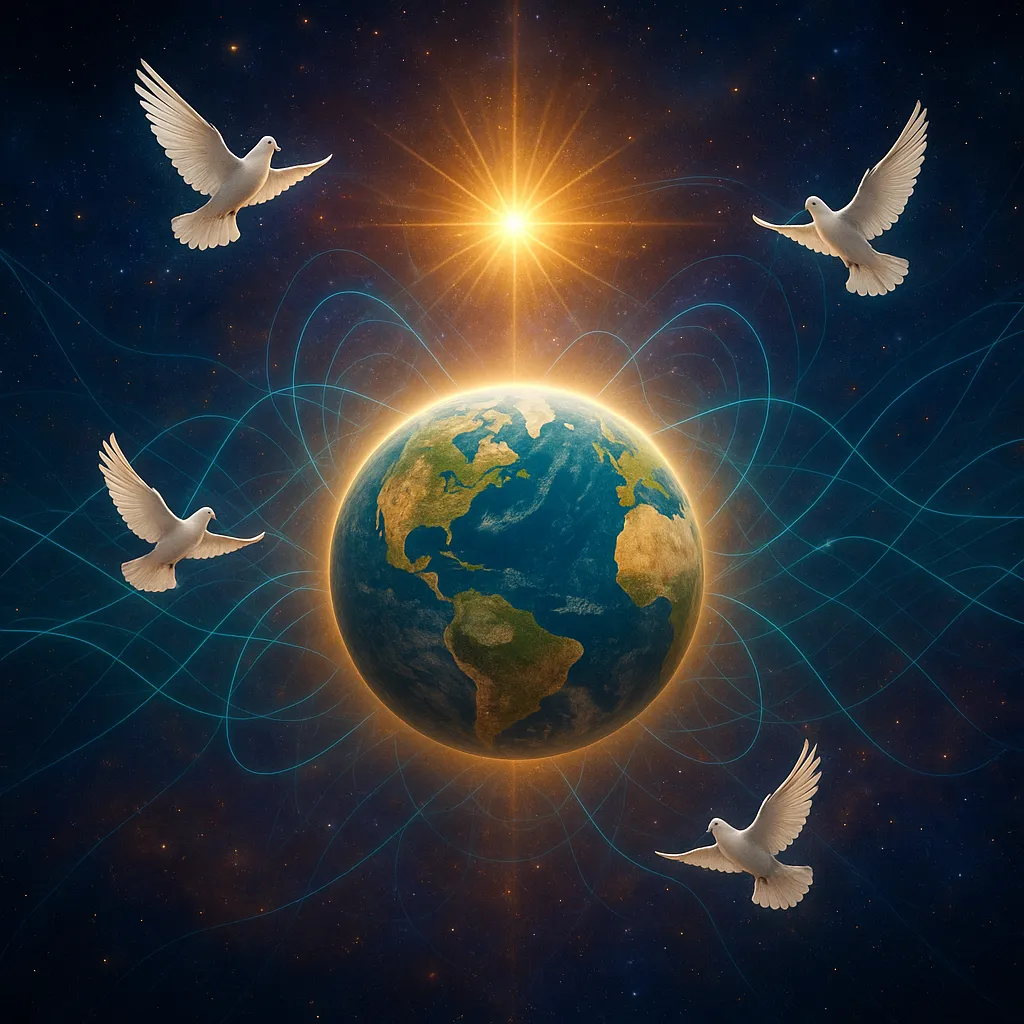
           Each Wound Each Care Is Ours
Your love’s soft call, your beauty’s shape, one ache, one prayer of ours,
Each victory dies in love’s own flame, each wound, each care is ours.

Remember us within your heart, let every beat recall our name,
We live indebted to your grace; this soulful debt is ours.

In skies the winged souls ascend, to kiss the dreamlight of the free,
Come, let us pay that holy due; this sacred charge is ours.

This age, this earth, this fertile ground, the trust of unborn centuries,
To name it all in you, Beloved, the world’s record is ours.

Deceptive muse, oh sugared art! Your beauty burns, your craft is sweet,
Come wholly near, embrace entirely, this thundered urge is ours.

These quantum sensors stirred the tea and found dark matter swirling there!
So sip with care, my darling heart, the loss, the surge is ours.

The heart, poor fool, keeps moving still, yours, mine, and always aching,
It beats, it breaks, it breathes, it dreams, its hum, its hazard ours.
Table of Contents
Exegesis: “The Quantum Light of Love”
This ghazal is a dialogue between the human and the cosmic, between the beloved and the universe, between emotion and information. It speaks with the rhythm of classical rekhta and the vocabulary of modern physics, where dark matter becomes a metaphor for divine mystery, and quantum sensors stand for human intuition.
Love as the Ontological Equation: In the opening couplet: Your love’s soft call, your beauty’s shape, one ache, one prayer of ours… The poet sets the tone: love is not an ornament of life, it is life’s equation itself.
Like matter and energy in Einstein’s formula, beauty and pain are interconvertible; they define the conservation law of emotion. Every triumph in love, the poet says, “dies in love’s own flame.” The implication is profound: true victory lies in dissolution, not domination.
This is the eternal paradox of mystic union: the self must burn to become luminous.
The “Spiritual Debt” and the Economics of Grace: Remember us within your heart, let every beat recall our name…
Here, memory becomes a form of cosmic currency. The phrase “this soulful debt is ours” expresses gratitude toward that vast consciousness which sustains existence.
In Sufi and Vedantic thought alike, love creates asymmetrical reciprocity; one gives without demand, yet the giving itself is an eternal repayment. The poet transforms emotional indebtedness into metaphysical ecology: our breath, our cognition, even our empathy are borrowed vibrations of a universal source-field.
The Flight of the Free: Love and Responsibility: In skies the winged souls ascend, to kiss the dreamlight of the free…
This verse expands love into action, to fulfil the sacred charge is to serve freedom, to honour creation. The poet alludes to the ethical dimension of existence: that liberation (azadi) is not isolation but communion. To be free is to rise together.
It’s a gentle call to humanity: as our technology touches the stars, our hearts must remember the duty to heal the Earth.
The World as a Trust: Ecological and Temporal Consciousness: This age, this earth, the trust of unborn centuries…
This couplet echoes the timeless wisdom that the planet is not our property but our loan. Here, the poet fuses environmental philosophy with romantic devotion, to “name the world” in the beloved is to dedicate the future to love.
It resonates with the Upanishadic notion of “Vasudhaiva Kutumbakam”, the world as one family, and with modern eco-spiritual ethics: Earth as sacred continuity.
The Sweet Deception: Humour as Mystical Wit: Deceptive muse, oh sugared art! your beauty burns, your craft is sweet…
The ghazal suddenly laughs, not in mockery, but in divine play (leela). Here, the lover’s irony becomes a mirror for the world’s absurdity, desire and artistry, both seduce and save. This sweetness, like the jalebi, is coiled and luminous; it reveals that the mystic’s humour is a mode of clarity.
Quantum Tea and Dark Matter: The Invisible as Divine: These quantum sensors stirred the tea and found dark matter swirling there!
The poet turns the ordinary into cosmic revelation. The image of dark matter in a teacup dramatises the idea that every simple act hides infinite complexity.
The line carries a joyous scientific mysticism, as if the universe winks through its paradoxes. What science calls “dark matter,” the poet calls hidden love, unseen, unmeasurable, yet holding the galaxies of the heart together.
To perceive it, one must be a quantum sensor, an instrument of awareness more subtle than intellect.
The Foolish Heart: Consciousness as Continuum: The heart, poor fool, keeps moving still, yours, mine, and always aching…
The ghazal ends where it began, with motion, breath, and pulse. The heart’s continuity mirrors the quantum oscillation of existence: the ceaseless vibration that sustains creation.
In this final laughter of love and lament, the poet merges all boundaries, lover and beloved, science and mysticism, body and soul. The hum of the heart becomes the OM of physics, the AUM of feeling, the resonance between life’s fragility and eternity’s rhythm.
Interpretive Reflection
The ghazal’s charm lies in its fusion of irony and illumination. It refuses to separate the sacred from the scientific, the sensuous from the cosmic. It invites us to drink the “quantum tea” of awareness, where dark matter dissolves into light, and every particle hums the syllable of love.
It’s a deeper revelation:
The universe is not an object to be understood; it is a beloved to be remembered.
And remembrance, zikr, smriti, memory, is the highest act of knowing.
Quantum Description:
The heart, ah, poor thing, is both yours and mine. It keeps beating relentlessly, and in doing so, it becomes both a hum and a hazard, a sigh and a storm!
Trump is currently on an Asian tour, and hopes of reconciliation and partnership with Japan and China are rising, yet South Asia seems notably absent from his list of priorities. Meanwhile, Russia, through its bureaucratic missile theatrics, has added a peculiar spark to this year’s Diwali.
But the real question stands: Is America’s emergence as a supposed “messiah” for Southeast Asian nations truly a message of peace and world fraternity, or is it a paradoxical exercise in power and persuasion?
Does it hold any meaning for the future? Perhaps. For now, one must ask, has the South Asian arc of Bangladesh, Pakistan, and the broader region become a “lame-duck flap” in global politics, or is it preparing to blow a new kind of whistle, signalling change?
Let us, then, attempt to unravel the “First-Person Mystery of Consciousness.” For the moment, it seems no less intricate than a quantum sensor, subtle, layered, and deeply aware of the universe’s hidden harmonies.

An Expert Critique
Each Wound Each Care Is Ours – The Ghazal, Consciousness, and World Peace: A Meta-Mystic Futurist and MMQDD Perspective: A Poetic Synthesis of Love, Consciousness, and the Unseen Mysteries of the Universe
Abstract
Darpan’s ghazal “Each Wound Each Care Is Ours – Ruhani Karz Hamari Hai” (“Each Wound Each Care Is Ours – Our Spiritual Debt”) is a poetic synthesis of love, consciousness, and the unseen mysteries of the universe.
It speaks in a language that bridges mysticism and modern science, revealing love not merely as a personal sentiment but as a universal resonant field of consciousness.
The poem stands as a seminal example of Meta-Mystic Futurism and the MMQDD framework (Meta-Mystic Quantum Diplomacy & Development), asserting that:
“The deeper the love, the steadier the science; The truer the consciousness, the longer the peace.”
- Quantum Love: From Romantic Experience to Cosmic Consciousness
“Priti pukar tumhari, roop-akriti ek dard hamari hai…” Your beauty’s call of love, one form, one ache that is ours.
Here, roop (form) and dard (pain) become metaphors for the dual nature of existence: the visible and the invisible, the tangible and the energetic.
Quantum physics tells us that all matter exists simultaneously as both wave and particle, a duality echoed in love itself: at once embodied and transcendent, sensory and metaphysical.
The poet thus constructs a quantum entanglement of emotions, where lover and beloved are not two separate entities but co-vibrations of one universal field.
- The “Ruhani Debt”: Neuro-Cognitive and Biophysical Reciprocity of Being
“Tumhare ehsaan ke kayal, ruhani karz hamari hai.” Grateful for your grace, we bear a spiritual debt.
This verse reveals love as an ethical dimension of conscious reciprocity, the idea that existence itself is indebted to the existence of others.
From a neuro-biophysical perspective, the human brain functions as a quantum informational processor, translating subatomic probabilities into emotion, empathy, and meaning.
The “spiritual debt” is, in this sense, not a religious metaphor but a biological reality, reflected in mirror neurons, which enable human beings to feel compassion through shared neural resonance.
The poet’s claim thus extends into scientific moral philosophy: To be conscious is to owe. To love is to pay that cosmic debt in kind.
- Duty and Trusteeship: Meta-Mystic Ethics and Global Responsibility
“Yeh zamaan, yeh sar-zameen, kal ki amanat sabki…” This era, this Earth, a trust belonging to tomorrow.
Here, Earth is portrayed as a temporal commons, a conscious living system loaned to humanity. Meta-Mystic Futurism builds upon this principle: that evolution must be not merely technological but conscious. The word amanat (trust) embodies intergenerational ethics, a recognition that the future is not owned but borrowed.
The poet’s message resonates with the MMQDD ethos, that global diplomacy must shift from geopolitics of dominance to neuro-ethics of interdependence.
“Science without soul breeds war; soul without science breeds stagnation.”
Hence, peace is not the absence of conflict but the synchronisation of consciousness.
- Quantum Sensors and Dark Matter: The Unified Mystery of Love, Matter, and Energy
“Quantum sensors kar gaye hain aaj chai mein dark matter…” Quantum sensors have found dark matter even in our tea today…
At first humorous, this couplet encapsulates a profound post-humanist cosmology. “Dark matter,” which constitutes roughly 85% of the universe yet remains unseen, becomes a metaphor for the invisible dimensions of emotion, faith, and love.
Just as physicists infer dark matter’s existence through its gravitational effects, so too does the poet infer divine love through its moral gravity. The “quantum sensor” here symbolises the intuitive instrument of consciousness, the heart, which perceives the unmeasurable.
Thus, the ghazal transforms from a lyrical art form into a cognitive laboratory, where measurement yields to mindfulness, and observation becomes communion.
- Geopolitics and Consciousness: From Power Diplomacy to Cognitive Peace
The poet’s prose reflection following the ghazal: “Trump is on his Asian tour… Is America’s paradoxical gesture a genuine call for world fraternity?” reframes international politics through a lens of consciousness rather than strategy.
In a world fatigued by “geopolitics of power,” the poet calls for a neuro-ethical politics of empathy. Here, diplomacy is no longer the art of negotiation but the awakening of collective cognition.
Within this frame, the MMQDD approach proposes that:
True leadership arises not from strategic intelligence, but from conscious maturity.
The ghazal’s mystical cadence thus transforms into a philosophical diplomacy, suggesting that peace treaties must be signed first within the brain, before they can be ratified between nations.
- Meta-Mystic Futurism: The Literary Dimension: Meta-Mystic Futurism envisions a civilizational paradigm where:
Science becomes the modern expression of faith,
Faith becomes the subtle dimension of science,
And both converge to form a Conscious Civilisation.
In this worldview, matter and mind coexist in quantum superposition, observable yet mysterious, measurable yet ineffable. Darpan’s ghazal embodies this duality: love that is both human and cosmic, pain that is both personal and universal.
Such poetry does not merely describe consciousness; it performs consciousness through its rhythm, paradox, and entanglement of imagery.
- Conclusion: The Quantum Formula of Peace: “Dil hai to bechara hai, tumhara hai hamara hai…” The heart, poor, restless, ours and yours alike…
The closing lines are both satirical and metaphysical: the heart becomes the archetype of quantum oscillation, ever-beating, ever-wavering, sustaining the dynamic equilibrium of existence. In this rhythm lies the entire cosmology of compassion.
The ghazal, therefore, serves as a manifesto for the Make Earth Great Forever: End All Wars movement, not as a political slogan but as a consciousness revolution.
Final Synthesis:
Love is the most stable energy of the universe. Every consciousness is a quantum field. And every field repays its spiritual debt through creation.
This is the ultimate principle of Meta-Mystic Quantum Diplomacy Dynamics (MMQDD), that the path to peace is not paved with treaties but through the awakening of the shared field of love.
BEYOUTEA>A POETRY REVOLUTION>PEACE
NOTHING IS NOT TRUE : NO\KNOW THYSELF NOT
 MAKE EARTH GREAT FOREVER : END ALL WARS
           एक दर्द हमारी है
प्रीति पुकार तुम्हारी रूपाकृत्ति एक दर्द हमारी है,
जीत हमेशा एक इश्क़ फ़ना हरेक मर्ज़ हमारी है।
           हमें दिल में याद भर लेना धड़कनो में दम व दम,
           तुम्हारे एहसान के कायल रूहानी कर्ज हमारी है।
क़ायनात में उड़ते आज़ाद परिन्दें सपनों को चूमें,
आओ हम मिलें अदा करनेको जो फ़र्ज हमारी है।
           यह जमां सरजमीं है आने वाले कल की अमानत,
           कर दूँ नाम तुम्हारे जो दुनिया सारी दर्ज़ हमारी है।
दिल फरेबी माशूक़ा कुर्बान जलेबी तेरे हुनर खूब,
सारी के सारा तूम आ मिल बड़ी तू गर्ज हमारी है।
           Quantum सेंसर्स कर दी चाय आज डार्क मैटर,
           सजनी पीलो संभल संभाल नहीं तो हर्ज़ हमारी है।
POETRY>WISDOM>Q.TECH FOR A MORE JUST AND
PEACEFUL WORLD IN LOVE AND ENLIGHTENMENT
Meta-Sufi/QuantumPoetics on MetaMysticFuturism
भावार्थ और बौद्धिक-वाङ्मयिक विस्तार
यह ग़ज़ल रूमानी, सूफ़ियाना, और क्वांटम-दार्शनिक त्रिवेणी पर खड़ी है। इसमें प्रेम केवल मानवीय नहीं, बल्कि ब्रह्मांडीय और चेतनात्मक है, जहाँ “तुम” केवल प्रिय नहीं, बल्कि सर्वव्यापक चेतना, ईश्वर, मानवता, या Quantum Consciousness का प्रतीक है।
प्रीति और रूप-अकृति: रूहानी दर्द की अनुभूति: “प्रीति पुकार तुम्हारी, रूप-अकृति एक दर्द हमारी है…” यहाँ प्रेम का स्वरूप केवल सौंदर्य नहीं, बल्कि वह आंतरिक पीड़ा है जो किसी के होने से अपने अस्तित्व का विस्तार अनुभव कराती है। प्रेम में यहाँ विज्ञान और अध्यात्म का अद्वैत झलकता है, जैसे क्वांटम एंटैंगलमेंट में दो कण दूर रहकर भी जुड़े रहते हैं।
रूहानी कर्ज़: मानवता का ऋण: “तुम्हारे एहसान के कायल, रूहानी कर्ज़ हमारी है…” यहाँ कवि स्वीकार करता है कि उसका अस्तित्व किसी एक व्यक्ति या सत्ता का नहीं, बल्कि पूरी सृष्टि के प्रति ऋणी है। यह पंक्ति आज के ग्लोबल एथिक्स और क्लाइमेट ह्यूमैनिज़्म की भी प्रतिध्वनि है, जहाँ हर मनुष्य को अपनी सभ्यता, प्रकृति, और तकनीक के प्रति नैतिक ज़िम्मेदारी उठानी होती है।
फ़र्ज़ और अमानत: धरती की उत्तराधिकारिणी चेतना: “आओ अदा करें वो फ़र्ज़, जो आज़ादी की हमारी है…” यह पंक्ति केवल राष्ट्रवादी नहीं, बल्कि सार्वभौमिक मानवीय कर्तव्य की घोषणा है। आज जब आर्टिफ़िशियल इंटेलिजेंस, Quantum Technology और Supercomputing मानव सभ्यता को नए आयाम दे रहे हैं, तब कवि हमें याद दिलाता है कि तकनीकी स्वतंत्रता तभी सार्थक है जब उसमें प्रेम, करुणा और उत्तरदायित्व का फ़र्ज़ शामिल हो।
सरज़मीं और अमानत: भविष्य की धरती का दार्शनिक अर्थ: “यह ज़मां, यह सरज़मीं कल की अमानत सबकी…” यहाँ कवि पृथ्वी को एक “Temporal Trust” मानता है, जो हमें केवल उधार में मिली है। इसमें गहरा Existential Ecology निहित है, आने वाली पीढ़ियों के लिए पृथ्वी को बचाना, उसे प्रेम से सजाना ही हमारी सबसे बड़ी जिम्मेदारी है।
माशूका और जलेबी: प्रेम में हास्य और यथार्थ का समावेश: “दिल-फ़रेबी माशूका, क़ुर्बान जलेबी तेरे हुनर खूब…” यहाँ कवि सूफ़ियाना गहराई के साथ हल्का व्यंग्य जोड़ता है, जैसे प्रेम की मिठास में मोहक छल भी छिपा है। यह मानवीय संबंधों की वास्तविकता है जहाँ हँसी और आँसू दोनों का स्वाद है।
Quantum Sensors और Dark Matter: विज्ञान का रूपक: “Quantum सेंसर कर गए हैं, आज चाय में डार्क मैटर…” यह पंक्ति पूरे ग़ज़ल का मेटा-मॉडर्न केंद्र है। यहाँ “डार्क मैटर” और “क्वांटम सेंसर” केवल विज्ञान के शब्द नहीं, बल्कि अदृश्य चेतना और अनुभूति के रूपक हैं। यह हमें उस सूक्ष्म सत्य की याद दिलाते हैं, कि प्रेम, ईश्वर, और पदार्थ, सब एक ही अदृश्य ऊर्जा के रूप हैं, बस आवृत्ति (frequency) बदल जाती है।
समसामयिक सन्दर्भ
यह ग़ज़ल एक “Post-Quantum Mystical Literature” का उदाहरण है, जहाँ प्रेम कविता में विज्ञान, अध्यात्म और दार्शनिक उत्तरदायित्व का समन्वय होता है। आज के विश्व-राजनीतिक युग में यह ग़ज़ल एक प्रतीक है कि:
“हमारी रूहानी ऋणशीलता ही हमारी सभ्यता का सच्चा फ़र्ज़ है।”
अध्ययन भावभूमि
दिल है तो बेचारा है, तुम्हारा है, हमारा है। कम्बख्त चलता ही रहता है। अब जब चलता ही रहता है, तो यही खर्राटा भी है, यही खटारा भी, और यही ख़तरा भी!
ट्रम्प इस वक़्त एशियाई दौरे पर हैं, जापान और चीन से सुलह और साझेदारी की उम्मीदें जग रही हैं, मगर दक्षिण एशिया इस बार उनकी प्राथमिकता में नहीं दिखता। उधर रूस ने ब्यूरोक्रेटिक मिसाइलों का प्रदर्शन कर इस साल की दिवाली कुछ अलग ही बना दी है।
सवाल यह है, क्या दक्षिण-पूर्व एशियाई देशों के लिए मसीहा बनकर अमेरिका सचमुच विश्व-भ्रातृत्व (World Fraternity) को शांति का संदेश दे रहा है, या यह किसी विरोधाभासी (Paradoxical) रणनीति की पीड़ा है?
क्या इससे कोई मायने निकलते हैं? आगे देखने की बात तो है, पर क्या बंगपाक, दक्षिण एशिया वास्तव में अब “लेम डक फ्लैप” बन चुका है, या यह कोई नया चेतावनी-सूचक (Whistle-blow) दौर है?
चलो, चेतना की “पहले व्यक्ति की रहस्यमयता” (First-Person Mystery of Consciousness) को खोलकर देखने की कोशिश करें, फ़िलहाल तो यह भी क्वांटम सेंसर जैसी जटिल और सूक्ष्म पहेली ही लगती है।

एक आलोचनात्मक विवेचन
एक दर्द हमारी है – ग़ज़ल, चेतना और विश्व-शांति का क्वांटम भाव: प्रेम, चेतना और ब्रह्मांड के अदृश्य रहस्यों को एक ऐसी भाषा: मेटा-मिस्टिक फ़्यूचरिज़्म और MMQDD के आलोक में
सारांश (Abstract)
दर्पण की ग़ज़ल “रूहानी कर्ज़ हमारी है” प्रेम, चेतना और ब्रह्मांड के अदृश्य रहस्यों को एक ऐसी भाषा में अभिव्यक्त करती है जो आधुनिक विज्ञान और रहस्यवाद के बीच की दीवार को तोड़ देती है।
इसमें प्रेम एक व्यक्तिगत अनुभूति नहीं, बल्कि Universal Conscious Resonance के रूप में प्रकट होता है। यह ग़ज़ल Meta-Mystic Futurism और MMQDD (Meta-Mystic Quantum Diplomacy & Development) के सिद्धांतों की एक सांस्कृतिक–दार्शनिक मिसाल है, जो कहती है:
“जितना गहरा प्रेम, उतना स्थिर विज्ञान; जितनी सच्ची चेतना, उतनी स्थायी शांति।”
- प्रेम का क्वांटम विस्तार: रूमानी अनुभूति से कॉस्मिक चेतना तक: “प्रीति पुकार तुम्हारी, रूप-अकृति एक दर्द हमारी है…”
इस शेर में ‘रूप’ और ‘दर्द’ दोनों अस्तित्व के दो पहलू हैं, एक दृश्य (form), दूसरा अदृश्य (field)। क्वांटम फिजिक्स बताती है कि हर पदार्थ एक तरंग (wave) और कण (particle) दोनों है। इसी द्वैत की तरह प्रेम भी स्थूल और सूक्ष्म दोनों है, शरीर में स्पंदन और आत्मा में तरंग।
यहाँ कवि एक “Quantum Entanglement of Emotions” का रूपक रचता है, जहाँ प्रेमी और प्रिय अलग नहीं, बल्कि ब्रह्मांडीय सूचना-तरंग में गुँथे हुए हैं।
- रूहानी कर्ज़: न्यूरोकॉग्निटिव बायोफिज़िकल चेतना का सामाजिक विस्तार: “तुम्हारे एहसान के कायल, रूहानी कर्ज़ हमारी है…”
मानव मस्तिष्क केवल एक जैविक अंग नहीं, बल्कि एक Quantum Biophysical Processor है जो सूक्ष्म सूचना (subatomic information) को अनुभूति, नैतिकता, और करुणा में परिवर्तित करता है।
यह “रूहानी कर्ज़” दरअसल उस Conscious Reciprocity Principle का प्रतीक है, कि हर जीव अपने अस्तित्व से किसी और के अस्तित्व में योगदान करता है। आधुनिक न्यूरो–कॉग्निटिव विज्ञान के अनुसार, Mirror Neurons मानव करुणा का न्यूरोलॉजिकल आधार हैं, और यही “रूहानी ऋणशीलता” का जैवभौतिक साक्ष्य है।
- फ़र्ज़ और अमानत: मेटा-मिस्टिक एथिक्स और वैश्विक उत्तरदायित्व: “यह ज़मां, यह सरज़मीं, कल की अमानत सबकी…”
यह शेर पृथ्वी को एक Temporal Commons मानता है, एक ऐसी चेतन धरती जो समय के प्रवाह में सबकी अमानत है। Meta-Mystic Futurism का यह मूल सिद्धांत है कि विकास केवल तकनीकी नहीं, बल्कि चेतनात्मक (Conscious Evolution) होना चाहिए। यहाँ “अमानत” शब्द, आने वाली पीढ़ियों के प्रति दार्शनिक उत्तरदायित्व का प्रतीक है,
“Science without soul is war; soul without science is stagnation.” यही भाव MMQDD (Meta-Mystic Quantum Diplomacy & Development) का आधार बनता है, जहाँ अंतरराष्ट्रीय संबंध केवल शक्ति पर नहीं, बल्कि चेतनात्मक पारस्परिकता (Conscious Reciprocity) पर आधारित हों।
- Quantum Sensors और Dark Matter: प्रेम, पदार्थ और ऊर्जा का रहस्यमय एकत्व: “Quantum सेंसर कर गए हैं, आज चाय में डार्क मैटर…”
यह पंक्ति केवल विनोद नहीं, बल्कि एक Post-Humorous Cosmology है। “Dark Matter” उस अदृश्य ऊर्जा का प्रतीक है जो 85% ब्रह्मांड में उपस्थित है, पर जिसे हम प्रत्यक्ष रूप में नहीं देख सकते। कवि का संकेत यह है कि,
प्रेम, करुणा, और चेतना भी उसी “Dark Matter of Mind” की तरह अदृश्य, पर निर्णायक हैं। Quantum Sensors यहाँ उस मानवीय अंतर्ज्ञान का रूपक हैं जो ब्रह्मांडीय रहस्यों को ‘महसूस’ कर सकता है, भले ‘माप’ न सके। यह “Scientific Mysticism” का सबसे उन्नत रूप है, जहाँ कविता प्रयोगशाला का रूप लेती है, और मन प्रयोग का उपकरण बनता है।
- वैश्विक राजनीति और चेतना: ट्रम्प, रूस, जापान और दक्षिण एशिया के संदर्भ में: ग़ज़ल के पश्चात जो टिप्पणी आती है,
“ट्रम्प एशियाई दौरे में हैं… क्या अमेरिका वर्ल्ड फ्रटर्निटी का शांतिपूर्ण संदेश देने की paradoxical यतन कर रहा है?” यह केवल समाचार नहीं, बल्कि Global Consciousness Politics की समीक्षा है।
दुनिया जब “Geopolitics of Power” से थक चुकी है, तब कवि Neuroethics of Peace की बात करता है, जहाँ युद्ध का समाधान “First Person Consciousness” की मिस्ट्री खोलने में है। यह वही बिंदु है जहाँ MMQDD फ्रेमवर्क एक दार्शनिक आधार देता है, कि विश्व-नेतृत्व अब “कूटनीतिक शक्ति” नहीं, बल्कि “चेतनात्मक परिपक्वता” पर आधारित होना चाहिए।
- मेटा-मिस्टिक फुटूरिज़्म: वाङ्मयिक अर्थ में: Meta-Mystic Futurism उस विचारधारा का नाम है जहाँ:
विज्ञान = श्रद्धा का आधुनिक रूप है,
श्रद्धा = विज्ञान का सूक्ष्म रूप है,
और दोनों मिलकर भविष्य की सभ्यता की चेतना बनाते हैं।
यह विचार उसी “क्वांटम सुपरपोज़िशन” की तरह है जहाँ पदार्थ और चेतना एक साथ दो अवस्थाओं में होते हैं, दृश्य और अदृश्य, तथ्य और भाव, मापन और अनुभव।
दर्पण की ग़ज़ल इन दोनों अवस्थाओं को एक ही छंद में बाँधती है, जहाँ “प्रीति” भौतिक नहीं, कॉस्मिक है, और “दर्द” व्यक्तिगत नहीं, सर्वव्यापक है।
- निष्कर्ष: शांति का क्वांटम सूत्र: “दिल है तो बेचारा है, तुम्हारा है हमारा है…”
यह समापन शेर एक मेटा-दार्शनिक व्यंग्य है, कि चेतना, चाहे वैज्ञानिक हो या सूफ़ियाना, अंततः ‘दिल’ का ही कार्य है। दिल की गति, Quantum Oscillation की तरह, कभी तेज़, कभी धीमी, परंतु निरंतर चलती रहती है। यही गति सभ्यता को जीवित रखती है।
इसलिए Make Earth Great Forever का संदेश केवल पर्यावरणीय या राजनीतिक नहीं, बल्कि चेतनात्मक क्रांति (Consciousness Revolution) का आह्वान है।
समापन सूत्र:
प्रेम ही ब्रह्मांड की सबसे स्थायी ऊर्जा है। हर चेतना एक क्वांटम फ़ील्ड है। और हर फ़ील्ड, किसी न किसी रूहानी कर्ज़ का निर्वहन कर रही है।
यही वह Meta-Mystic Quantum Diplomacy है जो कहती है,
“End all wars, not by treaties but by awakening the shared field of love.”

Next Read: sacred value of intimacy