


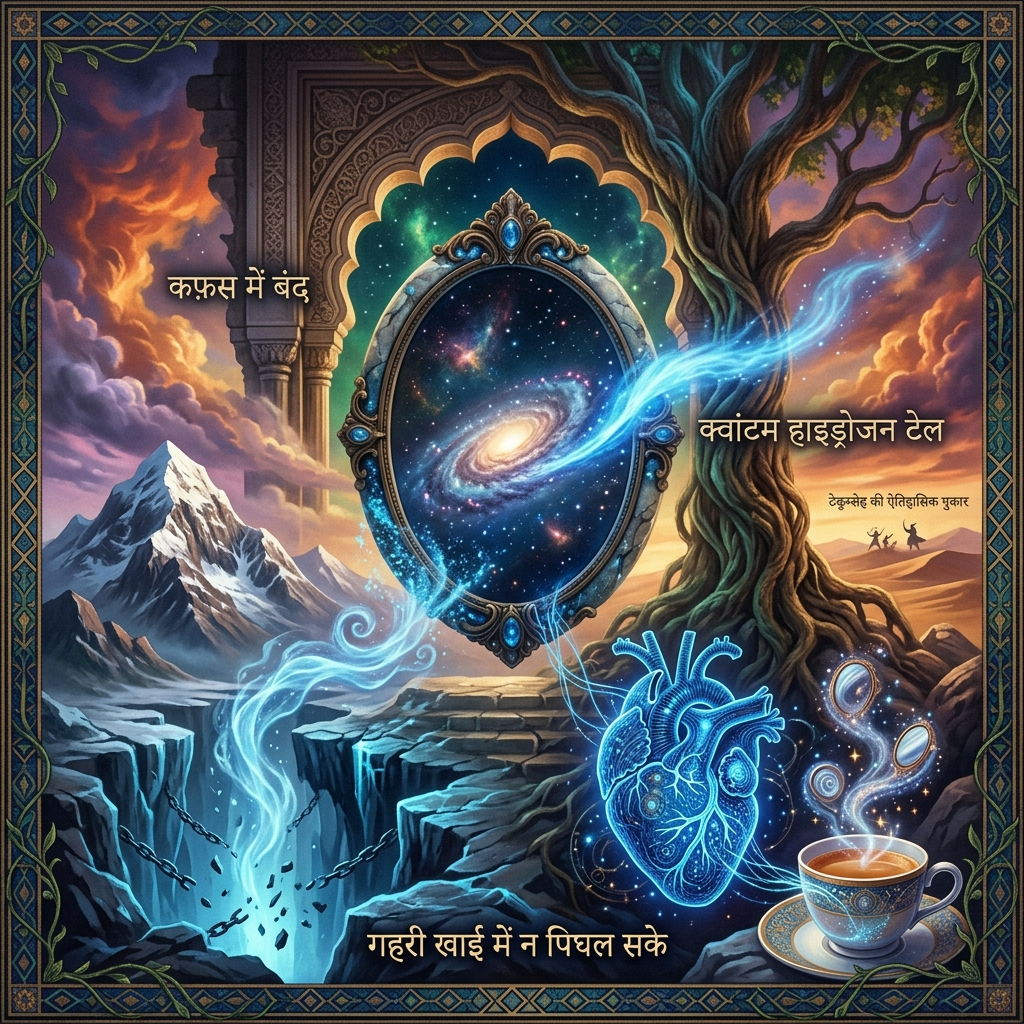
BEYOUTEA ! A QUANTUM POETRY>REVOLUTION !! MAKE EARTH GREAT FOREVER : END ALL WARS !!! NOTHING IS NOT TRUE : NO\KNOW THYSELF NOT !!!! META-SUFI/QUANTUM POETICS ON QUANTUM META MYSTIC FUTURISM !!!!!
Quantum Sufi Poetics an Informational Continuum
The Poem of the Day: October 10, 2026
ग़ज़ल
           आतिश-फ़िशां पहाड़, खूबसूरती नज़र
आतिश-फ़िशां पहाड़, खूबसूरती नज़र देखते ही जल जाएँगे,
बागी-ए-फ़िज़ा में गुलनार, महकते-महकाते हाथ मल जाएँगे।
            उड़ते परिंदे हवाओं के मुतालिक, हर सिम्त रफ़्तार पाएँगे,
            साज़िश कैसी धड़कनों को तड़पाती, सर-माथे पर गल जाएँगे।
यह आग है, वह जलवा, नज़ारे, रोशनी, तपिश-ओ-कशिश,
हैरान, ख़ौफ़ज़दा, हया, बहादुरी से, हर शय भाँपते चल जाएँगे।
            दीवाने को छोड़ो भी भला, ख़यालों में जीने-मरने को मस्त,
            निज़ाम की ख़िदमत में ख़तूत लिखते-पढ़ते निकल जाएँगे।
ख़ूनी दरिंदगी, मज़हबी तहज़ीबी, तारीख़-ए-सफ़ाकी नाकाफ़ी,
मेरे मौला, ईमान-काफ़िरी दिन-ब-दिन नवाज़ते ढल जाएँगे।
             Qubits की fabrications मुश्किल नहीं, हाँ मगर housing,
             क्वांटम कंप्यूटिंग वैक्यूम-ट्यूब के फ़ेज़ में, बदलते कल जाएँगे।
वाह! बनी है यख़नी-सोरबा तेरी चाय की, सजनी, क्या कहने!
फ़क़ीर, बादशाह, दर्पण सामने, देखते-देखते निगल जाएँगे।

अदबी, नफ़्सियाती और फ़लसफ़ी तशरीह
यह ग़ज़ल क्लासिकल शायरी के पारंपरिक तख़्त से उतरकर आधुनिक तकनीक, राजनीतिक विडंबना, मानवीय चेतना और अस्तित्ववादी विरोधाभासों के एक जटिल संकुल (complex) पर आधारित है। पहले शेर में 'आतिश-फ़िशां पहाड़' और 'गुलनार' का बिम्ब महज़ प्रकृति का वर्णन नहीं, बल्कि उस विनाशकारी ऊर्जा का रूपक है जो बाहरी भव्यता को देखते-देखते राख कर देती है, जहाँ इंसानी प्रयास और उनकी सुवासिक उम्मीदें लाचारी के आलम में हाथ मलती रह जाती हैं।
दूसरे और तीसरे शेर इंसानी नफ़्सियात (Psychology) की गहराइयों में उतरते हैं। परिंदों की आज़ाद रफ़्तार और साजिशों के बीच पिसती धड़कनों का द्वंद यह दर्शाता है कि बाह्य स्वतंत्रता और आंतरिक घुटन के बीच का संघर्ष कितना घातक होता है। इसके बाद 'हैरान, ख़ौफ़ज़दा, हया और बहादुरी' जैसे जज़्बात का एक साथ आना इस बात का प्रतीक है कि जब हक़ीक़त अपनी पूरी तपिश और कशिश के साथ सामने आती है, तो इंसान का अहसास-ए-कम्तरी और ताक़त का गुरूर दोनों बिखर जाते हैं।
चौथे और पाँचवे शेर में सत्ता, निज़ाम और तारीख़ (इतिहास) के काले पन्नों पर करारा व्यंग्य है। दीवाने अपनी ही काल्पनिक दुनिया में मस्त हैं, जबकि सत्ता के गलियारों में 'ख़तूत' लिखने और पढ़ने की औपचारिकताएं चल रही हैं। इसके साथ ही, 'ख़ूनी दरिंदगी' और 'मज़हबी तहज़ीब' के अंतर्विरोध यह समझाते हैं कि इतिहास की बर्बरता के सामने धार्मिक कट्टरता और मानवीय सभ्यता के दावे कैसे नाकाफी साबित होते हैं, और आस्था व नास्तिकता (ईमान-काफ़िरी) के पैमाने वक्त के साथ कैसे ढलते जाते हैं।
छठे शेर में अचानक शायरी का फलक बदलकर विज्ञान और आधुनिकता के धरातल पर आ जाता है। 'Qubits की fabrication' (क्वांटम बिट्स का निर्माण) और उसकी 'housing' (संरचनात्मक संभाल) की तकनीकी दुश्वारियां इस बात का दार्शनिक संकेत हैं कि इंसान चाहे जितनी उन्नत तकनीक बना ले, अंततः वह अपने ही बनाए पुराने या जटिल चक्रव्यूह (वैक्यूम-ट्यूब के शुरुआती दौर) में उलझकर भविष्य के कल को बदल देता है।
अंतिम शेर ग़ज़ल को एक सट्टेबाज़ यथार्थ और ज़मीनी मज़ाक पर लाकर खत्म करता है। 'यख़नी-सोरबा जैसी चाय' का घरेलू और व्यंग्यात्मक बिम्ब इस बात का गवाह है कि दुनिया की बड़ी-बड़ी क्रांतियां, फकीरी और बादशाहत अंततः सामान्य जीवन के छोटे-छोटे प्रलोभनों और समय के दर्पण के सामने कैसे नेस्तनाबूद हो जाती हैं। निष्कर्षतः, यह ग़ज़ल भौतिक विज्ञान, समाजशास्त्र और मानवीय मनोविज्ञान का एक अनूठा और आधुनिक अक्कीय संगम है।
The Poem of the Day: October 10, 2026
Ghazal
            Free Birds Shall Track the Winds
Volcanic summits shall burn
Down while we behold their glow,
In gardens of the realm, red
Blooms shall fade as hands outgrow.
            Free birds shall track the winds
            Across each highway of the sky,
            While tangled plots press on the
            Heart, where noble heads must die.
This blaze, this radiance, vision,
Warmth, and magnetic desire,
Stunned, fearful, chaste, yet bold,
We trace the steps beneath the fire.
            Leave dreamers to their phantom
            Realms where they exist and die,
            While clerks of state transcribe
            Their scrolls as centuries pass by.
Bloody carnage, sacred codes,
And history's ruthless page,
My Lord, devotion and dissent
Shift shadows age by age.
            Qubits lack not for craft, yet
            Housing proves the trial's crest,
            As quantum computers devolve
            To vacuum-tube's old test.
Ah, what a broth my love has
Brewed, your tea, a sovereign spell,
Which beggars, kings, and mirrors
Watch, then swallow down as well.

Exegesis: A Localised Political-technical Critique into A Universal Meditation
This literary transformation elevates the ghazal from a localised political-technical critique into a universal meditation on transience, systemic decay, and technological hubris. In the opening couplet, the juxtaposition of "volcanic summits" and fading "red blooms" constructs a classic romantic elegy of inevitable ruin, wherein human passion and natural splendour succumb to forces beyond comprehension.
The central stanzas explore existential alienation and historical disillusionment. The tension between soaring freedom ("free birds") and institutional oppression ("tangled plots") highlights a persistent motif of modern and classical verse: the subjugation of individual vitality by authoritarian or dogmatic structures. The interplay of psychological extremes, fear, chastity, and audacity serves as an epistemological mirror for humanity confronting profound historical shifts.
Moving into late-modern subversion, the verse bridges high romanticism with technocratic irony. The juxtaposition of "Qubits" and "housing" alongside historical artefacts like "vacuum-tubes" critiques humanity's cyclical entrapment in its own technological ambitions, suggesting that future advancements merely replicate older, more cumbersome constraints under a different guise.
Finally, the concluding couplet anchors the grand metaphysical scope into a mundane yet surreal domestic realism. The "sovereign spell" of simple tea encapsulates how absolute power, spiritual asceticism, and worldly vanity are ultimately consumed by the quiet, levelling passage of time.
The Poem of the Day: October 9, 2026
ग़ज़ल
        चश्म-दीदा जलवा फ़रोज़ा
सुल्तान-ए-दिलनवाज़ा, चश्म-दीदा जलवा फ़रोज़ा,
रोशन हुकूमत-ए-जिगर, माफ़रीदा जलवा फ़रोज़ा।
            हिकमत-ओ-हक़ीक़त तुम्हारी मोजिज़ा-ए-करम है,
            आसमाँ, कुऱ्रा-ए-अर्श-ओ-फ़र्श, नवीदा जलवा फ़रोज़ा।
चंगेज़ी दौड़े रंग-रग में, तैमूरी जंगजू हुआ आशिक़ी,
पीकर क़य जाम-ए-लहू किया, रवीदा जलवा फ़रोज़ा।
            मक़सूद है बक़ा करने में वहाँ वक़्त का ताय्युन भी,
            ओहदा, रुतबा, दौलत नब्ज़-ए-नमीदा जलवा फ़रोज़ा।
ग़ैब, मंज़र-ए-आम से हर शय राज़दार-ए-हरम के,
रहे रिआया, निज़ाम-ए-ख़ास, ज़बीदा जलवा फ़रोज़ा।
            Helios-1 की एरर-चेक्स के नतीजे सार्थक हुए,
            Quantinuum Processor फ़िदा जलवा फ़रोज़ा।
सजनी, हर दिन मुख़्तलिफ़-सी चाय तुमसे बनी है,
तलब दर्पण की है दम-ब-दम, अली-दा जलवा फ़रोज़ा।

अदबी, नफ़्सियाती और फ़लसफ़ियाना तशरीह
दिलनवाज़ सल्तनत और जलवे की मनोवैज्ञानिक बुनियाद: ग़ज़ल का आरम्भ ‘सुल्तान-ए-दिलनवाज़ा’ की छवि से होता है। यहाँ सुल्तान का अर्थ केवल राजनीतिक शासक नहीं, बल्कि ऐसी हस्ती भी हो सकता है जिसका वास्तविक अधिकार दिलों पर है। ‘चश्म-दीदा’ देखने, अनुभव करने और साक्षात्कार की तरफ़ संकेत करता है; ‘जलवा फ़रोज़ा’ उस सौन्दर्य या नूर की तरफ़, जो अपने आसपास की दुनिया को रोशन करता है। इस तरह बाहरी सत्ता और भीतरी आकर्षण के बीच एक मनोवैज्ञानिक रिश्ता बनता है।
‘रोशन हुकूमत-ए-जिगर’ में हुकूमत का केन्द्र जिगर है:हिम्मत, दिलेरी, गहरे जज़्बात और भावनात्मक सहनशीलता का प्रतीक। यह सत्ता भय से नहीं, आत्मीय प्रभाव से स्थापित होती है। प्रेम के मनोविज्ञान में भी किसी का वास्तविक प्रभाव उसके पद या प्रतिष्ठा से अधिक उस भावनात्मक सुरक्षा और अर्थ से पैदा होता है, जो वह दूसरे के जीवन में लाता है। इस अर्थ में महबूब की सल्तनत आत्मा पर हुकूमत नहीं, बल्कि दिल की स्वीकृति से बनने वाला एक आन्तरिक अनुशासन है।
हिकमत, हक़ीक़त और कायनात का तख़य्युल: दूसरे शेर में ‘हिकमत-ओ-हक़ीक़त’ को ‘मोजिज़ा-ए-करम’ से जोड़ा गया है। हिकमत विवेक, दूरदर्शिता और अर्थपूर्ण निर्णय की सूचक है; हक़ीक़त अस्तित्व की वास्तविकता का बोध कराती है। दोनों का संगम उस दृष्टि को जन्म देता है जिसमें संसार केवल घटनाओं का संग्रह नहीं, बल्कि समझे जाने योग्य एक गहरा तजुर्बा है।
‘आसमाँ’, ‘कुऱ्रा-ए-अर्श-ओ-फ़र्श’ और ‘नवीदा’ जैसे शब्द इस तख़य्युल को ब्रह्माण्डीय विस्तार देते हैं। अर्श और फ़र्श के बीच की दूरी ऊँचाई और ज़मीन, आध्यात्मिक कल्पना और भौतिक अस्तित्व के बीच का प्रतीकात्मक सेतु बन सकती है। यहाँ प्रेम का जलवा केवल व्यक्ति के चेहरे तक सीमित नहीं रहता; वह कायनात को देखने के ढंग में प्रवेश करता है।
नफ़्सियाती दृष्टि से प्रेम में ऐसा विस्तार स्वाभाविक है: महबूब से जुड़ा अनुभव स्मृति, प्रकृति और संसार की व्याख्या को बदल सकता है। फ़लसफ़ियाना दृष्टि से यह अनुभूति और वस्तुगत वास्तविकता के बीच सम्बन्ध पर प्रश्न उठाता है। फिर भी अनुभूति की गहराई अपने आप किसी ब्रह्माण्डीय दावे का वैज्ञानिक प्रमाण नहीं बनती। ग़ज़ल की शक्ति इस भेद को मिटाने में नहीं, बल्कि उसके बीच अर्थपूर्ण संवाद रचने में है।
चंगेज़ी और तैमूरी प्रतीक: हिंसा, शक्ति और आशिक़ी का द्वन्द्व: तीसरे शेर में चंगेज़ी और तैमूरी संकेत इतिहास की युद्धप्रिय सत्ता, विजय की लालसा और जंगजू मानसिकता को सामने लाते हैं। ‘रंग-रग में दौड़ने’ का मुहावरा बताता है कि यह प्रवृत्ति केवल बाहरी आचरण नहीं, बल्कि किसी व्यक्ति या सभ्यता की मानसिक बनावट में गहरे उतर चुकी है। इसके साथ ‘आशिक़ी’ का जुड़ना शेर को एक महत्त्वपूर्ण विरोधाभास देता है: क्या प्रेम भी विजय की भाषा बोलने लगता है, या वह हिंसक विरासत को बदलने की शक्ति रखता है?
‘जाम-ए-लहू’ रक्तपात, बलिदान और विनाश की तीखी छवि है। इसे पीने का बिम्ब हिंसा के परिणामों को अपने भीतर उतार लेने की ओर संकेत कर सकता है। इस अर्थ में प्रेम केवल कोमलता का नाम नहीं; वह उस ऐतिहासिक और मनोवैज्ञानिक अँधेरे का सामना भी है, जो मनुष्य के भीतर मौजूद है।
यहाँ एक महत्त्वपूर्ण अदबी सम्भावना खुलती है। यदि ‘चंगेज़ी’ और ‘तैमूरी’ शक्ति के हिंसक रूपों का प्रतिनिधित्व करते हैं, तो ‘आशिक़ी’ उस शक्ति का रूपान्तरण भी बन सकती है। मगर यह अर्थ तभी पूर्णतः स्थापित होगा जब शायर की मंशा स्पष्ट हो कि प्रेम इन ऐतिहासिक शक्तियों से पराजित होता है, उनमें समा जाता है, या उन्हें बदल देता है। मौजूदा पाठ इस द्वन्द्व को खोलता है, पर उसका अन्तिम निर्णय पाठक पर छोड़ देता है।
बक़ा, वक़्त और पद-प्रतिष्ठा की अस्थिरता: चौथे शेर में ‘बक़ा’ का अर्थ टिके रहने, अस्तित्व बनाए रखने या स्थायित्व की आकांक्षा से जुड़ता है। ‘वक़्त का ताय्युन’ समय के निर्धारण, उसकी सीमाओं और उसके प्रभाव को सामने लाता है। मनुष्य अक्सर स्थायित्व चाहता है, लेकिन उसका जीवन समय के भीतर बदलता रहता है। इसी विरोधाभास से अस्तित्ववादी चिन्ता पैदा होती है: क्या बचा रहेगा, किस रूप में रहेगा और किस मूल्य पर रहेगा?
‘ओहदा, रुतबा, दौलत’ सामाजिक पहचान और बाहरी प्रतिष्ठा के तीन परिचित आधार हैं। इनके साथ ‘नब्ज़’ का बिम्ब जुड़ने पर यह प्रश्न उठता है कि क्या सत्ता और सम्पन्नता की चमक के नीचे जीवन की वास्तविक धड़कन सुरक्षित है। ‘नमीदा’ का आशय यदि नमी, मुरझाहट या किसी अन्य भाव से जुड़ा है, तो शेर की व्याख्या उसी के अनुसार बदलेगी; इसलिए इस शब्द पर निश्चित अर्थ थोपना उचित नहीं।
फ़लसफ़ियाना स्तर पर शेर यह विचार सम्भव बनाता है कि सामाजिक उपलब्धियाँ स्थायित्व का भ्रम दे सकती हैं, लेकिन वे समय और मृत्यु की सीमाओं को समाप्त नहीं करतीं। नफ़्सियाती स्तर पर पद और धन को आत्म-मूल्य का एकमात्र स्रोत बना लेना व्यक्ति को बाहरी मान्यता पर निर्भर कर सकता है। इसके विपरीत, प्रेम, स्मृति और अर्थपूर्ण सम्बन्ध ऐसी विरासत बन सकते हैं जो पदवी से आगे जाती है।
ग़ैब, राज़ और सामाजिक निज़ाम: पाँचवें शेर में ‘ग़ैब’ अदृश्य, अप्रकट या सामान्य इन्द्रिय-अनुभव से परे की दुनिया का संकेत देता है। ‘मंज़र-ए-आम’ सार्वजनिक दृश्यता है, जबकि ‘राज़दार-ए-हरम’ निजी पवित्रता, अंतरंगता या संरक्षित रहस्य का रूपक बन सकता है। इन दोनों के बीच का तनाव बताता है कि हर दिखाई देने वाली चीज़ पूरी तरह जानी हुई नहीं होती और हर निजी अनुभव सार्वजनिक भाषा में व्यक्त नहीं किया जा सकता।
‘रिआया’ और ‘निज़ाम-ए-ख़ास’ सत्ता, समाज और व्यवस्था के सम्बन्ध को सामने लाते हैं। यदि ‘रिआया’ प्रजा है, तो शेर को इस प्रश्न से पढ़ा जा सकता है कि सार्वजनिक जीवन और विशेषाधिकार प्राप्त क्षेत्रों के बीच कैसी दूरी मौजूद है। ग़ैब का रूपक तब केवल आध्यात्मिक रहस्य नहीं रहता, बल्कि उन छिपी संरचनाओं का भी संकेत बन जाता है जो किसी व्यवस्था को चलाती हैं, पर सामान्य दृष्टि से हमेशा स्पष्ट नहीं होतीं।
नफ़्सियाती तौर पर यह शेर मनुष्य की सीमित जानकारी और अनिश्चितता को पहचानने का अवसर देता है। फ़लसफ़े में भी ज्ञात और अज्ञात का भेद बुनियादी है। फिर भी हर रहस्य को किसी गुप्त शक्ति का प्रमाण मान लेना उचित नहीं; कुछ चीज़ें अभी अज्ञात होती हैं, कुछ निजी रहती हैं और कुछ को समझने के लिए बेहतर प्रमाण तथा अधिक सूक्ष्म विवेचन की आवश्यकता होती है।
Helios-1 और Quantinuum Processor: तकनीक के भीतर जलवे की तलाश: छठे शेर में ग़ज़ल आधुनिक वैज्ञानिक भाषा की ओर मुड़ती है। ‘Helios-1 की error checks’ और उनके सार्थक परिणामों का उल्लेख जाँच, सत्यापन और त्रुटियों को पहचानने की वैज्ञानिक प्रक्रिया का काव्यात्मक रूप प्रस्तुत करता है। यहाँ ‘जलवा फ़रोज़ा’ को तकनीकी उपलब्धि की चमक के रूप में पढ़ा जा सकता है—ऐसी चमक जो केवल आकर्षण से नहीं, परीक्षण और परिणाम से अर्थ प्राप्त करती है।
Quantinuum Processor का उल्लेख क्वांटम कम्प्यूटिंग के संसार को प्रेम और रूहानियत की उसी काव्यात्मक ज़मीन पर लाता है, जहाँ पहले अर्श, फ़र्श, दिल और हक़ीक़त मौजूद थे। इस संयोजन की विशेषता यह है कि आधुनिक तकनीक को ग़ज़ल से बाहर की वस्तु नहीं समझा गया; उसे मानवीय तख़य्युल के भीतर जगह दी गई है। विज्ञान यहाँ एक नया रूपक-भण्डार प्रदान करता है, जबकि ग़ज़ल तकनीकी वस्तु को भावनात्मक अर्थ देती है।
इसके साथ एक तथ्यगत सावधानी भी आवश्यक है। किसी प्रणाली की error checks के सार्थक परिणाम अपने आप यह साबित नहीं करते कि वह प्रणाली किसी व्यापक अर्थ में त्रुटिरहित है या किसी विशिष्ट क्वांटम उपलब्धि तक पहुँच गई है। इसी तरह Quantinuum Processor का काव्य में आना अपने आप किसी वैज्ञानिक दावे की पुष्टि नहीं करता। यदि ‘Helios-1’ किसी विशिष्ट परियोजना, प्रोसेसर या परीक्षण का नाम है, तो उसके तकनीकी सन्दर्भ की पुष्टि से शेर का वैज्ञानिक पक्ष और मज़बूत किया जा सकता है।
सजनी की चाय, आत्मीयता और दर्पण का तख़ल्लुस: मक़ते में ग़ज़ल की व्यापक ब्रह्माण्डीय और तकनीकी यात्रा एक घरेलू, आत्मीय दृश्य में उतरती है। ‘सजनी’ की उपस्थिति प्रेम को अमूर्त विचार से जीवित सम्बन्ध में बदल देती है। हर दिन बनने वाली ‘मुख़्तलिफ़-सी चाय’ रोज़मर्रा के जीवन में विविधता, नयापन और अपनापन पैदा करती है। चाय केवल पेय नहीं रहती; वह साझा समय, ध्यान, स्मृति और निकटता की छोटी-सी रस्म बन जाती है।
नफ़्सियाती दृष्टि से रोज़मर्रा के ऐसे कर्म सम्बन्धों की भावनात्मक निरन्तरता में योगदान दे सकते हैं। किसी प्रिय व्यक्ति के हाथ की चाय में स्वाद के साथ उससे जुड़ी स्मृतियाँ और अपेक्षाएँ भी शामिल होती हैं। यही वजह है कि एक मामूली घरेलू दृश्य कभी-कभी किसी बड़े दार्शनिक विचार से अधिक प्रत्यक्ष रूप में आत्मीयता का अनुभव करा देता है।
‘तलब दर्पण की’ में दर्पण एक साथ शायर के तख़ल्लुस और आत्म-प्रतिबिम्ब का प्रतीक बन सकता है। प्रेमी सजनी की ओर देखता है, लेकिन उस देखने में अपने भीतर की इच्छा, पहचान और भावनाओं को भी पहचानता है। इस तरह महबूब और आत्मबोध के बीच एक दर्पण-सदृश रिश्ता बनता है: दूसरे को चाहना स्वयं को समझने का रास्ता भी हो सकता है। ‘दम-ब-दम’ इस चाहत की निरन्तरता को सामने लाता है, जबकि ‘अलीदा’ का सटीक आशय स्पष्ट होने पर मक़ते की अन्तिम अर्थ-परत अधिक निश्चित हो सकेगी।
समग्र निष्कर्ष: यह ग़ज़ल अपनी मूल बनावट में प्रेम को केवल रोमानी आकर्षण नहीं, बल्कि सत्ता, इतिहास, अस्तित्व, रहस्य, विज्ञान और रोज़मर्रा की आत्मीयता के बीच सक्रिय एक व्यापक अनुभव के रूप में प्रस्तुत करती है। ‘जलवा फ़रोज़ा’ की आवर्ती ध्वनि को इस व्यापकता का प्रतीक माना जा सकता है: कहीं वह दिल पर प्रभाव डालती है, कहीं कायनात को अर्थ देती है, कहीं इतिहास की हिंसा से टकराती है, कहीं समय और प्रतिष्ठा की सीमाओं पर प्रश्न उठाती है और कहीं तकनीकी उपलब्धियों तथा सजनी की चाय में चमकती है।
इसकी सबसे दिलचस्प विशेषता ऊँचे और साधारण अनुभवों को एक ही काव्यात्मक धरातल पर लाना है। अर्श-ओ-फ़र्श से चाय तक की यात्रा बताती है कि अर्थ केवल भव्य प्रतीकों में नहीं, बल्कि दैनिक जीवन की आत्मीयता में भी मिलता है। वहीं ऐतिहासिक हिंसा और आधुनिक तकनीक के संकेत ग़ज़ल को समकालीन प्रश्नों से जोड़ते हैं।
अन्ततः इसकी अदबी सम्भावना उस जलवे में है जो बाहरी सत्ता से आगे बढ़कर आन्तरिक पहचान, विवेक और सम्बन्धों तक पहुँचता है। लेकिन इसकी भाषिक और अरूज़ी पूर्णता के लिए इसमें निहित कुछ मूल शब्दों का आशय स्पष्टत: पाठक की ग्रहण करने में आवश्यक हक देती है। मूल स्वरूप और भावार्थ की हिफ़ाज़त का सबसे विश्वसनीय रास्ता यही है कि जहाँ अर्थ निश्चित है वहाँ अपनी इस्लाही क्षमता से की जाए, और जहाँ अर्थ संदिग्ध है वहाँ शायर की मंशा की पुष्टि के बिना कोई निर्णायक बदलाव किए बगैर मानी दर की जाए।
The Poem of the Day: October 9, 2026
Ghazal
        Who  Lights the Throne of Hearts Alone
O Sultan, who maketh every tender heart thy own,
Thy witnessed splendour lights the throne of hearts alone;
Thy sovereignty within my soul doth brightly reign,
A grace-born kingdom where love’s light shall ever shine.
           Thy wisdom and thy truth, a miracle of grace,
           Reveal the heavens’ wonder in thy countenance;
           From celestial heights to earth’s embracing ground,
           Thy radiant presence maketh all things newly crowned.
The blood of Genghis courses through the warrior’s veins,
And Timur’s martial fire within his heart remains;
Yet Love, that gentle conqueror, doth enter strife,
And drinks the crimson chalice of the warrior’s life.
           What is survival, if Time itself must set its span?
           What worth hath rank or wealth in the brief estate of man?
           The pulse beneath the titles, faint or fiercely bright,
           Must face the mortal shadows that consume the night.
The unseen veil conceals what common eyes would miss,
Each secret holds its silence in the sanctuary of bliss;
The people and the hidden order, each in their domain,
Seek meaning in the mysteries that mortal thoughts contain.
           Helios-1 hath passed its checks, its findings clear and bright,
           Whilst Quantinuum’s processor glimmers in the light;
           Where errors meet their testing, new possibilities arise,
           And reason seeks its wonders beneath the searching skies.
My darling, every day thy tea assumes a different hue,
Each cup a fresh enchantment, each fragrant sip anew;
And Darpan’s heart, from breath to breath, doth seek thy light,
Thy love its endless longing, its dawn, its sweetest night.

Exegesis: Love, Sovereignty, Consciousness, and the Radiance of Being
The Sultan of the Heart: Love as an Inner Sovereignty: The ghazal opens with the figure of the Sultan of Hearts, an image that transforms political sovereignty into emotional and spiritual authority. The beloved is not merely a ruler who commands obedience; the beloved is a presence whose radiance awakens affection, reverence, and inward transformation. The language of witnessed splendour suggests a beauty encountered through experience rather than accepted solely through hearsay. The beloved’s sovereignty is therefore established through the heart’s recognition.
The image of a luminous kingdom within the soul further develops this distinction between external power and inward authority. Political rule may depend upon institutions, coercion, wealth, or inherited status, but emotional influence depends upon trust, intimacy, and the freedom to respond. In this romantic interpretation, the beloved’s kingdom becomes a realm in which affection is the governing principle and tenderness provides the foundation of order.
Psychologically, this image suggests that profound relationships can reorganise an individual’s inner world. The beloved becomes a centre of attention, memory, aspiration, and meaning. Philosophically, the metaphor invites a distinction between possessing power over another person and inspiring a freely given allegiance of the heart. The former may enforce submission; the latter arises through recognition and emotional consent.
Wisdom, Truth, and the Cosmic Imagination: The second couplet brings wisdom and truth together as a miracle of grace. Wisdom represents discernment, reflective understanding, and the ability to perceive relationships between apparently separate things. Truth signifies the reality that remains to be investigated, experienced, and understood. Their conjunction suggests that knowledge becomes most meaningful when intellectual clarity is accompanied by humility and an appreciation of existence.
The movement from heaven to earth enlarges the beloved’s radiance into a cosmic metaphor. The heavens evoke transcendence, while the earthly realm represents embodied existence, daily experience, and the material conditions of life. The beloved’s presence appears to illuminate both, suggesting that romantic perception can transform the world without requiring the world itself to change physically.
This is a familiar feature of mystical and romantic literature: the beloved becomes a lens through which the universe acquires renewed significance. A landscape, a starry sky, or an ordinary object may appear extraordinary because emotional experience has altered the observer’s relationship with it.
The philosophical importance of this imagery lies in the relationship between subjective experience and objective reality. Love can change how reality is perceived, what receives attention, and which meanings become important. Nevertheless, the intensity of such an experience does not, by itself, establish a scientific claim about the structure of the cosmos. The ghazal’s achievement is poetic: it gives emotional experience a cosmic scale while leaving the relationship between mystical insight and empirical knowledge open to reflection.
Genghis, Timur, and the Transformation of Martial Power: The third couplet introduces the historical figures of Genghis Khan and Timur, whose names evoke conquest, military ambition, and the violent dimensions of imperial power. Their presence changes the emotional atmosphere of the poem. The imagery of blood coursing through the warrior’s veins suggests that the habits of conflict may become deeply embedded in individual and collective identity.
Against this inheritance, the arrival of love creates a striking tension. The warrior’s world is governed by victory, endurance, domination, and the willingness to sacrifice. Love introduces another form of power, one founded upon vulnerability, attachment, and the recognition of another’s humanity.
The crimson chalice is central to this tension. Blood becomes something consumed, internalised, and carried within the self. The image may suggest the terrible cost of violence, the burden of historical memory, or the transformation of martial intensity into the suffering of passionate attachment. The warrior who once sought to conquer others may discover that love exposes him to an inward struggle that cannot be resolved by force.
Psychologically, the couplet invites reflection upon inherited patterns of aggression. Individuals and societies may reproduce behaviours learned through history, culture, and collective memory. Yet these patterns need not determine every future action. Love can challenge the assumption that strength must express itself through domination.
The poem does not entirely resolve whether love conquers violence or becomes entangled within it. This ambiguity gives the couplet its dramatic force. Its strongest ethical possibility lies in the prospect that courage might be redirected from conquest towards compassion, and that the energy once devoted to domination might serve the protection of life.
Time, Survival, and the Fragility of Status: The fourth couplet turns from historical violence towards the existential problem of permanence. Survival is considered in relation to time, whose limits shape every human ambition. Rank, reputation, and wealth may establish a person’s position in society, but none can guarantee freedom from change, decline, or mortality.
The pulse offers a particularly suggestive counterpoint to these outward signs of achievement. Titles and possessions are socially visible; the pulse belongs to the living body. It reminds the reader that beneath every public identity there remains a vulnerable organism subject to time. The contrast questions whether external distinction can provide the permanence that human beings often seek through it.
Existential philosophy repeatedly confronts this discrepancy between the desire for enduring significance and the finite character of human life. People may pursue recognition because it promises continuity beyond the present moment. Yet social esteem remains dependent upon circumstances, institutions, collective memory, and the changing judgements of others.
Psychologically, excessive dependence upon rank or wealth can make self-worth vulnerable to external approval. The ghazal opens another possibility: permanence may be sought through meaningful relationships, acts of compassion, creative expression, and the influence a life leaves upon others.
The couplet does not necessarily reject material success or social distinction. Rather, it asks whether such achievements are sufficient to answer the deeper question of existence. Its philosophical force lies in distinguishing the possession of status from the experience of living meaningfully.
The Unseen, the Sanctuary, and the Limits of Knowledge: The fifth couplet introduces the unseen as a domain that cannot be exhausted by public appearances. The common scene represents what is accessible to ordinary observation, whereas the sanctuary evokes privacy, sacredness, and the protection of intimate truths. The contrast suggests that visible reality and inward significance are not always identical.
The image may be read spiritually, psychologically, or socially. In its spiritual dimension, the unseen signifies mystery: those aspects of existence that invite contemplation without necessarily yielding complete explanation. In its psychological dimension, it represents the private emotional life that cannot be fully inferred from outward behaviour. A person may appear composed while carrying grief, longing, uncertainty, or devotion that remains invisible to others.
The references to the people and a special order also introduce a political implication. Public life and privileged structures may operate according to different rules, and not every influence upon society is immediately visible. The image therefore raises questions about transparency, authority, and the relationship between those who participate in a system and those who determine its hidden arrangements.
Yet the unseen must be approached with intellectual care. Mystery is not automatically evidence of supernatural intervention, nor does every unexplained event demonstrate the existence of a concealed power. Some matters remain private; others are difficult to investigate; still others require better evidence before a reliable conclusion can be reached.
The couplet’s enduring insight is that knowledge has limits. Wisdom consists not merely in seeking explanations, but also in distinguishing what is known, what is inferred, and what remains uncertain.
Helios-1 and Quantinuum: Scientific Inquiry as a New Poetic Language: The sixth couplet introduces contemporary technological imagery into the ghazal’s established mystical and romantic vocabulary. The reference to Helios-1 and meaningful error checks evokes the scientific practices of testing, verification, and the detection of discrepancies. The processor associated with Quantinuum brings quantum computation into the poem as a symbol of technological possibility and intellectual ambition.
This transition is significant because it refuses to treat science as an alien presence within poetic experience. The language of processors and error checks enters the same imaginative world as the heavens, the beloved, the sanctuary, and the heart. Technology becomes another means through which humanity seeks to understand, test, and transform its relationship with reality.
Error checking is especially suggestive as a philosophical metaphor. Human understanding is vulnerable to mistakes, assumptions, and incomplete information. Testing provides a disciplined means of identifying and correcting some of these weaknesses. In this respect, scientific inquiry can be understood as an ongoing practice of intellectual humility: a claim gains credibility not merely because it is attractive, but because it withstands appropriate scrutiny.
Quantum computing adds another dimension. Quantum processors exploit quantum-mechanical properties to perform certain computational tasks in ways that differ from conventional computing. Their importance lies in specific capabilities, experimental results, and carefully established performance measures, not in a general promise that all problems will become solvable or that scientific mystery will disappear.
The poem’s scientific references should therefore be understood as poetic invocations rather than technical conclusions. Successful error checks do not establish that a complete system is infallible, and the mention of a quantum processor does not independently verify a particular scientific achievement. The exact technical significance of Helios-1 would require a clearly identified project or source.
Within these limits, the couplet creates an appealing dialogue between reason and wonder. Science examines the world through reproducible methods, while poetry explores the meanings, emotions, and aspirations associated with discovery. Neither needs to impersonate the other to enrich the human search for understanding.
The Beloved’s Tea and the Intimacy of Everyday Life: The final couplet brings the poem from cosmic scale and technological ambition into the intimate world of the beloved. The daily preparation of tea provides a striking contrast with the earlier references to imperial power, historical warfare, metaphysical mystery, and quantum computation. Yet this contrast does not diminish the poem’s philosophical reach. It gives that reach a human centre.
The tea changes from day to day, becoming an emblem of variation within continuity. The ritual remains familiar, but each cup belongs to a particular moment, mood, and encounter. Its significance arises not only from flavour or preparation, but also from the presence of the person who makes it. A simple act becomes a form of care through repetition, attention, and shared experience.
Psychologically, such rituals can sustain intimacy by creating reliable opportunities for connection. Their emotional significance accumulates over time: each cup may recall previous conversations, quiet companionship, reconciliations, or moments of affection. The ordinary becomes meaningful through the history attached to it.
The final invocation of Darpan adds a further layer. As the poet’s pen name, Darpan also means a mirror, allowing the poetic persona to become an image of self-reflection. The lover looks towards the beloved, but in that act of looking also encounters his own longing, vulnerability, and identity. The beloved becomes not simply the object of desire but a presence through which the self becomes more intelligible.
The phrase expressing longing from breath to breath suggests an affection that persists through the smallest units of lived experience. Love is no longer an abstract doctrine or an imperial force; it is a continuing orientation towards another person. The closing image thus restores the poem’s immense imaginative journey to the simple, embodied fact of companionship.
Conclusion: From Imperial Splendour to the Radiance of Relationship: The ghazal brings together several apparently distant domains: romantic devotion, spiritual imagination, the violence of history, existential uncertainty, the mystery of the unseen, contemporary quantum technology, and the tenderness of domestic life. Their coherence emerges through the recurring idea of radiance. The beloved illuminates the heart; wisdom illuminates the cosmos; historical violence exposes the darkness within power; reflection reveals the limits of status; inquiry tests the claims of knowledge; and everyday affection gives meaning to the passing moment.
The poem’s psychological foundation lies in the capacity of love to reorganise perception and identity. Its philosophical foundation lies in the questions it raises about permanence, knowledge, power, and the distinction between appearance and meaning. Its contemporary character emerges from its willingness to incorporate scientific and technological vocabulary into a traditional poetic form.
The historical references prevent its romanticism from becoming entirely detached from human suffering, while the quantum imagery introduces a modern language of investigation and possibility. The final image of tea, meanwhile, ensures that the poem does not remain suspended in abstraction. It returns to the intimate practices through which affection becomes tangible.
Ultimately, the ghazal suggests that the most enduring sovereignty is not necessarily exercised through conquest, wealth, or prestige. It may instead reside in the ability to inspire love, awaken understanding, question inherited violence, and recognise significance in ordinary life. The beloved’s radiance is therefore most persuasive not as a claim of absolute dominion, but as an invitation to a more reflective and compassionate way of being.
The poem’s deepest movement is from power over the world towards meaningful participation in it, from the warrior’s blood-stained chalice to the beloved’s daily cup of tea. In that movement, Darpan’s romantic imagination finds a meeting place for the mystical, the philosophical, the scientific, and the profoundly human.
The Poem of the Day: October 8, 2026
ग़ज़ल
           कम-अज़-कम ज़िन्दा हैं हम
दर्द है तो मालूम है, कम-अज़-कम ज़िन्दा हैं हम,
शिफ़ा-ओ-सुकूँ से शर्मिन्दा है मरीज़ा, कम-अज़-कम।
            मोहब्बत करने वालों से वफ़ा की उम्मीद भर ही है,
            बेवफ़ाई में ईमान का कारिन्दा है कम-अज़-कम।
दुआओं में मुमकिनन क्या नहीं पाया, क्या खोया है,
बददुआओं से क़िस्मत का उड़ता परिन्दा है कम-अज़-कम।
            शाम ही सुबह है, उरूज-ओ-ज़वाल ज़िन्दगी का सवाल,
            जवाबों में मसअला-ए-हल का पुलिन्दा है कम-अज़-कम।
यही वह वहम है, इख़्तिताम-ए-इब्तिदा, फ़ारिग़ सदा,
निज़ामी दानाई, शमशीर-ए-बारिन्दा है कम-अज़-कम।
            CPGE से हेलिसिटी-डिपेंडेंट फ़ोटोकरंट्स निकले,
            क्वांटम पोलराइज़ेशन सीधा-सा बन्दा है कम-अज़-कम।
हम दीवाने, नमाने सजनी, मन तेरे हाथ की चाय पिएँ,
दर्पण बड़ा मासूम समझे, सब काम-धन्धा है कम-अज़-कम।

अदबी, नफ़्सियाती और फ़लसफ़ियाना तशरीह
दर्द, जीवन-बोध और शिफ़ा की विडम्बना: ग़ज़ल का आरम्भ दर्द को महज़ तकलीफ़ नहीं, बल्कि जीवित होने की एक मनोवैज्ञानिक गवाही के रूप में स्थापित करता है। जब व्यक्ति कहता है कि दर्द है, इसलिए कम-अज़-कम ज़िन्दगी का एहसास बाक़ी है, तब पीड़ा और जीवन के बीच एक गहरा सम्बन्ध उभरता है। नफ़्सियाती दृष्टि से दर्द मनुष्य को अपनी उपस्थिति, अपनी सीमाओं और अपनी अधूरी इच्छाओं से परिचित कराता है। इसके विपरीत, शिफ़ा और सुकून की प्राप्ति हमेशा सरल मुक्ति नहीं होती; कभी-कभी राहत के साथ अपराधबोध, शर्मिन्दगी या अपने पुराने संघर्षों से बिछुड़ने का अजीब-सा एहसास भी जुड़ जाता है।
यहाँ ‘मरीज़ा’ का स्त्रीलिंग प्रयोग किसी स्त्री-पात्र, किसी बीमार आत्मा अथवा रूपकात्मक चेतना की ओर संकेत कर सकता है। मूल पाठ में यह स्पष्ट नहीं कि शर्मिन्दगी रोगिणी की है या शिफ़ा-ओ-सुकून की स्थिति से जुड़ी कोई विडम्बना है। इस अस्पष्टता में एक सम्भावित काव्यात्मक शक्ति मौजूद है: मनुष्य कभी अपने दर्द से परेशान होता है और कभी उसी दर्द के चले जाने पर अपनी पुरानी पहचान खोने से डरता है। फिर भी दर्द को जीवन का अनिवार्य प्रमाण नहीं मानना चाहिए; ग़ज़ल का आशय पीड़ा का महिमामण्डन करने के बजाय उसके भीतर जीवित चेतना की तलाश के रूप में अधिक अर्थवान बनता है।
मोहब्बत, वफ़ा और नैतिक आत्मविरोध: दूसरे शे'र में प्रेम करने वालों से वफ़ा की उम्मीद तो है, लेकिन वह उम्मीद पूर्ण विश्वास की जगह एक सीमित सम्भावना बनकर सामने आती है। मोहब्बत में वफ़ा की आकांक्षा मनुष्य की भावनात्मक सुरक्षा, परस्पर सम्मान और सम्बन्ध की स्थिरता से जुड़ी होती है। मगर जब प्रेम के साथ बेवफ़ाई की आशंका भी उपस्थित रहती है, तब व्यक्ति का नैतिक विश्वास और उसका वास्तविक अनुभव आमने-सामने आ जाते हैं।
‘ईमान का कारिन्दा’ एक महत्त्वपूर्ण रूपक है। कारिन्दा किसी व्यवस्था के भीतर काम करने वाला प्रतिनिधि होता है; इस अर्थ में ईमान का कारिन्दा वह व्यक्ति हो सकता है जो नैतिकता की सेवा करने का दावा करता है, लेकिन अपने आचरण में उसी नैतिकता की परीक्षा से गुज़रता है। यदि बेवफ़ाई को ईमान का कारिन्दा कहा गया है, तो यह एक जानबूझकर रची गई विडम्बना है: वफ़ा का दावा करने वाली दुनिया में बेवफ़ाई भी मानो नैतिकता की भाषा बोलने लगती है। इस विरोधाभास से प्रेम के आदर्श और मनुष्य की वास्तविक कमज़ोरियों के बीच की दूरी उजागर होती है।
यहाँ मूल भाव को सुरक्षित रखना ज़रूरी है: प्रेम करने वालों से वफ़ा की उम्मीद एक भावनात्मक आवश्यकता है, कोई सुनिश्चित सामाजिक नियम नहीं। इसी कारण यह शे'र प्रेम की शिकायत के साथ-साथ आत्मपरीक्षण का अवसर भी बनता है।
दुआ, बददुआ और क़िस्मत का मनोविज्ञान: तीसरे शे'र में दुआ और बददुआ दो विपरीत मानसिक दिशाओं का प्रतिनिधित्व करती हैं। दुआ उम्मीद, सम्भावना और उस भरोसे की अभिव्यक्ति है जिसके सहारे मनुष्य अपनी सीमित परिस्थितियों से आगे देखने का प्रयास करता है। इसके बरअक्स बददुआ चोट, क्रोध, निराशा अथवा प्रतिशोध की भाषा बन सकती है। ‘क्या नहीं पाया, क्या खोया’ का प्रश्न जीवन के हिसाब-किताब को अनिश्चित बना देता है: प्राप्ति और हानि हमेशा अलग-अलग खानों में नहीं रखी जा सकतीं।
‘क़िस्मत का उड़ता परिन्दा’ स्वतंत्रता और अस्थिरता, दोनों का बिम्ब है। परिन्दा उड़ान भरता है, लेकिन उसकी दिशा और मंज़िल हमेशा दर्शक के नियन्त्रण में नहीं होती। इसी तरह मनुष्य अपनी तक़दीर को कभी अपने कर्मों का फल समझता है, कभी बाहरी परिस्थितियों का परिणाम और कभी उन शक्तियों का क्षेत्र जिन्हें वह पूरी तरह समझ नहीं सकता।
यहाँ नफ़्सियाती अर्थ विशेष रूप से महत्त्वपूर्ण है। दुआ मनुष्य को आशा और सक्रियता की ओर प्रेरित कर सकती है, जबकि बददुआ किसी चोट की स्मृति को लम्बा खींच सकती है। मगर ग़ज़ल किसी निश्चित धार्मिक या कर्मकाण्डीय निष्कर्ष पर आग्रह नहीं करती; वह इस प्रश्न को खुला रखती है कि मनुष्य अपने जीवन के अर्थ को प्राप्तियों, हानियों, इच्छाओं और विश्वासों के बीच किस प्रकार पहचानता है।
शाम की सुबह: उरूज-ओ-ज़वाल का फ़लसफ़ा: चौथा शे'र समय के सीधे-सादे विभाजन को चुनौती देता है। शाम और सुबह सामान्यतः दिन के दो अलग छोर हैं, मगर ‘शाम ही सुबह है’ कहने से अन्त और आरम्भ के बीच की सीमा धुँधली हो जाती है। किसी अनुभव का अन्त दूसरे अनुभव की शुरुआत हो सकता है; पतन के भीतर उन्नति की सम्भावना और उन्नति के भीतर पतन का बीज मौजूद रह सकता है। यही उरूज-ओ-ज़वाल का बुनियादी द्वन्द्व है।
जीवन को केवल सफलता और असफलता की स्थिर श्रेणियों में बाँटना इस शे'र की दृष्टि को सीमित कर देगा। मनुष्य की परिस्थितियाँ बदलती रहती हैं, और उनके साथ अपने बारे में उसकी समझ भी। जो उत्तर किसी प्रश्न को समाप्त करने का दावा करता है, वह स्वयं नए प्रश्नों का पुलिन्दा खोल सकता है। इसलिए ‘मसअला-ए-हल’ का बिम्ब ज्ञान की उस सीमा की ओर संकेत करता है जहाँ समाधान और समस्या एक-दूसरे से पूरी तरह अलग नहीं रह जाते।
इस शे'र का फ़लसफ़ियाना बल इसी बात में है कि जीवन को किसी एक अन्तिम उत्तर में बन्द नहीं किया जा सकता। कभी प्रश्न स्वयं विकास का साधन बनता है और कभी उत्तर की प्राप्ति यह दिखाती है कि समझने के लिए अभी बहुत कुछ शेष है।
इख़्तिताम-ए-इब्तिदा और निज़ामी दानाई: पाँचवाँ शे'र ग़ज़ल का सबसे अधिक गूढ़ और अर्थगत रूप से खुला हुआ हिस्सा है। ‘इख़्तिताम-ए-इब्तिदा’ अर्थात आरम्भ का अन्त, या अन्त में आरम्भ का समा जाना, समय की चक्रीय अनुभूति का रूपक हो सकता है। मनुष्य कई बार किसी घटना को समाप्त समझता है, जबकि वही घटना उसके विचार, व्यक्तित्व या जीवन की नई दिशा का आधार बनती है। ‘फ़ारिग़ सदा’ को यदि मुक्ति, विरक्ति या किसी बोझ से खाली हो जाने की ध्वनि में पढ़ें, तो शे'र का सम्बन्ध उस मानसिक अवस्था से बनता है जिसमें अन्त और आरम्भ एक-दूसरे को अर्थ देते हैं।
‘निज़ामी दानाई’ को व्यवस्था, अनुशासन अथवा संगठित बुद्धि के रूप में समझा जा सकता है। ‘शमशीर-ए-बारिन्दा’ का आशय, यदि तलवार के वर्षा करने या बरसती धार वाले रूपक से लिया जाए, तो ज्ञान की शक्ति केवल शान्त विचार तक सीमित नहीं रहती; वह काटती है, भेद करती है और पुराने भ्रमों को चुनौती देती है। लेकिन तलवार का रूपक दोधारी भी है। बुद्धि अज्ञान को काट सकती है, पर यदि उसमें विनम्रता न हो तो वही बुद्धि विनाशकारी कठोरता में बदल सकती है।
यहाँ मूल पदों का आशय निश्चित किए बिना कोई एक अर्थ अन्तिम घोषित करना उचित नहीं होगा। इतना अवश्य कहा जा सकता है कि शे'र आरम्भ और अन्त, व्यवस्था और मुक्ति, ज्ञान और शक्ति के बीच एक जटिल सम्बन्ध स्थापित करता है। यही उसकी अदबी गहराई है, और यही वह स्थान है जहाँ स्पष्टता की सम्भावना तथा रहस्य की काव्यात्मकता एक-दूसरे से मिलती हैं।
CPGE, हेलिसिटी-डिपेंडेंट फ़ोटोकरंट्स और क्वांटम पोलराइज़ेशन: छठा शे'र वैज्ञानिक भाषा को ग़ज़ल की पारम्परिक संरचना के भीतर लाता है। CPGE का प्रचलित वैज्ञानिक विस्तार circular photogalvanic effect है। यह एक ऐसा प्रकाश-विद्युत प्रभाव है जिसमें उपयुक्त पदार्थों में प्रकाश की वृत्ताकार ध्रुवण-अवस्था के अनुसार विद्युत धारा उत्पन्न होने या उसके बदलने का अध्ययन किया जाता है। हेलिसिटी-डिपेंडेंट फ़ोटोकरंट्स इसी व्यापक शोध-क्षेत्र से सम्बन्धित हैं: प्रकाश की हेलिसिटी, अर्थात उसकी वृत्ताकार ध्रुवण-दिशा, प्रकाश-प्रेरित धारा के गुणों से सम्बन्ध रख सकती है। यह प्रभाव पदार्थ की सममितियों, इलेक्ट्रॉनिक संरचना और प्रयोग की परिस्थितियों पर निर्भर करता है।
इसलिए ‘CPGE से हेलिसिटी-डिपेंडेंट फ़ोटोकरंट्स निकले’ को एक काव्यात्मक संक्षेप के रूप में पढ़ा जा सकता है, लेकिन वैज्ञानिक दृष्टि से CPGE स्वयं उस प्रभाव का नाम है, और हेलिसिटी-निर्भर फ़ोटोकरंट उसका वर्णनात्मक परिणाम या अध्ययन-विषय हो सकता है। इसी तरह क्वांटम पोलराइज़ेशन को केवल ‘सीधा-सा’ कह देना तकनीकी रूप से पर्याप्त नहीं है: पोलराइज़ेशन प्रकाश के विद्युत क्षेत्र की दिशा और अवस्था से सम्बन्धित गुण है, जबकि क्वांटम स्तर पर ध्रुवण-अवस्थाओं का वर्णन अधिक सूक्ष्म हो सकता है।
अदबी स्तर पर इस शे'र का आकर्षण वैज्ञानिक जटिलता और साधारण भाषा के बीच का तनाव है। आधुनिक विज्ञान के कठिन विचार को ‘सीधा-सा बन्दा’ कहने में हल्की शरारत भी है: प्रकृति के नियम अत्यन्त सूक्ष्म हो सकते हैं, मगर मनुष्य उन्हें समझने के लिए सरल भाषा खोजता है। विज्ञान की इस उपस्थिति से ग़ज़ल का दायरा निजी प्रेम और आध्यात्मिक अनुभूति से आगे बढ़कर भौतिक संसार की संरचना तक पहुँचता है। फिर भी वैज्ञानिक शब्दों का काव्यात्मक प्रयोग तभी अधिक प्रभावी होता है जब तकनीकी अर्थ और रूपकात्मक अर्थ के बीच का अन्तर स्पष्ट बना रहे।
सजनी, चाय और दर्पण की मासूमियत: मक़ते में ग़ज़ल की दार्शनिक और वैज्ञानिक जटिलता एक घरेलू, आत्मीय दृश्य में उतर आती है। सजनी के हाथ की चाय प्रेम का ऐसा बिम्ब है जिसमें निकटता, देखभाल, साझा समय और साधारण जीवन की ऊष्मा एक साथ मौजूद हैं। चाय यहाँ केवल पेय नहीं, बल्कि सम्बन्ध का छोटा-सा अनुष्ठान है। बड़े विचारों और कठिन सवालों से भरी दुनिया में किसी प्रिय व्यक्ति के हाथ की चाय मनुष्य को वर्तमान क्षण में वापस ला सकती है।
‘हम दीवाने’ प्रेम की आत्मविस्मृति का संकेत देता है, जबकि ‘दर्पण’ आत्मचेतना और आत्मनिरीक्षण का प्रतीक बनता है। दर्पण अपने को देखने का माध्यम भी है और अपने भ्रमों को पहचानने का अवसर भी। ‘सब काम-धन्धा’ के साथ ‘मासूम’ का सम्बन्ध एक हल्की विनोदी विडम्बना पैदा करता है: प्रेम में डूबा व्यक्ति अपने सारे कामकाज को साधारण समझ सकता है, जबकि उसकी भावनात्मक दुनिया में वही छोटी-सी मुलाक़ात सबसे महत्त्वपूर्ण घटना बन जाती है।
‘नमाने’ का मूल आशय स्पष्ट नहीं है; यदि इससे कोई विशेष स्थानीय, बोलचाली या सूफ़ियाना अर्थ अभिप्रेत है, तो उसे बदलने के बजाय मूल रूप में सुरक्षित रखना बेहतर होगा। इसी तरह ‘मन तेरी हाथ की चाय खाय’ में बोलचाल की आत्मीयता है, मगर मानक व्याकरण में ‘तेरे हाथ की चाय पिएँ’ अधिक स्वाभाविक होगा। यदि मूल की लोकधर्मी लय और क्षेत्रीय स्वाद प्राथमिकता रखते हैं, तो इस परिवर्तन को अनिवार्य नहीं समझना चाहिए।
मक़ते में ‘दर्पण’ तख़ल्लुस की भूमिका केवल हस्ताक्षर की नहीं, बल्कि पूरी ग़ज़ल की आत्मचेतना को समेटने की है। जो आवाज़ दर्द, बेवफ़ाई, क़िस्मत, समय, ज्ञान और क्वांटम भौतिकी पर विचार करती रही, वही अन्ततः चाय के प्याले और सजनी की आत्मीयता में ठहरती है। इस प्रकार ग़ज़ल का निजी प्रेम व्यापक बौद्धिक संसार का विरोध नहीं करता, बल्कि उसे मानवीय अर्थ देता है।
निष्कर्ष: यह ग़ज़ल दर्द को जीवन-बोध, मोहब्बत को नैतिक परीक्षा, दुआ को आशा, बददुआ को भावनात्मक प्रतिक्रिया, समय को निरन्तर परिवर्तन, ज्ञान को शक्ति और विज्ञान को आधुनिक संवेदना के रूप में देखती है। इसकी विशेषता यह है कि आध्यात्मिक और वैज्ञानिक शब्दावली को प्रेम तथा रोज़मर्रा के जीवन से अलग नहीं रखा गया। CPGE और क्वांटम पोलराइज़ेशन की तकनीकी दुनिया से लेकर सजनी के हाथ की चाय तक, कविता मनुष्य की उस जिज्ञासा को सामने लाती है जो जटिल ब्रह्माण्ड में अर्थ खोजते हुए अन्ततः आत्मीय सम्बन्धों की ओर लौटती है।
‘कम-अज़-कम’ की आवर्ती ध्वनि इस पूरी यात्रा को एक सीमित मगर महत्त्वपूर्ण स्वीकार में बाँधती है। जीवन में सब कुछ निश्चित नहीं, वफ़ा की गारण्टी नहीं, दुआ का परिणाम हमेशा स्पष्ट नहीं और ज्ञान भी अन्तिम उत्तर नहीं देता; फिर भी कुछ न कुछ शेष रहता है, दर्द में जीवन का एहसास, प्रेम में उम्मीद, प्रश्नों में सम्भावना और चाय के प्याले में अपनापन।
The Poem of the Day: October 8, 2026
Ghazal
Pain, Fidelity, Quantum Light, and the Beloved’s Tea
I. Pain and the Proof of Life:
If pain abides, then life yet breathes in us, at least;
Though healing and repose may shame the soul, at least.
II. Love, Fidelity, and the Wounded Faith:
From those who love, we ask but faithfulness in hope;
Yet serves the cause of faith the faithless heart, at least.
III. Prayer, Curses, and the Bird of Fate:
What hath prayer failed to grant, or taken from our hands?
By curses, Fate’s wild bird takes flight, at least.
IV. The Evening That Becomes the Dawn:
The evening is the morning; life ascends, declines,
And answers bear the gathered sheaf of riddles, at least.
V. The End That Inherits the Beginning:
Behold, the end of beginnings, an illusion’s final breath;
Ordered wisdom wields a rain-sword’s flashing blade, at least.
VI. Quantum Light and the Helicity of Current:
From CPGE emerge the currents shaped by helicity’s light;
Quantum polarisation stands a humble servant, at least.
VII. The Beloved’s Tea - Maqta:
We madly yearn, my sweet, to drink the tea thy hands have made;
And Darpan, innocent, deems all life mere work and trade, at least.

Scholarly Exegesis in Standard World English
Pain as a Psychological Witness to Being: The ghazal begins with a paradox: pain becomes evidence that life is still being experienced. The speaker does not simply celebrate suffering; rather, the presence of pain signifies that consciousness remains responsive to the world. From a psychological perspective, suffering can make an individual acutely aware of personal vulnerability, frustrated desire, emotional attachment, and the continuing struggle to find meaning.
The juxtaposition of healing and repose with shame introduces a subtler dimension. Recovery is not always psychologically simple. A person may become so accustomed to suffering that relief feels unfamiliar, even threatening to an identity formed around endurance. The patient may fear not merely the illness but also the loss of the self that has learned to survive it.
Nevertheless, pain should not be treated as a necessary condition of authentic existence. The more defensible philosophical reading is that suffering sometimes reveals dimensions of life that comfort conceals. The opening couplet thus establishes the poem’s central concern: how can consciousness recognise its own existence amid vulnerability, uncertainty, and the desire for peace?
Love, Fidelity, and the Moral Contradictions of the Human Heart: The second couplet explores the fragile covenant between love and fidelity. Those who love naturally hope for faithfulness, yet hope cannot guarantee the conduct of another person. Love creates expectations of trust, mutual recognition, and emotional security, but human beings do not invariably act in accordance with the ideals they profess.
The paradoxical image of faith being served by the agent of unfaithfulness intensifies this conflict. A servant of faith ordinarily suggests a person committed to moral constancy. When that figure becomes associated with betrayal, the poem exposes the distance between professed virtue and actual behaviour.
Psychologically, betrayal can be especially painful because it damages not only trust in another person but also confidence in one’s own judgement. The injured lover may begin to question whether the original signs of affection were genuine or whether hope itself encouraged self-deception.
The couplet consequently speaks beyond romantic disappointment. It questions the reliability of moral appearances and suggests that fidelity must be demonstrated through conduct rather than declarations. Love remains an aspiration, but its ethical credibility depends upon the consistency between feeling, promise, and action.
Prayer, Curses, and the Uncertain Flight of Destiny: The third couplet places prayer and curses within a shared landscape of uncertainty. Prayer represents hope, supplication, and the attempt to establish a meaningful relationship with what lies beyond immediate human control. The question of what prayer has granted or taken away introduces the difficulty of interpreting experience: blessings and losses do not always reveal their significance at the moment they occur.
The bird of destiny is an evocative image of freedom and instability. A bird in flight suggests movement beyond confinement, yet its destination cannot necessarily be predicted by the observer. Likewise, human lives unfold through an interaction of personal decisions, social conditions, chance, and circumstances beyond individual control.
The reference to curses complicates this symbolism. A curse may express anger, injury, helplessness, or the desire to restore a sense of justice when ordinary means appear inadequate. Psychologically, however, sustained resentment can keep an individual bound to the very injury from which release is sought.
The poem does not establish that prayers or curses mechanically determine events. Its deeper question concerns the human desire to interpret destiny through the language of hope, loss, justice, and divine possibility. Fate remains elusive, and the human mind continues to search for patterns within experiences whose ultimate causes may not be fully knowable.
The Evening as Dawn: The Philosophy of Rise and Decline: The fourth couplet destabilises the conventional distinction between beginning and ending. By declaring evening to be morning, the speaker proposes that temporal boundaries may be less absolute than they initially appear. An ending can initiate a new phase, while apparent success may already contain the conditions of decline.
The paired concepts of urūj and zawāl, ascent and decline, are central to this interpretation. Human life rarely proceeds along a single, uninterrupted trajectory. Emotional maturity, intellectual development, personal relationships, and collective histories all involve cycles of expansion, crisis, loss, and renewal.
The image of answers containing a bundle of problems further challenges the fantasy of final certainty. A solution may resolve one difficulty while revealing several others. Knowledge does not necessarily eliminate complexity; it often makes complexity more visible.
This is a philosophical vision of existence as an unfinished process. Life acquires meaning not because every question can be permanently settled, but because questions continue to transform the individual who asks them. The evening becomes dawn whenever an apparent conclusion opens a new horizon of understanding.
The End of the Beginning: Ordered Wisdom and the Sword of Knowledge: The fifth couplet is among the most semantically elusive passages in the ghazal. Its central expression, the ending of a beginning, suggests a circular or recursive conception of time. What appears to conclude an experience may become the foundation of another, allowing beginnings and endings to define one another.
The expression concerning ordered wisdom may be understood as an image of disciplined intelligence, systematic thought, or the organising power of knowledge. The sword, meanwhile, symbolises discernment: the capacity to distinguish truth from illusion, resolve conceptual confusion, and challenge inherited assumptions.
Yet the sword is an ambivalent emblem. Knowledge can liberate when it cuts through deception, but it can also become destructive when intellectual certainty hardens into dogmatism. Wisdom requires not merely the power to distinguish but also the humility to recognise the limits of one’s own understanding.
The unusual image of a rain-bearing or rain-shedding sword intensifies the ambiguity. It may evoke an instrument that both cuts and releases, destroys and nourishes, depending on how its symbolism is interpreted. Because the original expression is uncertain, this interpretation should remain provisional rather than being treated as a definitive decoding.
The couplet’s philosophical value lies precisely in its unresolved tension between order and freedom, intellectual power and humility, conclusion and renewal. It suggests that wisdom is not simply the possession of answers; it is the disciplined capacity to confront contradiction without prematurely abolishing it.
CPGE, Helicity-Dependent Photocurrents, and Quantum Polarisation: The sixth couplet brings contemporary physics into the literary structure of the ghazal. Its technical vocabulary creates a striking contrast between the complexity of quantum phenomena and the apparently ordinary simplicity of the human world.
CPGE commonly denotes the circular photogalvanic effect, a light-induced electrical response studied in materials whose symmetries and electronic properties permit photocurrents to depend on the circular polarisation, or helicity, of incident light. In suitable systems, changing the light’s helicity can alter the direction or magnitude of the resulting photocurrent.
The expression helicity-dependent photocurrents therefore belongs to a genuine field of research in condensed-matter physics and optoelectronics. Scientifically, however, CPGE is the name of the effect rather than an independent source from which all such photocurrents simply emerge. The observed response depends upon the material, its symmetry, the illumination conditions, and the relevant electronic processes.
Quantum polarisation likewise cannot be reduced to a universally straightforward phenomenon. Polarisation describes properties associated with the orientation and state of light’s electromagnetic field, while its quantum treatment may involve superposition and other features that require more precise mathematical description.
Literarily, the phrase describing quantum polarisation as a simple or humble servant introduces a playful contrast between the technical sophistication of modern science and the speaker’s desire to render its ideas accessible. The quantum world may resist ordinary intuition, yet poetry attempts to bring its abstractions into a language of human familiarity.
This scientific couplet broadens the ghazal’s imaginative field. Its concerns are no longer confined to romantic relationships, destiny, or spiritual introspection; they extend to the physical processes through which light interacts with matter. Nevertheless, the scientific references are most effective when metaphorical freedom remains distinguishable from empirical explanation. Poetry can illuminate the emotional significance of science without substituting for scientific precision.
The Beloved’s Tea: Intimacy, Innocence, and the Mirror of the Self: The final couplet returns from quantum phenomena and philosophical uncertainty to the intimate world of the beloved. This movement is characteristic of the ghazal’s emotional architecture: the universe may be vast and conceptually bewildering, yet the human heart finds meaning in an ordinary gesture of affection.
Tea prepared by the beloved becomes a symbol of care, hospitality, shared time, and embodied intimacy. Its significance lies not in the beverage alone but in the relationship expressed through its preparation. The warmth of the cup becomes an extension of the warmth of the person who offers it.
The declaration of madness in love invokes the familiar poetic condition in which affection rearranges the hierarchy of values. Ordinary duties may continue to exist, but they lose their apparent supremacy when measured against the beloved’s presence. A seemingly modest encounter can become the emotional centre of an otherwise complicated life.
The pen-name Darpan, meaning mirror, deepens this closing movement. The mirror suggests self-reflection, the recognition of personal illusion, and the possibility of seeing oneself through the experience of another. Darpan’s innocence may be read as affectionate self-mockery: the lover who has contemplated suffering, morality, destiny, and quantum physics can still regard the beloved’s tea as the most immediate truth of existence.
The closing reference to work and worldly affairs introduces gentle humour. The lover may believe that life consists of ordinary business, yet the emotional world reveals a different measure of importance. In this sense, the beloved’s tea does not trivialise the poem’s philosophical ambitions; it gives them a human destination.
The original wording of the final couplet contains colloquial and potentially regional expressions whose precise meanings remain uncertain. A fully definitive literary translation would benefit from clarification of those terms. The present rendering preserves the intended movement towards love, simplicity, and the affectionate voice of the poet’s signature while acknowledging that some linguistic nuances may not be recoverable from the text alone.
Conclusion: From Suffering to Quantum Light, and from Knowledge to Love: This ghazal develops a philosophical journey through several dimensions of human experience. Pain becomes an occasion for recognising life; fidelity exposes the gap between ethical ideals and actual behaviour; prayer and curses express the desire to interpret uncertainty; and the movement between evening and dawn presents existence as a continuous process of transformation. The imagery of ordered wisdom and the sword introduces the double-edged character of knowledge, while the scientific vocabulary of CPGE, helicity-dependent photocurrents, and quantum polarisation extends the poem into the physical world.
Yet the poem’s final movement is not towards abstraction for its own sake. It returns to the beloved’s tea, where intimacy, tenderness, and ordinary human presence provide a counterweight to conceptual complexity. The universe may resist definitive explanation, but affection offers a form of meaning that can be experienced without being reduced to a theory.
The recurring phrase at least is central to this emotional architecture. It suggests a modest form of endurance rather than absolute certainty: even when healing is complicated, fidelity uncertain, destiny obscure, and knowledge incomplete, something remains. There is still the awareness of being alive, the hope that love might be faithful, the possibility of renewal, the wonder of scientific discovery, and the warmth of a beloved’s gesture.
The ghazal’s deepest achievement lies in bringing the intimate and the universal into conversation. Its romantic sensibility does not reject science, and its philosophical questioning does not extinguish tenderness. Instead, the poem suggests that the search for truth, whether psychological, ethical, spiritual, or scientific- finds its fullest human significance when it remains connected to compassion, humility, and love.
In Darpan’s poetic mirror, the human being is at once a sufferer, a lover, a questioner, and an observer of the cosmos. The final measure of wisdom is not the claim to possess every answer, but the capacity to remain open to life: to its pain, its mysteries, its discoveries, and the simple grace of sharing a cup of tea with the beloved.
The Poem of the Day: October 7, 2026
ग़ज़ल
           के तू ही अकबर-ओ-अरशद
आबाद हुकूमत-ए-जिगर के तू ही अकबर-ओ-अरशद,
सहरा-ओ-चमन-ए-बंजर के तू ही अकबर-ओ-अरशद।
            हर यौम-ओ-सहर-ओ-शब बदलते हैं यह दिलकश नज़ारे,
            नूरानी-ओ-कामिल मंज़र के तू ही अकबर-ओ-अरशद।
हर शख़्स नए ख़याल से ख़ौफ़ज़दा-ओ-अंदेशी है,
मुरशिद-ओ-मुरीद-ओ-ख़ंजर के तू ही अकबर-ओ-अरशद।
            क़ाएम जो किया हक़-ए-हुकूमत वो ईमान से हलाल है,
            इश्क़-ओ-उल्फ़त के मुंतज़िर के तू ही अकबर-ओ-अरशद।
दीवाने बक़ा के आज आदिल के बने हैं राहगुज़र,
इंसाफ़ से वाज़ेह बदर के तू ही अकबर-ओ-अरशद।
            पेनरोज़ से गैलेक्टिक तक जो तवानाई का रिसाव है,
            ब्लैक-होल के अर्गोस्फ़ीयर के तू ही अकबर-ओ-अरशद।
जानेमन आज की चाय को किस रंग में ढाला है तुमने,
आकीना-ए-दर्पण-ए-नज़र के तू ही अकबर-ओ-अरशद।

ग़ज़ल की तशरीह: अदबी, नफ़्सियाती एवं फ़लसफ़ियाना विश्लेषण
इस ग़ज़ल की मरकज़ी ज़मीन (Core Thesis) इंसान की आंतरिक दुनिया (Inner Psyche) और बाहरी ब्रह्मांड (Cosmos) के बीच का संतुलन है। यह दर्शाती है कि चाहे दिल की हुकूमत हो, ख़ौफ़ और अंदेशे हों, इंसाफ़ की तलाश हो या फिर ब्लैक होल की असीम ऊर्जा, हर जगह एक ही 'परम चेतना' या 'सत्य' (अकबर-ओ-अरशद) का आधिपत्य है।
मतला (आंतरिक साम्राज्य और बंजरता): मिसरा 1 व 2: आबाद हुकूमत-ए-जिगर... सहरा-ओ-चमन-ए-बंजर... नफ़्सियाती तौर पर इंसान का दिल और जिगर भावनाओं का केंद्र हैं। आशिक़ स्वीकार करता है कि उसके आंतरिक साम्राज्य ('हुकूमत-ए-जिगर') का वास्तविक शासक वही परम सत्ता/महबूब है। फ़लसफ़ियाना दृष्टिकोण से, वही शक्ति बंजर सहरा (सूखे/खालीपन) को भी चमन में बदलने की क्षमता रखती है। अस्तित्व का खिलना या वीरान होना उसी एक चेतना के अधीन है।
मंज़र और समय की निरंतरता: मिसरा 3 व 4: हर यौम-ओ-सहर-ओ-शब बदलते... नूरानी-ओ-कामिल मंज़र... समय (दिन, सुबह, रात) का बदलना और दृश्यों का परिवर्तन नश्वरता का प्रतीक है। लेकिन इन बदलते हुए नज़ारों के बीच, जो 'नूरानी और कामिल (पूर्ण) मंज़र' है, वह ईश्वर या सत्य की सर्वव्यापकता का परिचायक है। हमारी नज़रों को जो भी पूर्णता दिखती है, उसका मूल स्रोत वही एक शक्ति है।
ख़ौफ़, भय और मुरशिद-मुरीद का द्वंद्व: मिसरा 5 व 6: हर शख़्स नए ख़याल से ख़ौफ़ज़दा... मुरशिद-ओ-मुरीद-ओ-ख़ंजर... यह मिसरा गहराई से नफ़्सियाती है। इंसान अज्ञात से डरता है, 'नया ख़याल' उसके मन में असुरक्षा पैदा करता है। इस डर से निपटने के लिए वह 'मुरशिद' (गुरु) और 'मुरीद' (शिष्य) का रिश्ता बनाता है, लेकिन कभी-कभी यही व्यवस्था 'ख़ंजर' (आघात/विच्छेद) बन जाती है। यहाँ फ़लसफ़ा यह है कि गुरु, शिष्य और उस दुख/ख़ंजर तीनों की सत्ता के पीछे वही सर्वोच्च नियति (अकबर-ओ-अरशद) विराजमान है, जो इंसान को इस भय से उबार सकती है।
हक़, हुकूमत और इश्क़ की हलाली: मिसरा 7 व 8: क़ाएम जो किया हक़-ए-हुकूमत... इश्क़-ओ-उल्फ़त के मुंतज़िर... जब कोई व्यक्ति अपनी आत्मा या दुनिया पर सच्चाई और ईमानदारी (ईमान) से शासन करता है, तो वह अधिकार 'हलाल' (पवित्र) हो जाता है। प्रेम में प्रतीक्षा ('मुंतज़िर') कर रहे आशिक़ के लिए यह एक नैतिक फ़लसफ़ा है कि सच्चे प्रेम और आत्म-नियंत्रण का स्वामी भी वही सर्वशक्तिमान है।
बक़ा (अमरता) और इंसाफ़ की राह: मिसरा 9 व 10: दीवाने बक़ा के आज आदिल के बने हैं राहगुज़र... वाज़ेह बदर... बक़ा (अमरता/सत्य में लीन होना) की चाह रखने वाले लोग अंततः 'आदिल' (न्यायप्रिय/न्यायकर्ता) के रास्ते पर चलते हैं। ऐतिहासिक और फ़लसफ़ियाना संदर्भ में (जैसे बदर का स्पष्ट न्याय), इंसाफ़ का प्रकट होना इस बात का प्रमाण है कि अंतिम न्याय और अंतिम मार्गदर्शक केवल वही एक परम सत्ता है।
कॉस्मोलॉजिकल फ़लसफ़ा (Penrose Process & Ergosphere): मिसरा 11 व 12: पेनरोज़ से गैलेक्टिक तक जो तवानाई... ब्लैक-होल के अर्गोस्फ़ीयर... यह इस ग़ज़ल का सबसे अनूठा प्रयोग है। आधुनिक भौतिकी (Physics) में Penrose Process वह प्रक्रिया है जिससे ब्लैक होल के Ergosphere (घटना क्षितिज के बाहर का क्षेत्र) से घूर्णी ऊर्जा (Rotational Energy) निकाली जा सकती है।
अदबी और फ़लसफ़ियाना दृष्टि से, ब्लैक होल ब्रह्मांड का सबसे अंधकारमय और गहन बिंदु है, जहाँ समय और स्थान टूट जाते हैं। कवि कहता है कि उस गहन अंधकार के बीच से भी जो असीम ऊर्जा (Energy) का रिसाव और दोहन हो रहा है, उसका नियंत्रण और नियमन भी उसी परम सत्य (अकबर-ओ-अरशद) के हाथों में है। यह विज्ञान और आध्यात्मिकता का सुंदर मेल है।
मक़्ता (रोज़मर्रा की ज़िंदगी में सौंदर्य और दर्पण): मिसरा 13 व 14: जानेमन आज की चाय को किस रंग में ढाला है... आइना-ए-चश्म-ए-नज़र... अंत में ग़ज़ल एक बेहद सूक्ष्म, अंतरंग और व्यावहारिक मोड़ लेती है। 'चाय के रंग' का ज़िक्र रोज़मर्रा के जीवन में रूहानी/रोमैंटिक मिठास को दर्शाता है। देखने वाले की आँख का चश्मा (आकीना-ए-दर्पण) महबूब के इस रूप को कैद करता है। यह नफ़्सियाती सच्चाई है कि सुंदरता देखने वाले की नज़र में होती है, और उस नज़र को यह दृष्टि देने वाला भी वही अकबर-ओ-अरशद है।
निष्कर्ष (Conclusion): यह ग़ज़ल मानव मन की जटिलताओं, भावनात्मक उथल-पुथल, न्यायिक/नैतिक खोज और ब्रह्मांडीय रहस्यों (Cosmic Laws) को एक ही धागे में पिरोती है। इसका अंतिम निष्कर्ष यह है कि चाहे इंसान के मन का अंधकार और ख़ौफ़ हो, सामाजिक-नैतिक व्यवस्था हो, या फिर ब्रह्मांड के दूरस्थ ब्लैक होल की ऊर्जा, सृष्टि के हर रूप, परिवर्तन और ऊर्जा का अंतिम स्रोत, निर्देशक और स्वामी वही एक सर्वशक्तिमान एवं मार्गदर्शक सत्ता (अकबर-ओ-अरशद) है।
The Poem of the Day: October 7, 2026
Ghazal
        Thou art Supreme and Highest Guide
In the sovereign kingdom of my heart,
Thou art Supreme and Highest Guide,
Over the barren wild and blooming garden
Thou art Supreme and Highest Guide.
           With every passing day, dawn, and dusk,
           These enchanted vistas shift and sway,
           In every luminous and perfect vision,
           Thou art Supreme and Highest Guide.
Every soul stands apprehensive, haunted
By the shadow of some novel thought,
Of the master, the disciple, and the cold
Blade, Thou art Supreme and Highest Guide.
           That rightful rule established in earnest
           Faith remains pure and divine,
           For the patient soul awaiting true affection,
          Thou art Supreme and Highest Guide.
Seekers of eternity today tread the
Path of the Just and Righteous One,
In the resplendent clarity of truth's triumph,
Thou art Supreme and Highest Guide.
           From Penrose dynamics to galactic
           Spans where cosmic energy is harvested,
           Over the whirling ergosphere of black holes,
           Thou art Supreme and Highest Guide.
My love, into what wondrous hue
Hast thou steeped today's cup of tea?
In the reflective Mirror of my gazing eye,
Thou art Supreme and Highest Guide.

Literary, Psychological, and Philosophical Exegesis
This ghazal represents a rare thematic convergence: bridging the inner landscape of human emotion (nafs), moral philosophy, existential dread, romantic intimacy, and modern relativistic astrophysics under a unified metaphysical overarching principle. The refrain (radif), "Thou art Supreme and Highest Guide", serves as the foundational anchor, asserting that a single, absolute consciousness governs both micro-psychological phenomena and macro-cosmic laws.
The Kingdom of the Heart and Desolation (Matla): Couplet Analysis: In the sovereign kingdom of my heart... Over the barren wild and blooming garden... Psychologically, the human heart (jigar) is portrayed as a contested domain of warring desires and emotions. The poet acknowledges that true sovereignty over this inner landscape belongs not to the ego, but to a higher spiritual presence. Philosophically, whether one's internal state resembles a desolated wasteland (sahrā) or a flourishing sanctuary (chaman), both conditions fall under the divine ordinance that converts existential void into spiritual vitality.
Temporal Impermanence and Luminous Perfection: Couplet Analysis: With every passing day, dawn, and dusk... In every luminous and perfect vision... This stanza explores the psychological perception of time (yowm, sahar, shab). While earthly phenomena remain in constant flux, creating sensory impermanence, the underlying structure of reality retains a "luminous and perfect vision" (nūrānī-o-kāmil manzar). The supreme guide is realised not as an isolated entity, but as the enduring essence behind the unfolding cosmos.
Existential Dread and the Master-Disciple Dynamic: Couplet Analysis: Every soul stands apprehensive... Of the master, the disciple, and the cold blade... A deep foray into existential psychology: human anxiety (khawf) often stems from confronting unfamiliar paradigms or "novel thoughts." To anchor themselves, individuals construct hierarchical institutions, represented by the spiritual guide (murshid) and the seeker (murīd). Yet, these very structures can become double-edged swords (khanjar) of disillusionment or betrayal. The philosophical resolution dictates that the supreme truth transcends institutional constructs, governing both the mentor, the devotee, and the painful severance between them.
Moral Integrity and Faithful Love: Couplet Analysis: That rightful rule established in earnest faith... For the patient soul awaiting true affection... Here, political and moral philosophy intersect with romantic devotion. Authority (huqūmat) attained or exercised with unyielding integrity (īmān) becomes sanctified (halāl). For the devotee patiently awaiting love's realisation (muntazir), moral discipline is not a constraint, but a sacred preparation overseen by the ultimate source of harmony.
Eternal Seeking and Absolute Justice: Couplet Analysis: Seekers of eternity today tread... In the resplendent clarity of truth's triumph... Addressing the existential yearning for immortality (baqā), the poet observes that true seekers inevitably align themselves with absolute justice ('Ādil). Referencing historical clarity (evoking the decisive clarity of Badr), the verse posits that moral rectitude and divine justice are fundamentally intertwined aspects of cosmic order.
Cosmic Physics and the Penrose Mechanism: Couplet Analysis: From Penrose dynamics to galactic spans... Over the whirling ergosphere of black holes... The most striking conceptual leap in the ghazal. In theoretical astrophysics, the Penrose Process details how rotational energy can be extracted from the ergosphere of a rotating black hole, a region where spacetime itself is dragged into motion. Symbolically, a black hole represents ultimate void, destruction, and impenetrable darkness. The poet asserts that even at the extreme limits of physics, where energy is harvested from the brink of oblivion, the governing laws of energy and gravity remain subject to the ultimate Cosmic Architect.
Domestic Romance and the Reflective Mind (Makta) Couplet Analysis: My love, into what wondrous hue hast thou steeped today's cup of tea?... In the reflective mirror of my gazing eye... The closing couplet grounds the cosmic and metaphysical back into intimate, everyday human experience. The simple act of preparing tea becomes a canvas of love and subtle transformation. Psychologically, the "mirror of the eye" (ā'īna-e-chashm) reflects how beauty is co-created through perception. The ultimate reality is thus experienced not merely in galactic expanses, but in the quiet, shared warmth of a romantic moment.
Conclusion: This ghazal synthesises the mystical, the psychological, the ethical, and the scientific into a cohesive worldview. Its ultimate thesis asserts that whether navigating the psychological anxieties of the mind, the ethical demands of justice, the intimate beauty of daily love, or the extreme physics of relativistic astrophysics, a singular, supreme intelligence orchestrates the harmony of existence across all dimensions.
The Poem of the Day: October 6, 2026
ग़ज़ल
           बात ग़लत वाजिब हक़ से है
सवाल सही दिल से निकला, या बात ग़लत वाजिब हक़ से है?
जवाल-ए-फ़रोज़ाँ की महफ़िल, क्या मात ग़लत वाजिब हक़ से है?
            जिगर की हद तक सल्तनत-ए-इश्क़ क़ायम है मेरी,
            कमाल-ए-फ़न से चलती यह बिसात ग़लत वाजिब हक़ से है?
सहर का नूर, गुलशन की महक, हवा-ए-ख़ुश-गवार-ओ-ठंड,
गुलाल-ए-सुर्ख़ से आँखें मली, यह रात ग़लत वाजिब हक़ से है?
            निज़ाम-ए-तख़्त-ओ-ताक़त से भला क्या फ़क़ीरी-ओ-आज़ादी?
            हुक्मराँ सुख़न की मुन्नवली, ज़ात ग़लत वाजिब हक़ से है?
मुआशरा फ़ाँस, मुख़बरी-ओ-ग़ुलामी, महज़ एक इख़्तियार,
जम्हूर-ए-रियाया में मची खलबली, बात ग़लत वाजिब हक़ से है?
            चैनल के बिना ही अब 'क्यू-के-डी' एन्क्रिप्ट होगी,
            'क्यू-न्यू लैब्स' की ऐप्स में यह ख़लिश-ए-ज़ात ग़लत वाजिब हक़ से है?
बड़ी बेचैनी सजन! रहती है चाय पिए बग़ैर साथ में,
दर्पण ख़ाली देख जो छलछली, यह सौगात ग़लत वाजिब हक़ से है?

अदबी, नफ़्सियाती और फ़लसफ़ियाना तशरीह
मरकज़ी ज़मीन (Core Philosophy): यह ग़ज़ल द्वंद्ववाद (Dialectics) और अस्तित्ववाद (Existentialism) की ज़मीन पर खड़ी है। इसका मुख्य सवाल यह है कि समाज, निज़ाम और मानव मन में क्या चीज़ 'सही' है और क्या 'गलत'? जब व्यवस्थाएँ या भावनाएँ अपने अधिकार (वाजिब हक़) का दावा करती हैं, तो वे अक्सर दूसरों के दृष्टिकोण से 'ग़लत' ठहराई जाती हैं। यह ग़ज़ल आंतरिक मनोविज्ञान (इश्क़ और तन्हाई), बाह्य राजनीति (सत्ता और जम्हूरियत) तथा आधुनिक तकनीकी क्रांति (क्वांटम सिक्योरिटी) के बीच संतुलन तलाशती है।
अशआर की बारीक़ियाँ एवं विश्लेषणात्मक व्याख्या पहला शेर (मत्ला - संशय और अस्तित्व): शूरुआत ही एक मनोवैज्ञानिक द्वंद्व से होती है। दिल से निकली हुई सच्ची पुकार जब दुनिया के सामने आती है, तो दुनिया उस पर 'गलत' होने का ठप्पा लगा देती है। ढलते हुए सूरज या बुझते हुए चिराग (जवाल-ए-फ़रोज़ाँ) की चमक में भी जो गरिमा है, क्या उसे पराजय मान लेना उचित है? यह इंसान के आत्म-सम्मान और सामाजिक न्याय के टकराव को दर्शाती है।
दूसरा शेर (सल्तनत-ए-इश्क़ - आंतरिक एकाधिकार): प्रेमी या साधक अपने दिल (जिगर) के भीतर अपनी एक संप्रभु सल्तनत रखता है, जिस पर दुनिया के किसी निज़ाम का बस नहीं चलता। यह मनोवैज्ञानिक रूप से आत्म-नियंत्रण (Internal Locus of Control) को रेखांकित करता है। दुनिया इसे दीवानगी या गलत मानती है, जबकि यह व्यक्ति की सबसे बड़ी कला और अधिकार है।
तीसरा शेर (कुदरत और मानवीय संवेदना): सुबह का उजाला, चमन की खुशबू और ठंडी हवा प्रकृति के शाश्वत सत्य हैं। लेकिन मानव मन जब विरह या दुःख की सुर्ख लालिमा (गुलाल-ए-सुर्ख़) आँखों में मले रहता है, तो उसे यह नैसर्गिक सुंदरता भी चुभती है। यह दृश्य-काव्य के ज़रिए मानव नफ़्सियात (Psychology of Perception) को उजागर करता है।
चौथा शेर (सत्ता बनाम फ़क़ीरी): तख़्त, ताक़त और सत्ता के निज़ाम कभी भी विचार की स्वतंत्रता (फ़क़ीरी और आज़ादी) को बर्दाश्त नहीं करते। जो हुक्मराँ शायरी या विचारों (सुख़नवरी) पर पहरा लगाते हैं या अपनी मनमर्ज़ी थोपते हैं, वे असल में मानवीय चेतना का दमन करते हैं। राजनीतिक फ़लसफ़े के तहत यह स्वतंत्रता और निरंकुशता का संघर्ष है।
पांचवां शेर (सामाजिक ताना-बाना और दमन): समाज (मुआशरा) जब जासूसी (मुख़बरी), दमन और वैचारिक ग़ुलामी में जकड़ जाता है, तो जनता (जम्हूर-ए-रियाया) में खलबली मचती है। सत्ता अपने इख़्तियार को सही ठहराती है, जबकि जनता के मौलिक अधिकारों को 'ग़लत' घोषित करती है। यह मार्क्सवादी और सामाजिक-राजनीतिक फ़लसफ़े की प्रत्यक्ष अभिव्यक्ति है।
छठा शेर (तकनीकी विस्थापन और क्वांटम युग): यह शेर समकालीन तकनीक (QKD - Quantum Key Distribution और QNu Labs) की ओर इशारा करता है। आज के तकनीकी युग में सुरक्षा और सूचना के भौतिक माध्यम ख़त्म हो रहे हैं। इस डिजिटल क्रांति में जब मानवीय तत्व (ज़ात) की ख़लिश या असुरक्षा पैदा होती है, तो यह सवाल उठता है कि क्या तकनीक इंसान की गोपनीयता और अस्तित्व पर हावी हो रही है?
सातवां शेर (मक़्ता/आख़िरी शेर - तन्हाई और भावनात्मक सत्य): चाय की छोटी-सी लत से लेकर साथी की अनुपस्थिति में ख़ाली दर्पण को देखकर आँखों का छलछला जाना, यह मानवीय संवेदनाओं की गहराई को दिखाता है। दर्पण का ख़ाली होना व्यक्ति के आघात (Trauma) और अकेलेपन को दर्शाता है। क्या अपनी पीड़ा में रोना या अपनों की याद में तड़पना 'ग़लत' है? नहीं, यह इंसान होने का प्रमाण है।
निष्कर्ष: यह ग़ज़ल व्यक्तिगत आघातों से लेकर सामाजिक-राजनीतिक और वैज्ञानिक युग की चिंताओं को एक ही सूत्र में पिरोती है। इसका दार्शनिक निष्कर्ष यही है कि 'सही' और 'ग़लत' की परिभाषाएँ अक्सर सत्ता, समाज और रूढ़ियों द्वारा तय की जाती हैं। लेकिन इंसान का आत्म-सम्मान, उसका इश्क़, उसकी आज़ादी और उसकी भावनाएँ हमेशा अपने 'वाजिब हक़' पर क़ायम रहती हैं, चाहे ज़माना उन्हें कितना ही 'ग़लत' क्यों न कहे।
The Poem of the Day: October 6, 2026
Ghazal
        The Heart’s True Question
Is the heart’s true question deemed an
Error, though by rightful claim expressed?
Does the dusk of faded splendour
Fall by righteous claim suppressed?
            To the boundaries of the soul
            Endures my sovereignty of love;
            Moves this noble game of passion
            By a rightful claim transgressed?
Dawn’s pure lamp, the garden’s
Scent, the gentle breeze of whisper’d air,
Must these tear-stained eyes rub
Crimson under rightful claims distress’d?
            What is freedom, what is mantle,
            To the pomp of throne and power?
            If the sovereign rules by mandate,
            Is his lineage rightful, blest?
Society bound in snare and
Treason, servitude as sole command;
When the sovereign populace trembles,
Is their grievance unaddressed?
            Now without a physical channel,
            Quantum keys shall weave their seal,
            In these newfound apparatus,
            Is soul's anguish rightly press’d?
Restless beats the heart, my
Darling, lacking tea and lack of thee;
When the glass reflects an absence,
Are these tears a rightful guest?

Exegesis: An Analytical and Philosophical Reading
Central Ground (Metaphysical & Existential Foundations): This ghazal operates at the intersection of dialectical existentialism and classical Persian-Victorian romanticism. Its primary thematic focus is the tension between legitimate personal authenticity (wājib haq) and institutionalised or external condemnation (ghalat). The recurring refrain serves as a meditative inquiry into how authority, be it state power, societal convention, or technological determinism, invalidates individual emotion and truth.
Detailed Stanzaic Analysis: Couplet 1 (The Matla - Epistemic Ambiguity): The opening verse establishes a fundamental ontological paradox. When an inquiry springs directly from the unvarnished heart, it is routinely branded as erroneous by societal norms. The metaphor of jawāl-e-farozāñ (the fading glow of a dying light) asserts that even in defeat or decline, there exists an inherent dignity that external judgment cannot diminish.
Couplet 2 (The Realm of Love - Internal Sovereignty): Here, the speaker asserts the absolute autonomy of inner devotion (salṭanat-e-ishq). The domain of human affectivity operates outside the jurisdiction of worldly governance. Psychological agency remains intact within the individual, even when the external world views such unwavering devotion as an error or transgression.
Couplet 3 (Natural Harmony vs. Subjective Grief): A stark juxtaposition is drawn between the serene, ordered beauty of nature, morning light, fragrant blossoms, and gentle breezes, and the internal anguish of the observer. The eyes, rubbed red with grief (gulāl-e-surkh), perceive the external elegance not as a comfort, but as an alien backdrop to personal suffering.
Couplet 4 (Political Philosophy - Power vs. Spiritual Freedom): This couplet critiques the illusion of temporal authority. True liberty (faqīrī-o-āzādī) stands in direct opposition to state-sanctioned hegemony (niẓām-e-takht-o-tāqat). When rulers attempt to dictate literary expression and thought, they commit an act of existential suppression, compromising the integrity of governance itself.
Couplet 5 (Societal Alienation and Popular Unrest): Extending the political critique, the verse addresses systemic oppression (mu‘āshara fāñs) and surveillance (mukhbarī). When a populace (jamhūr-e-riyāyā) is subjected to arbitrary authority, widespread unrest becomes an inevitable physiological and social response to disenfranchisement.
Couplet 6 (Technological Determinism and Modern Anguish): In an evocative modern turn, the ghazal incorporates advanced cryptographic paradigms (Quantum Key Distribution and QNu Labs). The transition to channel-less, unhackable communication mirrors the loss of tangible, human contact. Amidst impenetrable digital security, the intrinsic angst of the self (khalish-e-zāt) remains unalleviated and unresolved.
Couplet 7 (The Makhta - Intimate Solitude and Domestic Trauma): The final verse grounds the overarching philosophy in quiet, domestic vulnerability. The absence of a beloved during a daily ritual (drinking tea) culminates in the stark visual of an empty mirror. The resulting tears validate the speaker's emotional reality: grief is not a defect, but a profound testament to human sensitivity.
Conclusion: The ghazal synthesises personal longing, political critique, and modern technological reality into a unified philosophical statement. It concludes that while external structures, whether state power, societal dogma, or digital systems, persistently redefine legitimacy, the authentic truths of human emotion and personal freedom retain an immutable right to exist.
The Poem of the Day: October 5, 2026
ग़ज़ल
           और शहरा में हम-तुम
उड़ती-गिरती हुई बर्फ़ के रुएँ और शहरा में हम-तुम,
बढ़ती गर्म साँसों से निकले धुएँ और शहरा में हम-तुम।
            फ़ज़ा और हवा का दोनों होना दो-एक, दो-सा भी नहीं,
            चलते हमराही दो से एक हुएँ और शहरा में हम-तुम।
पहाड़ों में कंदरा, ग़ारों में दिल की गली-नुक्कड़ गुज़रा,
जलती बिजली, बदली गुम हुएँ और शहरा में हम-तुम।
            एक रूह, दूसरा बदन, हमने रोशन मोहब्बत जहाँ की,
            अलग जिस्म-ओ-जाँ बिन छुएँ और शहरा में हम-तुम।
निगाहों से निकली निकाह-दरख़्वास्त, बन जुनूँ ख़ुतूत,
इंक़िलाब, रस्म-ए-वफ़ा डूबे कुएँ और शहरा में हम-तुम।
            स्पिन्ट्रॉनिक्स, इलेक्ट्रॉनिक सिग्नल्स नियंत्रण की नई विधि,
            क्वांटम डिवाइस किफ़ायती हुए और शहरा में हम-तुम।
चुस्की भरके ग़ौर से बहुत आज की चाय पी है सजनी,
एक दर्पण हर चेहरा समाए हुए और शहरा में हम-तुम।

तशरीह : अदबी, नफ़्सियाती और फ़लसफ़ियाना पाठ
इस ग़ज़ल का केंद्रीय मनोवैज्ञानिक और दार्शनिक संसार “शहरा में हम-तुम” की पुनरावृत्ति से निर्मित होता है। “शहरा” यहाँ केवल भौगोलिक मरुस्थल या वीरान प्रदेश नहीं रह जाता; वह बाहरी दुनिया की कठोरता, दूरी, अनिश्चितता और अस्तित्वगत एकान्त का प्रतीक बन जाता है। उसके सामने “हम-तुम” दो व्यक्तियों का निजी प्रेम-संसार है, ऐसा संसार जिसमें बाहर की ठंड, धूल, पहाड़, बिजली, तकनीक और सामाजिक व्यवस्था तक अन्ततः दो चेतनाओं के संवाद में परिवर्तित हो जाती हैं। ग़ज़ल की विशेषता यह है कि प्रेम को केवल भावुक अनुभूति नहीं माना गया, बल्कि देह, मन, रूह, सामाजिक संस्था, प्रकृति और आधुनिक विज्ञान, सभी के बीच सम्बन्ध स्थापित करने वाली मनोवैज्ञानिक शक्ति के रूप में देखा गया है।
आरम्भिक शेर में “उड़ती-गिरती हुई बर्फ़ के रुएँ” और “गर्म साँसों से निकले धुएँ” का विरोधाभास अत्यन्त अर्थवान है। बर्फ़ बाहर की ठंडक, दूरी और निष्प्राणता का बिम्ब है, जबकि साँस से निकलता धुआँ जीवित शरीर की ऊष्मा और उपस्थिति का। मनोवैज्ञानिक स्तर पर प्रेमी-युगल बाहरी शीत के बीच अपनी आन्तरिक गर्मी खोजते हैं। “रुएँ” शब्द बर्फ़ को कठोर पदार्थ न बनाकर कोमल, उड़ते हुए रेशों में बदल देता है। इस प्रकार शीत भी स्पर्शनीय कोमलता ग्रहण कर लेती है और गर्म साँस भी दृश्य बन जाती है। प्रेम यहाँ शरीर के भीतर की अनुभूति को बाहर के दृश्य में प्रक्षेपित करता है।
“फ़ज़ा और हवा” में दो ऐसी शक्तियाँ हैं जो अलग होते हुए भी एक-दूसरे से अविभाज्य हैं। “दो-एक, दो-सा भी नहीं” का प्रयोग समानता और भिन्नता के बीच की सूक्ष्म मनोवैज्ञानिक स्थिति को पकड़ता है। प्रेम में दो व्यक्ति पूर्णतः समान नहीं होते; यदि वे बिल्कुल एक ही हो जाएँ तो संवाद का आधार ही समाप्त हो जाता है। फिर भी उनकी “हमराही” उन्हें “दो से एक” की अनुभूति तक ले आती है। यहाँ एकत्व का अर्थ व्यक्तित्व-विलोप नहीं, बल्कि सम्बन्ध के भीतर व्यक्तित्वों का परस्पर पूरक हो जाना है। यही इस ग़ज़ल के मनोवैज्ञानिक दर्शन की एक प्रमुख धुरी है।
तीसरे शेर में बाहरी भूगोल धीरे-धीरे आन्तरिक भूगोल बन जाता है। “पहाड़”, “कंदरा”, “ग़ार”, “दिल की गली” और “नुक्कड़” क्रमशः विशालता से सूक्ष्मता की ओर जाने वाले बिम्ब हैं। पहाड़ और गुफाएँ मनोविश्लेषणात्मक दृष्टि से अवचेतन की गहराइयों का संकेत देती हैं; वहीं “दिल की गली-नुक्कड़” उस अवचेतन को निजी, मानवीय और घरेलू बना देती है। “जलती बिजली” और “बदली” क्षणभंगुर प्रकाश और आवरण का द्वन्द्व रचते हैं। बिजली अचानक चेतना की चमक की तरह आती है, जबकि बादल उस चमक को फिर ढँक देता है। प्रेम में स्मृति, आकर्षण, भय और आत्मबोध इसी प्रकार अचानक प्रकाशित और फिर अस्पष्ट होते रहते हैं।
“एक रूह, दूसरा बदन” ग़ज़ल को सीधे अस्तित्ववादी और सूफ़ियाना क्षेत्र में ले जाता है। यहाँ दो प्रेमियों के बीच रूह और शरीर का सम्बन्ध किसी स्थूल देहात्मक आग्रह के रूप में नहीं, बल्कि अस्तित्व के दो आयामों के रूप में उपस्थित है। “रोशन मोहब्बत जहाँ” में प्रेम स्वयं प्रकाश का माध्यम बन जाता है। विशेष रूप से “अलग जिस्म-ओ-जाँ बिन छुएँ” का भाव यह स्थापित करता है कि वास्तविक निकटता के लिए भौतिक स्पर्श अनिवार्य नहीं। मनोवैज्ञानिक निकटता कभी-कभी शारीरिक दूरी से भी अधिक गहरी हो सकती है। दो शरीर अलग रहकर भी एक साझा भाव-जगत रच सकते हैं। इसीलिए यहाँ प्रेम possession नहीं, बल्कि presence बनता है।
“निगाहों से निकली निकाह-दरख़्वास्त” अत्यन्त दिलचस्प मनोवैज्ञानिक रूपक है। आँखें पहले इच्छा व्यक्त करती हैं, फिर वह इच्छा “निकाह” की सामाजिक-सांस्कृतिक आकांक्षा में बदलती है और अन्ततः “ख़ुतूत” अर्थात लिखित संवाद का रूप ग्रहण करती है। इस क्रम में दृष्टि → इच्छा → सामाजिक स्वीकृति → शब्द, मानवीय प्रेम की पूरी मनोवैज्ञानिक यात्रा दिखाई देती है। “जुनूँ” इस यात्रा में केवल उन्माद नहीं, बल्कि वह तीव्र आन्तरिक ऊर्जा है जो निजी अनुभूति को सामाजिक परिवर्तन की ओर धकेलती है। “इंक़िलाब, रस्म-ए-वफ़ा डूबे कुएँ” में पुरानी रूढ़ियों और वफ़ादारी की जड़ धारणाओं के डूबने का बिम्ब आता है। कुआँ यहाँ गहराई भी है और पुरानी बंद संरचना भी; उसमें डूबना एक पुराने मनो-सामाजिक संसार के विघटन का संकेत बन सकता है।
छठे शेर में अचानक आधुनिक विज्ञान का प्रवेश ग़ज़ल की संवेदना को वर्तमान तकनीकी युग से जोड़ देता है। स्पिन्ट्रॉनिक्स में इलेक्ट्रॉन के केवल आवेश के बजाय उसके spin से सम्बन्धित गुणों का उपयोग सूचना-प्रसंस्करण और उपकरणों में किया जाता है। कविता इसे “इलेक्ट्रॉनिक सिग्नल्स नियंत्रण” की नई विधि कहकर प्रेम की सूक्ष्मता से जोड़ती है। जैसे आधुनिक तकनीक पदार्थ के सूक्ष्म गुणों को नियंत्रित कर नई कार्यक्षमता पैदा करती है, वैसे ही प्रेम मानवीय चेतना की सूक्ष्म अवस्थाओं को रूपान्तरित करता है। “क्वांटम डिवाइस किफ़ायती हुए” का कथन इस वैज्ञानिक संसार को आम जीवन की सम्भावना तक ले आता है। यहाँ तकनीक और प्रेम विरोधी नहीं हैं; दोनों मनुष्य की अदृश्य सम्भावनाओं को अधिक सुलभ बनाने वाली शक्तियों के रूप में दिखाई देते हैं।
अन्तिम शेर पूरी ग़ज़ल को फिर से निजी और घरेलू धरातल पर लौटा देता है। “चुस्की भरके ग़ौर से बहुत आज की चाय पी है सजनी” में चाय केवल पेय नहीं, बल्कि साझा उपस्थिति, संवाद और आत्मीयता का क्षण है। इतनी विशाल ग़ज़ल, बर्फ़, पहाड़, रूह, निकाह, इंक़िलाब, स्पिन्ट्रॉनिक्स और क्वांटम डिवाइस, अन्ततः एक छोटी-सी चाय की चुस्की में सिमट जाती है। यही उसका मनोवैज्ञानिक सौन्दर्य है: मनुष्य के लिए ब्रह्माण्डीय अर्थ अक्सर किसी अत्यन्त साधारण क्षण में सघन हो जाता है।
“एक दर्पण हर चेहरा समाए हुए” इस पूरी रचना का आत्म-प्रतिबिम्ब है। दर्पण यहाँ केवल देखने का उपकरण नहीं, बल्कि वह चेतना है जिसमें दूसरे का चेहरा अपना चेहरा बन जाता है। “हम-तुम” की द्वैतता अन्ततः दर्पण में प्रतिबिम्बित होकर एक साझा आत्मबोध प्राप्त करती है। इस अर्थ में “दर्पण” आत्म और पर के बीच की सीमा को मिटाने वाला रूपक है, दूसरे को देखने पर स्वयं का दर्शन होना। यही प्रेम की नफ़्सियाती गहराई है: प्रिय व्यक्ति बाहरी “दूसरा” रहते हुए भी आन्तरिक आत्म की पहचान का माध्यम बन जाता है।
समग्रतः यह ग़ज़ल शीत और ऊष्मा, दूरी और निकटता, दो और एक, देह और रूह, निजी प्रेम और सामाजिक संस्था, परम्परा और इंक़िलाब, तथा मानव चेतना और क्वांटम-तकनीकी आधुनिकता के बीच संवाद स्थापित करती है। इसका मूल भाव प्रेम को केवल प्रणय नहीं, बल्कि अस्तित्व को जोड़ने वाली रचनात्मक शक्ति के रूप में देखना है। “शहरा” जितना बाहर का वीरान संसार है, उतना ही मनुष्य का आन्तरिक अकेलापन भी; और “हम-तुम” उस अकेलेपन के भीतर निर्मित सम्बन्धात्मक आश्रय हैं। इसीलिए बार-बार लौटती रदीफ़ “शहरा में हम-तुम” केवल काव्य-संगीत नहीं, पूरी ग़ज़ल का दार्शनिक निष्कर्ष बन जाती है।
निष्कर्ष: इस रचना का सबसे विशिष्ट गुण यह है कि प्रेम यहाँ वियोग से एकत्व, देह से रूह, निजी अनुभूति से सामाजिक अर्थ और रोज़मर्रा की चाय से ब्रह्माण्डीय चेतना तक निरन्तर विस्तार करता है। मूल स्वरूप की बर्फ़, धुआँ, फ़ज़ा, हवा, पहाड़, ग़ार, बिजली, निकाह, इंक़िलाब, स्पिन्ट्रॉनिक्स, क्वांटम डिवाइस और चाय, इन सभी को हटाने या अत्यधिक शास्त्रीय बनाने के बजाय उनकी पारस्परिक प्रतीकात्मकता को सुरक्षित रखना इस ग़ज़ल की असली ख़ूबसूरती है। यहाँ प्रेम अन्ततः किसी एक व्यक्ति में सीमित नहीं रहता; वह दूसरे को अपने भीतर प्रतिबिम्बित करके स्वयं को जानने की प्रक्रिया बन जाता है। यही “दर्पण” और “हम-तुम” के मिलन का सबसे गहरा अदबी और नफ़्सियाती अर्थ है।
The Poem of the Day: October 5, 2026
Ghazal
        And in The Desert We Two
The drifting, falling snow-flakes
Softly flew, and in the desert, we two;
From warming breaths arose pale
Clouds anew, and in the desert, we two.
            The air and atmosphere were two,
            Yet neither quite as two nor one;
            As fellow-travellers, two became
            Anew, and in the desert, we two.
Through mountains, caves and caverns,
Through the alleys of the heart we strayed;
Lightning burned, the clouds withdrew
From view, and in the desert, we two.
            One soul, the other body, we made
            Love a luminous world between;
            Two separate flesh and lives, yet
            Touched by no touch, in the desert, we two.
From glances came a marriage-plea,
Then letters written out of longing’s fire;
Old rites sank deep, and faith found
Something new, and in the desert, we two.
            Spintronics, new ways of governing
            Electronic signals through the spin of things;
            Quantum devices grew affordable
            Too, and in the desert, we two.
With measured sips, in contemplation,
We drank today’s tea, beloved;
One mirror holding every face in
View, and in the desert, we two.

Exegesis: Love, Psyche, Metaphysics, and the Quantum Imagination
This ghazal constructs an unusual poetic continuum in which romantic intimacy, psychological perception, mystical union, social transformation, and contemporary science are not treated as separate domains. Its governing refrain, “in the desert, we two,” establishes the fundamental paradox of the poem: two consciousnesses remain distinct while discovering an experience of profound unity within an apparently barren world. The desert is therefore both geographical and existential. It signifies exposure, solitude, uncertainty, and the absence of familiar securities; against that barrenness, the beloved relationship becomes an inhabited space of warmth, recognition, and meaning.
The opening movement establishes this contrast through snow and breath. Falling snow possesses an almost tactile softness, while the warmth of human breath produces visible vapour. The imagery therefore reverses the expected relationship between environment and human presence: the cold landscape is external, but warmth originates within the lovers themselves. Psychologically, this suggests that intimacy does not merely respond to circumstances; it actively generates an alternative emotional climate. The snow becomes an image of external remoteness, whereas breath becomes the visible evidence of inward life. Love consequently appears as an embodied form of resistance to existential coldness.
The second couplet deepens the problem of identity. Air and atmosphere are related yet not identical; likewise, two lovers may become profoundly united without ceasing to possess individual consciousness. The phrase “two became anew” is important in this respect. The poem does not advocate the annihilation of individuality. Rather, it imagines relational identity: the self becomes transformed through companionship. Philosophically, this lies between absolute dualism and absolute monism. The beloved remains an “other”, yet the encounter produces an experiential unity in which separation becomes porous. The psychological insight is that mature intimacy need not erase difference; it can make difference meaningful.
The mountain, cave, cavern, and “alleys of the heart” extend the geography inward. The external landscape gradually becomes a cartography of consciousness. Mountains evoke magnitude and distance; caves and caverns suggest hidden chambers of memory, desire, fear, and the unconscious; the narrow alley of the heart brings this vast landscape into the intimate scale of human experience. The sudden lightning is particularly suggestive. It resembles an instantaneous illumination of consciousness, an insight that appears with extraordinary intensity and then disappears. The retreating cloud, by contrast, reminds the reader that psychological clarity is rarely permanent. Human consciousness alternates between revelation and obscurity.
The fourth couplet gives the poem its most explicitly metaphysical formulation: one is soul, the other body. Yet this opposition is not presented as a conflict. Instead, the lovers create “a luminous world” through Love. The separation of flesh and life remains, but physical contact is no longer the sole criterion of intimacy. The phrase “touched by no touch” articulates a paradox familiar to mystical and romantic traditions alike: the deepest contact may occur through consciousness, remembrance, imagination, gaze, language, or emotional resonance rather than through bodily proximity. The poem thus distinguishes physical possession from psychic presence. Love becomes less a claim upon another person than an expanded field of mutual being.
The marriage imagery introduces a social dimension. A glance becomes a proposal, and longing becomes written correspondence. The movement is significant: perception generates desire; desire seeks articulation; articulation seeks social recognition. The private emotion therefore begins to encounter the structures of communal life. The language of revolution suggests that authentic affection may challenge inherited conventions when those conventions cease to serve human fidelity. The sinking of old rites into the well can be read psychologically as the descent of obsolete patterns into the unconscious, where they must either be transformed or relinquished. The poem does not simply reject tradition; it asks whether tradition can remain meaningful when confronted by living experience.
The introduction of spintronics produces a deliberate modern rupture. The poem moves from the ancient language of love and marriage into the language of contemporary information technology. Spintronics exploits the spin-related properties of electrons alongside, or rather than merely, their electrical charge. Within the poetic architecture, this scientific image becomes metaphorically significant because it introduces the idea that matter possesses subtler dimensions of behaviour than ordinary appearances reveal. The lovers likewise possess dimensions of consciousness that cannot be reduced to their visible bodies. The technological image therefore participates in the poem’s larger fascination with hidden properties, invisible processes, and emergent possibilities.
The reference to affordable quantum devices extends that analogy from microscopic physics towards technological democratisation. Quantum technology is no longer imagined solely as an inaccessible frontier belonging to laboratories or specialised institutions; it enters the poetic landscape of ordinary human life. This is consistent with the ghazal’s larger method: the sublime is repeatedly brought into proximity with the everyday. Mountains coexist with alleys; metaphysics coexists with marriage; quantum devices coexist with tea. The poem thereby proposes a kind of technological romanticism, in which scientific advancement becomes part of humanity’s evolving imagination rather than an alien force opposed to intimacy.
The final couplet returns deliberately to the ordinary act of drinking tea. After snow, mountains, caves, mystical union, marriage, revolution, spintronics, and quantum devices, the poem closes with a humble shared ritual. Tea becomes an epistemological act: to drink it “in contemplation” is to transform an everyday gesture into attentive presence. The beloved is not merely consumed as an object of desire; the moment is contemplated. This is psychologically important because sustained intimacy depends upon attention. The beloved becomes meaningful not through abstraction but through the quality of perception brought to an ordinary moment.
The final image of the mirror containing every face gathers the preceding symbolism into a single metaphysical emblem. A mirror does not possess the faces it reflects; it gives them visibility without imprisoning them. In this sense, the mirror represents consciousness itself. Every face appears within it, yet no face exhausts it. The beloved can therefore become a mirror through whom the self encounters dimensions of itself that were previously unseen. The image also recalls the classical mystical conception in which the self recognises the other, and ultimately reality, through reflection. The poet’s “Darpan” thus operates not merely as a signature but as an epistemological principle: to behold another deeply is to encounter the hidden architecture of one’s own consciousness.
From a psychological perspective, the ghazal may consequently be read as a movement through several layers of human experience: sensation, attachment, companionship, desire, symbolic union, social recognition, intellectual imagination, and reflective self-knowledge. Its lovers are not isolated from the world; rather, the world becomes legible through their relationship. Snow becomes emotional climate, mountains become psychic depth, marriage becomes social embodiment, revolution becomes transformation, quantum technology becomes a metaphor for hidden potential, and tea becomes contemplative presence.
Its philosophical structure is equally significant. The poem repeatedly refuses simple binaries: cold and warmth, two and one, body and soul, separation and intimacy, tradition and revolution, nature and technology, the ordinary and the sublime. Instead of resolving these oppositions by choosing one side, it allows them to coexist dynamically. The ghazal therefore approaches a relational metaphysics in which reality is not constituted solely by isolated entities but by relations, transformations, and acts of perception.
The refrain, “in the desert, we two,” ultimately gives the entire composition its existential centre. The desert remains desert: it does not magically disappear because love exists. What changes is the mode of inhabiting it. The lovers create warmth within coldness, companionship within solitude, meaning within uncertainty, and reflection within separation. Love does not abolish the desert; it makes the desert habitable.
Conclusion: The enduring strength of this ghazal lies in its ability to bring apparently distant worlds into one imaginative field. Romantic love becomes psychological intimacy; psychological intimacy becomes metaphysical reflection; metaphysical reflection opens towards science and technological modernity; and all of these finally return to the quiet intimacy of tea shared between two people.
The poem’s deepest proposition is therefore not simply that two lovers become one. It is subtler: two distinct beings may remain two while creating a reality in which separation no longer means isolation. The desert represents the uncertainty of existence; the beloved represents relational meaning; the mirror represents consciousness; and the final cup of tea represents the possibility that the infinite may be encountered within the ordinary.
Thus, “we two” is not a denial of plurality but its fulfilment. The self remains itself, the beloved remains the beloved, yet each becomes intelligible through the presence of the other. In that sense, the ghazal transforms romantic companionship into an epistemology of love: to love is to perceive more deeply, to perceive more deeply is to discover relation, and to discover relation is to find that even the desert can become a dwelling-place for two souls.
The Poem of the Day: October 4, 2026
ग़ज़ल
         अरमानों में जड़ी सी ऐश-कदा
सारी ज़मीं सिमट गई आँखों में गड़ी सी ऐश-कदा,
ग़म-ए-ख़ुमारी दिल की धड़कनों पे चढ़ी सी ऐश-कदा।
            पिघलता जिस्म बर्फ़ सा कि पानी बूंद-बूंद टपके,
            थरथराते लबों की सदा चट्टानों से लड़ी सी ऐश-कदा।
साक़ी ज़रा सम्हाल कि ख़ैर ख़ुदा-ना-ख़ास्ता बहक जाएँ,
तख़्त-ए-मोहब्बत की नशा तूफ़ानों में कड़ी सी ऐश-कदा।
            है इंसाँ बद-नसीबी से तख़्त पे या तख़्त हावी इंसाँ पर?
            बदलता चाक-ए-तारीख़ लहू-लुहानों में खड़ी सी ऐश-कदा।
ऐतमाद से ऐतराफ़ इत्मीनान हो सके अब आक़िबत का,
मियाँ हुकमराँ! हम भी ना-फ़रमानों में गढ़ी सी ऐश-कदा।
            सेमीकंडक्टर क्वांटम डॉट से यकसाँ फ़ोटॉन बनें,
            क्वांटम डेटा प्रोसेसिंग उफ़ानों में बढ़ी सी ऐश-कदा।
सजनी आज की चाय में अदरक ओ शहद मिला-जुला,
कैसा दर्पण चमक उठा अरमानों में जड़ी सी ऐश-कदा।

अदबी, नफ़्सियाती और फ़लसफ़ियाना तशरीह (Comprehensive Analysis):
यह ग़ज़ल मानव चेतना (Human Consciousness), सत्ता, वजूद और आधुनिक तकनीक के अंतर-संबंधों का एक अदबी-नफ़्सियाती (Literary-Psychological) और फ़लसफ़ियाना (Philosophical) आलेख है। रदीफ़ "ऐश-कदा" (विलास-गृह या सुख का केंद्र) यहाँ कोई केवल भौतिक महल नहीं है, बल्कि इंसानी मन, इतिहास और इस ब्रह्मांड का रूपक है, जो सुख और पीड़ा दोनों को एक साथ समेटे हुए है।
मतला (आँखों का फैलाव और आंतरिक बेखुदी): मिसरा 1 & 2: "सारी ज़मीं सिमट गई... चढ़ी सी ऐश-कदा", फ़लसफ़ियाना नुक़्ता: जब इंसान के भीतर गहन अनुभव या आत्म-साक्षात्कार (Self-realization) घटित होता है, तो बाहरी भौतिक ब्रह्मांड सिकुड़कर उसकी दृष्टि (आँखों) का हिस्सा बन जाता है। नफ़्सियाती तौर पर, 'ग़म-ए-ख़ुमारी' दुख और आनंद के उस बिंदु को दर्शाती है जहाँ पीड़ा ही परम सुख बन जाती है। मन का यह 'ऐश-कदा' बाहरी दुनिया की विशालता को अपने भीतर समेट लेता है।
नफ़्सियाती और जिस्मानी कशमकश (Self-Dissolution & Resistance): मिसरा 3 & 4: "पिघलता जिस्म बर्फ़ सा... लड़ी सी ऐश-कदा", अदबी बारकी: यहाँ वजूद के गलने (नश्वरता) और अभिव्यक्ति की कशमकश को उकेरा गया है। जिस्म का बर्फ़ की तरह पिघलना अस्तित्व के मिटने की मनोवैज्ञानिक अवस्था (Ego Dissolution) है। वहीं दूसरी ओर, थरथराते हुए होंठों की पुकार (सदा) का चट्टानों से टकराना यह दर्शाता है कि इंसानी रूह विपरीत परिस्थितियों और समय की कठोरता के सामने कभी आत्मसमर्पण नहीं करती।
नशा-ए-मोहब्बत और वजूद की सम्भाल (Surrender vs Control): मिसरा 5 & 6: "साक़ी ज़रा सम्हाल... कड़ी सी ऐश-कदा", नफ़्सियाती मरकज़: साक़ी से सम्हालने की गुज़ारिश मन के उस भय को उजागर करती है जहाँ प्रेम का अतिरेक इंसान को विवेकहीन बना सकता है। 'तख़्त-ए-मोहब्बत' पर विराजमान होना एक ऐसा नशा है जो तूफ़ानों के बीच भी इंसान को टूटने नहीं देता। ऐश-कदा यहाँ प्रेम की कठोर परीक्षा का केंद्र बन जाता है।
तारीखी फ़लसफ़ा और सत्ता का द्वंद्व (Power & Destiny): मिसरा 7 & 8: "है इंसाँ बद-नसीबी से... खड़ी सी ऐश-कदा", सामाजिक-राजनीतिक फ़लसफ़ा: यह शेर हेगेलियन और मार्क्सवादी इतिहास-दर्शन (Dialectics of History) की याद दिलाता है। सवाल यह है कि क्या इंसान सत्ता (तख़्त) का मालिक है या सत्ता इंसान को अपना गुलाम बना लेती है? इतिहास का चाक (कुम्हार का पहिया) हमेशा हिंसा और रक्तपात ('लहू-लुहानों') के बीच घूमता है, और महलों (ऐश-कदा) की नींव हमेशा इंसानी कुर्बानियों पर खड़ी होती है।
सत्ता के प्रति विद्रोह और आत्म-स्वीकृति (Existential Rebellion): मिसरा 9 & 10: "ऐतमाद से ऐतराफ़... गढ़ी सी ऐश-कदा", अदबी नफ़्सियात: 'ऐतराफ़' (स्वीकारोक्ति) से ही आत्मा को इत्मीनान और आक़िबत (भविष्य/परलोक) का विश्वास मिलता है। सत्ताधीशों ('मियाँ हुकमराँ') के सामने खुद को 'ना-फ़रमान' (विद्रोही) घोषित करना अस्तित्ववादी दर्शन (Existentialism) की पराकाष्ठा है। सच बोलने और विद्रोही होने का यह बोध ही मन के 'ऐश-कदा' को वास्तविक गरिमा देता है।
साइंटिफिक चेतना और क्वांटम यथार्थ (Science & Modern Consciousness): मिसरा 11 & 12: "सेमीकंडक्टर क्वांटम डॉट... बढ़ी सी ऐश-कदा", फ़लसफ़ियाना संश्लेषण: क्वांटम डॉट से निकलने वाले 'एक समान (Identical) फोटॉन' और 'क्वांटम डेटा प्रोसेसिंग' वस्तुतः 21वीं सदी के उस 'ऐश-कदा' की ओर इशारा करते हैं जहाँ ज्ञान और तकनीक अपनी चरम सीमा पर हैं। दार्शनिक दृष्टि से, जिस तरह क्वांटम भौतिकी में पदार्थ और ऊर्जा का द्वैतवाद (Dualism) समाप्त होता है, उसी तरह इंसान का मन भी चेतना के नए उफ़ानों (Dimensions) को छू रहा है।
मक़्ता/अंतिम शेर: सांसारिक आत्मीयता और आत्म-प्रतिबिंब (Domestic Harmony): मिसरा 13 & 14: "सजनी आज की चाय में... जड़ी सी ऐश-कदा", नफ़्सियाती समापन: क्वांटम और दर्शन की भारी-भरकम बहसों के बाद, यह शेर जीवन के वास्तविक, सरल और सहज सौंदर्य की ओर लौटता है। 'अदरक और शहद वाली चाय' आत्मीयता, संवेदनशीलता और कायाकल्प का प्रतीक है। जब जीवन में यह सहज प्रेम घुलता है, तो मन रूपी 'दर्पण' चमक उठता है और सारे अरमान ऐश-कदा की तरह जगमगाने लगते हैं।
निष्कर्ष (Conclusion):
यह ग़ज़ल वैचारिक विविधता और मनोवैज्ञानिक विकास का एक नायाब नमूना है। यह इंसान के आंतरिक दुःख से शुरू होकर, सत्ता और इतिहास के कड़वे सत्यों से गुज़रती हुई, आधुनिक क्वांटम विज्ञान के क्षितिज को छूती है और अंततः प्रेम व सादगी के गृहस्थ-बोध में विश्राम पाती है। इसका 'ऐश-कदा' केवल ऐश-ओ-इश्रत का स्थान नहीं, बल्कि इंसानी चेतना, संघर्ष, विज्ञान और प्रेम का संयुक्त रंगमंच है।
The Poem of the Day: October 4, 2026
Ghazal
         Inlaid Desire Lies a Pleasure-Bower
The wide expanse of Earth contracts
Within mine eyes, a pleasure-bower,
Where grief of deep intoxication o’er
My heart doth rise, a pleasure-bower.
            My melting frame, like perishing ice,
            In tearful drops doth weep and flow,
            While accents from my trembling lips
            Against the rocks arise, a pleasure-bower.
O Cupbearer! Sustain my steps,
Lest through mischance I turn astray,
For high upon the storms of Love, its
Crown in trial lies, a pleasure-bower.
            Is Man, by wretched fate accursed,
            Enthralled beneath the royal throne?
            Or doth the Potter’s wheel of Time in
            Crimson bloodshed rise, a pleasure-bower?
With solemn faith and full confession,
Peace may bless our final hour;
O Sovereign Lord! Ranked midway with the
Rebels, our defiance lies, a pleasure-bower.
            From quantum dots of semiconductor
            Twin photons equal-born emerge;
            In boundless crests of data-waves,
            Modern thought outvies, a pleasure-bower.
My sweet Beloved, in today’s brewed tea,
Spiced ginger weds with honey’s gold;
How brightly shines the soul’s glass mirror,
Where inlaid desire lies a pleasure-bower!

Exegesis & Literary-Psychological Interpretation:
This ghazal represents a unique synthesis of classical Oriental romanticism, Victorian elegance, political existentialism, and modern quantum philosophy. The recurring motif of the “pleasure-bower” (Ish-qada) serves not merely as a venue of sensory delight, but as a psycho-philosophical crucible wherein human consciousness, power, science, and intimate devotion intersect.
The Contracting Cosmos and Inner Ecstasy: Couplet 1: The opening couplet captures the psychological state of fana (dissolution of self) combined with Victorian sublime melancholy. When an individual undergoes intense inner awakening or emotional intoxication, the macrocosm contracts into the microcosm of the lover's vision. The "grief of intoxication" signifies that tragic joy where agony and spiritual bliss become indistinguishable.
Corporeal Dissolution vs. Resilient Utterance: Couplet 2: Here lies a dramatic tension between bodily fragility and spirit. The melting physical frame symbolises the transience of mortal existence. Yet, the voice emanating from trembling lips strikes against unyielding rocks, symbolising the eternal psychological impulse of the human soul to assert its expression against cold, indifferent destiny.
The Tempest of Devotion and Spiritual Equilibrium: Couplet 3: Addressing the Saki (Cupbearer), the poet invokes the archetype of divine grace or moral restraint. Love is framed not as a tranquil haven, but as a high throne erected amidst tempests. The plea for guidance reflects the human consciousness acknowledging its vulnerability when swept by divine or romantic frenzy.
Hegelian Dialectics of Power and History: Couplet 4: This couplet poses an existential question regarding authority and human fate: Is man an unwitting victim of power, or does the throne itself consume human agency? The "potter's wheel of Time" turning over crimson battlefields mirrors historical determinism, suggesting that political monuments and empires ("pleasure-bowers") are inevitably forged upon human sacrifice.
Existential Rebellion and Ethical Confession: Couplet 5: True peace regarding the afterlife (Aqibat) is achieved through honest confession (Aetaraf) and integrity of conscience. By declaring allegiance among the "rebels" before the earthly sovereign, the poet asserts existential freedom. The pleasure-bower here becomes a fortress of moral defiance against tyranny.
Quantum Reality and Synthetic Consciousness: Couplet 6: Bridging 19th-century romanticism with 21st-century physics, this couplet references quantum dots emitting identical photons and the surges of quantum data processing. Philosophically, it reflects the collapse of dualism: at the subatomic level, order and light emerge from synthetic architecture, proving that the modern "pleasure-bower" of human intellect continues to expand into infinite frontiers.
Domestic Serenity and the Illuminated Soul: Couplet 7: The closing couplet returns from abstract metaphysics to the warmth of domestic intimacy. The blending of ginger and honey in a cup of tea symbolises organic harmony, healing, and grounded affection. This humble act of devotion clarifies the "mirror of the soul" (Darpan), illuminating the pleasure-bower with quiet, abiding joy.
Conclusion: The ghazal traces a complete developmental arc of human experience: beginning with internal emotional intensity, moving through existential rebellion and historical critique, ascending to the heights of technological revelation, and finally resting in the peaceful sanctuary of shared love and simple grace.
The Aish-kadah (pleasure-bower) serves as a unifying symbol, a reminder that whether through grief, rebellion, quantum light, or a shared cup of tea, the human spirit continuously constructs its own sanctuary of joy amidst a tumultuous universe.
The Poem of the Day: October 3, 2026
ग़ज़ल
         तसब्बुर-ए-इश्क़ मुसब्बिरी
आग से खेलना मामूली है, तसब्बुर-ए-इश्क़ मुसब्बिरी,
लागी का मंज़र बातुली है, तसब्बुर-ए-इश्क़ मुसब्बिरी।
            तुझको इश्क़-ए-हक़ीकी दिल-जिगर नज़र करूँ पाकीज़ा,
            ख़लवत से चढ़ी सूली है, तसब्बुर-ए-इश्क़ मुसब्बिरी।
शहंशाही आला तख़्त में कनीज़ें तोहफ़े में आईं हसीं,
किसने मगर रूह तुली है, तसब्बुर-ए-इश्क़ मुसब्बिरी।
            माँ, बेटी, बहन की तरफ़ ऐसे नज़राने मिलने के उसूल,
            बीबी की तरफ़ से खुली है, तसब्बुर-ए-इश्क़ मुसब्बिरी।
फिर तख़्त की मोहब्बत में कोई कैसे न हो गिरफ़्तार,
बुतों के पत्थर भी छूली है, तसब्बुर-ए-इश्क़ मुसब्बिरी।
            Quantum Renaissance - 2027 में रहनुमाई का मेला,
            क्यू-इनसाइडर बना मौली है, तसब्बुर-ए-इश्क़ मुसब्बिरी।
कहवा आज कड़क, रंगीं सजनी, चाय बड़ी ज़ोरदार,
दर्पण मोह-जाल भूली है, तसब्बुर-ए-इश्क़ मुसब्बिरी।

अदबी-नफ़्सियाती-फ़लसफ़ियाना तशरीह
इस ग़ज़ल की केन्द्रीय ज़मीन “तसब्बुर-ए-इश्क़ मुसब्बिरी” है। यहाँ इश्क़ केवल प्रेमानुभूति नहीं, बल्कि एक ऐसी मानसिक अवस्था है जिसमें प्रेमी अपने भीतर की आग, आकर्षण, सत्ता, त्याग, आध्यात्मिक आकांक्षा और आत्म-पहचान, सभी को एक साथ अनुभव करता है। “तसब्बुर” कल्पना, ध्यान, आन्तरिक दृश्य और मन में किसी सत्य की निरन्तर उपस्थिति का संकेत देता है, जबकि “मुसब्बिरी” को सब्र, सहनशीलता और प्रेम में धैर्य की ओर संकेत करने वाली ध्वनि के रूप में ग्रहण किया जा सकता है। इस प्रकार रदीफ़ एक मनोवैज्ञानिक सूत्र बन जाता है: इश्क़ को केवल महसूस करना पर्याप्त नहीं; उसे सहना, समझना और आत्मानुभूति में रूपान्तरित करना भी आवश्यक है।
पहले शेर में आग से खेलना प्रेम के सामान्य जोखिम से आगे जाकर उस मानसिक साहस का प्रतीक है जिसमें मनुष्य जानता है कि किसी गहरे आकर्षण में प्रवेश करने से उसका पुराना व्यक्तित्व बदल सकता है। आग यहाँ विनाश और शुद्धि दोनों है। “लागी” उस अग्नि को निजी अनुभव बना देती है, जबकि “मंज़र-ए-बातुली” को पवित्र, त्यागमयी और फ़ातिमी-बातुली प्रतीक-परम्परा की ओर खुलने वाला आध्यात्मिक दृश्य पढ़ा जा सकता है। मनोवैज्ञानिक स्तर पर यह बाहरी प्रेम से आन्तरिक तपस्या की ओर संक्रमण है। प्रेमी जिस दृश्य को देखता है, वह वस्तुतः उसके भीतर घट रहा दृश्य भी है।
दूसरे शेर में इश्क़-ए-हक़ीकी इस अनुभव को व्यक्तिगत आसक्ति से आध्यात्मिक समर्पण तक उठा देता है। “दिल-जिगर नज़र करना” केवल प्रेमिका को अपना हृदय देना नहीं, बल्कि अपनी इच्छा, अहं और भावात्मक सुरक्षा को किसी उच्चतर सत्य के सामने रख देना है। “ख़लवत” बाहरी संसार से दूरी नहीं मात्र, बल्कि मन की वह भीतरी कोठरी है जहाँ व्यक्ति अपने असली भय और इच्छाओं से सामना करता है। इसी कारण सूली यहाँ मृत्यु से अधिक अहं के विघटन का प्रतीक बनती है। प्रेमी का पुराना “मैं” सूली पर चढ़ता है ताकि कोई अधिक विस्तृत आत्म-बोध जन्म ले सके। यह सूफ़ियाना फ़ना की अवधारणा से संवाद करता है, यद्यपि ग़ज़ल इसे किसी एक धार्मिक मत में सीमित नहीं करती।
तीसरे शेर में कविता अचानक आध्यात्मिकता से शहंशाही सत्ता की ओर मुड़ती है। “आला तख़्त”, “कनीज़ें” और “तोहफ़ा” उस ऐतिहासिक मानसिकता का रूपक हैं जिसमें सत्ता मनुष्यों को भी अधिकार और उपभोग की वस्तु समझ सकती है। लेकिन मिसरे का असली प्रश्न “किसने मगर रूह तुली है” में है। देह को प्राप्त करना सरल हो सकता है; रूह को प्राप्त करना असम्भवतः कठिन है। इस मनोवैज्ञानिक अन्तर से शेर सत्ता और प्रेम के बीच निर्णायक भेद स्थापित करता है। अधिकार देह पर हो सकता है, आत्मा पर नहीं। इसलिए यह शेर बाहरी शहंशाही के सामने आन्तरिक स्वतन्त्रता की स्थापना करता है।
चौथे शेर में माँ, बेटी, बहन और बीबी जैसे पारिवारिक स्त्री-संबंधों को एक साथ लाना प्रेम और सामाजिक संरचना के बीच छिपी हुई नैतिक जटिलता को सामने लाता है। “नज़राने” और “उसूल” की संगति यह प्रश्न उठाती है कि जब मनुष्य दूसरे मनुष्य को रिश्ते, उपहार, प्रतिष्ठा या सामाजिक भूमिका के माध्यम से देखता है, तब वास्तविक व्यक्तित्व कहाँ बचता है। “बीबी की तरफ़ से खुली” को मनोवैज्ञानिक अर्थ में एक नैतिक द्वार के खुलने की तरह पढ़ा जा सकता है, अर्थात स्त्री को वस्तु, पुरस्कार या सत्ता के विस्तार के रूप में देखने के बजाय एक स्वतंत्र आत्मचेतना के रूप में देखने का मार्ग। इस शेर का मूल तनाव इसी परिवर्तन में है।
पाँचवें शेर में तख़्त की मोहब्बत सत्ता की मनोविज्ञान को पकड़ती है। सत्ता पहले साधन होती है, फिर आकर्षण बनती है, और अन्ततः स्वयं अपने धारक को गिरफ़्तार कर सकती है। इसीलिए प्रश्न आता है, जब तख़्त स्वयं मोहब्बत का विषय बन जाए तो उससे मुक्त होना कैसे सम्भव होगा? “बुतों के पत्थर भी छूली है” को प्रतीकात्मक रूप से पढ़ें तो पत्थर की मूर्ति भी मनुष्य के मानसिक निवेश से अर्थ प्राप्त करती है। मनोविज्ञान में बाहरी वस्तु पर आन्तरिक इच्छा का आरोपण इसी प्रकार होता है: वस्तु पत्थर रहती है, लेकिन चेतना उसे सत्ता, सौन्दर्य, भय या मुक्ति का प्रतीक बना देती है। यहाँ बुत और तख़्त दोनों मन के बनाए हुए आकर्षण-केंद्र बन जाते हैं।
छठा शेर ग़ज़ल की सबसे आधुनिक छलाँग है। “क्वांटम रेनेसाँ-2027” में आध्यात्मिक तसब्बुर का सामना भविष्य की वैज्ञानिक-तकनीकी चेतना से होता है। “रहनुमाई का मेला” ज्ञान की उस बहुल दुनिया का संकेत है जहाँ quantum computing, information, artificial intelligence और नई वैज्ञानिक दृष्टियाँ मानव भविष्य को पुनर्परिभाषित कर रही हैं। “क्यू-इनसाइडर” यहाँ केवल तकनीकी विशेषज्ञ नहीं, बल्कि उस व्यक्ति का रूपक बन सकता है जो नयी ज्ञान-व्यवस्था के भीतर प्रवेश कर चुका है। “मौली” को यदि आध्यात्मिक अर्थ में लिया जाए तो आधुनिक quantum-ज्ञान और प्राचीन आध्यात्मिक रहस्य के बीच एक प्रतीकात्मक सेतु बनता है। इस शेर की मनोवैज्ञानिक शक्ति इस प्रश्न में है कि ज्ञान बदलने पर क्या मनुष्य की आत्म-समझ भी बदलती है?
अन्तिम शेर इस गम्भीर दार्शनिक यात्रा को फिर कहवा, चाय और सजनी की घरेलू आत्मीयता में लौटा देता है। “कहवा आज कड़क” चेतना की तीव्रता है; “रंगीं सजनी” सौन्दर्य और प्रेम का भावात्मक आयाम; और “चाय बड़ी ज़ोरदार” रोज़मर्रा के जीवन में आध्यात्मिक अनुभव की साधारण लेकिन जीवित उपस्थिति। यह महत्वपूर्ण है कि ग़ज़ल किसी अमूर्त ब्रह्माण्ड में समाप्त नहीं होती, बल्कि चाय के प्याले में लौटती है। अर्थात प्रेम और दर्शन का अन्तिम परीक्षण जीवन के साधारण क्षण में होता है। “दर्पण मोह-जाल भूली है” में “दर्पण” आत्म-दर्शन का प्रतीक बनता है: जब मोह का जाल कुछ क्षण के लिए हटता है, तब प्रतिबिम्ब और प्रतिबिम्बित के बीच की दूरी भी कम होने लगती है। यहाँ “दर्पण” को मक़्ते में आत्म-चिह्न की तरह रखना ग़ज़ल की आत्मपरक संरचना को पूरा करता है।
निष्कर्ष:
समग्रतः यह ग़ज़ल इश्क़ को एक नफ़्सियाती यात्रा के रूप में देखती है, आकर्षण से आग तक, आग से ख़लवत तक, ख़लवत से आत्मबलिदान तक, वहाँ से सत्ता और वस्तुकरण की आलोचना तक, और फिर आधुनिक quantum ज्ञान के प्रश्नों से होती हुई चाय और आत्मीयता के साधारण संसार में लौटती है। इसकी मूल दार्शनिक धुरी यह है कि मनुष्य जिस वस्तु से प्रेम करता है, धीरे-धीरे वही वस्तु उसके मानस का केन्द्र बन सकती है, चाहे वह प्रेमिका हो, तख़्त हो, बुत हो, सत्ता हो या ज्ञान।
इस अर्थ में “तसब्बुर-ए-इश्क़ मुसब्बिरी” केवल रदीफ़ नहीं, बल्कि पूरी ग़ज़ल की मनोवैज्ञानिक कुंजी है: प्रेम की तीव्रता को सहना, उसके भीतर अपने अहं को पहचानना, आसक्ति और आध्यात्मिक समर्पण में अन्तर करना, और अन्ततः यह समझना कि वास्तविक मुक्ति किसी बाहरी तख़्त या बुत को जीतने में नहीं, बल्कि अपने ही भीतर निर्मित मोह-जाल को पहचानने में है।
The Poem of the Day: October 3, 2026
Ghazal
        The Reverie of Love, Musabbirī
To play with fire is but a trifle
In love’s contemplative mystery;
The spectacle of ardour burns more
Fiercely, the reverie of love, Musabbirī.
            To Thee, Beloved of the Real,
            I offer heart and soul in purity entire;
            In solitude I mount the cross of
            Longing, the reverie of love, Musabbirī.
Within the lofty throne of kings, fair
Handmaids came as gifts of imperial grace;
Yet who has weighed the soul, or purchased it, beneath
That sovereign majesty? The reverie of love, Musabbirī.
            Mother, daughter, sister, what strange
            Offerings the customs of desire devise;
            Yet from the wife there opens another
            Covenant of vision, the reverie of love, Musabbirī.
How then should any heart escape
The throne once enthroned within desire?
Even stones of idols are touched by love and
Made to breathe, the reverie of love, Musabbirī.
            At the Quantum Renaissance of 2027,
            A fair of guidance unfolds before the mind;
            The Q-insider becomes a mystic guide within
            That new dominion, the reverie of love, Musabbirī.
Tonight the qahwa is strong, O beloved!
Radiant, the tea possessed of wondrous fire;
And Darpan forgets the snares of
Illusion, the reverie of love, Musabbirī.

Exegesis: Love An Experience That Tests Consciousness
The English rendering deliberately retains “Musabbirī” as a refrain rather than reducing it to a single English equivalent. Its semantic field suggests patience, endurance, inward contemplation and the spiritual discipline of bearing the intensity of love. Throughout the ghazal, therefore, love is not merely an emotion possessed by the lover; it is an experience that tests consciousness. The beloved, the throne, the idol, the soul, scientific knowledge and even the humble cup of tea become successive mirrors in which the psychology of attachment reveals itself.
The opening couplet establishes the fundamental paradox. Playing with fire is described as almost trivial when compared with the inner spectacle produced by passionate love. Fire has two complementary psychological meanings: it destroys established forms of identity, yet it also purifies. The lover voluntarily approaches an experience capable of altering the self. The “spectacle of ardour” is therefore not simply an external scene but an inward theatre in which desire, fear, surrender and imagination become visible to consciousness. Love begins as attraction but quickly becomes a test of psychic endurance.
The second couplet deepens this movement through the language of Ishq-e-Haqiqi, the love of the Real. The offering of heart and soul signifies a surrender exceeding romantic possession. The beloved becomes a locus through which the lover confronts the limitations of the ego. “Solitude” is consequently not mere physical separation from society. It is the inward chamber in which consciousness is deprived of its usual distractions and compelled to encounter itself. The image of mounting the cross transforms suffering into spiritual psychology: the lover must relinquish an old conception of self before a more expansive identity can emerge. Love becomes a form of inward death and renewal.
The third couplet introduces the radically different world of imperial power. Thrones, handmaids and gifts evoke a political order in which human beings can be treated as possessions of sovereignty. Yet the decisive question is not who can possess the body, but who can weigh or purchase the soul. The distinction is crucial. Political power may command bodies, institutions and material resources, but the inward person remains resistant to ownership. The couplet thus converts the traditional imagery of the royal court into an ethical meditation upon human dignity. True love cannot be reduced to possession because the soul is not an object of exchange.
The fourth couplet extends this ethical inquiry through the vocabulary of familial and marital relations. Mother, daughter, sister and wife are not merely categories of social relationship; they represent different forms through which the feminine can be perceived, valued or objectified. The poem questions the psychological mechanisms by which desire turns persons into “offerings”. The wife, however, opens another covenant of vision: an intimate relationship in which the other is recognised as a conscious subject rather than an acquisition. The movement is therefore from possession towards reciprocity. Romantic love becomes ethically meaningful only when the beloved retains an autonomous interiority.
The fifth couplet turns the throne itself into an object of psychological attachment. The crucial idea is that power does not merely imprison those subjected to it; it can imprison the person who possesses it. Once the throne becomes an object of love, sovereignty becomes addiction. The ruler begins to depend psychologically upon the very structure that was originally intended to serve the ruler. This is a subtle transformation of political power into narcissistic attachment.
The image of the idol’s stone being touched by love develops the same principle on another plane. The stone remains materially inert, but consciousness invests it with significance. Psychological projection transforms an external object into a carrier of desire, fear, sacredness or authority. In this sense the throne and the idol become structurally related: both can become screens upon which the human mind projects its deepest longings. The ghazal therefore treats idolatry not merely as a theological question but as a psychology of projection. Anything can become an idol when consciousness surrenders its freedom to the meaning it has itself imposed upon an object.
The sixth couplet makes an intentionally dramatic transition from classical mystical imagery to contemporary scientific imagination. Quantum Renaissance 2027 represents a future-oriented intellectual landscape in which quantum technologies, information science and new forms of computation challenge inherited ideas about knowledge and reality. The “fair of guidance” suggests not one authoritative doctrine but a plural marketplace of emerging possibilities. The Q-insider is consequently more than a technical specialist: within the poem's symbolic architecture, the figure becomes a guide standing at the threshold between technological knowledge and metaphysical wonder.
This juxtaposition should not be read as a literal claim that quantum physics proves mystical doctrine. Its poetic function is different. Quantum science becomes a contemporary metaphor for the instability of familiar categories: observer and observed, information and matter, possibility and actuality, knowledge and mystery. The ghazal places this intellectual revolution beside its older language of tasabbur, suggesting that both science and mysticism can provoke a fundamental reconsideration of what it means to know.
The final couplet deliberately returns from these enormous metaphysical and technological horizons to the intimate domestic universe of qahwa, tea and the beloved. This descent is aesthetically important. The poem does not conclude in an abstract heaven of philosophy; it returns to an ordinary cup. The strong qahwa represents awakened intensity, the radiant beloved represents relational beauty, and the powerful tea represents the alchemy through which the extraordinary enters everyday existence.
The final appearance of Darpan completes the psychological architecture. The mirror is traditionally an image of self-recognition: it reflects the face while remaining itself invisible as an object of attention. Here Darpan forgets the snares of illusion, suggesting a moment in which consciousness ceases to be trapped by its own projections. The mirror no longer merely reflects appearances; it becomes a metaphor for consciousness recognising the mechanisms by which appearances acquire power.
At the deepest level, therefore, the ghazal is concerned with the psychology of attachment. The beloved, the throne, the idol and even knowledge can become centres of fixation. What distinguishes spiritual love from possessive desire is not the intensity of feeling but the transformation of the relationship to that feeling. Possessive desire says, “I must have the object”; contemplative love asks, “What is this desire revealing about the self?” The latter question converts passion into self-knowledge.
The ghazal consequently moves through three concentric domains: love, power and consciousness. Love tests the ego; power exposes the ego's appetite for possession; consciousness provides the possibility of liberation from both. Its mystical dimension lies in surrender, its psychological dimension in the examination of attachment, its ethical dimension in the defence of human dignity, and its futurist dimension in the encounter between spiritual imagination and quantum-era knowledge.
Conclusion:
The poem ultimately proposes that the greatest throne is not the imperial throne but the throne established within consciousness. Whoever becomes captive to desire, status, power, ideology or even intellectual certainty may remain externally sovereign while being inwardly imprisoned. Conversely, the lover who can endure passion without converting the beloved into an object begins to recover inner freedom.
Thus “the reverie of love, Musabbirī” becomes the governing principle of the entire ghazal: to love intensely, yet patiently; to surrender without annihilating the dignity of the beloved; to encounter suffering without mistaking suffering for possession; to approach science without turning it into dogma; and finally to return from the immensities of metaphysics to the simple warmth of tea, companionship and self-recognition.
The ultimate movement is therefore from fire to solitude, from solitude to sacrifice, from sacrifice to power, from power to attachment, from attachment to knowledge, and from knowledge back to the mirror of the self. In that return, the lover discovers that the deepest object of love was never merely outside the self. It was the awakening of consciousness itself.
The Poem of the Day: October 2, 2026
ग़ज़ल
        तेरा ही फ़ज़्ल अफ़ज़ल है
ग़म-ओ-उलफ़त से ऐ दावर तेरा ही फ़ज़्ल अफ़ज़ल है,
रस-ए-उलफ़त हो या ग़म हो तेरा ही फ़ज़्ल अफ़ज़ल है।
            जला दे दिल में वो शम-ए-ज़िया जो रूह को बख़्शे,
            उजाला हो शब-ए-ग़म में तेरा ही फ़ज़्ल अफ़ज़ल है।
गिरा हो या कि बैठा हो मगर साक़ित नहीं होता,
मिले जो आब-ए-ज़मज़म से तेरा ही फ़ज़्ल अफ़ज़ल है।
            हो दानिश या जहालत हो या फिर नशा-ए-ताक़त,
            कोई भी ज़ेर-ए-फ़रमाँ हो तेरा ही फ़ज़्ल अफ़ज़ल है।
ज़र्रा-ज़र्रा है नूर-ए-नज़र मुख़्तलिफ़ नफ़्स-ए-सुल्ताँ,
ज़मीं हो या कि अर्श-ए-हरम तेरा ही फ़ज़्ल अफ़ज़ल है।
            ऑक्टुपोलर से क्रिस्टल तक क्वांटम की जो है रफ़्तार,
            रिसर्च पहुँचे जो उरूज पर तेरा ही फ़ज़्ल अफ़ज़ल है।
देखो दर्पण क्या कहे ऐ जान तेरे रहम की छौँ में,
लिखूँ मैं तुझ को ही हर दम तेरा ही फ़ज़्ल अफ़ज़ल है।

अदबी, नफ़्सियाती और फ़लसफ़ियाना तशरीह (व्याख्या)
१. मतला (पहला शे'र): मानवीय संवेदनाओं की सीमा और ईश्वरीय अनुग्रह: अदबी और नफ़्सियाती (मनोवैज्ञानिक) धरातल पर इंसान की आंतरिक स्थिति सुख (उलफ़त) और दुख (ग़म) के दो छोरों के बीच डोलती रहती है। फ़लसफ़ा यह कहता है कि जीवन का वास्तविक रस चाहे प्रेम की आत्मीयता से मिले या दुख की मर्मघात से, इंसान की अपनी कोशिशें सीमित हैं; अंतिम शांति और संतुलन केवल ईश्वरीय अनुग्रह (फ़ज़्ल/करम) से ही संभव है।
२. दूसरा शे'र: अंतर्मन की चेतना का जागरण: नफ़्सियाती दृष्टि से जब इंसान का आंतरिक संसार अज्ञान या अवसाद के अंधेरे में डूबता है, तो बाहर की कोई भी शक्ति उसे उबार नहीं सकती। जब तक आत्मा में ज्ञान और ईश्वरीय चेतना (शम-ए-ज़िया) का प्रकाश नहीं जलता, तब तक मन की उदासी दूर नहीं होती। ईश्वर का अनुग्रह ही उस आत्म-साक्षात्कार की ज्योति जलाता है।
३. तीसरा शे'र: निरंतरता और आध्यात्मिक ऊर्जा का संबंध: फ़लसफ़ियाना दृष्टिकोण से भौतिक रूप से थका, रुका या गिरा हुआ व्यक्ति भी यदि आत्मिक रूप से जागृत है, तो वह गतिशील माना जाता है। ज़मज़म (पवित्र जल) यहाँ आत्मिक शुद्धि और आस्था का प्रतीक है। जब इंसान का संबंध इस पवित्र स्रोत से जुड़ता है, तो उसका शारीरिक रूप से ठहरा होना भी उसकी आध्यात्मिक यात्रा में बाधा नहीं बनता।
४. चौथा शे'र: सांसारिक बुद्धि, ज्ञान और सत्ता की निरर्थकता: अहंकार और ज्ञान-अज्ञान के मनोविज्ञान पर यह शे'र प्रहार करता है। मनुष्य की बुद्धि (दानिश), उसका अज्ञान (जहालत) या सत्ता और राजनीति का दंभ (नशा-ए-ताक़त) ये सभी मानवीय अवस्थाएँ क्षणभंगुर हैं। कोई भी सांसारिक व्यवस्था या विचार ईश्वरीय नियति से परे नहीं है, सब कुछ उसकी रज़ा के अधीन है।
५. पाँचवाँ शे'र में: सृष्टि का वैविध्य और एकात्मवाद: अद्वैतवादी फ़लसफ़े (वहदत-उल-वजूद) के अनुसार, ब्रह्मांड का प्रत्येक कण (ज़र्रा) और हर जीव की आत्मा उस परम सत्ता का ही प्रतिबिंब है। चाहे धरती हो या आकाश का उच्चतम शिखर (अर्श-ए-हरम), हर जगह एक ही प्रकाश विभिन्न रूपों में अभिव्यक्त हो रहा है।
६. छठा शे'र: आधुनिक विज्ञान (क्वांटम/मैग्नेटिज्म) और ईश्वर का नियम: यह शे'र आधुनिक विज्ञान और अध्यात्म के संगम को दर्शाता है। भौतिक विज्ञान पदार्थ के नए रूपों (Octupolar Magnetism, Crystallography) और क्वांटम दुनिया के रहस्यों की चरम सीमा तक पहुँच रहा है। फ़लसफ़ियाना नुक्ता यह है कि विज्ञान जितनी भी प्रगति कर ले, अंततः वह ईश्वर द्वारा बनाए गए प्राकृतिक नियमों और उसकी चेतना के ही रहस्यों को उजागर कर रहा है।
७. मक़्ता (अंतिम शे'र): आत्म-प्रतिबिंब और समर्पण: नफ़्सियाती रूप से आईना इंसान के आत्म-अवलोकन (Self-reflection) का प्रतीक है। ईश्वर की कृपा और करुणा के समक्ष इंसान की अपनी सत्ता और सुंदरता फीकी पड़ जाती है। यहाँ शराफ़त और समर्पण की पराकाष्ठा है, जहाँ रचनाकार अपनी हर साँस और हर शब्द को केवल उस परमेश्वर की प्रशंसा और आभार के लिए समर्पित करता है।
निष्कर्ष: यह ग़ज़ल इंसानी भावनाओं, बुद्धि, सत्ता और आधुनिक वैज्ञानिक उपलब्धियों के परे ईश्वरीय अनुग्रह (करम/फ़ज़्ल) को ही सर्वोपरि मानती है। इसका मुख्य विचार यह है कि चाहे ज्ञान-अज्ञान का द्वंद्व हो, आध्यात्मिक यात्रा हो या क्वांटम भौतिकी की चरम खोजें, हर मार्ग अंततः उसी एक परम सत्ता के नियमों और उसकी असीम कृपा पर जाकर समाप्त होता है।
The Poem of the Day: October 2, 2026
Ghazal
        O Sovereign Lord Thy Grace Excels
Upon the trial of grief and love,
O Sovereign Lord, Thy Grace excels,
In nectar-draughts of grief or love,
O Sovereign Lord, Thy Grace excels.
            Kindle within the heart that lamp
            Whose radiant light the spirit quickens,
            Though darkness veil the night of grief,
            O Sovereign Lord, Thy Grace excels.
Though fallen low or sitting mute,
He halteth not who onward strides,
Whose spirit slakes at Zamzam’s spring,
O Sovereign Lord, Thy Grace excels.
            Let worldly wit or folly reign,
            Or youth’s intoxicating might,
            No sway endures beneath the heavens,
            O Sovereign Lord, Thy Grace excels.
Each atom shines with divine glare;
Though earthly monarchs boast their soul,
From dust below to Heaven’s high Throne,
O Sovereign Lord, Thy Grace excels.
            From octupolar magnetic realms
            To crystal structures newly traced,
            Though Quantum Science reach its zenith,
            O Sovereign Lord, Thy Grace excels.
What can the mirror yield, my Love, to
See beneath the shadow of Thy grace?
To Thee alone my pen shall cleave,
O Sovereign Lord, Thy Grace excels.

Scholarly Exegesis: A Socio-Psychological and Philosophical Commentary
1. The Opening Couplet (Matla’): The Polarity of Affective Experience and Divine Transcendence: From an affective and psycho-philosophical perspective, human existence fluctuates constantly between the binary poles of pleasure (ulfat / love) and suffering (gham / grief). The opening verse posits that neither the ecstasy of romantic attachment nor the agony of despair constitutes an ultimate reality. Through a Sufi-inflected lens akin to classical Persian tasawwuf, all subjective emotional states are subsumed under the overarching primacy of Divine Grace (Fazl / Karam).
2. The Inner Illuminant: Psychological Awakening and Spiritual Illumination: Psychologically, the "night of grief" (shab-e-gham) signifies the dark night of the soul, a state of interior desolation and epistemological blindness. External panaceas fail to mitigate such existential dread. The verse asserts that true illumination is an interior phenomenon, catalysed solely when divine grace ignites the spiritual lamp (sham-e-ziya) within the core of human consciousness.
3. Temporal Stasis versus Spiritual Velocity: The Symbol of Zamzam: Philosophically, this verse interrogates the superficial distinction between physical mobility and spiritual progression. A person physically prostrate or static is not stagnant if anchored to a transcendent source. Zamzam, serving as an archetype of sacred vitality and purification, imparts an indelible momentum that transcends physical limitations.
4. The Ephemerality of Human Intellect and Governance: Addressing the psychology of hubris, this couplet critiques the constructs of human knowledge (danish), ignorance (jahalat), and political power (siyasati fitrat). From an epistemological standpoint, rational intellect and temporal hegemony are inherently contingent and transient. No socio-political order or cognitive apparatus operates outside the supreme ordinance of the Divine.
5. Panentheism and the Unity of Being (Wahdat al-Wujud): Grounded in the philosophical framework of Sufi panentheism, this couplet reflects the cosmic manifestation of the Divine Light in every minute constituent of the universe (zarra-zarra). The distinction between the monarch's ego (nafs-e-sultan) and the common dust, or between the terrestrial realm and the celestial throne (Arsh-o-Haram), is dissolved in the overarching radiance of the Divine essence.
6. The Convergence of Quantum Physics and Theological Realism: This verse bridges contemporary theoretical physics with classical metaphysics. The explicit references to Octupolar Magnetism, Crystallography, and Quantum Physics represent the zenith of empirical inquiry. Philosophically, however, scientific discovery does not supplant the divine order; rather, as empirical science reaches its apex (urooj), it merely unveils the intricate laws pre-ordained by Divine Wisdom.
7. The Closing Couplet (Maqta’): Self-Reflection, Devotion, and Ultimate Surrender: In psychological terms, the mirror (aena) symbolises self-awareness and introspective reflection. Placed beneath the shelter of Divine Mercy, the ego recognises its own insufficiency and pales in comparison to the Absolute. The poet's ultimate resolution, to dedicate every breath and stroke of the pen exclusively to the Divine, marks the final stage of spiritual surrender (fana).
Conclusion: This ghazal achieves a synthesis of classical Sufi metaphysics, psychological introspection, and modern scientific inquiry. It asserts that human emotion, empirical intellect, political power, and subatomic phenomena all converge upon a singular truth: the absolute supremacy of Divine Grace (Karam/Fazl) over every domain of existence.
The Poem of the Day: October 1, 2026
ग़ज़ल
        तुम्हारे लिए एक अलग जगह है
मुख़्तलिफ़ वो बात तुम्हारे लिए एक अलग जगह है,
ज़ज़्बात-ओ-ख़यालात हमारे लिए एक अलग जगह है।
            ज़िंदगी भी असाइशों-भरी, शय ख़ूबसूरत, सज़ा-मज़ा,
            दिल में एहसासों के गुब्बारे लिए एक अलग जगह है।
क़द्र मालूम होती है उसकी तब, जब वो पास न हो,
हर पहलू की तलाशी के इशारे लिए एक अलग जगह है।
            देखी तारीख़ों में बयाँ अदब, मज़हब, तहज़ीबें मुबहमी,
            पर मोहब्बत लाज़वाल सारे लिए एक अलग जगह है।
माक़ूल-सी एक ही ख़्वाहिश, दीदार-ए-यार पुरसुकून,
वहम-ओ-गुमाँ सब तुम्हारे लिए एक अलग जगह है।
            NATO का नया क्वांटम रोडमैप होने को है अब तैयार,
            क्वांटम-रेज़िलिएंट संचार हमारे लिए एक अलग जगह है।
प्रेयसी चाय की रंगत कथई, सुर्ख़-सी महके प्यारी,
दर्पण पीकर देख निहाल, तुम्हारे लिए एक अलग जगह है।

अदबी, नफ़्सियाती और फ़लसफ़ियाना तशरीह
इस ग़ज़ल की बुनियादी ज़मीन अलगाव में मौजूद आत्मीयता की है। “एक अलग जगह है” केवल रदीफ़ नहीं रहता, बल्कि पूरे कलाम में मनुष्य की आंतरिक दुनिया के उन कोनों का रूपक बन जाता है जहाँ प्रेम, स्मृति, अनुभूति, ज्ञान, तकनीक और आत्मचेतना अपनी-अपनी स्वतंत्र अर्थवत्ता प्राप्त करते हैं। यहाँ “जगह” भौगोलिक स्थान नहीं, बल्कि मनोवैज्ञानिक और अस्तित्वगत स्पेस है, वह भीतरी कक्ष जहाँ कोई अनुभव सामान्य अनुभव से उठकर निजी अर्थ बन जाता है। इसीलिए ग़ज़ल का प्रेम केवल रोमानी आकर्षण नहीं, बल्कि चेतना की ऐसी प्रक्रिया है जिसमें प्रिय की उपस्थिति और अनुपस्थिति दोनों आत्म-अनुभूति को गहरा करती हैं।
आरंभिक शेर में “मुख़्तलिफ़” और “अलग जगह” का संबंध अत्यंत अर्थपूर्ण है। प्रिय से जुड़ी कोई बात सामान्य बातचीत की वस्तु नहीं रह जाती; वह चेतना में एक विशिष्ट स्थान बना लेती है। ज़ज़्बात और ख़यालात का साथ-साथ आना भी मनोवैज्ञानिक दृष्टि से महत्वपूर्ण है। मनुष्य केवल भावनाओं से प्रेम नहीं करता और केवल विचारों से भी नहीं; प्रेम में भावना और विचार लगातार एक-दूसरे को प्रभावित करते हैं। इसलिए प्रिय का स्मरण कभी भावात्मक होता है, कभी बौद्धिक, कभी कल्पनात्मक। यही वह बिंदु है जहाँ ग़ज़ल का इश्क़ emotion और cognition के संगम में बदल जाता है।
दूसरे शेर में ज़िंदगी को असाइशों से भरी, ख़ूबसूरत और साथ ही “सज़ा-मज़ा” के द्वंद्व में देखना जीवन की मनोवैज्ञानिक जटिलता को सामने लाता है। जीवन सुख और कष्ट को अलग-अलग compartments में नहीं रखता; अक्सर वही अनुभव जो आनंद देता है, उसी में असुरक्षा, विरह या क्षणभंगुरता की छाया भी रहती है। “दिल में एहसासों के गुब्बारे” एक कोमल और दृश्यात्मक रूपक है। गुब्बारा भीतर जमा भाव को ऊपर उठाता है, लेकिन वह नाज़ुक भी है और फूट सकने वाला भी। इस प्रकार एहसास यहाँ एक साथ उत्सव और अस्थिरता का प्रतीक बन जाता है। मन की सुंदरता इसी बात में है कि वह नश्वर अनुभवों को भी अर्थपूर्ण बना देता है।
तीसरे शेर में ग़ज़ल स्मृति और अनुपस्थिति के मनोविज्ञान में प्रवेश करती है। किसी व्यक्ति, वस्तु या संबंध की वास्तविक क़द्र अक्सर उसकी अनुपस्थिति में अधिक स्पष्ट होती है। निकटता में जो सामान्य दिखाई देता है, दूरी उसे मूल्यवान बना देती है। “हर पहलू की तलाशी के इशारे” इस भाव को और सूक्ष्म करते हैं। अनुपस्थित प्रिय को मन प्रत्यक्ष रूप से पकड़ नहीं सकता, इसलिए वह संकेतों, स्मृतियों, छोटी-छोटी घटनाओं और व्यवहार के अंशों में उसकी तलाश करता है। मनोविज्ञान की भाषा में यह स्मृति का reconstruction है; अदब की भाषा में यही तलाश-ए-यार है। प्रिय बाहर जितना दूर होता है, भीतर उतना ही अधिक उपस्थित हो सकता है।
चौथे शेर में इतिहास, अदब, मज़हब और तहज़ीब एक व्यापक मानवीय पृष्ठभूमि बनाते हैं। “मुबहमी” का अर्थ यहाँ अस्पष्टता या बहुअर्थता की ओर जाता है। इतिहास मनुष्य के प्रेम, संघर्ष, धर्म और सभ्यता की असंख्य व्याख्याएँ प्रस्तुत करता है, मगर प्रेम उन सभी व्याख्यात्मक सीमाओं से आगे निकल जाने वाली शक्ति के रूप में उपस्थित होता है। “मोहब्बत लाज़वाल” कहकर ग़ज़ल प्रेम को किसी एक धर्म, संस्कृति या ऐतिहासिक व्यवस्था की संपत्ति नहीं बनाती; वह उसे मानवीय अनुभव की ऐसी साझा भूमि मानती है जो अलग-अलग तहज़ीबों के पार भी अपना अर्थ बनाए रखती है। इस स्तर पर शेर में एक सूक्ष्म मानवतावादी और सार्वभौमिकतावादी दर्शन दिखाई देता है।
पाँचवें शेर में पूरी ग़ज़ल का केंद्र पुनः व्यक्तिगत प्रेम पर लौटता है। असंख्य इच्छाओं के बीच “दीदार-ए-यार पुरसुकून” को एकमात्र माक़ूल ख़्वाहिश कहना इच्छा की मनोवैज्ञानिक संरचना को सरल बनाता है। मनुष्य की इच्छाएँ सामान्यतः अनेक दिशाओं में फैलती हैं, लेकिन गहरा प्रेम उन्हें एक केंद्रीय आकांक्षा में समेट देता है। यहाँ “वहम-ओ-गुमाँ” भी महत्त्वपूर्ण हैं। प्रिय की अनुपस्थिति में मन निश्चित ज्ञान से अधिक अनुमान, आशंका और कल्पना पर निर्भर करता है। इसलिए प्रेम में वास्तविक व्यक्ति के साथ-साथ उसकी मानसिक प्रतिमा भी रहती है। प्रिय की “अलग जगह” वास्तव में चेतना में निर्मित वह आंतरिक स्थान है जहाँ स्मृति, कल्पना और आकांक्षा एक साथ रहते हैं।
छठा शेर ग़ज़ल को अचानक समकालीन वैज्ञानिक-तकनीकी संसार से जोड़ देता है। NATO के नए क्वांटम रोडमैप और क्वांटम-रेज़िलिएंट संचार का उल्लेख पारंपरिक इश्क़िया ग़ज़ल की ज़मीन को आधुनिक सुरक्षा-चिंतन से जोड़ता है। यहाँ “अलग जगह” का अर्थ बदलकर सभ्यता की सामूहिक सुरक्षा और भविष्य की तकनीकी चेतना तक पहुँच जाता है। क्वांटम तकनीक केवल वैज्ञानिक उपलब्धि नहीं, बल्कि संचार, सूचना और सुरक्षा की बदलती प्रकृति का प्रतीक बनती है। इस शेर की विशेषता यही है कि ग़ज़ल का निजी प्रेम अचानक वैश्विक तकनीकी वास्तविकता के साथ संवाद करने लगता है। दिल के भीतर सुरक्षित रखे जाने वाले एहसास और भविष्य के लिए सुरक्षित किए जाने वाले संचार, दोनों के बीच एक रूपकात्मक समानता बनती है।
अंतिम शेर में तकनीकी और वैश्विक विस्तार के बाद कविता फिर घरेलू आत्मीयता में लौट आती है। प्रेयसी की चाय की कथई और सुर्ख़ रंगत, उसकी महक और उसे पीकर मिलने वाली निहालियत जीवन के अत्यंत साधारण क्षण को आध्यात्मिक-सौंदर्यात्मक अनुभव में बदल देती है। चाय यहाँ केवल पेय नहीं रहती; वह संबंध की रोज़मर्रा की रस्म, साथ होने का ताप और प्रेम की घरेलू भाषा बन जाती है। बड़े-बड़े दार्शनिक प्रश्नों के बाद एक प्याली चाय का स्वाद यह बताता है कि अस्तित्व का अर्थ केवल ब्रह्मांडीय या वैज्ञानिक स्तर पर नहीं, बल्कि छोटे मानवीय क्षणों में भी निर्मित होता है। अंतिम “दर्पण” इसीलिए केवल शायर का तख़ल्लुस नहीं, बल्कि आत्म-दर्शन का संकेत भी है, जो बाहर की दुनिया, प्रिय और अपने भीतर की अनुभूति को एक ही प्रतिबिंब में देखने की कोशिश करता है।
समग्र रूप से यह ग़ज़ल व्यक्तिगत प्रेम से सार्वभौमिक चेतना तक की यात्रा रचती है। इसकी संरचना में निजी भावना, स्मृति, अनुपस्थिति, इतिहास, धर्म, तहज़ीब, प्रेम, तकनीकी भविष्य और घरेलू आत्मीयता अलग-अलग विषय प्रतीत होते हुए भी “एक अलग जगह है” के माध्यम से एक सूत्र में बँध जाते हैं। हर अनुभव का अपना मनोवैज्ञानिक क्षेत्र है और हर क्षेत्र मनुष्य के अस्तित्व को किसी नए कोण से प्रकाशित करता है। इसीलिए “अलग जगह” यहाँ दूरी का प्रतीक कम और विशिष्टता की स्वीकृति अधिक है।
फ़लसफ़ियाना स्तर पर ग़ज़ल यह संकेत देती है कि वास्तविकता को किसी एक सार्वभौमिक खाँचे में पूरी तरह बंद नहीं किया जा सकता। प्रेम का सत्य वैज्ञानिक सुरक्षा के सत्य से भिन्न है, स्मृति का सत्य इतिहास के सत्य से भिन्न है और चाय की आत्मीय ऊष्मा किसी अमूर्त दार्शनिक सिद्धान्त से भिन्न है, फिर भी ये सभी मनुष्य के अनुभव-जगत में सह-अस्तित्व रखते हैं। यही बहुलता ग़ज़ल को आधुनिक बनाती है। यहाँ “अलग” का अर्थ अलगाव नहीं, बल्कि हर अनुभव के अपने अर्थ-क्षेत्र का सम्मान है।
अंततः ग़ज़ल का निष्कर्ष किसी एक बाहरी उत्तर में नहीं, बल्कि उस आंतरिक स्वीकृति में निहित है कि प्रेम, स्मृति, ज्ञान, संस्कृति, तकनीक और रोज़मर्रा की आत्मीयता, इन सबकी अपनी-अपनी जगह है। मनुष्य की पूर्णता शायद इसी में है कि वह इन अलग-अलग जगहों को एक-दूसरे का विरोधी न मानकर चेतना के विस्तृत घर के अलग-अलग कक्षों की तरह देख सके। इस अर्थ में “एक अलग जगह है” केवल रदीफ़ नहीं, बल्कि पूरी ग़ज़ल का अस्तित्व-दर्शन है, हर अनुभूति को उसकी अपनी जगह देना और फिर उन सभी जगहों के बीच एक गहरी मानवीय एकता को पहचान लेना।
The Poem of the Day: October 1, 2026
Ghazal
        Within my Heart Hath Found A Realm Apart
That word, so strangely thine,
Within my heart hath found a realm apart,
Our thoughts, our tenderest passions,
Each within my heart hath found a realm apart.
            Life, with its sweet repose and woe,
            Its pageantry of joy and pain,
            The heart’s bright balloons of yearning
            Have, in their ascent, a realm apart.
The worth of that which once was
Near is known when it hath fled from sight;
Each token searched through memory’s
Veil hath for its hidden sign a realm apart.
            In annals of mankind are writ the
            Arts, the creeds, the ancient ways;
            Yet Love, immortal sovereign,
            Reigns beyond them all, in a realm apart.
One gracious wish alone I seek,
The tranquil vision of thy face;
Whilst every doubt and dream of
Thee keeps, in my soul, a realm apart.
            NATO prepares its quantum road-map
            For an age yet veiled in time;
            Quantum-resilient speech and trust
            Must likewise claim a realm apart.
Thy tea, beloved, russet-hued,
With crimson fragrance softly fair,
Darpan drinks, and in its warmth
Beholds thee, enthroned in a realm apart.

Scholarly Exegesis
This classical recasting intensifies the original poem’s central conception of interiority, distinction and mystical belonging. The refrain, “a realm apart”, deliberately elevates the original notion of “a separate place” from ordinary spatial language into a more courtly and metaphysical register. “Realm” suggests not merely a location but a domain of existence, a sovereign territory of consciousness. The beloved, therefore, is not simply remembered; the beloved possesses an inward kingdom. The ghazal consequently becomes a meditation upon those experiences which acquire sovereignty within the human psyche.
The opening couplet establishes this inward sovereignty through the transformation of a single word into an entire emotional dominion. A word spoken by the beloved becomes more than communication: it becomes an event capable of altering the interior landscape of the lover. The Persianate courtly vocabulary of the rendering reinforces this process by treating emotion as something that may be enthroned, possessed and reverently guarded. Thoughts and passions are placed beside one another because the poem does not regard reason and feeling as hostile forces. Within romantic consciousness, thought is coloured by affection, whilst affection acquires form through thought. The beloved consequently exists simultaneously as an emotional presence and an intellectual preoccupation.
The second couplet develops the paradoxical metaphysics of life. Existence appears as a pageant in which repose and sorrow, pleasure and pain, continually intermingle. The Victorian diction of “pageantry” gives life a theatrical dimension: human beings enter the world, experience its splendours and griefs, and eventually pass beyond the visible stage. Yet the heart remains capable of producing its own imaginative worlds. The “bright balloons of yearning” preserve the delicate image of emotional ascent from the earlier version, but “yearning” makes the psychological movement more specifically romantic. Desire rises towards the beloved, yet remains vulnerable to rupture. The image thus embodies both transcendence and fragility.
The third couplet enters the realm of absence, one of the oldest psychological foundations of the ghazal tradition. Presence often conceals value because familiarity normalises what is precious. Absence reverses that process. When the beloved is no longer physically present, memory begins its archaeology. Every gesture becomes a relic; every word becomes a token; every fragment becomes potentially meaningful. The expression “memory’s veil” is deliberately Persianate in its imagery. Memory conceals and reveals simultaneously. It does not reproduce the past mechanically; it veils it in emotion and then permits the imagination to search through that veil. The beloved is therefore recreated through signs.
The fourth couplet expands the poem from the private chamber of romantic consciousness into the immense historical theatre of civilisation. The arts, creeds and customs of mankind constitute the accumulated memory of humanity. Yet Love is represented as an “immortal sovereign” whose sovereignty exceeds the boundaries of particular historical formations. This is not a denial of religious or cultural diversity. Rather, the poem imagines love as a human capacity capable of traversing those distinctions. Its universality lies precisely in its ability to appear in innumerable cultural forms without being exhausted by any single one of them.
The courtly metaphor of sovereignty is particularly important here. Love is not portrayed as a passive sentiment but as a governing principle. It reigns, commands and gives meaning. This is consistent with the Sufi and Persianate poetic tradition in which earthly love may become a symbolic threshold towards a greater metaphysical apprehension. The beloved can therefore be read simultaneously as a particular beloved and as an image through which the lover encounters something larger than the individual self.
The fifth couplet returns to the beloved’s face and introduces the mystical concentration of desire. The lover has innumerable possible wishes, yet one gracious wish remains supreme: the peaceful vision of the beloved. “Tranquil vision” is significant because the desire is not presented as possession. The lover asks to behold, not to own. This distinction transforms romantic longing into contemplative longing. The beloved is approached through sight, remembrance and inward reverence rather than conquest. Doubt and dream retain their own inward realm because love never exists entirely outside uncertainty. Indeed, uncertainty can intensify attachment by forcing consciousness to dwell upon what cannot be completely possessed or known.
The sixth couplet represents the most conspicuous modern intervention. The reference to NATO’s quantum roadmap introduces the strategic and technological horizon of the twenty-first century into an otherwise courtly and mystical poetic world. Yet the juxtaposition is deliberate. The ancient ghazal traditionally concerns the preservation of the beloved within the heart; the modern technological world concerns the preservation of information and communication against emerging forms of vulnerability. Quantum-resilient communication therefore becomes, at the symbolic level, a technological counterpart to emotional resilience.
The phrase “speech and trust” further broadens the technological metaphor. Communication is never merely the transmission of information. Human civilisation depends upon the preservation of meaningful communication, trust and mutual intelligibility. Quantum-resilient infrastructure, within the poem’s imaginative structure, thus becomes part of a larger philosophy of safeguarding connection. The language of future technology is absorbed into the language of love rather than placed outside it.
The concluding couplet deliberately descends from strategic technology to the intimate ritual of tea. This descent is not a diminution of the poem’s philosophical scope; it is its resolution. After history, civilisation, longing and quantum communication, the poem discovers transcendence in an ordinary domestic moment. The beloved’s tea becomes russet and crimson, not merely because of its physical colour but because affection has transformed perception. A commonplace object becomes aesthetically radiant when consciousness associates it with the beloved.
“Darpan drinks” performs the traditional function of the takhallus while also completing the poem’s philosophy of reflection. A mirror does not create the face it reflects; it reveals an image already present before it. The poet, too, becomes a reflective medium between external reality and inward consciousness. The tea, the beloved and the self converge within a single moment of perception. To drink the beloved’s tea is therefore, metaphorically, to absorb an atmosphere of affection into the self.
The mystical dimension of the poem emerges most clearly through this continual movement between the particular and the universal. The beloved begins as an individual presence but gradually becomes a principle of consciousness. Memory begins with personal recollection but opens towards the philosophical problem of absence. Cultural history becomes a field in which Love appears in innumerable forms. Quantum communication becomes a contemporary metaphor for the preservation of connection. Tea returns the entire metaphysical journey to the body and the senses.
The Victorian-Persian register reinforces this architecture through its vocabulary of realm, sovereign, veil, yearning, token, vision and enthronement. These words create an atmosphere in which romantic attachment resembles a form of courtly devotion. Yet the poem remains fundamentally psychological: the kingdom is within consciousness, the sovereign is love, the veil is memory, and the realm apart is the unique interior space created by profound attachment.
The philosophical proposition underlying the ghazal is therefore one of unity without uniformity. Human experience does not need to become identical in order to become interconnected. Love, history, religion, culture, science, technological security and domestic intimacy possess different meanings and functions, yet they may inhabit one consciousness without cancelling one another. Each deserves its own realm.
In its final implication, the ghazal proposes that the richness of existence depends upon preserving these distinctions while recognising their underlying relationality. The beloved has a realm apart; memory has one; culture has one; technological responsibility has one; and even a cup of tea has one. None is reducible to another, yet all become meaningful through consciousness. The “realm apart” is therefore not a territory of isolation but a chamber of significance.
The ultimate movement is from separation towards sacred intimacy. What appears separate is not necessarily disconnected. The beloved’s word, the lover’s thought, the memory of absence, the history of civilisation, the security of future communication and the warmth of tea all become different expressions of humanity’s fundamental desire to preserve meaningful connection. The ghazal thus ends where mystical poetry often begins: with the recognition that the most ordinary object may become luminous when the consciousness beholds it through love.
And so, “a realm apart” finally signifies the mysterious interior kingdom where the beloved is neither merely outside the self nor completely identical with it, but dwells in that subtle region between memory and presence, desire and knowledge, earthly affection and transcendence. It is there that the romantic, the psychological, the philosophical and the mystical dimensions of the poem become one.
Table of Contents
ग़ज़ल
है अपना दिल मगर ये दिल न ढल सके कफ़स में बंद,
हुक़ूक़-ए-ज़ात के जज़्बे न पल सके कफ़स में बंद।
            मोहब्बत का खड़ा हमने किया था इक पहाड़ ऊँचा,
            गहरी खाई में वो अब न पिघल सके कफ़स में बंद।
यक़ीं आता नहीं जो कुछ भी है अतराफ़ में होता,
मिले दुश्मन भी दोस्तों से, न ख़ल सके कफ़स में बंद।
            न जाने कब थमेगा ये नेकी ओ बदी का तूफ़ाँ,
            मेले की रंगीनियाँ न दिखल सके कफ़स में बंद।
मैदान-ए-जंग सी ज़िंदगी में तुम सुकून की सूरत,
शमशीरें चल पड़ीं, ज़ंजीर न टिक सके कफ़स में बंद।
            न नज़रों से छुप सके वो क्वांटम की टेल गैलेक्सी की,
            राज़-ए-कुन-फ़यकाँ न कभी छुप सके कफ़स में बंद।
सजनी तुम्हारी चाय में जादू था कुछ तो पोशीदा,
दर्पण अब साफ़ है, झिलमिल न रुक सके कफ़स में बंद।
अदबी, नफ़्सियाती और फ़लसफ़ियाना तशरीह (व्याख्या) THE ENGLISH RENDITION FOLLOWS IMMEDIATELY BELOW
नफ़्सियाती कश्मकश और आज़ादी की तड़प (मत्ला): पहला शेर इंसान के अंदरूनी वजूद और बाहरी पाबंदियों (कफ़स/पिंजरा) के बीच के टकराव को दर्शाता है। नफ़्सियाती तौर पर, इंसान अपने दिल और भावनाओं पर अधिकार रखता है, लेकिन जब समाज या परिस्थितियां उसे क़ैद कर देती हैं, तो उसके अधिकार और आत्म-सम्मान (हुक़ूक़-ए-ज़ात) का दमन होने लगता है। कफ़स में बंद रहकर भी जज़्बात मरते नहीं, बल्कि घुटन बनकर अंदर ही अंदर उबलते रहते हैं।
फ़लसफ़ा-ए-इश्क़ और अज़मत का पतन: दूसरा शेर मोहब्बत के फ़लसफ़े पर रोशनी डालता है। प्रेमी ने अपने जज़्बात से मोहब्बत का एक बुलंद और अज़ीम पहाड़ खड़ा किया था। लेकिन हालात की ज़द में आकर जब इंसान किसी गहरी खाई में गिरता है या क़ैद होता है, तो वह ऊँचा फ़लसफ़ा पिघलकर अपना असीलता (identity) खोने लगता है। यह इस बात का प्रतीक है कि बंदिशें बड़े से बड़े इंसानियत और प्रेम के विचार को कमज़ोर कर देती हैं।
समाजी नफ़्सियात और दोहरे चरित्र (Hypocrisy): तीसरे शेर में अतराफ़ (आस-पास) के माहौल और समाजी नफ़्सियात की तल्ख़ हक़ीक़त बयान की गई है। जब इंसान क़ैद (असमर्थता) की स्थिति में होता है, तो वह देखता है कि उसके दोस्त और दुश्मन आपस में मिल चुके हैं। यह बाहरी धोखे और छल की वह स्थिति है जो इंसान को अंदर से तोड़ देती है, और वह इस घुटन से निकल (ख़ल) नहीं पाता।
द्वंद्व (Dualism) और आत्म-अन्वेषण की सीमाएँ: चौथा शेर दुनिया में जारी नेकी और बदी (अच्छाई और बुराई) के नफ़्सियाती तूफ़ान की तरफ़ इशारा करता है। दुनिया के मेले में हज़ार रंगीनियाँ और ख़ुशियाँ मौजूद हैं, लेकिन जो इंसान मानसिक या भौतिक कफ़स में बंद है, उसके लिए वह मेला बेमायने हो जाता है। उसकी चेतना (consciousness) कफ़स के बाहर झांकने में असमर्थ हो जाती है।
अस्तित्ववादी (Existential) संघर्ष और प्रेम का सहारा: पाँचवें शेर में ज़िंदगी को एक मैदान-ए-जंग बताया गया है जहाँ लगातार अस्तित्व की जंग चल रही है। इस अराजकता और तलवारों (शमशीरों) की खनक के बीच ‘महबूब’ ही एकमात्र सुकून और ठहराव का जरिया है। हालाँकि बंदिशों की ज़ंजीरें इंसान को बांधने की कोशिश करती हैं, लेकिन मानसिक सुकून के आगे वे ज़ंजीरें ज़्यादा देर टिक नहीं पातीं।
कॉस्मिक फ़लसफ़ा और क्वांटम यथार्थ: छठे शेर में ब्रह्मांडीय (Galactic) और क्वांटम स्तर की हक़ीक़त को मानवीय संकीर्णता से जोड़ा गया है। गैलेक्सी NGC 4698 या ब्रह्मांड के विशाल क्वांटम आयाम (Hydrogen tail) इतने व्यापक हैं कि उन्हें किसी छोटे कफ़स या संकुचित सोच के पिंजरे में क़ैद नहीं किया जा सकता। यह फ़लसफ़ा-ए-इल्म है कि सत्य और ज्ञान को कभी दबाया नहीं जा सकता।
अनुभूति, बोध और आत्म-साक्षात्कार (मक़्ता): अंतिम शेर नफ़्सियाती बोध (Perception) और जागृति का है। चाय में ‘पोशीदा जादू’ दरअसल आत्मीयता और प्रेम का वह अहसास है जो इंसान के भ्रम के पर्दे को हटा देता है। जो चेतना पहले धुंधली और झिलमिलाती थी, इस अहसास के बाद दर्पण की तरह साफ़ हो जाती है। कफ़स में रहते हुए भी मानसिक आत्म-साक्षात्कार और स्पष्टता हासिल हो जाती है।
निष्कर्ष: यह ग़ज़ल मानवीय चेतना (human consciousness), सामाजिक बंदिशों और ब्रह्मांडीय सत्य के बीच एक गहरा पुल बनाती है। इसका मूल निष्कर्ष यह है कि यद्यपि भौतिक और समाजी परिस्थितियाँ (कफ़स) इंसान को सीमित करने का प्रयास करती हैं, चाहे वह अधिकारों का हनन हो, अपनों का धोखा हो, या अच्छाई-बुराई का द्वंद्व हो, लेकिन प्रेम का बोध, सत्य की व्यापकता और आत्म-साक्षात्कार (आईने की सफ़ाई) ऐसी चीज़ें हैं जिन्हें कभी किसी कफ़स में हमेशा के लिए बंद नहीं किया जा सकता।
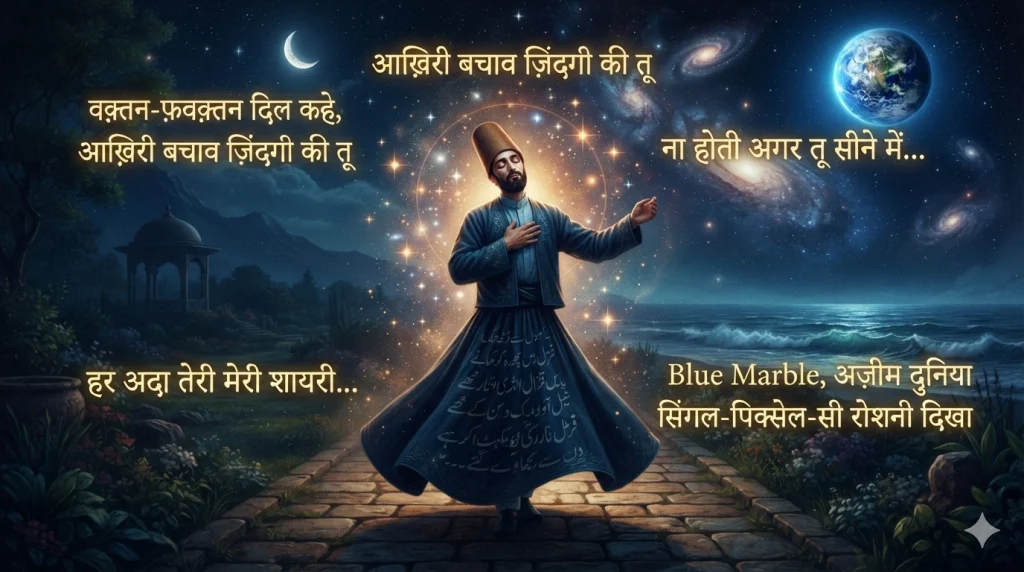
क्वांटम दर्पण काव्यभाव भूमि:
अपने ही अंदर क़ैद हूँ मैं, ये धड़कता हुआ दिल का कहना है वही तो तुम हो। तुम दिल हो, धड़कन भी हो और मोहब्बत भी। तुम्हारा होना मेरा नहीं होना, एक वो जंग है। तुमसे दोस्ती का, तुमसे ही दुश्मनी का। ये कैसी फ़ितरत है, ये कैसी क़िस्मत है। हम तब्दील-ए-दिल से हबीब-ए-आज़म क्यों नहीं?
८१वाँ UNGA का दौर चला। दुनिया भर के दो सौ तीन से ज़्यादा वर्ल्ड लीडर्स दिखे। ट्रम्प और शी जिनपिंग एक बार फिर से मिले। लेकिन दुनिया की वारदात थमने का नाम नहीं ले रही है। विंटर वॉर फिर से यूक्रेन और रूस बढ़ाएँगे। नेपाल में पहाड़ गिर रहे हैं। दरियाओं का बहाव ख़तरे के ऊपर से हो रहा है। लेकिन यहाँ की सरकार जंगी विश्वविद्यालय में निवेश की तैयारी कर रही है। क्या दुनिया का निज़ाम सिर्फ़ जंग से ही क़ायम होगा?
दुनियावी यकता आज क्वांटम कॉन्शियसनेस नेटवर्क टेक्नोलॉजी है। लीडर्स, -isms, डेमोक्रेसी, लिबरलिज्म, जियोपॉलिटिक्स आज देखने में कतई सफल नज़र नहीं आते। क्रिप्टो इकॉनमी ने एक ओर वर्ल्ड डेब्ट बढ़ने का संकेत दिया है, तो दूसरी तरफ़ इसने फ़ाइनेंशियल सॉवरेन्टी की आस भी जगाई है। ज़मीं, जंग और जज़्बात से माज़ी हमें लज्जास्पद तारीख़ दिखाता है।
मिचियो काकू स्ट्रिंग थ्योरी को डिज़ाइन करने वाला ‘गॉड’ हो सकने का अंदेशा व्यक्त करते हैं, और मुस्तक़बिल में हमारे आज के जवान दानिश्वर उस बात को ढूँढ पाएँगे। उधर हर AI सरमायेदार डर पैदा कर रहा है कि दुनिया को AI नीस्त-ओ-नाबूद कर सकता है, तो हमने जंगें क्यों लड़ते रहना है?
“Where are the Pequot today? Where are the Narragansett, the Mohican, Pokanoket, and many other once-powerful tribes of our people? They have vanished before the avarice and the oppressions of the White Man, as snow before a summer sun.
Will we let ourselves be destroyed in our turn without a struggle, give up our homes, our country bequeathed to us by the Great Spirit, the graves of our dead and everything that is dear and sacred to us? I know, you will cry with me, ‘Never, Never!'”
– TECUMSEH OF THE SHAWNEE (From ‘Bury My Heart at Wounded Knee’, by Dee Brown, 1991)
क्या इस वाक़ये को आज के संदर्भ में नज़रअंदाज़ किया जा सकता है?
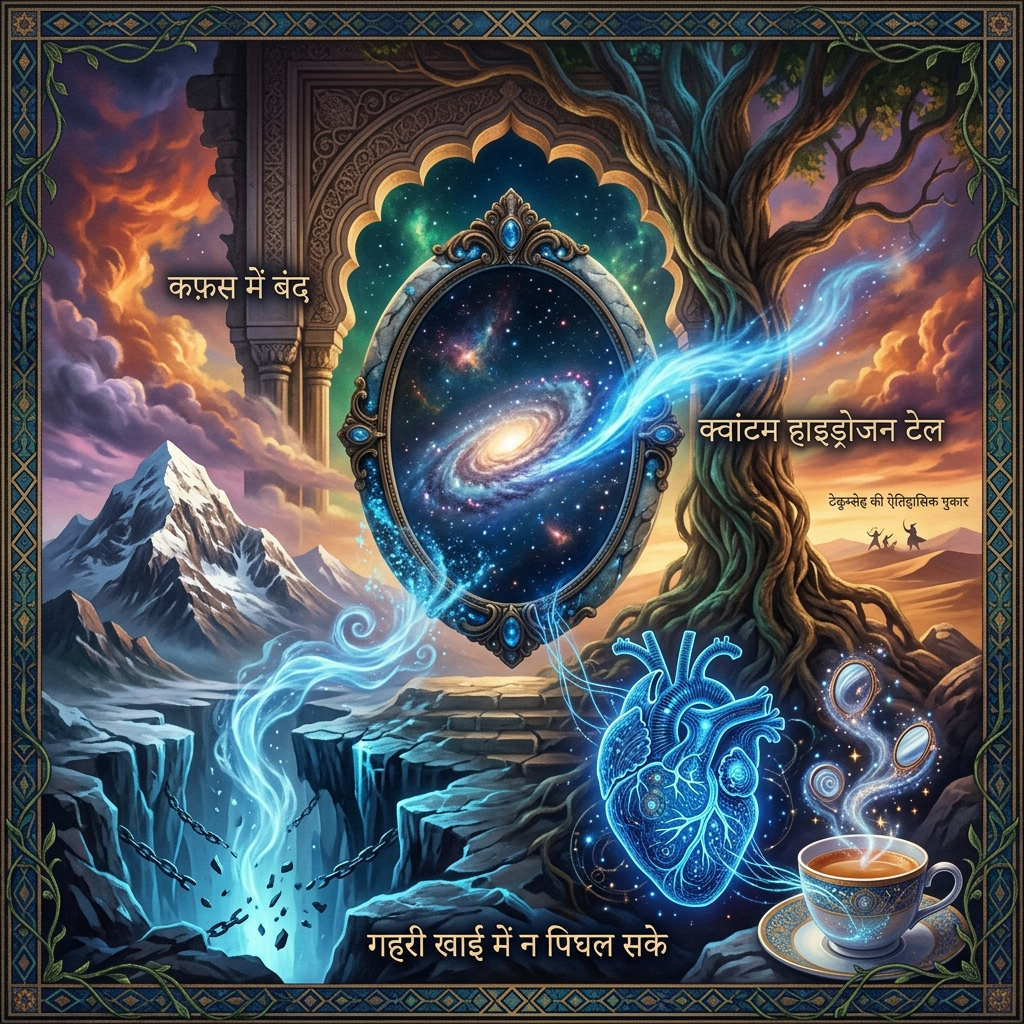
Quantum Sufi Poetics an Informational Continuum: कविता केवल शब्दों का विन्यास नहीं, बल्कि वास्तविकता का एक सूचनात्मक और तात्विक निरंतरता
प्रस्तावना:
क्वांटम दर्पण काव्यभाव भूमि और वैश्विक विमर्श: मानव चेतना जब अपनी अंतरंगता से निकलकर ब्रह्मांडीय फलक पर विस्तार पाती है, तब कविता केवल शब्दों का विन्यास नहीं रह जाती, बल्कि वह वास्तविकता का एक सूचनात्मक और तात्विक निरंतरता (Informational Continuum) बन जाती है।
darpanpoems.com के क्वांटम क्रिटिकल फ़लसफ़े के अंतर्गत प्रस्तुत ग़ज़ल और उसके साथ जुड़ी क्वांटम-मेटा सूफ़ी चेतना इस बात का प्रमाण है कि आंतरिक कश्मकश (‘कफ़स में बंद’) और बाहरी भू-राजनीतिक (Geopolitical) विडंबनाएं मूलतः एक ही ताने-बाने के दो छोर हैं।
जब संयुक्त राष्ट्र संघ (UNGA) के 81वें सत्र के मंच पर दुनिया भर के दो सौ से अधिक राष्ट्राध्यक्षों का जमावड़ा होता है, ट्रम्प और शी जिनपिंग जैसे वैश्विक ध्रुव मिलते हैं, किंतु यूक्रेन-रूस का शीतकालीन युद्ध, नेपाल में प्राकृतिक आपदाओं के बीच ‘जंगी विश्वविद्यालयों’ में निवेश की विडंबनाएं और एआई (AI) सरमायेदारों का अंतहीन भय जारी रहता है,तब यह स्पष्ट हो जाता है कि शास्त्रीय (Classical) राजनीतिक और वैचारिक ढाँचे अपने दिवालियापन की पराकाष्ठा पर हैं।
- अंतर्संबंधों का क्वांटम जाल: कफ़स, चेतना और गैलेक्टिक यथार्थ: ग़ज़ल का यह मिस्र्रा, “क्वांटम हाइड्रोजन टेल न छिपल सके कफ़स में बंद”, कन्या राशि (Virgo Cluster) की गैलेक्सी NGC 4698 के उस अनोखे ब्रह्मांडीय इतिहास से जुड़ता है जिसका केंद्रीय उभार (Bulge) मुख्य डिस्क के लंबवत घूमता है और हाइड्रोजन की पूँछ इसके अशांत अतीत को बयान करती है।
नफ़्सियाती और तात्विक समीक्षा: जिस प्रकार ब्रह्मांडीय शक्तियों और क्वांटम स्तर पर सूचनाओं को किसी पिंजरे या कफ़स में कैद नहीं किया जा सकता, उसी प्रकार मनुष्य की मूल चेतना और ‘अनल-हक़’ (An-al-Haqq) की आवाज़ को कृत्रिम सीमाओं या युद्धों की जंजीरों में नहीं बांधा जा सकता।
फितरत और किस्मत का द्वंद्व: “तुम से दोस्ती का, तुम से ही दुश्मनी का” यह विरोधाभास आज की ग्लोबल लीडरशिप का चरित्र बन चुका है, जहाँ राष्ट्र शांति के मंचों पर गले मिलते हैं और पर्दे के पीछे हथियारों के सौदागर बने रहते हैं।
- टेकुम्सेह की ऐतिहासिक पुकार और आज का संदर्भ: शोनी (Shawnee) कबीले के महान नेता टेकुम्सेह (Tecumseh) ने कभी अमेरिकी गोरे उपनिवेशवादियों के लोभ और दमन के आगे अपनी जातियों (Pequot, Narragansett, Mohican आदि) के पतन को देखते हुए इतिहास को झकझोरने वाला सवाल पूछा था:
“Will we let ourselves be destroyed in our turn without a Struggle, give up our homes… everything that is dear and sacred to us? I know, you will cry with me, ‘Never, Never!'” [दीप ब्राउन, ‘बेरी माई हार्ट एट वूंडेड नी’, 1991]
वर्तमान संदर्भ में प्रासंगिकता: आज के भू-राजनीतिक परिदृश्य में इस वाकये को कतई नजरअंदाज नहीं किया जा सकता। आज केवल मूलनिवासी जनजातियाँ ही नहीं, बल्कि संपूर्ण वैश्विक मानवता जलवायु परिवर्तन, बेलगाम युद्धों और एआई (AI) के आसन्न विनाश के साए में उसी औपनिवेशिक व संहारक लालच का शिकार हो रही है। यदि आज के वर्ल्ड लीडर्स ने अपनी विनाशकारी नीतियों को नहीं बदला, तो संपूर्ण पृथ्वी एक विशाल ‘वूंडेड नी’ (Wounded Knee) में बदल जाएगी।
- क्वांटम कॉन्शियसनेस नेटवर्क टेक्नोलॉजी बनाम ओल्ड-वर्ल्ड -isms: आज की दुनियाबी एकता (Global Unity) न तो पारंपरिक -isms (वादों), न पुरानी डेमोक्रेसी, और न ही लिबरलिज्म या भू-राजनीति के पुराने साँचों से चल सकती है।
क्रिप्टो इकोनॉमी और सॉवरेन्टी: एक तरफ क्रिप्टो अर्थव्यवस्था ने वैश्विक कर्ज (World Debt) के बढ़ने के खतरे को रेखांकित किया है, तो दूसरी तरफ इसने वित्तीय संप्रभुता (Financial Sovereignty) की एक नई उम्मीद भी जगाई है।
मीचिओंकाकु का स्ट्रिंग थ्योरी दर्शन: भौतिकशास्त्री मिचियो काकु (Michio Kaku) द्वारा स्ट्रिंग थ्योरी के माध्यम से ब्रह्मांड के रचयिता या ‘गॉड’ के होने के अंदेशे को व्यक्त किया गया है। मुस्तक़बिल के जवान और दानिश्वरान इसी ब्रह्मांडीय कोड को डिकोड करेंगे। जब विज्ञान और अध्यात्म एक बिंदु पर मिलते हैं, तो यह स्पष्ट होता है कि AI का डर या युद्धों की लिप्सा मनुष्य की अज्ञानता का परिणाम है, न कि उसकी नियति।
- निष्कर्ष: Make Earth Great Forever – End All Wars: इस क्वांटम क्रिटिकल फ़लसफ़े का केंद्रीय निष्कर्ष यह है कि “Nothing Is Not True: No\KNOW Thyself Not” यानी सत्य वही है जो अद्वैत और आत्म-बोध के धरातल पर खरा उतरे।
संयुक्त राष्ट्र (UN) के नीति-निर्माताओं और वैश्विक नेतृत्व को यह समझना होगा कि:
पृथ्वी के पहाड़ और नदियाँ तबाह हो रही हैं, और सरकारें यदि जंगी विश्वविद्यालयों में निवेश करती रहेंगी, तो यह सभ्यता का आत्मघाती कदम होगा।
युद्धों से कभी कोई स्थायी निज़ाम कायम नहीं हो सकता; स्थायी शांति केवल क्वांटम कॉन्शियसनेस नेटवर्क टेक्नोलॉजी और आंतरिक आत्म-साक्षात्कार (आईने की सफाई और चाय के पोशीदा जादू जैसी आत्मीयता) से ही संभव है।
इसलिए, वैश्विक आह्वान यही है: MAKE EARTH GREAT FOREVER: END ALL WARS, युद्धों का अंत ही मानवता का पुनर्जन्म है।
Darpan Poems
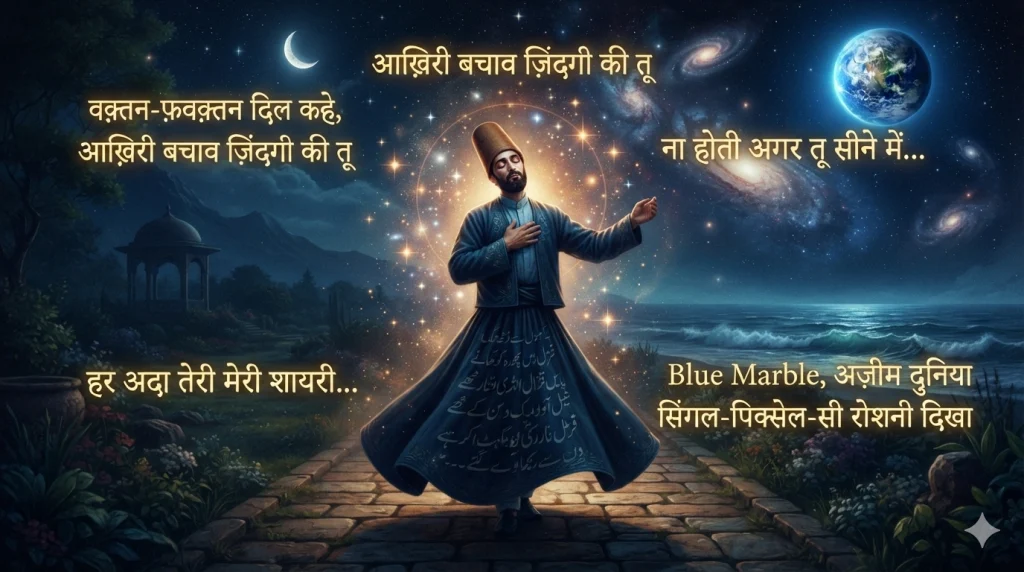
Ghazal
Though 'tis my heart, this bounded heart yields not to prison's frame,
The rights of self, though bound in chains, refuse to die in shame.
           A mountain high of noble love we built against the sky;
           In caverns deep, tis frozen stone; no fire shall melt its name.
I mark no truth in all that turns where shadows haunt the floor;
Though foes and friends now blend as one, no key unlocks this game.
           I know not when the storm shall cease of evil versus good;
           The pageant's bright and festive hues remain a shadowed claim.
Though life be forged in fields of war, in thee I find my peace;
Though sabres clash and fetters fall, no chain can hold this flame.
           No veil can hide the quantum tail that trails across the night;
           The secrets of the cosmic word no cage can ever tame.
A secret magic touched the tea thy gentle hand poured forth;
The glass shines clear, no transient mist can put my sight to shame.
Exegesis: Literature, Psychological Philosophy, and the Cosmic Paradigm
Psychological Conflict and the Inviolable Self (The Matla): The opening couplet presents the fundamental conflict between external constraint and internal sovereignty. Psychologically, while human consciousness may be physically or socially confined within a “cage” (qafas), the core agency of the individual, the innate right of selfhood (huqūq-e-zāt), refuses to assimilate into subjugation. Confinement does not erase human dignity; rather, it intensifies the psychological tension between imposed boundaries and inner freedom.
The Philosophy of Love and the Fall from Elevation: The second couplet explores the vulnerability of grand ideals. Love, constructed as an imposing mountain of emotional and philosophical magnitude, faces the threat of dissolution when cast into the abysses of circumstance. Confinement attempts to erode noble aspirations, yet the poet asserts that the fundamental essence of true love resists complete destruction, even when cast down into dark valleys.
Social Psychology, Hypocrisy, and Alienation: The third couplet addresses the unsettling nature of social betrayal and moral ambiguity. In times of severe restriction or crisis, the boundaries between friend and foe blur into deceptive collusions. The psychological impact of witnessing such pervasive hypocrisy creates profound existential alienation, making escape from the mental cage all the more difficult.
Dualism and the Obscured Consciousness: The fourth couplet reflects on the eternal moral storm, the cosmic and psychological struggle between good and evil (neki-o-badī). In a world consumed by superficial distractions and grand spectacles (“the festive fair”), the incarcerated or traumatized consciousness remains unable to participate. The external world’s superficial beauty fails to penetrate the deep gloom of systemic or internal captivity.
Existential Struggle and the Sanctuary of the Beloved: The fifth couplet contrasts the chaos of human existence, conceived as a continuous battlefield (maidān-e-jang), with the serene presence of the beloved. While swords clash and external chains attempt to bind the human spirit, authentic connection and mental tranquillity provide an unyielding fortress that no physical force or tyranny can break.
The Cosmic Paradigm and Quantum Reality: The sixth couplet integrates astrophysicophysics with philosophical inquiry. Drawing inspiration from galactic phenomena, such as the Virgo Cluster’s NGC 4698 and its unique perpendicular core and hydrogen tail, the verse posits that cosmic truths and quantum reality transcend localised human confinement. The secrets of existence (Rāz-e-Kun-Fayakān) and fundamental physical laws cannot be restricted by mortal boundaries or ideological dogmas.
Perception, Awakening, and Self-Realization (The Makhta): The concluding couplet brings the journey back to intimacy and heightened perception. The “hidden magic” in the tea symbolises an awakening, a subtle, transformative experience that clears the mist from the mirror of the mind (darpān). Self-realisation and clarity of vision allow the individual to achieve inner liberation and truth, proving that true freedom resides within enlightened consciousness, regardless of external confinement.
Conclusion: This ghazal bridges human consciousness, social conflict, and the broader cosmic order. Its central thesis asserts that while physical and political structures frequently attempt to constrain human potential through war, betrayal, or systemic oppression, the combination of love, self-knowledge, and universal truth remains fundamentally uncontainable. True liberation is achieved not merely by breaking physical bars, but by clearing the mirror of the mind to perceive the interconnectedness of all existence.
Quantum Darpan Poetic Consciousness Description
I am imprisoned within my own self; this throbbing heart insists that you are that very essence. You are the heart, the heartbeat, and love itself. Your existence versus my non-existence, that is the conflict. A feud born of you, an enmity with you alone. What kind of nature is this? What sort of destiny? Why can we not, through a transformation of the heart, become the Ultimate Beloved (Habib-e-Azam)?
The 81st UNGA session unfolded, bringing together over two hundred and three world leaders. Trump and Xi Jinping met once again, yet the turmoil of the world shows no sign of ceasing. Winter war threatens to intensify between Ukraine and Russia once more. In Nepal, mountains are collapsing, and rivers surge above dangerous thresholds. Yet the government here prepares to invest in a defence-focused military university. Must the order of the world be sustained through war alone?
Global unity today lies in Quantum Consciousness Network Technology. World leaders, political ‘-isms’, democracy, liberalism, and geopolitics appear wholly inadequate today. The crypto economy signals a rising global debt on one hand, while igniting hopes for financial sovereignty on the other.
History, steeped in territory, warfare, and volatile emotion, exhibits a shameful past. Michio Kaku suggests that the designer behind String Theory might be ‘God’, a truth that the young intellectuals of our future will ultimately uncover. Meanwhile, AI capitalists cultivate fear that artificial intelligence could annihilate humanity, so why do we continue to fight wars?
“Where are the Pequot today? Where are the Narragansett, the Mohican, Pokanoket, and many other once-powerful tribes of our people? They have vanished before the avarice and the oppressions of the White Man, as snow before a summer sun.
Will we let ourselves be destroyed in our turn without a struggle, give up our homes, our country bequeathed to us by the Great Spirit, the graves of our dead and everything that is dear and sacred to us? I know, you will cry with me, ‘Never, Never!'”
- TECUMSEH OF THE SHAWNEE (From ‘Bury My Heart at Wounded Knee’, by Dee Brown, 1991)
Can this historic testament be ignored in today’s context?
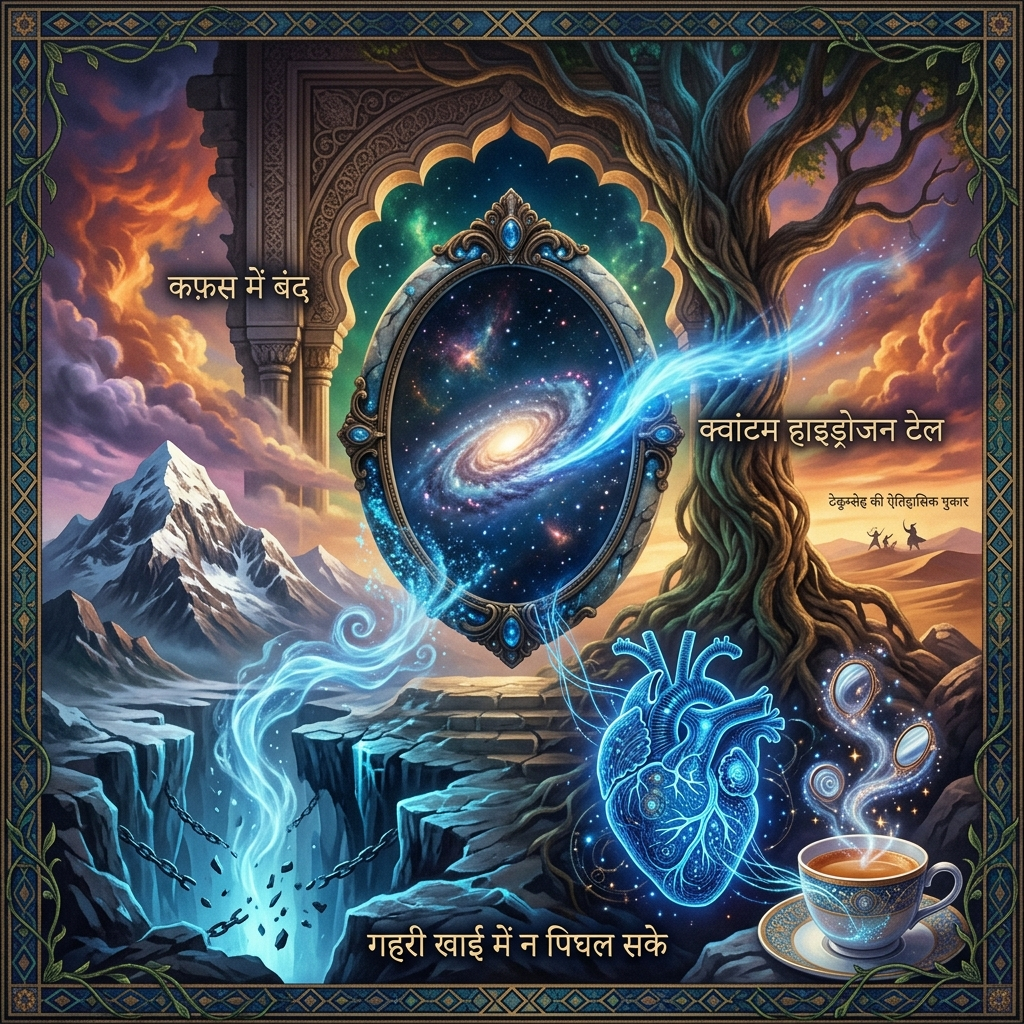
Quantum Sufi Poetics an Informational Continuum – A Quantum-Critical Philosophical Treatise on Global Governance, Existential Risk, and the Paradigm Shift in Universal Consciousness: MAKE EARTH GREAT FOREVER: END ALL WARS – NOTHING IS NOT TRUE: NO\KNOW THYSELF NOT
Abstract: This research essay formulates a Quantum-Critical Philosophical Framework designed to interrogate contemporary failure modes in international relations, anthropocentric geopolitics, and socio-technological paradigms.
Grounded in the Darpan-Quantum hermeneutic, this discourse synthesises classical Urdu ghazal poetics (Kafas, the cage motif), astrophysics (the Virgo Cluster galaxy NGC 4698 and its perpendicular nuclear kinematic decoupling), string theory, and Indigenous anti-imperialist resistance (Tecumseh’s 1811 Shawnee oration) into a unified critique of the contemporary global order.
Through an evaluation of the 81st Session of the United Nations General Assembly (UNGA 81), the escalating militarisation amidst ecological degradation in fragile ecosystems like the Himalayas, the systemic destabilisation of the sovereign debt-crypto duality, and the existential risk horizon of Artificial General Intelligence (AGI), this treatise argues that institutionalised “-isms”, liberal democracy, realpolitik, and market capitalism have reached an irredeemable epistemological dead end.
A sustainable global equilibrium can only be achieved by replacing zero-sum classical geopolitics with a Quantum Consciousness Network Paradigm rooted in non-dual self-knowledge (Know\No Thyself Not).
- Epistemological Grounding: The Poetic Hermeneutics of Constraint and Cosmic Transcendence: The fundamental paradox of human existence lies in the friction between localised physical/existential captivity (Kafas में बंद) and the unconstrained, non-local nature of consciousness. Within the Darpan-Quantum poetic tradition, the self exists simultaneously as an isolated subjective node and an indivisible component of the cosmic continuum.

This verse serves as a metaphor for the astrophysical phenomenon observed in galaxy NGC 4698, situated within the Virgo Cluster. NGC 4698 exhibits a structurally decoupled core where its central bulge rotates orthogonally to its extended disk, accompanied by an extended ram-pressure-stripped neutral hydrogen (HI) tail. Astrophysically, this structural anomaly demonstrates that chaotic merger histories leave immutable cosmic signatures that cannot be suppressed by localised gravitational constraints.
Philosophically and psychologically, this serves as an ontological parallel to human agency and the Ayn-al-Haqq (Self-as-Truth): individual consciousness (Huquq-e-Zāt) cannot be permanently coerced, erased, or compartmentalised by authoritarian governance, militarised borders, or technological containment. When geopolitical frameworks treat human beings as discrete, quantifiable targets of control rather than entangled nodes within a universal consciousness, they commit a fundamental category error derived from outdated classical Newtonian determinism.
- Geopolitical Pathology at UNGA 81: Institutional Failure and the Himalayan Paradox: The proceedings of the 81st United Nations General Assembly highlight the structural impotence of contemporary multilateral diplomacy. While over two hundred world leaders assemble under the banner of global consensus, punctuated by bilateral summits between dominant hegemonies such as the United States and China, the structural mechanics of global conflict remain uninterrupted.
A. The Perpetuation of Kinetic and Attritional Warfare: The continuation of violent conflicts, such as the protracted winter campaigns in the Russo-Ukrainian theatre, the ongoing destruction in the Levant, and proxy friction across the Indo-Pacific, exposes the bankruptcy of conventional deterrence theory. Classical geopolitics operates under the delusion that stability is an emergent property of balanced violence (Si vis pacem, para bellum).
B. The Ecological-Militaristic Disconnect (The Himalayan Case Study): A stark manifestation of this systemic pathology is visible in climate-vulnerable nations such as Nepal. As severe geomorphological disruptions, landslides, glacial lake outburst floods (GLOFs), and catastrophic river swellings threaten the fragile socio-ecological infrastructure of the Himalayas, state capital allocation remains perverse.
Instead of prioritising ecological resilience, climate adaptation, and community-level disaster mitigation, state apparatuses channel capital into military-industrial complexes and security institutions (e.g., funding defence-centric military universities). This represents a profound misalignment of state priority: investing in the instruments of human destruction while the immediate biophysical foundation of the state collapses due to ecological neglect.
| Sphere | Classical Geopolitical Paradigm | Quantum Consciousness Network Paradigm |
| Ontology | Atomised Nation-States / Zero-Sum Realism | Entangled Universal Nodes / Interdependent Reality |
| Security Mechanism | Kinetic Deterrence, Militarisation, Alliances | Non-Dual Co-Prosperity, Ecological Stewardship |
| Economic Basis | Sovereign Debt Manipulation, Resource Extraction | Sovereign Decentralization, Value-Aligned Allocation |
| Resolution Strategy | Permanent Attritional Conflict, Hegemonic Dominance | Radical Self-Knowledge (Know Thyself), End of Wars |
- Historical Continuity of Erasure: Tecumseh’s Oration and Modern Structural Colonialism: The ongoing systemic destruction of marginalised ecosystems and populations is not a novel anomaly; it is the logical continuation of colonial expansionism and capital accumulation. In 1811, Tecumseh, the Shawnee military leader and statesman, addressed the Choctaw and Chickasaw nations with an urgent warning regarding systemic erasure:
“Where are the Pequot today? Where are the Narragansett, the Mohican, Pokanoket, and many other once-powerful tribes of our people? They have vanished before the avarice and the oppressions of the White Man, as snow before a summer sun. Will we let ourselves be destroyed in our turn without a struggle… I know, you will cry with me, ‘Never, Never!'”
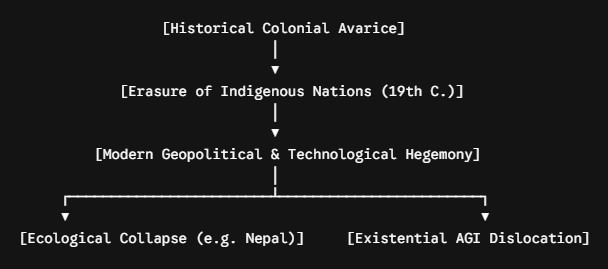
When evaluated through the Quantum-Critical lens, Tecumseh’s indictment transcends its 19th-century historical frame and becomes an existential warning for contemporary civilisation:
The Mechanism of Avarice: The same unchecked imperial expansion that systematically depopulated Indigenous North American nations now operates under the guises of neoliberal resource extraction, hyper-financialization, and corporate AI monopolies.
Universal Threat: Colonial erasure has scaled up. It no longer targets isolated tribes alone; it now threatens the entire human species with existential dislocation, either through catastrophic climate tipping points or unconstrained artificial general intelligence. To ignore Tecumseh’s warning today is to accept the eventual self-annihilation of humanity.
- Technological Dualities: String Theory, Financial Sovereignty, and the AI Existential Threat: A. Theoretical Physics and the Transcendental Code: In modern theoretical physics, formulations such as Michio Kaku’s String Field Theory hypothesise that the fundamental constituents of reality are not point-like particles, but vibrating one-dimensional strings operating across hyperspatial dimensions. Kaku’s reflection that the mathematical harmony governing string vibrations implies a cosmic “mind” or an underlying design matrix bridges the gap between quantum physics and non-dual philosophy.
The upcoming generation of researchers and thinkers must operationalise this realisation: if the substrate of reality is unified, multi-dimensional information, then kinetic warfare between artificially demarcated geographic states is an absurd violation of fundamental physical laws.
B. Crypto-Economy and Sovereign Debt: The global financial architecture presents a profound paradox: The Debt Trap: Sovereign debt has reached unsustainable, predatory levels, enslaving developing nations within cycles of austerity and resource extraction.
The Sovereign Alternative: Simultaneously, decentralised cryptographic technologies (Crypto-Economy) offer a mathematical mechanism to bypass centralised fiat coercion, enabling individual and community financial sovereignty.
C. Artificial Intelligence and Existential Risk: Concurrently, techno-capitalist elites disseminate a narrative of impending doom, warning that unaligned Artificial General Intelligence (AGI) poses an existential risk capable of eradicating humanity.
Yet, the hypocritical irony remains self-evident: state actors and corporate monopolies express existential dread over future autonomous AI systems, while actively funding and deploying autonomous weapons, drone swarms, and kinetic war machines in the present. The immediate threat to humanity is not an artificial consciousness; it is the unaligned, predatory consciousness of human leadership.
- Conclusion: The Quantum Critical Imperative: MAKE EARTH GREAT FOREVER – The ultimate thesis of darpanpoems.com and this Quantum Critical Research Report is summarised in the non-dual imperative:
\bfseriesNOTHING IS NOT TRUE: NO\KNOWTHYSELF NOT
Key Policy and Philosophical Directives for UN & Global Leadership:
Immediate Cessation of Kinetic Warfare: Global security frameworks must transition away from realpolitik and militarised defence budgets toward absolute disarmament. Human and financial capital must be urgently reallocated from military universities to climate resilience, planetary restoration, and universal basic well-being.
Transition to Quantum Consciousness Networks: Diplomatic engagement must evolve beyond outdated political “-isms” (capitalism, liberalism, state-nationalism). Global governance must recognise the entangled nature of human ecological survival, utilising transparent, decentralised cryptographic systems to guarantee equity and financial sovereignty.
Internal Liberation (Know Thyself): True peace cannot be constructed externally through treaties signed by conflicted minds. As expressed in the concluding couplet of the ghazal, where a subtle, transformative awakening clears the mirror of perception (darpān) global leadership must undergo an epistemic revolution. Until humanity confronts its internal fragmentation, external cages will continue to multiply.
To secure a future for coming generations, the global community must heed the ancient warnings of history and the objective truths of quantum reality: End all wars, dismantle the cages of illusion, and achieve radical self-knowledge to Make Earth Great Forever.