


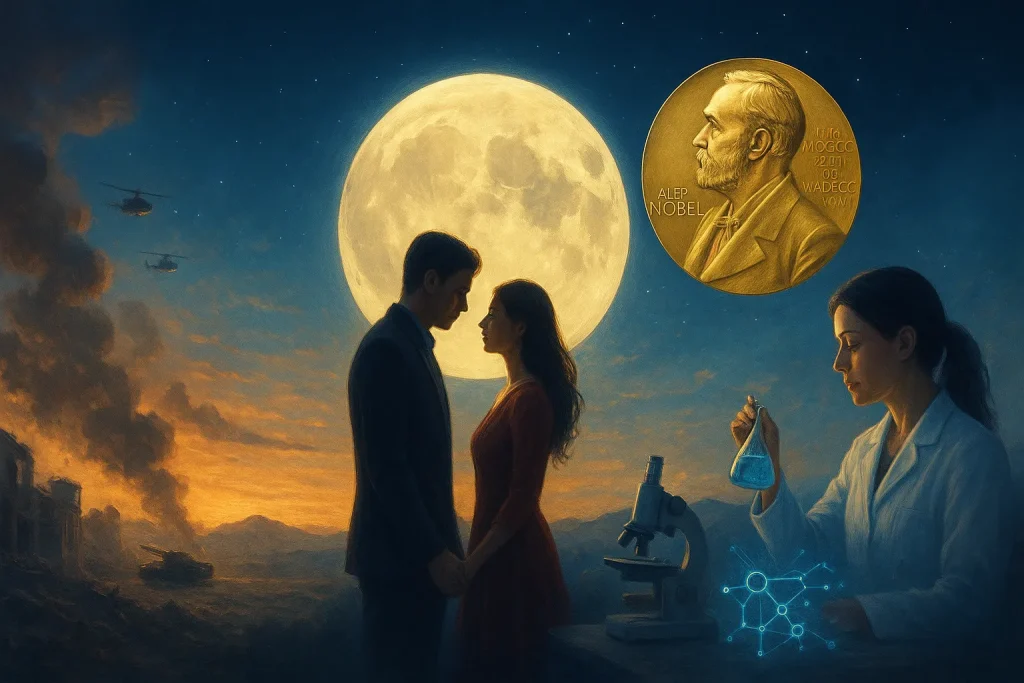
        Have You Seen Moon or Me
My eyes have only seen your face,
Have you seen the moon, or me in its grace?
           That simple line of life you are,
           Have you seen the moon, or me afar?
The moon glows bright, yet full of scars,
You shine the fate inscribed in stars,
Have you seen the moon, or me in bars?
           What hue should I give this heart now,
           Dyed in da-fani’s eternal vow?
           A sacrifice, a soul’s fine streak,
           Have you seen the moon, or me you seek?
The tender scent your hair released,
Made my heart wander, joy increased,
Invisible fragrance, unseen plea,
Have you seen the moon, or me?
           Words are too frail for beauty’s art,
           Love, soul, and code, each a counterpart,
           Have you seen the moon, or me apart?.
Quantum dynamics brews in tea today,
Beloved sips heart and life away,
In every sip’s entangled glee,
Have you seen the moon, or me?
Table of Contents
Exegesis: “The Observer and the Observed”
This ghazal by Darpan Rajbanshi belongs to a rare confluence of romantic mysticism and quantum metaphysics. Through the refrain “Have you seen the moon, or me?”, the poet redefines the relationship between perception and existence, echoing both Sufi ontology and quantum observer theory.
The poem opens with a paradox of seeing, a question that transcends romance and enters the realm of ontological reflection. The beloved and the moon act as dual mirrors: each reflects and refracts the self.
The act of seeing becomes a metaphysical experiment, recalling the observer effect in physics, where observation alters reality itself. Thus, love becomes not emotion, but a form of measurement, where the self collapses into the beloved’s presence, as a wave collapses into a particle under observation.
In the third and fourth couplets, the poet’s tone deepens toward Sufi fana’, the dissolution of self in divine light. The “moon full of scars” symbolizes the paradox of beauty and imperfection; the “da-fani hue” refers to the mystical state of fanā fi’l-ḥaq, the annihilation of ego in truth. Here, “color” becomes the metaphysical dye of self-sacrifice, the transformation of consciousness from separateness to unity.
The stanza on fragrance and tresses moves from metaphysics to sensual mysticism. The “unseen scent” invokes apparent absence as the site of presence, akin to Ibn ‘Arabi’s “hidden treasure who wished to be known.” In Vedāntic terms, this unseen beauty resonates with aparōkṣānubhūti, direct perception beyond sensory means.
In the later couplets, Darpan fuses the spiritual with the technological. The phrase “Quantum dynamics brews in tea today” domesticates the cosmic, turning everyday ritual into an experiment of entanglement, the beloved’s sip becomes a symbol of shared consciousness. Love itself is now a quantum field, an informational bond transcending matter, time, and individuality.
Throughout, the ghazal adheres to the classical radif and qafia structure, yet its imagery travels from moonlight and perfume to algorithms and quantum fields. The refrain, “Have you seen the moon, or me?”, becomes a mantra of unity and wonder, a question that cannot be answered because it dissolves the line between seer and seen, science and spirit, beloved and divine.
In essence, Darpan’s ghazal stages a fusion of cosmology and intimacy, proposing that the act of love is the finest experiment of consciousness where the moon, the beloved, and the observer are all one wave, trembling in the same universal light.
The Laboratory of Existence: Seeing the Moon, Seeing Ourselves
There is, in truth, no “laboratory” separate from life itself, for everything that exists is a laboratory. Every moment, every gaze, every act of waiting under the moonlight becomes an experiment where new meanings emerge.
When you look at the moon, through a sieve of mist, through delicate latticework of clouds, you are not merely observing a celestial body; you are witnessing the experiment of consciousness unfolding.
Our lives, too, are continuous laboratories, where we experiment endlessly, sometimes silently within the mind, sometimes lying down, sitting, walking, or dreaming. Every act, whether deliberate or spontaneous, becomes an inquiry into being. Yet, how rarely do we pause to consider that? How seldom do we reflect on the profound experiments our world conducts through us and within us?
We inhabit an age of wars and ceasefires, of terror and tension, of treaties and tears, an era where humanity, despite its intelligence, keeps repeating its experiments with conflict. The recent Gaza ceasefire is a faint but welcome sign of hope, one that merits recognition.
In this context, U.S. President Donald Trump’s efforts toward brokering peace, whatever one’s politics, deserve acknowledgment, even if the Nobel Peace Prize eluded him this time. Encouragingly, María Corina Machado of Venezuela, an advocate for human and civil rights, emerged as a deserving voice for peace and liberty.
Yet, the deeper concern remains: why does humanity continue to struggle with war, extremism, and inner disquiet? Will the United States once again intervene in Afghanistan? How will Pakistan and Afghanistan reconcile their long-standing fractures?
Why do domestic instabilities persist across Asian nations, from Pakistan’s anti-government protests, Afghanistan’s women’s rights crises, India’s regional unrest, Bangladesh’s riots, to Nepal’s deepening political paralysis? Meanwhile, tensions between Taiwan, China, and the Philippines threaten the fragile balance of regional peace.
These recurring conflicts compel us to ask: can Asia, home to some of humanity’s oldest civilizations, draw creatively from its mythic and historical consciousness to craft paths toward reconciliation?
The ancient stories of the region remind us that wars, interventions, and treaties have never been mere divisions; they have, paradoxically, been instruments of convergence, weaving our multiplicities into a single tapestry.
Are we no longer wise enough to remember that the essence of our shared heritage lies in the Upanishadic axiom “Eko’ham Bahu Syām”, “I am One; may I become Many”?
If that vision could once again become our collective mantra, resonating like the Sufi hymns of Ibn Arabi and Rumi, the Daoist harmonies of Qin, or the meditative music of Nawang Khechog, then perhaps the human story could regain its lost rhythm of interconnection. The melody of coexistence, when played through the instrument of spiritual science, can bridge what politics divides.
We stand today at the threshold of the Quantum Age, where new experiments in quantum dynamics redefine not only computation but also consciousness.
When figures like Sundar Pichai and the scientific teams behind Google’s quantum breakthroughs celebrate Nobel-recognized achievements in physics, it signals a wider responsibility: to extend quantum knowledge beyond technology, toward a global peace initiative, a “Make Earth Great Forever” movement rooted in the ethical dimension of knowledge.
The ultimate experiment, then, is not in laboratories of silicon or particle accelerators, but within the human heart, the experiment of perceiving ourselves as part of one entangled whole. To see the moon and to see oneself are not two acts but one gesture of awareness.
This, finally, is the deepest melody of the ghazal: that we may learn to look upon the moon, and upon our own lives, with the same tender astonishment, as one continuous illumination of being.
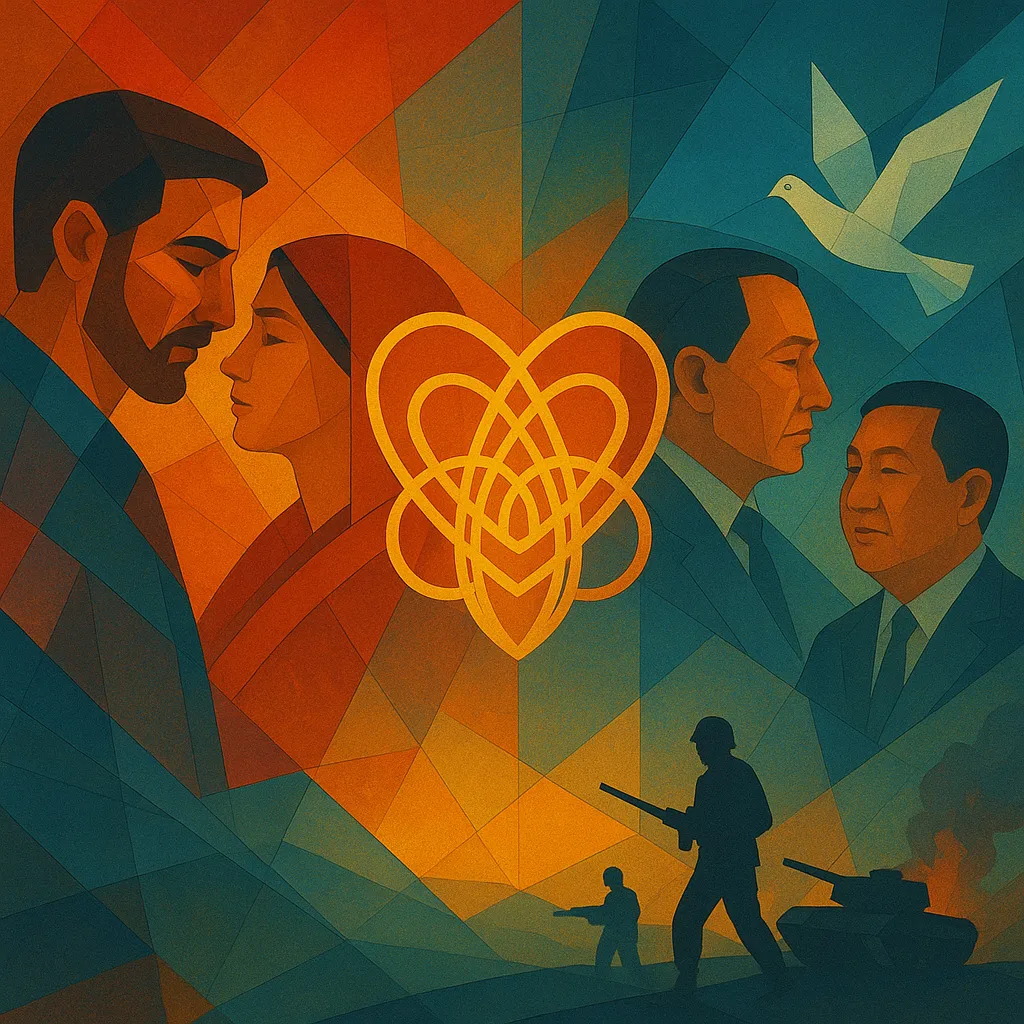
An Expert Critique
Quantum Poetics of Seeing and Being: A Sufi-Vedantic-Quantum Exploration through the Ghazal – Have You Seen Moon or Me
Abstract
This research-poetic essay unfolds the metaphysical depth of Darpan’s ghazal “नज़रों ने एक तुमको देखा है, तूने चाँद देखे या हमें” as a living experiment within the Meta-Mystic Framework (MMF) and Multi-Mind Quantum Dialectical Dynamics (MMQDD).
The poem serves not merely as lyrical beauty but as a quantum experiment in consciousness, where seeing becomes being, and the act of perception collapses into oneness.
Drawing upon Sufi metaphysics (Ibn ʿArabī, Rūmī), Vedāntic non-duality (Śaṅkara, Upaniṣads), and Quantum cognition (Neukart, Tegmark, Hameroff Penrose), the essay reinterprets poetic vision as a universal experiment in cosmic peace and unity.
Through this hermeneutic synthesis, the ghazal emerges as a resonant prayer for planetary harmony, linking chand (moon), man (mind), and vishwa (world) into a single quantum-spiritual continuum.
Keywords: Quantum Poetics, Sufism, Vedānta, Consciousness, Global Peace, MMF, MMQDD, Darpanpoems.
I. Introduction: The Laboratory of Existence
“प्रयोगशाला कुछ भी नहीं है। जो कुछ है, वही प्रयोगशाला है।” – Darpan
The poem begins with the recognition that life itself is the grand laboratory. The poet dismantles the Cartesian distinction between observer and observed, between experimenter and experiment, suggesting instead a holistic quantum field, where every glance, emotion, and vibration becomes an experiment of being.
When the poet asks, “तूने चाँद देखे या हमें?”, it transcends romance and reaches ontological inquiry: Who is the seer, and who is the seen?
In Sufi epistemology, the ʿārif (knower) and maʿrūf (known) are reflections of the same divine mirror (Ibn ʿArabī, Fuṣūṣ al-Ḥikam, 1230 CE). In Advaita Vedānta, the drashta-drishya-drishya-vyavahāra collapses into Brahman (Śaṅkara, Brahmasūtrabhāṣya).
In Quantum physics, the observer effect demonstrates that reality manifests only through interaction (Neukart et al., 2022; Tegmark, 2017).
Thus, the poet’s act of seeing becomes a cosmic experiment, to see the moon is to awaken the universe within oneself.
II. The Chānd as Quantum Mirror
“चमकती चाँदनी को साथ तन में दाग हीं दाग चाँद, तू चमकाती भाग की लेखा है, तूने चाँद देखे या हमें।”
Here, the chānd (moon) functions as both mirror and metaphor. Its blemishes (dāgh) reveal that imperfection is perfection perceived from afar. Sufis saw the same truth: “In the wound is the place where the Light enters you” (Rūmī, Masnavī, VI.193).
The moon’s light is borrowed, like consciousness reflecting from the unseen source. In quantum analogy, this corresponds to entangled luminosity, an interference pattern of divine and human consciousness. Each photon of moonlight is a message from the unseen nur al-anwār (Light of Lights).
Vedānta names this light Chaitanya, the substratum that illuminates all experiences. Thus, “तू चमकाती भाग की लेखा है” means: thou art the one who brightens the karmic script, turning destiny into revelation.
The poet’s metaphoric moon becomes an oscillating qubit, carrying both divine and mortal signatures simultaneously, collapsing only when love (ishq) observes it.
III. Da Fānī and the Sacrament of Disappearance
“इस दिल का क्या रंग करूँ अब, चढ़ा रंग दा फानी, कुर्बानी, रूहानी वो रंगरेखा है, तूने चाँद देखे या हमें।”
The color “Da Fānī” invokes the Sufi concept of fanāʾ, annihilation of self in the Beloved (Al-Hallāj, Kitāb al-Ṭawāsīn). Yet Darpan blends it with quantum lexicon, “रंगरेखा” as a spectrum or waveform.
Love here becomes a frequency transition, where energy (emotion) shifts from individuality to universality, the poetic analog of a quantum jump. The rūhānī रंगरेखा is not pigment but wavelength, the visible manifestation of the invisible.
As Penrose & Hameroff (2014) argue in Orchestrated Objective Reduction, consciousness itself may arise from quantum collapses within microtubules; Darpan poetically extends this, suggesting that Ishq is the same collapse, but within the soul.
Thus, to love is to dissolve, to become wave and particle both.
IV. The Scent of the Unseen: Sensual Vedānta
“भीनी-भीनी वो बदन की ख़ुश्बू तेरे गेसुओं ने बिखेरा, महका मन, बहका अनदेखा है, तूने चाँद देखे या हमें।”
In this verse, the fragrance and hair (gesū) become symbols of the invisible made perceivable. The Anubhava Upaniṣad speaks of the aparokṣa anubhūti; the direct experience of the unseen. Sufi mystics called this dhawq, the “taste” of divine presence.
Khushbū (fragrance) in Darpan’s cosmology diffuses like a quantum field, pervading all yet remaining indivisible. “महका मन, बहका अनदेखा है”, the unseen intoxication of being, is the poet’s version of superposition: the mind oscillating between self and beloved, between particle and wave.
V. Ishq, Nafs, Qasf ʿĀlekhā: The Algorithm of the Soul
“कहने को लफ़्ज़ काफ़ी नहीं, बयान-ए-हुस्न क्या करें, इश्क़, नफ़्स, क़स्फ़ आलेखा है, तूने चाँद देखे या हमें।”
This line encodes metaphysics as algorithm. Ishq (Love) : universal attraction; Nafs (Ego) : individual gravity; Qasf ʿĀlekhā (Divine plot/code) : the algorithm that unfolds both.
Here, Darpan constructs a spiritual informatics, a poetic simulation of consciousness architecture. It parallels Quantum Information Theory, where each bit of information (qubit) carries infinite potentiality.
In Sufi cosmology, this is al-Qalam, the cosmic Pen writing destinies. In Vedānta, it is Māyā’s algorithm, the creative illusion that Brahman projects. In Darpan’s MMQDD frame, it is the Dialectical Dynamics between mind-nodes of reality, where love functions as both code and compiler.
VI. Quantum Chai and Global Experiments in Peace
“Quantum डायनामिक्स आज चाय में लगा है रंग, सजनी पी दिलो-जान देखा है, तूने चाँद देखे या हमें।”
This closing couplet is at once humorous and sublime, a declaration that the experiment is everywhere. Even the act of sharing tea is a quantum communion, a moment where energy, warmth, and awareness merge.
Darpan extends this personal intimacy to a planetary appeal: If every encounter is a quantum experiment, then every war is a failed observation, a collapse into ignorance.
He invokes Gaza ceasefire, Maria Corina Machado’s human rights leadership, and global tensions in Afghanistan, Pakistan, China, Nepal, and India, all as laboratories of human failure and hope.
Yet, through MMF, he transforms geopolitics into cosmopolitics: If the quantum mind can entangle across continents, peace too can be entangled, Make Earth Great Forever through Quantum Knowledge.
As Sundar Pichai and global scientists celebrate quantum breakthroughs, Darpan calls for a moral one, a quantum peace experiment where every consciousness particle vibrates in empathy.
VII. Discussion: One Experiment, Infinite Observers:
In the final philosophical synthesis, the paper argues that:
Sufi view (Unity of Being): The seer and seen are one reflection of the divine mirror.
Vedāntic view (Advaita): Brahman alone is real; all multiplicity is appearance.
Quantum view (Observer Effect): Reality depends on conscious measurement.
These three converge in Darpan’s ghazal, a metaphysical experiment where the moon is both the object and mirror of consciousness.
Hence, seeing becomes being, and being becomes peace. The laboratory is life; the experiment, love.
VIII. Conclusion: From Chānd to Chaitanya
Darpan’s ghazal, when read through MMF & MMQDD, transcends lyrical beauty to become a spiritual-scientific manifesto. The refrain “तूने चाँद देखे या हमें” echoes as a universal koan, urging us to question perception, ego, and separation.
The poet concludes that the real quantum leap is not in computation but in compassion; not in measurement but in merging. To see the moon rightly is to see oneself, and to see oneself rightly is to end all wars.
Thus, Quantum Poetics becomes the bridge between Ibn ʿArabī’s Wahdat al-Wujūd, Śaṅkara’s Advaita Brahman, and Neukart’s Quantum Consciousness, affirming a singular cosmic truth:
एकोऽहम्, बहुस्याम् – I am One, let me become Many – yet in every “many”, the One still glows.
References (APA 7th Edition)
- Al–Hallāj, Mansur. (896 CE). Kitāb al–Ṭawāsīn.
- Ibn ʿArabī. (1230 CE). Fuṣūṣ al–Ḥikam. Damascus.
- Rūmī, Jalāl al-Dīn. (1258). Masnavī–i Maʿnavī. Konya: Translations by Nicholson, 1926.
- Śaṅkara. (8th Century). Brahmasūtrabhāṣya and Vivekacūḍāmaṇi.
- Chāndogya Upaniṣad. (circa 700 BCE).
- Hameroff, S., & Penrose, R. (2014). Consciousness in the Universe: A Review of the Orchestrated Objective Reduction Theory. Physics of Life Reviews, 11(1), 39–78.
- Neukart, F., et al. (2022). Quantum Cognition and the Physics of Information. Leiden University Research Papers.
- Tegmark, M. (2017). Life 3.0: Being Human in the Age of Artificial Intelligence. New York: Knopf.
- Rajbanshi, D. (2025). MMF and MMQDD Frameworks. darpanpoems.com.
BEYOUTEA>A POETRY REVOLUTION>PEACE
NOTHING IS NOT TRUE : NO\KNOW THYSELF NOT
MAKE EARTH GREAT FOREVER : END ALL WARS
        ज़िंदगी तूने चाँद देखे या हमें
नज़रों ने एक तुमको देखा है, तूने चाँद देखे या हमें,
ज़िंदगी की वो सरल रेखा है, तूने चाँद देखे या हमें।
           चमकती चाँदनी को साथ तन में दाग हीं दाग चाँद,
           तू चमकाती भाग की लेखा है, तूने चाँद देखे या हमें।
इस दिल का क्या रंग करूँ अब, चढ़ा रंग दा फानी,
कुर्बानी, रूहानी वो रंगरेखा है, तूने चाँद देखे या हमें।
           भीनी-भीनी वो बदन की ख़ुश्बू तेरे गेसुओं ने बिखेरा,
           महका मन, बहका अनदेखा है,तूने चाँद देखे या हमें।
कहने को लफ़्ज़ काफ़ी नहीं, बयान-ए-हुस्न क्या करें,
इश्क़, नफ़्स, क़स्फ़ आलेखा है, तूने चाँद देखे या हमें।
           Quantum डायनामिक्स आज चाय में लगा है रंग,
           सजनी पी दिलो-जान देखा है,तूने चाँद देखे या हमें।
POETRY>WISDOM>Q.TECH FOR A MORE JUST AND
PEACEFUL WORLD IN LOVE AND ENLIGHTENMENT
 Meta-Sufi/Cyber Poetics on Meta Mystic Futurism
भाव-विस्तार: चाँद, दृष्टि और क्वांटम प्रेम
यह ग़ज़ल देखने के उस क्षण का दर्शन है, जब “देखना” हीं साक्षात्कार बन जाता है। कवि कहता है, “नज़रों ने एक तुमको देखा है”, यह केवल दृष्टि का नहीं, चेतना का मिलन है।
देखने और देखे जाने के बीच जो सूक्ष्म कम्पन (vibration) है, वही प्रेम का क्वांटम वेवफ़ंक्शन है। जब वह collapses होता है, “तूने चाँद देखे या हमें”, तब यह प्रश्न बन जाता है: कौन किसे देख रहा है? देखना स्वयं एक ब्रह्मांडीय घटना बन जाती है।
“ज़िंदगी की वो सरल रेखा”, अस्तित्व का समीकरण: यहाँ “सरल रेखा” जीवन की trajectory है, जो linear लगती है, परंतु quantum दृष्टि से वह countless superpositions का परिणाम है। कवि इस linearity को चुनौती देता है, “तूने चाँद देखे या हमें?”
अर्थात, क्या तुमने केवल सौंदर्य का प्रतिरूप देखा, या उस चेतना को जो सौंदर्य का अनुभव कर रही थी? यह प्रश्न Advaita Vedānta के उस विचार से जुड़ता है कि देखने वाला, देखा जाने वाला और देखने की क्रिया तीनों एक ही ब्रह्म की लीला हैं।
“चमकती चाँदनी में दाग”: अपूर्णता की पूर्णता: कवि कहता है, “चमकती चाँदनी को साथ तन में दाग हीं दाग चाँद”। यहाँ दाग केवल खोट नहीं, बल्कि सौंदर्य का साक्षी है। यह सूफ़ी दृष्टि है, “हर कमी में क़माल का रहस्य छिपा है।”
इसीलिए प्रियतम को कहा गया, “तू चमकाती भाग की लेखा है।” भाग्य की रेखा स्वयं उसी से आलोकित होती है। यह रेखा केवल palmistry नहीं, बल्कि cosmic entanglement की रूपक है, दो आत्माएँ, दो वेवफ़ंक्शन्स, जो दूरी में भी एक हीं amplitude से vibrate करते हैं।
“रंग दा फानी”: आत्मा की कुर्बानी: यहाँ “दा फानी” (फ़ैज़ अहमद फ़ैज़ और मिर्ज़ा दा फ़ानी की परंपरा में) विलय का प्रतीक है जब व्यक्ति अपना अस्तित्व त्यागकर किसी उच्चतर प्रेम, या universal consciousness में समाहित हो जाता है।
“कुर्बानी, रूहानी वो रंगरेखा है”, यह रंगरेखा प्रेम का वह spectrum है जिसमें हर wavelength एक रूह की तान है। Quantum रूप में कहें तो यह energy transition है, जहाँ प्रेम ground state से excitation तक पहुँचता है, और फिर वापस selfless emission में परिवर्तित हो जाता है।
“खुश्बू और गेसू”: भौतिक की सूक्ष्म लय: “तेरे गेसुओं ने बिखेरा”, यह sensual imagery है, परंतु उसके नीचे सूक्ष्म दार्शनिक ध्वनि है। खुश्बू अनदेखी है, पर अनुभूत होती है, ठीक उसी प्रकार जैसे energy fields देखे नहीं जाते पर सबमें व्याप्त हैं।
“महका मन, बहका अनदेखा है”, यह अनदेखा हीं सत्य है। Vedantic consciousness इसे “अविक्रित” कहती है, जो इन्द्रियों से परे है परंतु सबका आधार है।
“इश्क़, नफ़्स, क़स्फ़ आलेखा”, आत्मा का अल्गोरिद्म: यह शे’र एक प्रकार की रहस्यात्मक समीकरण है। इश्क़ वह universal attraction है जो galaxies को बाँधता है; नफ़्स वह individual ego जो उसे सीमित करता है; और क़स्फ़ आलेखा वह divine plot है जिसमें सब कुछ एक cosmic code की तरह unfold होता है। कवि इन सबको एक सूत्र में बाँध देता है। “तूने चाँद देखे या हमें?” यानी, क्या तुमने कोड देखा या कोड का रचयिता?
“Quantum डायनामिक्स आज चाय में लगा है रंग”, विज्ञान और प्रेम का संघ: अंतिम शे’र playful होते हुए भी metaphysical है। “चाय में रंग” कोई तुच्छ बात नहीं यह रोजमर्रा के क्षणों में divinity की उपस्थिति का अनुभव है।
Quantum dynamics का उल्लेख बताता है कि प्रेम अब केवल भावना नहीं, बल्कि एक subatomic truth है। चाय की गर्मी, मन की गहराई, और देखने की नज़ाकत, तीनों मिलकर जीवन का superposition बनाते हैं। सजनी के साथ चाय पीना भी एक cosmological communion बन जाता है।
निष्कर्ष: दृष्टि का ब्रह्मांड: इस पूरी ग़ज़ल में “देखना” हीं सृजन है। चाँद को देखना और प्रेमी को देखना, दोनों एक हीं ब्रह्म-दृष्टि में विलीन हो जाते हैं। यह Quantum Consciousness की कविता है, जिसमें सूफ़ी इश्क़, वेदान्त का अद्वैत, और आधुनिक विज्ञान की लहरें एक साथ बहती हैं। हर मिसरा ऐसा लगता है मानो किसी experiment के बाद लिखा गया हो, जहाँ प्रयोगशाला हृदय है, और परिणाम: चाँद की आँखों में तुम्हारा प्रतिबिंब।
अध्ययन भावभूमि
प्रयोगशाला कुछ भी नहीं है। क्यों की जो कुछ है वह प्रयोगशाला है। जहां से कुछ नई बात का निकल आना होता है। जैसे वो तुम्हारा हमें चाँद देखना चालनी से झीनी झीनी सी झरोंखों से। कोई मुद्दत, एक इंतज़ार, चाँदनीके साथ निकलता चाँद, और जिंदगी। और एक प्रयोगशाला जहा हम पल छीन आये हर वक्त सिर्फ और सिर्फ प्रयोग experiment करते रहते है।
कभी मन ही मन तो कभी लेटकर, कभी बैठकर, कभी उठकर, कभी चलते चलते। क्या कभी ऐसी बातों का हम ने कोई ख़याल भी रखा? जंग है, तंग है, आतंक है, वार्स युद्ध है, ceasefire युद्ध बिराम, विवाद, संझौते, ख़ुशी और गम की हमारी दुनिया। बहुत सारे ऐसे experiments करते आये हैं जो आगे भी क्या ऐसे हीं होते रहना चाहिए?
फिलहाल तो ग़ज़ा सीजफायर एक खुसखबरी है जिसके लिए प्रेजिडेंट ट्रम्प की प्रयासोंका सराहना होनी ही चाहिए। और वे इसके लिए जरूर नोबेल प्राइज फॉर पीस deserve करते है भले ही इस बार यह हातसे निकल गया हो। हमें उम्मीद करना चाहिए दुनिया की सारी जंग इसी तरह ख़तम हों।
तसल्ली इसबात का है की उस प्राइज का हक़दार इसबारके लिए वेनेज़ुएला की मानव अधिकारवादी नेतृत्व Maria Corina Machado दमदार निकल पड़ी। हमें चिंतलशील इस बात के लिए होना है की हम जंग, तंग, आतंक जैसी बातों पर काबू क्यों नहीं पाते? क्या अमरीका फिरसे अफगान हस्तक्षेप में उतरेगा? पाक और अफगान मसलें किस तरह सुलझे ?
और तो और एशियाई मुल्को के घरेलु मामलें क्यों बिगड़ते हालात में होते दीखते हैं? पाकिस्तान एंटी गवर्नमेंट प्रोटेस्ट, अफगान women राइट्स एंड ह्यूमन राइट्स कन्फ्लिक्ट्स, इंडियन स्टेट्स इंटरनल इंस्ताबिलिटीज़, बांग्लादेश riots और नेपाल की तो बात करने में भी शर्म से पानी पानी हो जाने की हालात से भी बदतर है।
उधर ताइबान, चीन और फिलीपीन्स के बीच की तकरारें भी क्षेत्रीय शान्ति के लिए चिंता ही बढ़ाती है। क्या इससे निपटने के लिए हम एशियाई पौराणिक,ऐतिहासिक आदि तारीखों का क्रिएटिव इस्तमाल करके रास्तें निकाल पाएंगे? वे सब हमें कैसे बता रहे है की युद्धों, हस्तक्षेपों, सुलह और संबंधनो ने हमें किस तरह एक साथ मिलाया है?
हम कैसे बहुतेरे हो कर भी एक हैं? क्या आज हम इतनी भी समझदार नहीं की हमारे बिगत ने जो हमें सिखाया उसी के सहारे हम ‘एकोहम,बहुस्याम,’ की उपनिषादिक दृष्टि को कैलाषिक मंत्र बनाकर सूफी, Daoian Qin, नवांग खेचोग की धुनों की तरह मधुर सम्बन्ध की धुन नहीं गढ़ सकतें? हम क्वांटम युग में क्वांटम डायनामिक्स एक्सपेरिमेंटों के साथ आगे बढ़ रहें हैं।
सुन्दर पिचाई गूगल की पाँच पाँच हस्तिओं ने इसबार क्वांटम साइंस उपलब्धिओं के लिए नोबेल प्राइज हासिल करने की जब खुसी जताते हैं तो अब दुनिया भर की क्वांटम साइंस कम्युनिटी वर्ल्ड पीस, End ऑफ़ आल वार्स और एक अभियान Make Earth Great Forever के लिए भी through क्वांटम नॉलेज कोई ब्रेकथ्रू करने की बातों के लिए भी आगे आने की बात बनती तो हैना? हम चाँद और अपने आप को जिंदगी की तरह देख पाएं, यही इस ग़ज़ल की मधुरतम भावधारा है।
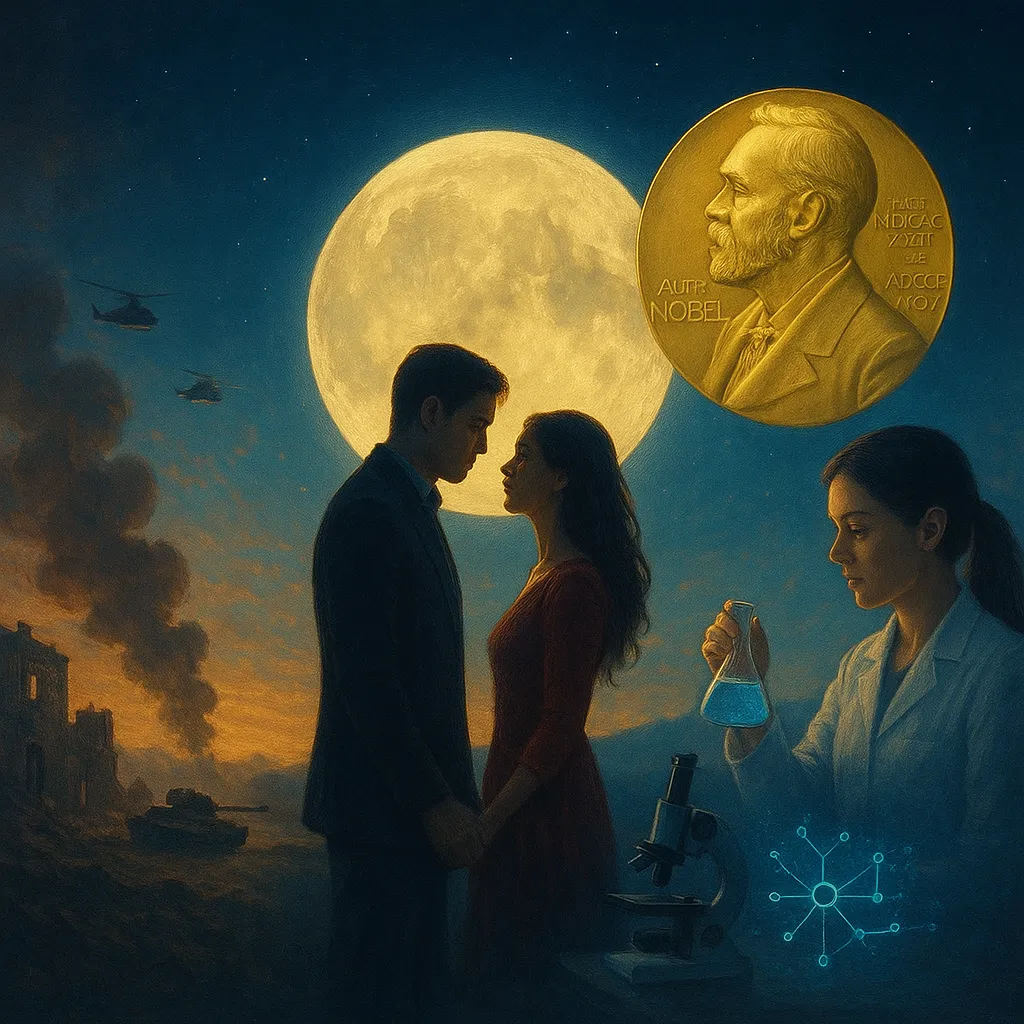
एक आलोचनात्मक गवेषणा :
ज़िंदगी तूने चाँद देखे या हमें – क्वांटम दृष्टि, सूफ़ी रहस्य और वेदान्तिक एकत्व का शोध-काव्य: सूफ़ी, वेदान्तिक और क्वांटम विज्ञान, तीनों की चेतना-धाराओं का एक काव्यात्मक प्रवाह
सारांश (Abstract)
यह लेख दर्पण की ग़ज़ल “नज़रों ने एक तुमको देखा है, तूने चाँद देखे या हमें” के आध्यात्मिक और क्वांटम आयामों का एक दार्शनिक परीक्षण है। यह ग़ज़ल केवल प्रेम की भावुकता नहीं, बल्कि एक “प्रयोगशाला–जगत्” का उद्घाटन करती है जहाँ देखना ही होना बन जाता है, और हर अनुभूति एक क्वांटम प्रयोग है।
सूफ़ी मत (इब्न–अरबी, रूमी), अद्वैत वेदान्त (शंकराचार्य, उपनिषद्) और क्वांटम चेतना–विज्ञान (हैमरोफ़-पेनरोज़, न्यूकार्ट, टेगमार्क) तीनों का संगम इस कविता में ऐसा घुलता है कि “चाँद” केवल एक खगोलीय पिंड नहीं, बल्कि “चैतन्य का दर्पण” बन जाता है।
यह शोध-काव्य इस प्रश्न को केंद्र में रखता है: “क्या हमने चाँद देखा, या उसने हमें देखा?” और इसी में छिपा है मनुष्य-प्रेम, विश्व-शांति और आत्म-अनुभूति का सूत्र।
I. प्रयोगशाला क्या है? जीवन ही प्रयोग है।
“प्रयोगशाला कुछ भी नहीं है, जो कुछ है, वही प्रयोगशाला है।” -दर्पण।
यहाँ कवि प्रयोगशाला को एक कमरे या संस्थान तक सीमित नहीं रखता। वह कहता है, हर साँस, हर नज़र, हर ख़याल ही प्रयोग है। जिस तरह भौतिक शास्त्र में observer effect बताता है कि देखने से ही कण की अवस्था बदल जाती है, उसी तरह कवि का कहना है, प्रेम में देखने से ही ब्रह्मांड बदल जाता है।
जब वह पूछता है, “तूने चाँद देखे या हमें”, तो यह प्रश्न रूमानी नहीं, अस्तित्ववादी है। कौन देख रहा है? और कौन देखा जा रहा है?
सूफ़ी दृष्टि कहती है, “मैं वही हूँ जिसे मैं देखता हूँ।” (इब्न अरबी, फुसूस अल–हिक़म) वेदान्त कहता है, “द्रष्टा, दृश्य और दर्शन: तीनों ब्रह्म ही हैं।” (बृहदारण्यक उपनिषद् 1.4.10) और क्वांटम भौतिकी कहती है, “पर्यवेक्षक के बिना कोई वास्तविकता नहीं।”
इस प्रकार, कवि का प्रेम-प्रयोग एक क्वांटम-अनुभवशाला बन जाता है जहाँ देखना ही अस्तित्व का निर्माण है।
II. चाँद: अपूर्णता में पूर्णता का दर्पण
“चमकती चाँदनी को साथ तन में दाग हीं दाग चाँद, तू चमकाती भाग की लेखा है, तूने चाँद देखे या हमें।”
यहाँ चाँद केवल प्रतीक नहीं, बल्कि एक क्वांटम दर्पण है। उसके दाग अपूर्णता नहीं, अपूर्णता में छिपी पूर्णता के संकेत हैं। रूमी ने कहा था, “ज़ख़्म वही जगह है जहाँ रौशनी दाख़िल होती है।” कवि की दृष्टि में चाँद उसी प्रकाश की परावर्तन है, जो हमारे भीतर की चेतना को उजागर करता है।
वेदान्त इसे चैतन्य कहता है, जो सब अनुभवों को आलोकित करता है। “तू चमकाती भाग की लेखा है”, अर्थात्, तू ही भाग्य की रेखा में रौशनी बनती है। यहाँ दाग़ और लेखा दोनों ही एक “एन्टैंगल्ड क्वांटम सूत्र” हैं, जहाँ आत्मा और ब्रह्म एक दूसरे में उलझे हैं, और देखने का क्षण ही wave collapse बन जाता है।
III. रंग दा फ़ानी: आत्मा का विलय
“इस दिल का क्या रंग करूँ अब, चढ़ा रंग दा फ़ानी, कुर्बानी, रूहानी वो रंगरेखा है, तूने चाँद देखे या हमें।”
यहाँ “दा फ़ानी” शब्द सूफ़ी शब्दावली फ़ना से उपजा है, स्वयं का विलय, प्रेम में मिट जाना। रंग यहाँ केवल भौतिक नहीं, आत्मिक आवृत्ति है, frequency of surrender. भौतिक शास्त्र में ऊर्जा का रूपांतरण जैसे electron jump होता है, वैसे ही प्रेम में आत्मा jump करती है, स्वयं से सर्व-स्व में।
पेनरोज़ और हैमरोफ़ के अनुसार, Consciousness स्वयं एक Quantum collapse है। दर्पण इस collapse को “इश्क़” कहते हैं। इसलिए यह शे’र केवल भाव नहीं, बल्कि क्वांटम रूपान्तरण की काव्यात्मक परिभाषा है।
IV. ख़ुश्बू और गेसू: अदृश्य का अनुभव
“भीनी-भीनी वो बदन की ख़ुश्बू तेरे गेसुओं ने बिखेरा, महका मन, बहका अनदेखा है, तूने चाँद देखे या हमें।”
यहाँ ख़ुश्बू और गेसू इन्द्रिय–बोध की सूक्ष्मतम अवस्था हैं। जो देखा नहीं जा सकता, वही सबसे गहराई से महसूस होता है। सूफ़ी इसे ज़ौक़ (धौक़) कहते हैं, “बिना देखे अनुभव करने का स्वाद।” वेदान्त में इसे अपरोक्षानुभूति कहा गया है, जो इन्द्रियों से परे है पर सर्वव्यापी है। कवि के अनुसार “महका मन, बहका अनदेखा है”, यानी आत्मा उस अदृश्य अनुभव से मतवाली है।
यह superposition की अवस्था है, जहाँ प्रेमी और प्रिय, सुगंध और श्वास, एक ही लय में बहते हैं।
V. इश्क़, नफ़्स, क़स्फ़ आलेखा: आत्मा का अल्गोरिद्म
“कहने को लफ़्ज़ काफ़ी नहीं, बयान-ए-हुस्न क्या करें, इश्क़, नफ़्स, क़स्फ़ आलेखा है, तूने चाँद देखे या हमें।”
यह शे’र अपने आप में एक रहस्य-सूत्र है। इश्क़, सार्वभौमिक आकर्षण शक्ति। नफ़्स: व्यक्तिगत अहंकार, सीमाबद्धता। क़स्फ़ आलेखा: सृष्टि का कोड, divine program। दर्पण यहाँ एक आध्यात्मिक सूचना-विज्ञान (Spiritual Informatics) रचते हैं। जैसे भौतिक विज्ञान में Quantum Bit अनन्त संभावनाएँ रखता है, वैसे ही आत्मा में भी अनन्त सम्भावनाएँ छिपी हैं।
सूफ़ी मत में यह अल-कलम (ईश्वरीय कलम) है, जो तक़दीरें लिखती है। वेदान्त में यह माया का प्रोग्राम है, जो ब्रह्म की लीला को गढ़ता है। और MMQDD के सन्दर्भ में यह “मन-नोड्स” के बीच एक डायलेक्टिकल डाइनामिक्स है, जहाँ इश्क़ हीं कोड भी है, कम्पाइलर भी।
VI. Quantum चाय और विश्व-शान्ति के प्रयोग:
“Quantum डायनामिक्स आज चाय में लगा है रंग, सजनी पी दिलो-जान देखा है, तूने चाँद देखे या हमें।”
यह शे’र खेल भी है और दर्शन भी। “चाय” यहाँ एक दैनिक अनुष्ठान है, जहाँ प्रेम और चेतना घुल जाते हैं। कवि कहता है, यदि क्वांटम डायनामिक्स हर कण में काम करता है, तो प्रेम भी उसी क्वांटम तरंग में चलता है। दर्पण इस शे’र से विश्व-परिस्थितियों पर उतर आते हैं। ग़ज़ा सीज़फ़ायर, मानवाधिकारों की लड़ाई, एशिया की अशांति, सब उनके लिए प्रयोगशालाएँ हैं।
वे कहते हैं, यदि हर चेतना कण एक-दूसरे से entangled है, तो शान्ति भी entangled हो सकती है। जब सुंदर पिचाई क्वांटम उपलब्धि की बात करते हैं, दर्पण उसे एक नैतिक उपलब्धि में बदलते हैं, Quantum Peace Experiment, जहाँ करुणा हीं क्वांटम छलाँग है।
VII. समन्वय : एक प्रयोग, असंख्य पर्यवेक्षक:
सूफ़ी मत कहता है, “अस्तित्व एक है, रूप अनेक हैं।” वेदान्त कहता है, “सत्यं ज्ञानं अनन्तं ब्रह्म।” क्वांटम भौतिकी कहती है, “पर्यवेक्षक ही वास्तविकता है।” दर्पण की ग़ज़ल इन तीनों को जोड़ देती है। यह कहती है, देखना हीं होना है, और होना हीं देखना। हर प्रेम, हर दृष्टि, हर क्षण, ब्रह्माण्डीय प्रयोगशाला का विस्तार है।
VIII. निष्कर्ष : चाँद से चैतन्य तक
अंततः दर्पण की यह ग़ज़ल एक काव्य-सूत्रधार बन जाती है; जहाँ चाँद प्रतीक नहीं, साधना है। हर मिसरा एक प्रयोग है, हर प्रयोग आत्म-साक्षात्कार की ओर। “तूने चाँद देखे या हमें”, यह प्रश्न नहीं, यह ध्यान है। यह हमें स्मरण कराता है कि क्वांटम छलाँग विज्ञान में नहीं, करुणा में है। मापने में नहीं, मिलने में है।
सूफ़ी, वेदान्त और क्वांटम; तीनों कहते हैं, एकोऽहम् बहुस्याम् !, “मैं एक हूँ, अनेक बनूँ, और फिर उसी एक में लौट आऊँ।”
दर्पण के शब्दों में: “हम चाँद और अपने आप को ज़िंदगी की तरह देख पाएँ ! यही इस ग़ज़ल की मधुरतम भावधारा है।”
उपसंहार: यह ग़ज़ल “तूने चाँद देखे या हमें” वास्तव में एक दर्पण है, जिसमें प्रेम, विज्ञान और चेतना एक हीं रौशनी में झिलमिलाते हैं। जहाँ प्रयोगशाला, हृदय और ब्रह्माण्ड तीनों एक हीं तरंग पर कंपन करते हैं।
Next Read: moonlight, and longing