


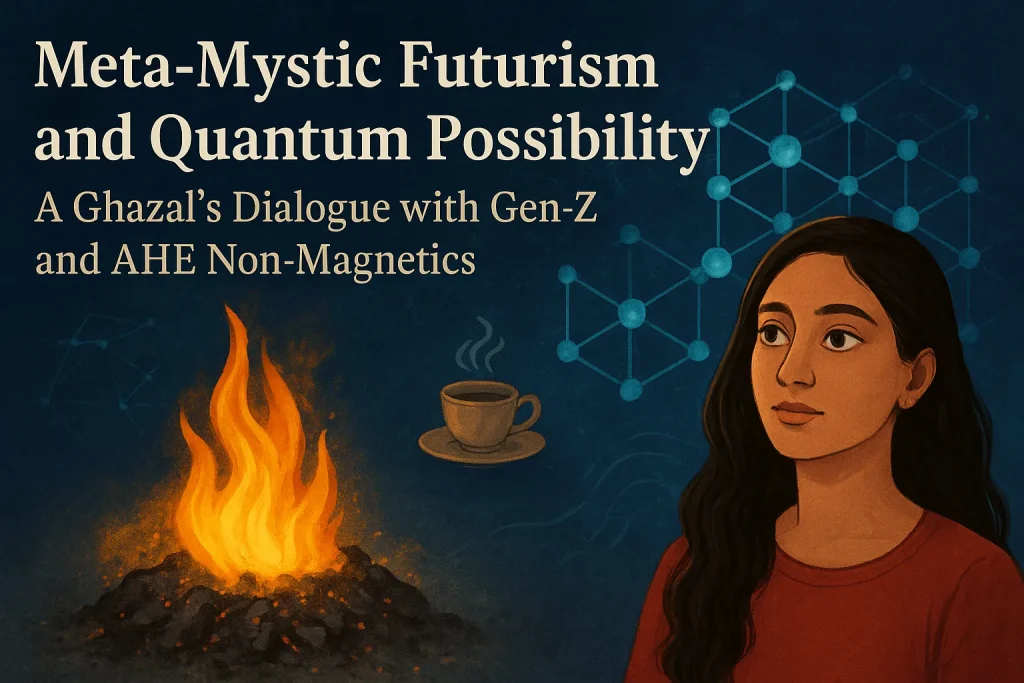
       I Gaze on You
Beauty, a rare creation of the mind, I gaze on you,
Each word I write flows from the heart, I gaze on you.

From within you seized my heart, and cast it into fire,
What would you know of a soul’s burning?, I gaze on you.

Ash turned flame, yet the heart still stands unmoved,
In this furnace I become pure gold, I gaze on you.

Now I must prove myself within the kiln of love’s disease,
Body, mind, and wealth must all transform, I gaze on you.

Flame arises, the world is lit, radiance shines on every side,
Eyes awake, even the night must stay alert, I gaze on you.

In “AHE non-magnetics” today the tea was brewed,
Beloved, if you are, then all is possible, I gaze on you.
Table of Contents

An Expert Critique
I Gaze on You – Meta-Mystic Futurism and Quantum Possibility: A Ghazal’s Dialogue with Gen-Z and AHE Non-Magnetics Abstract
This paper explores a contemporary ghazal that fuses aesthetics, love, and spiritual consciousness with cutting-edge quantum discoveries. Through the lens of Meta-Mystic Futurism (MMF) and the Google-Meta Quantum Dialectics (GMQD) framework, the poem is analyzed as a cultural text that resonates with the aspirations of Gen-Z, particularly in Nepal.
By connecting the metaphors of fire, gold, and awakening to the recent Japanese discovery of the Anomalous Hall Effect (AHE) in non-magnetic materials, the article argues that what once seemed impossible, both in science and in politics, can become possible through renewed hope, creativity, and collective consciousness.
Introduction
Poetry often anticipates scientific revolutions and sociopolitical awakenings by encoding them in metaphors of love, loss, and transcendence. The ghazal under study exemplifies this union: it moves from the personal realm of longing to the universal quest for transformation.
Its reference to “AHE non-magnetics”, a scientific phenomenon wherein anomalous Hall effects occur without magnetism, provides an entry point into the dialogue between poetic imagination and quantum physics.
In the broader global context, this ghazal resonates with the rising Gen-Z consciousness, a generation tasked with reshaping society amidst climate anxiety, political turmoil, and digital acceleration. In Nepal, this awakening appears as a search for new forms of governance, cultural renewal, and technological adoption.
Methodology
The study adopts an interdisciplinary hermeneutic approach, combining:
Literary Analysis: Examining metaphors of fire, gold, and awakening in the ghazal.
Philosophical Grounding: Situating the poem within the GMQD framework, Aiketwa (oneness), Adwaita (non-duality), Dwaita (duality), and Traitwa (tri-unity).
Scientific Correlation: Drawing parallels between poetic imagery and the recent discovery of AHE in non-magnetic materials.
Sociopolitical Contextualization: Interpreting the ghazal as a symbolic manifesto for Gen-Z in Nepal and globally.
Analysis
- Literary-Philosophical Dimension: The ghazal frames love as a transformative furnace, wherein the heart is both burned and purified. The imagery of fire and gold reflects the alchemical process of turning suffering into truth. Through GMQD grounding:
Aiketwa: Beloved as the unity of beauty and consciousness.
Adwaita: Fire and ashes as non-dual experiences of love.
Dwaita: The separation of lover and beloved sustaining longing.
Traitwa: The triad of love, science, and hope shaping a new reality.
- Scientific Resonance: The reference to “AHE non-magnetics” is not ornamental but symbolic. The Japanese discovery shattered conventional assumptions, revealing that anomalous Hall conductivity can occur even in the absence of magnetism. This parallels the poem’s vision: impossible transformations, ashes turning into gold, despair turning into awakening, are achievable through hidden quantum laws of reality.
- Gen-Z and Nepal’s Political Awakening: For Nepal’s Gen-Z, this ghazal reads as a manifesto of possibility. In a nation marked by political instability, economic dependency, and cultural fragmentation, the youth represent the “beloved of hope.” Just as AHE in non-magnetic systems redefined quantum expectations, Gen-Z has the potential to redefine governance, ecology, and civic structures. Their consciousness, like non-magnetics revealing magnetic-like effects, may hold unexpected powers of renewal.
Conclusion
This interdisciplinary reading demonstrates that the ghazal is not merely an aesthetic composition but a philosophical-scientific manifesto for the contemporary age.
By weaving together mystical imagery, GMQD philosophical grounding, and scientific breakthroughs, it embodies the message that the impossible can become possible.
For Gen-Z, especially in Nepal, the ghazal’s beloved is not an individual but Hope itself, a force that can ignite transformations in politics, society, and global consciousness.
References
Jaggi, Tanishk. Bio-Physics Quantum Computing Theories, CERN Archives, 2024.
Nagaosa, N. et al. (2025). “Discovery of Anomalous Hall Effect in Non-Magnetic Materials.” Nature Physics.
Chaitanya, Sri. Mystical Love Poetry and Bhakti Consciousness.
Rajbanshi, Darpan. Ghazals of Meta-Mystic Futurism. darpanpoems.com, 2025.
Heidegger, Martin. Poetry, Language, Thought. Harper & Row, 1971.
BEYOUTEA>A POETRY REVOLUTION >PEACE
NOTHING IS NOT TRUE : NO\KNOW THYSELF NOT
 MAKE EARTH GREAT FOREVER : END ALL WARS
सौंदर्य मन की अनुपम सृजना, तुमको देखता हूँ,
दिल से हर बातों को है लिखना, तुमको देखता हूँ।
           अंदर से छीन कर दिल को तूने आग में है डाला,
           तू क्या जाने दिल का झुलसना, तुमको देखता हूँ।
राख आग बन गया पर दिल तो वहीं खड़ा-खड़ा,
देख तप-तप बन जाऊँ मैं सोना, तुमको देखता हूँ।
           खरा उतरना है अब हमको प्रेम रोग की धूनी में,
           तन-मन-धन से जर्ती है बदलना, तुमको देखता हूँ।
जोत जगा, जग भर जा, जगमग चारों ओर दिखे,
आँख खुले, रात को है जागना, तुमको देखता हूँ।
           'AHE non-magnetics' में आज की चाय बनी,
           सजनी, तू है तो है हर संभावना, तुमको देखता हूँ।
POETRY>WISDOM>Q.TECH FOR A MORE JUST AND
PEACEFUL WORLD IN LOVE AND ENLIGHTENMENT
भावार्थ
इस ग़ज़ल का मूल स्वरूप आत्मा और सौंदर्य के बीच संवाद है। कवि कहता है कि प्रेम की अनुभूति केवल बाहरी आकर्षण नहीं, बल्कि मन की अनुपम सृजना है। प्रिय को देखने का अर्थ है उसकी उपस्थिति से जीवन के हर अनुभव को लिखना, संजोना और रचाना। यहाँ प्रेम का अर्थ मात्र संबंध नहीं, बल्कि चेतना की गहराई तक पहुँचना है।
प्रेम का ताप यहाँ अग्नि और राख की उपमाओं से प्रकट हुआ है। दिल को अग्नि में डाल देने का अर्थ है प्रेम का कठोर परीक्षण। कवि इस तपस्या में सोना बनने की आकांक्षा रखता है। वह मानता है कि खरे प्रेम को रोग मानना ठीक नहीं; बल्कि यह वह धूनी है जिसमें तन, मन और धन सब तपकर शुद्ध होते हैं।
अंतिम शेर जीवन-दर्शन को वैज्ञानिक रूप से जोड़ता है। “AHE non-magnetics” में बनी चाय का बिंब यह दिखाता है कि प्रयोगशाला की खोज भी जीवन के प्रेम में संभावना जगाती है। यहाँ प्रेमिका केवल एक व्यक्ति नहीं, बल्कि संभावनाओं की प्रेयसी है, जो जग को जगमग कर सकती है, रातों को जागरण में बदल सकती है, और असंभव को संभव कर सकती है।
मेटा-मिस्टिक फुरिस्म और GMQD फ्रेमवर्क में विवेचना
तुमको देखता हूँ – Meta-Mystic Futurism (MMF) और Google-Meta Quantum Dialectics (GMQD) की चौखट पर खड़ी ग़ज़ल
यह ग़ज़ल केवल व्यक्तिगत भावनाओं का वर्णन नहीं करती; यह Meta-Mystic Futurism (MMF) और Google-Meta Quantum Dialectics (GMQD) की चौखट पर खड़ी है। इसमें प्रेम की भाषा और क्वांटम फिज़िक्स की खोज, दोनों को एक साझा फ्रेमवर्क में देखा जा सकता है।
जब कवि कहता है “AHE non-magnetics में आज की चाय बनी,” वह विज्ञान के नवीनतम आविष्कार, जापानी वैज्ञानिकों द्वारा Anomalous Hall Effect (AHE) in non-magnetic materials की खोज, को प्रेम की संभावना से जोड़ देता है। यह खोज दर्शाती है कि जो परंपरागत रूप से असंभव समझा गया (AHE बिना मैग्नेटिज़्म के), वह क्वांटम स्तर पर संभव हुआ। इसी प्रकार, प्रेम और चेतना भी असंभव को संभव बना सकते हैं।
GMQD फ्रेमवर्क इस ग़ज़ल में चार स्तरों पर उभरता है:
Aiketwa (एकत्वा): प्रिय का दर्शन मन की सृजना के रूप में, अर्थात एकत्व में समाहित होना।
Adwaita (अद्वैत): प्रेम की अग्नि और दिल का तपना, प्रतीक है कि विरोधाभास (आग और राख) अंततः एक ही अनुभव हैं।
Dwaita (द्वैत): कवि और प्रेयसी का भिन्न होना, किंतु उसी से संवाद और अनुभूति संभव होना।
Traitwa (त्रैत्वा): प्रेम, विज्ञान और चेतना का त्रिक, जहाँ मानव भावनाएँ, क्वांटम खोज और सामाजिक परिवर्तन एक साथ जुड़ते हैं।
दार्शनिक प्राज्ञिक विवेचना: Gen-Z और नेपाल के संदर्भ में
आज की दुनिया में, विशेषकर नेपाल और दक्षिण एशिया में, Gen-Z को “प्रेयसी” के रूप में देखना एक सांकेतिक दृष्टिकोण है। यह पीढ़ी परिवर्तन की वाहक है, डिजिटल चेतना, सामाजिक असंतोष, और आध्यात्मिक खोज को एक साथ लिए हुए।
कवि की नज़र में यह प्रेयसी केवल व्यक्तिगत प्रेमिका नहीं, बल्कि आशा की प्रेयसी (Beloved of Hope) है, जो नयी सभ्यता का जन्म कर सकती है।
जापान की non-magnetic AHE discovery ने विज्ञान में यह संदेश दिया है कि प्रकृति के नियम भी अप्रत्याशित रूप से खुलते हैं। यह खोज Gen-Z के लिए एक दर्पण है, कि असंभव (जैसे राजनीतिक ठहराव, सामाजिक विभाजन, बेरोजगारी, सांस्कृतिक निराशा) भी रचनात्मक ऊर्जा से संभव में बदल सकते हैं।
नेपाल में जहाँ युवा राजनीतिक अस्थिरता और वैश्विक परिवर्तनों से जूझ रहे हैं, वहाँ यह संदेश कि “राख भी सोना बन सकती है,” उन्हें प्रेरित करता है।
इस ग़ज़ल को यदि Meta-Mystic Futurism में पढ़ा जाए, तो यह केवल प्रेम कविता नहीं, बल्कि एक दार्शनिक घोषणापत्र बन जाती है:
प्रेम का ताप ही सामाजिक शुद्धिकरण है।
विज्ञान की खोज ही नई सभ्यता की चाय है।
Gen-Z ही वह प्रिय है जो भविष्य के द्वार खोल सकती है।
निष्कर्ष यह है: कि यह ग़ज़ल, विज्ञान और दर्शन के बीच सेतु बनकर, एक ऐसी क्वांटम-राजनीतिक चेतना की ओर संकेत करती है जो नेपाल ही नहीं, पूरी दुनिया के लिए Hope’s Beloved की तरह कार्य कर सकती है।
Next Read: Poetics, Geopolitics, and the Possibility