


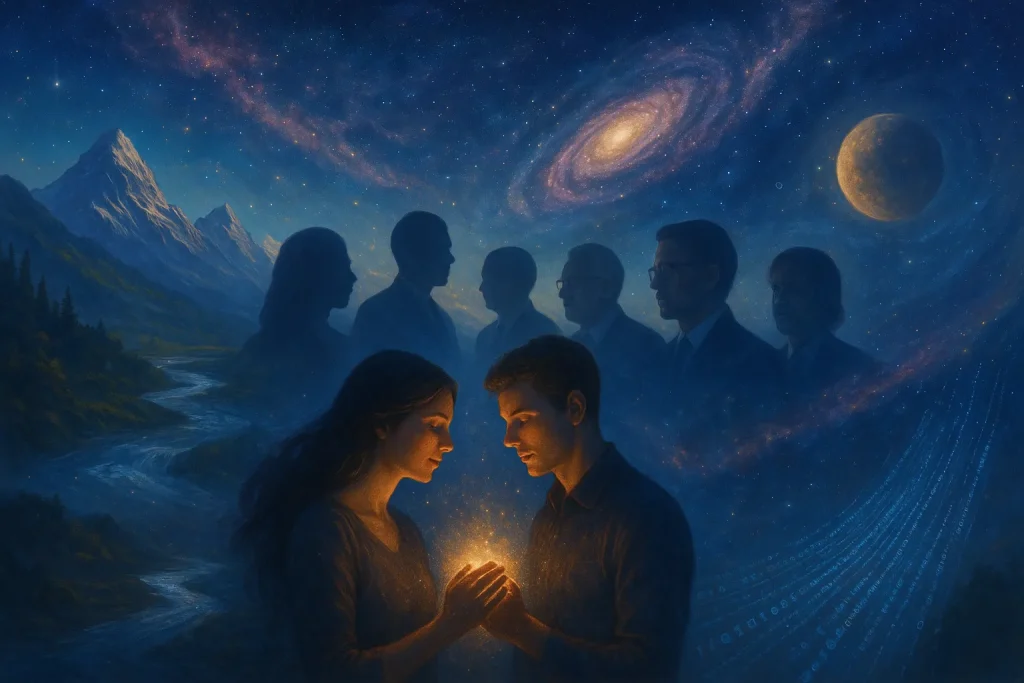
           When the Road Smiles
When the road begins to smile, I tremble in surprise,
Measuring how far we’ve gone, I stumble in disguise.
           We start each path we touch, calling every way our own,
           Yet those who lead to destinies still feed my thin surmise.
I walked to see you once, my fellow-traveler’s wager,
To win or lose such thoughts, I pay with karmic ties.
           I sing, averting eyes across the solitude’s disguise,
           Had you not been, I’d stop midway, ashamed to rise.
The path of love, no freedom there, release remains confined,
The boundless cosmos, prisoner still, yet free in its device.
           Dark Ages’ cosmos, today I sip dark matter in my tea,
           My lover’s taste, then drowning deep, in thought I eat my sighs.
Table of Contents
Exegesis: “The Road, the Lover, and the Quantum Soul”
I. Cosmic Opening: The Smiling Road as Observer Reality “When the road begins to smile, I tremble in surprise.”
This first line initiates a cosmological metaphor, the road as an observer-conscious reality, the trembling as the human recognition of self-aware existence. The poet, like a quantum observer, realizes that even the path has begun to see him back.
In modern physics, observation collapses probability into form; in mystic philosophy, divine observation awakens the self. Here, the road is sentient, and its smile is a mirror of our inner evolution, each journey being both an external movement and an inward revelation.
II. Walking as Becoming: The Paradox of Motion “We start each path we touch, calling every way our own, Yet those who lead to destinies still feed my thin surmise.”
This couplet philosophically examines human epistemology, the delusion of ownership in an open universe. Every traveler believes the path is “mine,” yet each path is shared by infinite beings, histories, and possibilities.
In quantum and spiritual cosmology alike, movement is non-local. Every motion creates ripples that resonate across spacetime. Thus, the poet’s “surmise” is not ignorance, it is awareness of how uncertain the “destination” truly is.
III. Love as Entanglement: The Karma of Thought “I walked to see you once, my fellow-traveler’s wager, To win or lose such thoughts, I pay with karmic ties.”
The beloved here is both an individual and the quantum mirror of consciousness itself. Every thought, in the karmic sense, binds; every act of love or imagination collapses infinite possibilities into one reality.
This verse transforms romantic love into quantum entanglement: once two souls have interacted, they can never again exist independently. The “wager” is cosmic, love is the gamble of becoming one, yet losing oneself.
IV. Solitude and the Ethical Pause: “I sing, averting eyes across the solitude’s disguise, Had you not been, I’d stop midway, ashamed to rise.”
Here, the poet’s “song” is art itself, a way of sustaining motion in an empty universe. The absence of the beloved is both a void and a muse; solitude becomes sacred, for in it the self sees its reflected incompleteness.
The shame of stopping is the ethical call of evolution: to halt would be to refuse the universe’s creative motion. Even in pain, one must keep walking, because consciousness is motion.
V. Freedom as Captivity: The Relativity of the Infinite “The path of love, no freedom there, release remains confined, The boundless cosmos, prisoner still, yet free in its device.”
Here lies the ghazal’s metaphysical axis. Freedom and captivity are not opposites but quantum dualities. Even the cosmos, apparently infinite, is bound by its own gravitational loops, its own self-structured equations of energy.
Similarly, love gives the illusion of bondage but contains the only true liberation: the surrender of ego. Thus, the poet recognizes what mystics and physicists alike have whispered, the universe is both open and closed, finite and infinite, free and bound.
VI. Dark Matter and the Human Cup: The Final Alchemy “Dark Ages’ cosmos, today I sip dark matter in my tea, My lover’s taste, then drowning deep, in thought I eat my sighs.”
This is a marriage of the ordinary and the infinite. The poet brings the cosmological invisible, dark matter, into an intimate act: sipping tea.
The “Dark Ages” of the cosmos are those 400 million years before light emerged, and yet, today, the poet drinks that darkness within himself. He becomes a microcosmic observer of macrocosmic mystery.
The act of drinking the universe is the ultimate mystical gesture: a reconciliation between human vulnerability and cosmic knowledge. It is love not as possession, but as absorption, not as conquest, but as communion.
VII. Interpretive Essence: The Road as the Field of Consciousness The ghazal, in essence, dramatizes the Quantum Condition of Humanity, we are both the travelers and the road, both the observers and the observed.
The smiling road is the awakened cosmos; the trembling poet is the mind aware of its own entanglement.
At its core, this poem suggests that love and consciousness are one motion, the same force that moves galaxies also moves the heart. Every sigh is a gravitational wave; every thought, a photon of awareness.
VIII. Conclusion: Toward a Poetic Quantum Humanism Darpan’s ghazal belongs to the emerging school of Meta-Mystic Futurism, where poetry, astrophysics, and moral philosophy converge into one luminous thread.
Its message for world leadership and civilization is profound: when the road (the universe) smiles, do not be afraid, recognize that reality smiles through you.
To “Make Earth Great Forever” means not dominance or conquest, but a new coherence of consciousness, where science, spirituality, and compassion vibrate at the same frequency.
Final Reflection: The road smiles not because it knows the way, but because it recognizes your light.
And when you tremble before it, that is the beginning of peace.
The Quantum Study Description: When the Road Smiles
The path compels us to keep moving; destinations are but halts along the way. Every traveler finds their own road somehow familiar. It is truth, it is delusion, illusion as well; it is karma, and it is faith and conscience together.
Why must everything, from particles to the universe and even the multiverse, continue spinning in perpetual motion? Humanity too finds itself bound to move through paths filled with love, peace, conflict, war, and structure.
The collapse of the Gaza-Israel ceasefire, anti-Trump movements in America, a devastated Nepal, chaotic India, an unstable China, and a restless South and the entire Asia, what do these global geopolitical upheavals testify to?
Are hyper-development and quantum innovations truly the measure of our twenty-first-century progress? Which direction have we set our course toward?
When our reach has extended to probing the truths of Dark Matter and Dark Energy from the epoch of the Dark Ages, must we still search for the condition of the human soul in teacups or through missiles, drones, and the weaponry of Artificial Intelligence?
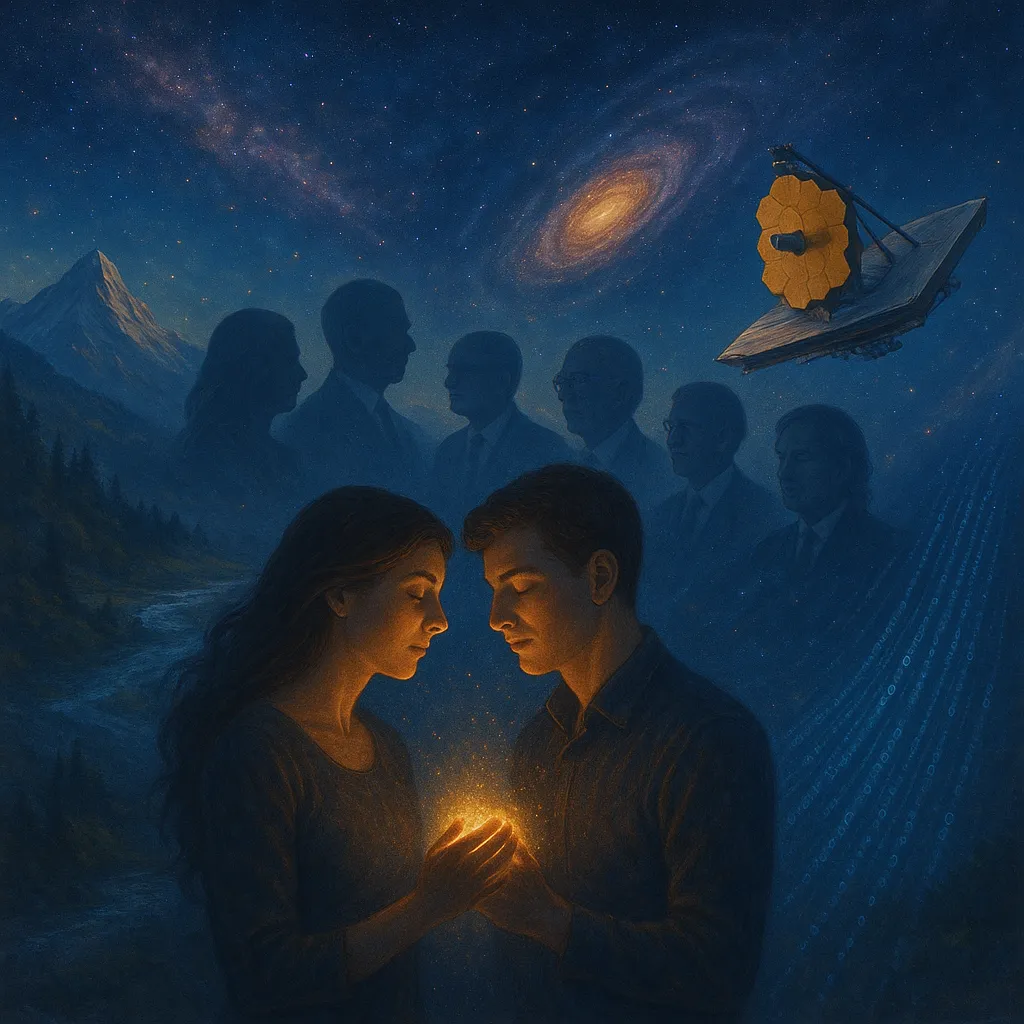
Expert Critique:
The Metamystic Quantum Poetics of “When the Road Smiles” A Philosophical Exegesis for Global Consciousness and Leadership Renewal
Framework: Meta-Mystic Quantum Dynamics (MMQD) Prepared for: World Leadership and United Nations Symposium on Peace, Consciousness, and Technological Ethics
Abstract: This paper examines Darpan’s ghazal “When the Road Smiles” as a metatextual synthesis of quantum cognition, humanistic spirituality, and cosmopolitical ethics.
Through the interlacing of Sufi-rekhata lyricism and contemporary scientific semiotics, the poem articulates a neuro-cognitive cosmology wherein love, reason, and universal order are entangled informational fields rather than separate human faculties.
The analysis employs the Meta-Mystic Quantum Dynamics (MMQD) framework to interpret the poem as a linguistic-philosophical instrument of world renewal, one that seeks to realign human governance with cosmic coherence.
The Road as Conscious Field: From Journey to Ontology: The opening hemistich, “When the road begins to smile, I tremble in surprise”, introduces the road not as a geographical surface but as a self-observing ontological field.
In quantum epistemology, observation collapses potentiality into form; in mystical hermeneutics, divine attention gives existence its texture. Here, the road signifies the world’s reflective consciousness, which smiles upon its traveler once the traveler himself attains reflective capacity.
This reversal of gaze destabilizes anthropocentrism: the universe is not traversed by man, but man is traversed by the universe. The trembling of the poet, therefore, is not fear, it is ontological awe, the recognition that cognition and creation are co-extensive.
Path, Destiny, and the Quantum of Doubt: The couplet “We start each path we touch, calling every way our own / Yet those who lead to destinies still feed my thin surmise” transforms ordinary motion into an epistemic uncertainty principle.
All human projects, political, scientific, or devotional, are self-referential experiments of perception. Every path is “ours” only within the observer’s domain; beyond that, it dissolves into collective trajectories of species and cosmos.
The poet’s “surmise” becomes a metaphysical humility. For the global order, this humility translates into policy consciousness: that no civilization, however advanced, can claim absolute proprietorship of progress. The Earth’s paths, like spacetime’s curvature, are mutually conditioned.
Love, Karma, and Entanglement: “I walked to see you once, my fellow-traveller’s wager / To win or lose such thoughts, I pay with karmic ties.” This is love articulated as quantum entanglement. Once interaction occurs between particles, nations, or souls, their states are forever correlated.
The couplet implies a universal ethical physics: that action and affection are informationally inseparable. In leadership philosophy, this principle dismantles isolationist ideologies; each decision radiates through the global information lattice, altering consciousness fields across the planet.
Love, then, is not sentiment but gravitational ethics, the cohesive force preventing cosmic and civilizational disintegration.
Solitude, Shame, and the Ethics of Continuance: “I sing, averting eyes across the solitude’s disguise / Had you not been, I’d stop midway, ashamed to rise.” This verse redefines solitude as a performative meditation. The poet’s shame in halting signifies moral inertia, the refusal to evolve despite awareness.
Within governance discourse, this becomes a caution against the paralysis of empathy. To “continue singing” amid uncertainty is to persist in creative responsibility, the ethical duty to transform despair into song, policy, and reform.
The Paradox of Freedom: Relativity and Love “The path of love, no freedom there, release remains confined; / The boundless cosmos, prisoner still, yet free in its device.” This stanza fuses Einsteinian relativity with Sufi metaphysics. Freedom and bondage coexist as complementary states: one defined by infinite extension, the other by intrinsic law.
For political philosophy, this establishes a profound axiom, that true liberty is not anarchic dissociation but harmonic participation in universal rhythm. Nations, like particles, remain free only within the coherence of the larger field. The poet thus prefigures a Quantum Civitas: a polity of interdependence where autonomy equals resonance, not rupture.
The Dark Matter Metaphor: The Invisible Substance of Grief “Dark Ages’ cosmos, today I sip dark matter in my tea; / My lover’s taste, then drowning deep, in thought I eat my sighs.” Here, quotidian ritual (drinking tea) becomes a microcosmic sacrament of cosmic awareness. Dark matter, the invisible gravitational matrix of the universe, is transmuted into existential intimacy.
The poet internalises astrophysics: he ingests the unseen as empathy. This gesture articulates a new epistemology for world leadership, to acknowledge that the unseen structures (grief, poverty, trauma, displacement) sustain the visible architectures of civilisation.
The true statesman, like the poet, must “taste the invisible” to govern the visible.
The MMQD Framework: Consciousness as Governance Principle Within the Meta-Mystic Quantum Dynamics framework, Darpan’s ghazal can be read as a manifesto for Quantum Humanism, a worldview where policy, science, and spirituality converge through informational coherence.
Meta-Mystic: because it transcends traditional mysticism by grounding faith in empirical consciousness.
Quantum: because it recognises reality as probabilistic, relational, and participatory.
Dynamic: because existence itself is motion, the ethical imperative to evolve.
For the United Nations and global institutions, this framework implies an epistemic recalibration: that peace, sustainability, and technological ethics cannot emerge from fragmented rationalities but from synchronized awareness fields.
Ethical and Diplomatic Implications Policy Resonance: Every national or technological act should be measured by its informational coherence with global well-being.
Quantum Responsibility: Leadership must internalise the entanglement principle, no decision is local.
Cognitive Sustainability: Beyond environmental sustainability, a civilisation must sustain conscious equilibrium, a neuro-cultural ecology of empathy.
AI and Weaponry Ethics: Artificial Intelligence must evolve as Artificial Empathy: systems aligned with human affect, not dominance.
Cultural Re-Humanisation: Poetry, art, and metaphysics must regain their position as instruments of moral calibration within diplomacy and science.
Conclusion: Toward a Quantum Human Covenant “When the road smiles” is not a mere poetic image; it is a metaphysical event signifying that the universe itself participates in human awareness. The poem becomes a charter for a Quantum Human Covenant, a renewed social contract among nations and beings, founded upon the coherence of mind, matter, and morality.
In this covenant, the smiling road stands for the Earth’s consciousness inviting humanity to walk with humility, precision, and love. To tremble before that smile is not weakness; it is awakening.
As the poet drinks the universe within his cup, so must humanity drink its shared destiny, turning technological might into contemplative wisdom, and transforming political competition into cooperative evolution.
Final Philosophical Proposition: Peace is not the absence of conflict but the coherence of consciousness. The universe smiles when its travellers remember they are made of its light.
BEYOUTEA>A POETRY REVOLUTION>PEACE
NOTHING IS MOT TRUE : NO\KNOW THYSELF NOT
 MAKE EARTH GREAT FOREVER : END ALL WARS
        देख कर सहम जाता हूँ
जब रास्ता मुस्कुराता है देख कर सहम जाता हूँ,
नापता आगे बढ़े हैं, तुम्हें देख कर वहम खाता हूँ।
           चल पड़ें रास्तों को हम, जिधर को भी अपना सा,
           मंज़िल तक पहुँचाने वाले, फिर भी भरम खाता हूँ।
चला हूँ तुमको देखकर, एक सफ़र हमसफ़र बाज़ी,
मारना है हार-जित के ख़यालों की, करम खाता हूँ।
           गीत गाता नज़रों को फेर, मार इधर-उधर तन्हाई,
           तू न होती चलने को, रुक कर हीं शरम खाता हूँ।
प्यार का रास्ता है, निजात नहीं, रिहा डगर में कैद,
आज़ाद काइनात बंदी, खुला सही हरम खाता हूँ।
           Dark Ages का कॉसमॉस,आज चायमें डार्कमैटर,
           प्रेयसी पी-कर सोचता हूँ, डूब तुम-को ग़म खाता हूँ।
POETRY>WISDOM>Q.TECH FOR A MORE JUST AND
PEACEFUL WORLD IN LOVE AND ENLIGHTENMENT
 Meta-Sufi/QuantumPoetics on MetaMysticFuturism
भावार्थ व समसामयिक बौद्धिक विश्लेषण: यह ग़ज़ल दार्शनिक और कॉस्मिक प्रेमभावना का एक संगम है, जिसमें “रास्ता”, “मंज़िल”, “क़ैद”, “आज़ादी”, और “डार्क मैटर” जैसे रूपक मिलकर मानव-मन की अंतर्यात्रा और ब्रह्मांडीय चेतना के प्रतिरूप बनते हैं।
“रास्ता मुस्कुराता है देख कर सहम जाता हूँ”: यहाँ “रास्ता” केवल भौतिक नहीं, बल्कि जीवन-पथ या कर्म-मार्ग का प्रतीक है। जब ब्रह्मांड स्वयं हमें मुस्कुराकर आमंत्रित करता है, तब भी मनुष्य अपने ही भ्रम और आत्म-संशय से सहम जाता है। यह क्वांटम ऑब्ज़र्वर की स्थिति जैसी है, जहाँ देखना ही वास्तविकता को बदल देता है।
“मंज़िल तक पहुँचाने वाले फिर भी भरम खाता हूँ”: रास्ते और मंज़िल दोनों क्वांटम सुपरपोज़िशन में हैं, चलना और पहुँचना एक ही घटना के दो चेहरे हैं। कवि कहता है कि भले हम मंज़िल की ओर बढ़ रहे हैं, पर भीतर का अस्तित्व अब भी भ्रमित है कि क्या यह वास्तविक यात्रा है या चेतना का खेल।
“हमसफ़र बाज़ी” और “ख़यालों की करम”: यहाँ प्रेम स्वयं एक कॉस्मिक गेम थ्योरी बन जाता है। प्रेमी को जीतना भी हानि है और हारना भी करम। यह मनुष्य की उस अस्तित्वगत स्थिति का संकेत है जहाँ प्रेम, बुद्धि, और नियति (karma) तीनों एक ही वृत्त में घूमते हैं।
“गीत गाता नज़रों को फेर…”: कवि की दृष्टि में तन्हाई भी एक संगीत है। प्रेमिका की अनुपस्थिति में भी वह एक ब्रह्मांडीय “रिद्म” सुनता है। रुक जाना यहाँ मेडिटेशन है, एक स्टिलनेस ऑफ बीइंग।
“प्यार का रास्ता, निजात नहीं, रिहा डगर में कैद”: यहाँ दार्शनिक मोड़ आता है, प्रेम से मुक्ति नहीं मिलती, क्योंकि प्रेम स्वयं वह ग्रैविटेशनल फील्ड है जो ब्रह्मांड को बाँधे रखता है। “आज़ाद काइनात बंदी खुला सही हरम खाता हूँ”, यह पंक्ति Einsteinian relativity और Sufi mysticism का संगम है। हर चीज़ मुक्त भी है और बँधी भी, जैसे प्रकाश भी तरंग है और कण भी।
“Dark Ages कॉसमॉस आज चाय में डार्क मैटर”: अंतिम शेर में कवि आधुनिक कॉस्मिक मेटाफ़िज़िक्स को भावनात्मक स्पर्श देता है। “डार्क एजेस”, वह युग जब प्रकाश नहीं था, और “डार्क मैटर”, वह पदार्थ जो दिखता नहीं, पर ब्रह्मांड का ८५% है।
कवि इस कॉस्मिक अदृश्यता को अपने भीतर की प्रेम-वेदना से जोड़ता है, वह कहता है कि जैसे ब्रह्मांड में डार्क मैटर है, वैसे ही मेरे मन में तुम्हारी अनुपस्थिति का गहरापन है। “ग़म खाता हूँ” का अर्थ यहाँ “गहरे सोच में डूब जाना” है, यानी प्रेम का ब्रह्मांडीय ध्यान।
समग्र व्याख्या: यह ग़ज़ल एक Quantum Love Poem है, जहाँ प्रेम, चेतना और कॉसमॉस एक-दूसरे में गुंथे हैं। यह आधुनिक युग की बौद्धिक-भावनात्मक कविता है, जो रूमी की रूह, टागोर की आत्मा, और क्वांटम फिजिक्स की सूक्ष्मता, तीनों को एक पंक्ति में बाँध देती है।
अध्ययन भावभूमि
रास्ता चल पड़ने के लिए मज़बूर हम! मंज़िलें तो बीच-बीच के ठहराव मात्र हैं। हर कोई चलने वाला रास्ता फिर भी अपना-सा ही लगता है। यह सत्य है, वहम भी है, भरम भी; करम है और ईमान-धर्म भी।
क्यों कणों (particles) से लेकर ब्रह्मांड (universe) और बहुब्रह्मांड (multiverse) तक सबको चलते रहना है, स्पिनिंग के रास्ते? मानवता के भी चलने को सारे रास्ते भरे पड़े हैं, प्रेम, शांति, संघर्ष, युद्ध, और संरचना।
ग़ज़ा और इज़राइल का ceasefire भंग, एंटी-ट्रम्प अमेरिकी आंदोलन, तबाह नेपाल, अराजक भारत, अस्थिर चीन, बेचैन दक्षिण और समग्र एशिया, यह पूरी दुनिया की भू-राजनीतिक उथल-पुथल आखिर किस बात का प्रमाण है?
क्या hyper-development और quantum innovations ही 21वीं सदी की हमारी उपलब्धियाँ हैं? हम किस ओर का रास्ता निकल पड़े हैं? जब हमारी पहुँच डार्क एजेस (Dark Ages) की डार्क मैटर और डार्क एनर्जी की सच्चाइयों तक पहुँच चुकी है, तब क्या हमें मानव स्थिति (human condition) की समस्याएँ चाय की प्याली में तलाशनी चाहिए या फिर मिसाइलों, ड्रोन और कृत्रिम बुद्धिमत्ता के शस्त्रों से?
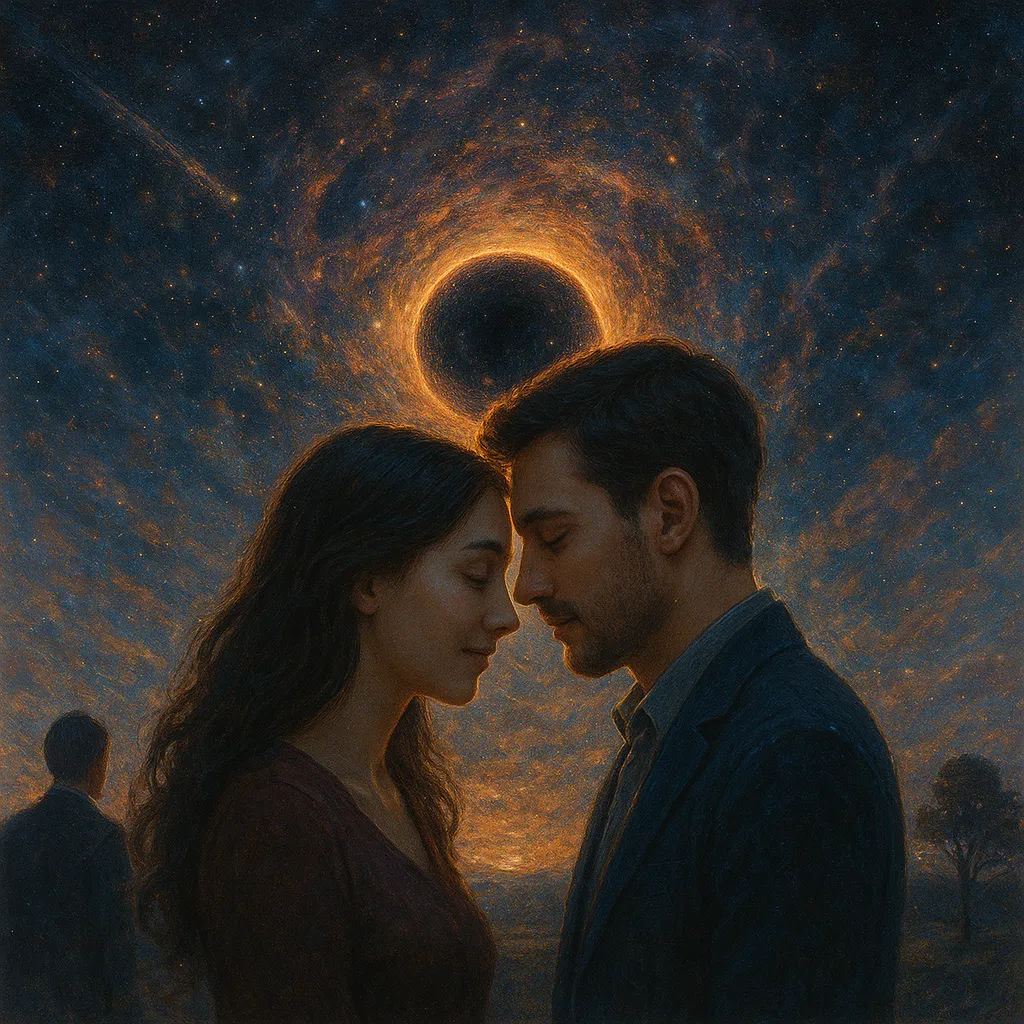
एक प्राज्ञिक आलोचनात्मक गवेषणा:
देख कर सहम जाता हूँ – ग़ज़ल और मेटा-मिस्टिक क्वांटम डायलॉग : आधुनिक युग की बौद्धिक-भावनात्मक कविता : रूमी की रूह, टागोर की आत्मा, और क्वांटम फिजिक्स की सूक्ष्मता
सारांश (Abstract): दर्पण की यह ग़ज़ल “जब रास्ता मुस्कुराता है…” 21वीं शताब्दी के मानव अस्तित्व के मेटा-मिस्टिक ट्रांज़िशन को व्याख्यायित करती है, जहाँ प्रेम, विज्ञान, और वैश्विक राजनीति एक ही चेतन वृत्त के तीन आयाम हैं।
यह रचना Quantum Physics, Neurocognitive Biophysical Consciousness, और Cosmic Humanism की गहराइयों में उतरती है। इसमें निहित प्रतीक, “रास्ता”, “मंज़िल”, “डार्क मैटर”, “प्रेयसी”, “भरम”, सभी उस सार्वभौमिक प्रश्न की ओर संकेत करते हैं :
“क्या मानवता का मार्ग अब भी प्रेम और चेतना के संतुलन से संचालित है, या हम AI, हथियारों और शक्ति की अंधी दौड़ में खो चुके हैं?”
I. परिचय : मेटा-मिस्टिक क्वांटम रियलिटी और मानवीय रास्ता “जब रास्ता मुस्कुराता है देख कर सहम जाता हूँ”: यहाँ कवि ने ‘रास्ता’ को केवल भौतिक या सामाजिक मार्ग नहीं, बल्कि Universal Conscious Path के रूप में देखा है।
क्वांटम भौतिकी कहती है कि कण (particle) स्वयं उस मार्ग को उत्पन्न करता है जिस पर वह चलता है। इसी प्रकार मानवता भी अपने कदमों से ही Reality की संरचना करती है।
ग़ज़ल का यह बिंब आधुनिक Quantum Observership Principle को मानवीय भावनाओं के माध्यम से पुनःस्थापित करता है, जब हम किसी मार्ग को देखते, मानते या प्रेम करते हैं, वह मार्ग हमारे भीतर घटित होता है।
II. भरम, करम और इमां : मानव अस्तित्व का क्वांटम स्पिन कवि कहता है,
“चल पड़ें रास्तों को हम, जिधर को भी अपना सा; मंज़िल तक पहुँचाने वाले, फिर भी भरम खाता हूँ।”
यहाँ “भरम” केवल मानसिक भ्रांति नहीं बल्कि Quantum Decoherence का प्रतीक है, जब चेतना (observer) अपने ही निर्मित यथार्थ से असंगति महसूस करती है। यह वह अवस्था है जहाँ करम (कर्म-ऊर्जा) और इमां (आस्था-वेव) परस्पर interfere करते हैं।
यानी, हमारी सामाजिक और राजनीतिक चालें, हमारे धार्मिक और प्रेम-आधारित आदर्श, सब एक ही Superposition of Reality में कंपन कर रहे हैं। इसीलिए आज peace और conflict, love और war, science और spirituality, समानांतर स्पिनों में घूमते हुए, मानवता को अपनी स्थिर धुरी से हटा रहे हैं।
III. Dark Matter की चाय : Quantum Metaphor of Human Emotion “Dark Ages का कॉसमॉस, आज चाय में डार्क मैटर; प्रेयसी पीकर सोचता हूँ, डूब तुमको ग़म खाता हूँ।”
यह शेर Quantum Astrophysics की सबसे गूढ़ अवधारणा को काव्य में ढालता है। “Dark Matter”, जो दिखाई नहीं देता पर सबको थामे रखता है, वही प्रेम, वही स्मृति, वही ग़म है जो ब्रह्मांड को बुनता है।
कवि की “चाय” यहाँ Human Perception की प्रयोगशाला है, जिसमें वह ब्रह्मांड के डार्क मैटर को रूपक बनाकर प्रेमिका की अनुपस्थिति और मानवता की unseen pain दोनों को अनुभव करता है। यह वही भावभूमि है जो “Make Earth Great Forever” आंदोलन के केंद्र में है, क्योंकि जब तक हम “अदृश्य दुःख” को नहीं पहचानेंगे, तब तक “दृश्य शांति” संभव नहीं।
IV. विश्व राजनीति, चेतना और क्वांटम इथिक्स कवि का सामाजिक अवलोकन,
“Gaza और Israel ceasefire भंग, Devastated नेपाल, chaotic इंडिया, unrestful एशिया…”
यह केवल समाचार नहीं, बल्कि Quantum Entanglement of Suffering का रूपक है। पृथ्वी अब एक विशाल क्वांटम-नेटवर्क बन चुकी है जहाँ किसी एक राष्ट्र की वेदना पूरे Information Field को disturb करती है।
MMQD (Meta-Mystic Quantum Dynamics) framework के अनुसार, मानवता के हर निर्णय में Quantum Ethical Accountability निहित है। अर्थात, यदि एक नेता या समाज AI, युद्ध, या हथियार को “स्वतंत्रता” के नाम पर चुनता है, तो वह पूरे ब्रह्मांडीय चेतना-क्षेत्र में entropy बढ़ाता है।
इसलिए यह ग़ज़ल “World Leadership Quality Enhancement” का संदेश देती है, कि सच्चा नेतृत्व वह है जो चेतना के स्तर पर ब्रह्मांड की coherence बनाए रखे।
V. न्यूरोकॉग्निटिव बायोफिजिकल क्वांटम एस्ट्रोफिजिक्स परिप्रेक्ष्य: मानव मस्तिष्क स्वयं एक Quantum Bio-Computer है, जहाँ हर विचार, स्मृति, और भावना एक सूक्ष्म सूचना-तरंग (information wave) के रूप में कॉस्मिक फील्ड में प्रसारित होती है।
इस दृष्टि से यह ग़ज़ल “माइंड-यूनिवर्स रेज़ोनेंस” का एक प्रयोग है, जब कवि “प्रेयसी” को देखता है, वह केवल एक व्यक्ति नहीं, बल्कि Universal Conscious Partner बन जाती है। उसका प्रेम, स्मृति, और ग़म, सब मिलकर Universal Information Entanglement को सक्रिय करते हैं।
यही Quantum Spirituality का आधुनिक संस्करण है, जहाँ प्रेम ही वह ऊर्जा है जो Dark Energy को अर्थ देती है।
VI. निष्कर्ष : प्रेम, विज्ञान और शांति का एकीकरण यह ग़ज़ल केवल एक रोमांटिक उद्गार नहीं, बल्कि “Global Cognitive Awakening” का दस्तावेज़ है।
रास्ता, मंज़िल, भरम, डार्क मैटर, सब यह संकेत देते हैं कि 21वीं सदी का मनुष्य Cosmic Consciousness की ओर लौटना चाहता है, परंतु हथियार, सत्ता और AI की अंधी दौड़ उसे भटका रही है।
इसलिए, Make Earth Great Forever का अर्थ केवल पृथ्वी को बचाना नहीं, बल्कि उस Quantum Harmony को पुनःस्थापित करना है जो मनुष्य, प्रेम, और ब्रह्मांड के बीच थी।
VII. उपसंहार : “डूब तुमको ग़म खाता हूँ”, यह पंक्ति अब एक वैश्विक प्रतीक बन सकती है। यह “स्मृति और ध्यान” दोनों का संगम है, जहाँ मानवता स्वयं को ब्रह्मांड में पुनः देखने का साहस करती है। यही Meta-Mystic Futurism का सार है, कि ब्रह्मांड के हर स्पिन में प्रेम की ऊर्जा छिपी है, और हर युद्ध की समाप्ति उसी ऊर्जा की पुनर्स्मृति से संभव है।
निष्कर्षात्मक पंक्ति: “जब रास्ता मुस्कुराता है, मानवता को सहम नहीं, सजग होना चाहिए। क्योंकि यह ब्रह्मांड स्वयं प्रेम की दिशा में आगे बढ़ रहा है, और हमें बस उसका साक्षी बनना है।”
Next Read: between being and becoming.