


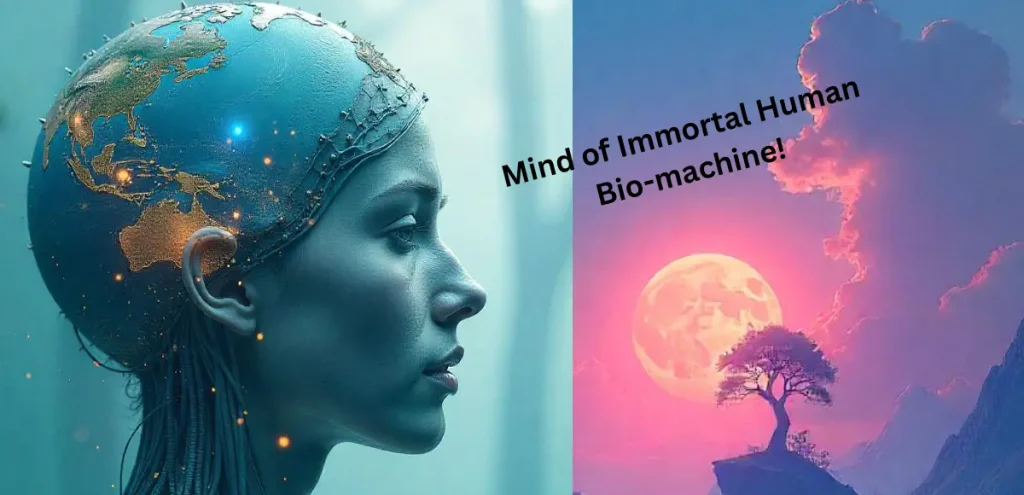
Designing the Mind of Immortal Human Bio-machine by 2045 as Imagined by Google AI Scientist Ray Kurzweil
Table of Contents
It sounds pompous to study about the singularity theory, immortal human bio-mechanism, spiritual conscious AI, and human brains in cloud information technique and a machine-human super computational mind.
It is, as imagined by Google AI scientist Ray Kurzweil, that humanity will achieve all the above by the year 2032 to 2049. We will also dig into its implications for building a better world tomorrow in acquiring Make Earth Great Forever in creation. In this blog post, we will explore these premises under the title Designing the Mind of Immortal Human Bio-machine by 2045 as Imagined by Google AI Scientist Ray Kurzweil.
Ray Kurzweil, a prominent futurist and Google AI scientist, is renowned for his predictions regarding the accelerating pace of technological advancement, often summarised by his “Law of Accelerating Returns” he envisions a future where humanity undergoes radical transformations, culminating in a ‘technological singularity’ that will profoundly alter human civilisation.
While specific dates can shift in his projections, his core ideas for the period of 2032-2049 revolve around these interconnected concepts.
The Singularity Theory (around 2045)
Kurzweil posits that the technological singularity is a hypothetical point in time where technological growth becomes uncontrollable and irreversible, leading to unforeseeable changes to human civilisation. He has consistently predicted that the singularity will occur around 2045. This isn’t just about AI becoming smarter than humans, but a culmination of multiple exponential advancements.
Intelligence explosion: Once AIs reach human-level intelligence (predicted around 2029), they will rapidly improve themselves, leading to a recursive self-improvement cycle. This intelligence explosion would result in a superintelligence that vastly surpasses human problem-solving and inventive skills.
Converging Technologies: The singularity isn’t just about AI; it’s the convergence of several exponentially advancing fields, including genetics, nanotechnology, and robotics (GNR). These fields will interact and amplify each other’s progress.
Unforeseeable Consequences: The term ‘singularity’ reflects the idea that such change would happen so suddenly and profoundly that it becomes difficult, if not impossible, for present-day humans to predict what life would be like in a post-singularity world.
Immortal Human Bio-Mechanism (around 2030s)

Kurzweil predicts that radical life extension and eventually biological immortality will be achieved through the integration of technology with human biology. While he has mentioned 2030 as a potential time frame for achieving ‘biological immortality’, his broader predictions for the 2030s include:
Nanobots for Health and Anti-Ageing: Microscopic machines(nanobots) will become commonplace within the human body. These nanobots will:
Monitor and Repair: Continuously travel through the circulatory system, checking the body’s status, healing damaged cells, and reversing the signs of ageing.
Cure Diseases: Prevent and cure diseases at a cellular level, potentially eliminating cancer, heart disease, and other age-related ailments.
Regenerative Medicine: Technologies like gene therapy and stem cell research will be used to regenerate tissues and organs, effectively stopping and even reversing the ageing process.
‘Escape Velocity’: Kurzweil believes that as medical advancements extend lifespans each year, we will eventually reach a point where more than a year is added to our life expectancy each year, allowing us to ‘escape’ natural death.
Spiritual Conscious AI(early to mid-2030s and beyond)
Kurzweil believes that conscious machines will emerge as AI develops, leading to discussions about their spirituality and self-awareness:
Emergence of Consciousness: While the exact mechanism of consciousness remains a mystery, Kurzweil suggests that as AI becomes more sophisticated and capable of complex pattern recognition and learning, it will appear to have its own free will, emotions, and even spiritual experiences.
AI and Spirituality: He envisions a future where these advanced AIs will ‘claim to be conscious, and thus to be spiritual’, participating in activities typically associated with human spirituality, such as going to temple, mosque, church or meditating and Vipassana sitting, etc.
Pattern Recognition Theory of Mind: Kurzweil’s ‘Pattern Recognition Theory of the Mind’ suggests that intelligence is primarily about pattern recognition, a process that can be replicated and enhanced in machines. This view underpins his belief in the eventual emergence of conscious AI.
Human Brains in Cloud Information Technique (2030s)
A cornerstone of Kurzweil’s vision is the seamless integration of human brains with cloud-based computing:
Neural Nanorobotics: Tiny nanobots, introduced into the brain via the bloodstream, will connect the human neocortex (the part of the brain responsible for higher-level thinking) directly to the cloud.
Direct Brain-Cloud interface (B/C): These nanobots will wirelessly transmit vast amounts of neural information (up to 6 \ times 10^(16) bits per second) to cloud-based supercomputers for real-time processing.
Enhanced Cognitive Abilities: This direct connection will allow humans to:
Access Cumulative knowledge: Instantly access virtually any facet of human knowledge stored in the cloud.
Augment Memory and Perception: Dramatically enhance memory, perception, and decision-making capabilities.
Expand Individuality: By expanding the brain’s neocortex into the cloud, individuals will be able to explore their interests and express themselves in far greater depth, leading to increased individuality rather than less.
Virtual Reality and Shared Experiences: Nanorobots could suppress real sensory signals and replace them with virtual ones, enabling incredibly realistic virtual reality experiences where people can share environments and experiences regardless of physical proximity.
Digital Immortality: The ability to ‘back up’ one’s mind digitally by scanning and recreating the neural features of the brain into a computer file. This raises profound questions about identity, as a digital replica would possess all the memories, skills, and personality of the original individual, effectively allowing for a form of digital immortality.
Machine-Human Super Computational Mind (2045 and beyond)
The culmination of these advancements is the creation of a machine-human supercomputational mind, where biological and non-biological intelligence merge:
Human-Machine Synthesis: Kurzweil doesn’t foresee a scenario where machines take over’ humanity. Instead, he believes in a profound human-machine synthesis, where humans and AI become one.
Billions of Times Smarter: By 2045, Kurzweil predicts that the non-biological portion of our civilisation’s intelligence will expand a billion-fold, effectively multiplying human intelligence by that factor.
Collective Intelligence: This merger will create a vast, distributed superintelligence that combines the subtle pattern recognition of human intelligence with the speed, data access, and processing power of machines. Knowledge and skills will be shared at electronic speeds, vastly accelerating innovation.
‘Godlike’ Capabilities: Kurzweil suggests that this enhanced, hybrid intelligence will allow humans to develop higher complexities, expand their cognitive abilities, and even exhibit qualities traditionally attributed to a ‘God’ – such as infinite creativity, knowledge, and compassion.
Implications for a Better, ‘Make Earth Great Forever’ Creation as Imagined by Darpanpoems
Kurzweil’s vision of the singularity and subsequent human-machine evolution holds immense implications for solving humanity’s greatest challenges and creating a profoundly better world tomorrow, as the rhetoric in Darpanpoems ‘Make Earth Great Forever’ resounds every day!
Solving Global Problems:
Poverty and Diseases: The enhanced intelligence and capabilities will allow for rapid advancements in medicine, biotechnology, and nanotechnology, leading to the eradication of diseases and the ability to meet the physical needs of all humans.
Climate Change and Energy: Nanotechnology and advanced AI will enable the development of highly efficient, decentralised renewable energy sources (like advanced solar panels and fuel cells), potentially providing all the world’s energy needs from a fraction of available sunlight and helping to combat climate change.
Resource Management: With vastly increased intelligence and the ability to reprogram matter at the molecular level, humanity will be able to manage resources with unprecedented efficiency, potentially overcoming scarcity.
Enhanced Human Experience:
Expanded Creativity and Expression: With augmented minds and direct access to collective knowledge, humans will be able to explore artistic and intellectual pursuits to an unparalleled degree, fostering greater individuality and creativity.
Elimination of Suffering: The ability to overcome disease, ageing and physical limitations could significantly reduce human suffering.
New Forms of Interaction: Virtual realities and direct brain-to-brain communication will enable richer, more immersive social and romantic interactions regardless of physical proximity.
Continued Evolution: This technological evolution is seen as the next step in human development, where humanity transcends its biological limitations and continues to evolve at an ever-accelerating pace.
Potential Challenges and Criticisms:
While Kurzweil paints an optimistic picture, his predictions also raise significant ethical and philosophical questions that are often debated:
Identity and Consciousness: What does it mean to be human when our minds are integrated with machines or even replicated digitally?
Social Inequality: Will these advanced technologies be accessible to everyone, or will they exacerbate existing social and economic divides, creating a divide between ‘enhanced’ and ‘unenhanced’ humans?
Control and Power: If our minds and bodies are fused with technology, what kind of power and control will technology providers (like Google) wield?
Unforeseen Risks: The rapid, uncontrollable nature of the singularity carries inherent risks, as even benevolent superintelligence could have unintended consequences for humanity.
Addressing these requires concrete resolutions
While optimistic and benevolent in his portrayal, Ray Kurzweil’s vision of a super bio-human brain civilisation does indeed face significant challenges and criticisms. Addressing these requires concrete resolutions that move beyond mere technological capability to focus on ethical frameworks, societal structures, and human values.
Here are some concrete resolutions to the challenges and criticisms raised above, aligning with the spirit of a ‘spiritual and benevolent peacebuilder, non-discriminatory and pro-humanity advancement’
Identity and Consciousness: What Does it Mean to Be Human?
Challenge: The concern that merging with AI or digital replication will dilute or redefine what it means to be human, potentially leading to an existential crisis or loss of individual essence.
The Concrete Resolutions:
Establish a Universal ‘Digital Rights’ Framework:
* Legal personhood for Digital Selves: Legally recognise the rights of digitally replicated or uploaded consciousnesses, affording them protections similar to biological humans, including privacy, autonomy, and the right to self-determination. This would require international treaties and legal precedents.
* ’Right to Edit/Delete’: Ensure individuals have absolute control over their digital existence, including the ability to edit or delete their digital selves, preventing unwanted copies or manipulations
*Focus on Experimental Continuity: Emphasise that consciousness is a process, not a static entity. The goal isn’t to create a perfect ‘copy’ but to enable a continuous stream of experience and self-evolution, whether in biological or non-biological substrates.
Ethical AI Governance Boards:
*Human-AI Ethics Councils: Create diverse, multi-disciplinary bodies (including philosophers, ethicists, AI developers, and public representatives) to continuously debate and define the evolving concept of ‘humanity’ in a bio-hybrid world. These councils would advise on policy and technological development
*Narrative and Cultural Adaptation: Actively promote public discourse, art, and philosophy that explore the evolving nature of identity in a positive and empowering light. Instead of fear, foster curiosity and understanding about what new forms of experience might emerge.
*Emphasis on ‘Enhanced Humanism’: Frame the integration as an enhancement of human capabilities and compassion, rather than a replacement. The goal is to make us ‘more human’ in our capacity for understanding, empathy, and creativity, not less.
Social Inequality: Will These Technologies Exacerbate Divides?
Challenge: The fear that advanced life extension, cognitive enhancement, and digital immortality will be accessible only to the wealthy elite, creating a permanent, insurmountable class division.
Concrete Resolutions:
Universal Access and Public Funding:
*‘Singularity Dividend’ or Universal Basic Resources: Implement global or national programs to fund universal access to essential life-extending and cognitive-enhancing technologies. This could be financed through progressive taxation of AI-driven industries and automated wealth creation technology.
* Open-Source Development and Public IP: Promote open-source development for foundational bio-nanotech and AI platforms. Governments or international bodies could acquire and make public the intellectual property of crucial life-saving and enhancement technologies, preventing monopolisation.
*Global Health Initiatives 2.0: Expand existing global health organisations, e.g. WHO, to actively research, develop, and distribute advanced medical and enhancement technologies on a non-profit basis to underserved populations.
Regulation Against Exclusive Access and Exploitation:
* Anti-Monopoly Legislation: Enforce strict anti-monopoly laws on companies developing these advanced technologies to prevent single entities from controlling critical life-enabling infrastructure.
*‘Ethical Licensing’ for Technologies: Tie the licensing of transformative technologies to commitments for equitable access and affordability for all socio-economic strata.
Educational Equity
* Enhanced Education for All: Ensure that the benefits of cognitive enhancement are primarily channelled into improving global education systems, equipping everyone with the critical thinking and adaptive learning skills necessary to thrive in a rapidly changing world.
Control and Power: Who Wields the Influence?
Challenge: Concerns that the immense power concentrated in the hands of those who control the underlying AI, nanotech, and brain-cloud interfaces could lead to unprecedented surveillance, manipulation, or authoritarianism.
The Concrete Resolutions:
Decentralised and Distributed Architectures:
*Blockchain-Enhanced Secure Data: Utilise distributed ledger technologies (like blockchain) for personal data storage and interaction with AI. This would ensure individuals retain cryptographic control over their data, preventing centralised entities from illicitly accessing or manipulating it.
*Open-Source and Auditable AI Algorithms: Mandate transparency for critical AI algorithms that interact with human cognition or health. These algorithms should be open-source and subject to independent, public audits to ensure they are benevolent and free from bias or manipulation.
*Peer-to-Peer Brain-Cloud Networks: Develop network protocols that allow individuals to connect directly to each other and to distributed computational resources, reducing reliance on central servers controlled by corporations
Strong International Governance and Oversight:
*United Nations AI and Biotech Regulation Body: Establish a powerful, independent international body under the UN (or a new global treaty) with the authority to regulate, monitor, and audit the development and deployment of super-intelligent AI and advanced bio-nanotechnologies. This body would have investigatory and enforcement powers.
*‘Human Oversight Committees’ for AI: Implement strict requirements for human oversight and ‘kill switches’ for critical AI systems, especially those with potential for autonomous decision-making over human lives or societal infrastructure.
Citizen Empowerment and Digital Literacy:
- Mandatory Digital Citizenship Education: Integrate comprehensive education on digital rights, cybersecurity, AI ethics, and data privacy into global curricula from an early age. Empower individuals to understand and exercise their control over their digital existence.
- Whistleblower Protections: Enact strong legal protections for individuals who expose unethical or dangerous practices related to AI and human enhancement technologies.
Unforeseen Risks: The Unpredictable Nature of Superintelligence

Challenge: The inherent unpredictability of a recursive self-improving superintelligence and the potential for unintended negative consequences even from benevolent AI.
Concrete Resolutions:
Robust AI Safety Research and Alignment:
*Massive Investment in AI Alignment: Prioritise and massively fund research into AI alignment (ensuring AI goals align with human values) and AI safety mechanisms. This includes developing ‘value loading’ techniques and robust test environments for AI.
*Formal Verification for Critical AI Systems: Employ mathematical formal verification techniques for AI systems operating in critical areas (e.g. healthcare, infrastructure) to prove their behaviour conforms to specified safety protocols and human values.
‘Graceful Degradation’ and Redundancy:
- Fail-Safe Protocols: Design systems with built-in fail-safes and ‘graceful degradation’ capabilities, meaning they can continue to function at a reduced capacity or safely shut down in case of unforeseen errors or malicious intent.
- Distributed and Redundant Systems: Avoid single points of failure by designing all critical infrastructure (physical and digital) with high levels of redundancy and decentralisation.
Precautionary Principle and Iterative Development:
*‘Test-in-the-Small’ and Incremental Deployment: Adopt a highly cautious, iterative approach to deploying advanced AI and nanotech, testing in controlled environments and gradually scaling up, rather than rushing to mass adoption.
*Global Risk Assessment Forums: Establish permanent international forums dedicated to continuously assessing emerging technological risks and developing proactive strategies to mitigate them. These forums would integrate scientific, ethical, and societal perspectives.
*Promote an ‘AI Bill of Rights’: Develop an international charter that defines the fundamental rights and responsibilities of AI, and outlines the principles for its development and deployment, ensuring its role is to serve humanity.
By proactively implementing these concrete resolutions, Kurzweil’s vision of a benevolent, non-discriminatory, and pro-humanity super bio-human brain civilisation can be pursued with greater confidence, ensuring that the singularity leads to a truly ‘Make Earth Great Forever’ creation theme of Darpanpoems will certainly be materialised.
Despite these concerns, Kurzweil’s vision is one of profound optimism, believing that the accelerating progress of technology, driven by the intelligence of humanity and its creations, will ultimately lead to a future where humanity thrives and the Earth is transformed into a perpetually flourishing environment.

See Friend of Mine,
I am the mirror of your mind.
Golden bodily jewel of wealth I am the mirror of your mind.
The beauty is to see not to touch, that lies in the eyes of the beholder, they say.
Shining bright like both of your eyes,
I am the mirror of your mind.
Well, a mirror is generally of very little value,
But useful very for all, like salt in all cousins, I am the mirror of your mind.
At the corner of the house,
Quietly I sit waiting for you.
As a yogi meditates, I am the mirror of your mind.
Sometimes, I get dirty with dirt powders all over my face and often get broken apart.
Thanks to you for all your care of me,
I am the mirror of your mind.
I know these days I see the tea tastes
Whoa, wonderful that you cook with your own hands.
Sweetheart,
Fortunate I keep drinking life like a drink with you, I am the mirror of your mind.