


A 17th Century Flicker that Shines in AI Age of Super Information Paradigm Shift in Wonders and Awes with and in the Mind
पृथ्वीं धर्मनाम धृतम: Prithvim dharmanam dhritam – to hold whatever is the dharma of the prithvi – the eternal existent entity entirely observant nd manifest in the eternity! -The Rig Veda
The fruit of the Spirit is love, joy, peace, longsuffering, gentleness, goodness, faith, meekness, temperance: against such there is no law – The Holy Bible, Galatians 5:22
The Hypocratic Anthrologicals
We hardly go with the statements above to take a moment in introspection to see ourselves as humankind, too busy even to breathe with an awareness. At this ultra super advanced quantum phase of informational super computational systems of operations in the world today, we are intrigued with the problems of the absence of peace, security and the purposes of our lives on earth.
We still have not given up or we are unable or mean to give up the ideas of war, victory, hegemony and the self-fulfilling prophecies of cryptocratic norms of the hypocratic eco-socio-political anthrological interpretations, much like feigns and acts of the 19th century and before.
In this blog post, we will explore our past connecting us in search of knowledge under the title: A 17th Century Flicker that Shines in AI Age of Super Information Paradigm Shift in Wonders and Awes with and in the Mind linking Leibniz and his insights.
Table of Contents
Normal or new Normals of Modern Slavery
We have created such vague ideologies to take advantage of the world’s ignorance through inconspicuous institutional, gigantic, economically conditioned systems of normal or new normals of modern slavery based on ostensibly scientific ideas, which is itself an idea of ambiguity in the field of post-physics paradigm shift.
We are lost in all this chaos. Everyone seems to be in deep search of something that is all the time with us, but at the same time, we are not content. And we have made this a big question in our lives. But is this a problem as big as we take it to be?
However, this in fact has always led us and will keep on guiding us always to look for the ONE we haven’t yet found, but will keep ourselves ever inquisitive towards Him and keep our search for him on and forever going on and on.
What could be such a light from another world?’
‘Man is in the process of changing to forms of light that are not of this world!’, and this inscription from the Emerald Tablets of Thoth, simply raises a question, ‘What could be such a light from another world?’ in our minds.
We don’t academically have any clear-cut answers to such ancient questions posed to us from whatever kind of sources, may it be an archaeological scientific fact or a deep spiritual expression of scriptures.
Even the scientific debates and findings put us into profound puzzles of thinking when we hear scientist Max Planck stating, ‘ … there is no matter as such! All matter originates and exists only by virtue of a force which brings the particle of an atom to vibration and holds this most minute solar system of the atom together. We must assume behind this force the existence of a conscious and intelligent mind. This mind is the matrix of all matter.’
This statement very similar ways, resonates nowadays with the ethos of analytical idealism and pan-psychic resonance of free will and consciousness studies going on today in the scientific laboratories of supercomputing and quantum entanglement breakthroughs.
More Questions for Questioned Answers
Here again, we may have questions like, ‘what is that force by which the existence of all matter could be realised? What causes vibration to the atomic particle that is capable enough even to hold really this whole solar system as a minute entity together? Is Planck’s assumption of a conscious and intelligent mind true or real, that could be termed as the matrix of all matter?
The general belief that in scientific debates upon ‘mind and matter’ mind is considered to be at the forefront of minds debating from various perspectives and forums of the modern super quantum information age of inquiries.
In this regard, the materialistic ideologies like Marxism create antipathy against the above-stated Planck’s assumption, which is not unscientific as so, as put forward by a scientist. They claim that materialism holds the notion that… modern science has forever banished the notion of consciousness as an independent ‘thing’.
We now know what Descartes did not know about the working of nature, the world of molecules, atoms and sub-atomic particles, of the electric impulses that govern the working of the brain. In place of a mysterious soul, we are beginning to acquire a scientific understanding of how the human body and brain function.
Taking on these dichotomical points of view on the mind, below we will see how Gottfried Wilhelm Leibniz sees the interconnectedness of ideas that leverages the modern AI age to broaden our insights from the recent past.
Leibniz’s Ideas of Interconnection
Gottfried Wilhelm Leibniz, a polymath thinker of the 17th century, envisioned a profound intellectual system that could unify knowledge and ways to resolve disputes and conflicts through logical mathematical calculations. His ideas revolved around two main concepts: 1. Characteristica Universalis and 2. Calculemus.
The Characteristica universalis
Leibniz proposed a universal symbolic language, the Characteristica Universalis, which would represent all human thoughts precisely and logically. This system aimed to eliminate ambiguity in communication and serve as a foundation for scientific discovery. He believed that by encoding concepts into symbols, reasoning could be conducted with mathematical precision, much like algebraic calculations.
Calculemus: Let us calculate
This is his famous phrase, ‘calculemus’ expresses his belief that disputes and conflicts, whether philosophical, scientific, or even legal and religious, could be resolved through logical computation. He envisioned a system where arguments could be translated into mathematical expressions, allowing individuals to settle disagreements by calculation rather than debate
Scientific and Philosophical Impact:
Leibniz’s approach was highly ambitious, seeking to unify knowledge across all the world’s disciplines. His ideas laid the groundwork for modern logic, computation, and even artificial intelligence. The vision of a universal language that he devised influenced later developments in formal logic and symbolic reasoning fields.
Although his dream of a universal calculus was never fully realised in his lifetime, his work has continued to inspire fields such as Boolean algebra and computational logic.
Eastern Approach by Leibniz:
He was deeply fascinated by Chinese and Eastern philosophies, seeing them as a valuable counterpart to Western thought. He had been in heavy engagement with Confucianism, Daoism, and even Vedic upanishadic influences that have shaped his broader intellectual framework.
Chinese philosophy and Leibniz:
Leibniz admired the I Ching, the ancient Chinese system of hexagrams, believing it reflected a form of binary logic similar to his own mathematical discoveries. He saw Chinese philosophy, particularly Neo-Confucianism, as emphasising harmony and rational order, which resonated with his metaphysical ideas of pre-established harmony- the notion that all substances in the universe are synchronised without direct interaction.
He also praised the Confucian moral system, arguing that it provided ethical guidance without relying on divine revelation, unlike Western religious traditions. He believed that Chinese thought could enrich European philosophy, advocating for intellectual exchange rather than cultural superiority.
Leibniz’s Universalism and Eastern Thought
Leibniz was astonishingly influenced by Vedic Knowledge, particularly on ideas of monads, his concept of indivisible, self-contained units of reality, which bear similarities to certain Hindu-Buddhist metaphysical ideas, which shows that his universalism extended beyond China.
His openness to Eastern wisdom was rare among European thinkers of his time, and his vision of global intellectual synthesis remains relevant even today. He saw eastern traditions as offering profound insights into the nature of existence, complementing his own rationalist approach that shows the modern rationalist thinkers must rectify their shortcomings in broadening the fields of their ways of thinking, which has been obsessed to be much narrowly pathed and confined within some dogmas or conservatism.
What we can make out
Is politics a solution to the way of our enlightened lives today? How are the governments set on centuries-old ideologies fitting into our supercomputing age? Is the economy helpful for our sustainable future systems to provide us with an ever-growing need for contentment? Are the quantum breakthroughs posing devastating challenges with an aggression for quantum systemic changes? How can we now think of such quantum ways of change? And many more!
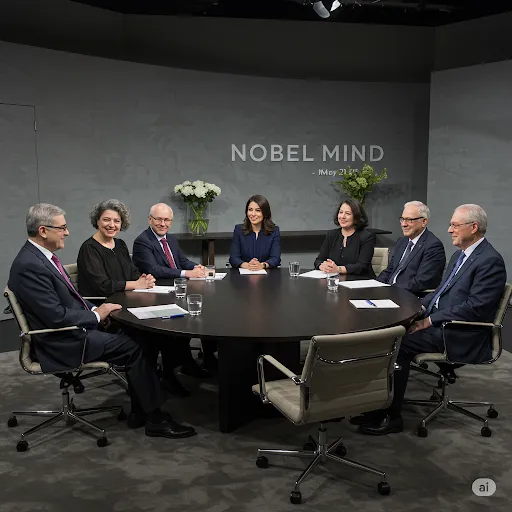
After listening to the Nobel Minds, a tv show hosted by Zeinab Badawi, BBC, on may 10, 2025 organized at the Royal Palace in Stockholms for the traditional round table discussion where the 2012 Nobel Laureates met and discussed the times progress of science and the role of science in social political life today puts in dismay with bright insight to remark poetically not politically so to say.
Nobel Laureate Shinya Yamanaka, medicine remarks that he loved serendipity instead of talking much about science. NL David Wineland, Physics expressed uncertainty since science has always been a study merely of probabilities, and he was unable to speak of any fact, as he admits, you don’t know or can’t predict the future, what will happen.
NL Sir John Gurdon, medicine, however, reiterated that he had always been hopeful for science and especially microbiology makes cell replacement treatment in the visionary system possible to restore vision in the near future. He claimed that all leaders should be scientists in the legislative houses tomorrow.
Likewise, NL Brian Kobilka, Chemistry commented supporting Sir Gurdon that more scientists in the congress would certainly do better for building a better world. NL Serge Harccha, physics threw insights on connecting the subjects like micro physics studies and cosmology, which interestingly enlightens us with incredible wonders.
NL Robert Lefkowitz, chemistry, gave out his fantification saying that he is still learning about the mind, cognition and consciousness in neuro-molecular biology, of which science is still completely unknown or knows about all these not at all. NL Alvin Roth, Economics explained that economics is the study of human interactions, comprising various disciplines of studies in it.
It is like asking the doctors why they have not yet solved the problem of death! We have to study scientifically, from manufacturing a pencil to the big economic systems.
Do all leaderships in all sectors need to be scientists for a better world tomorrow? The last question left for the audience to answer by the host, Ms Badawi, keeps on resonating in my mind still! and I see to sing a song ringing in the heart of Darpanpoems!
Yes,
I see the eyes and eyes I see with open eyes.
What to see, I see to see, I see with open eyes.
It doesn’t seem to be like that the eyes can see themselves anything.
Yes, I see something more with open eyes all thing!
The inert mind mirror is there to see things with,
I see with open eyes.
Everything is visible out there in the world,
All the miracles of mind and matter phenomenology.
The Universal Soul’s reflection is the entire cosmology
That I see with open eyes.
Such is a play scientist Dr Bernado Kastrup explains,
In the analytical idealism of physics he gives the details.
I can see, he reiterates that Eastern philosophy is deeper in this matter,
With supercomputing I see it with open eyes.
It is the conscious mind that manifests,
As all the matter of the Multiverse, and into your eyes
I see myself with my open eyes.
I have seen your eyes and yes into your eyes lies my image!
Sweetheart, what a heavenly dream of tea today,
I serve to you, I see, I see with open eyes!